
The SR-71 Blackbird Story (and Nearly Forgotten A-12)
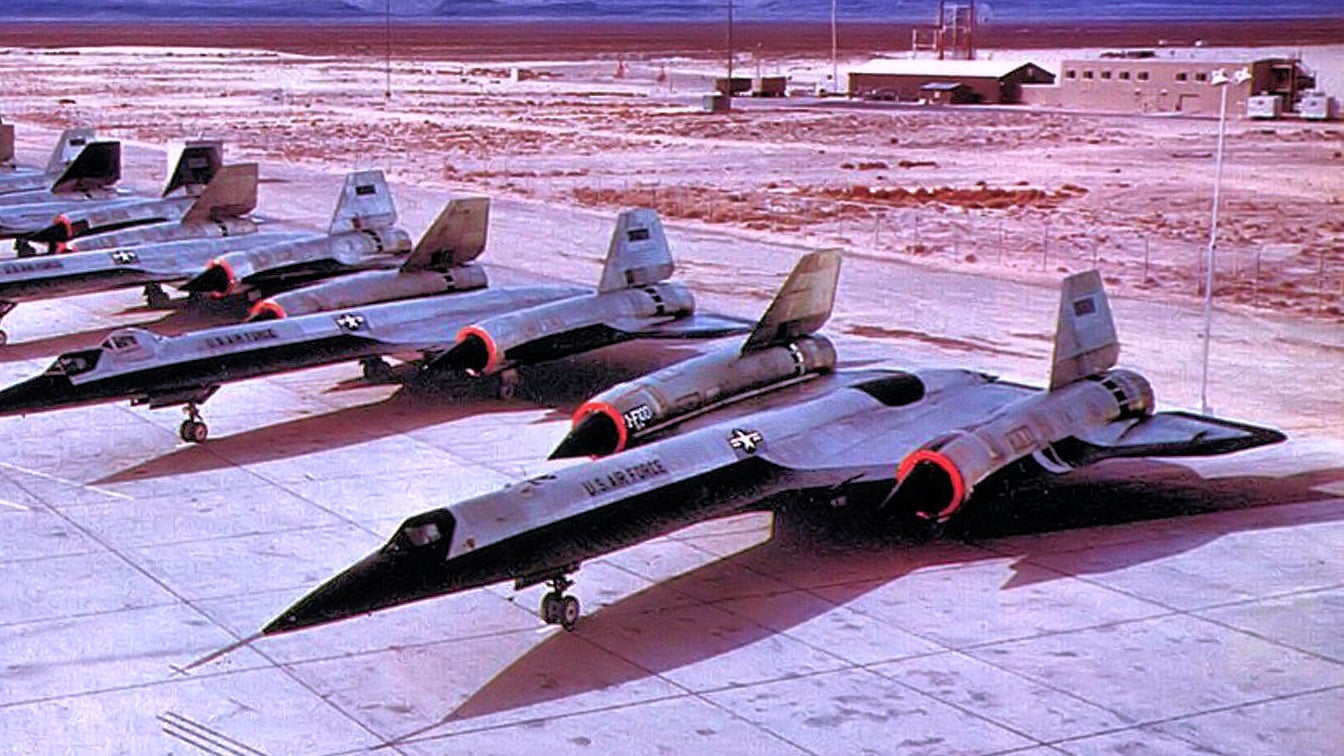
The SR-71 Blackbird was a fantastic aircraft. It was designed and built by Clarence “Kelly” Johnson’s Lockheed Skunk Works in Burbank, California. The Blackbird was envisioned to be a long-range, high-altitude, Mach 3+ strategic reconnaissance aircraft.
The SR-71 played that role at the highest possible level, proving its worth many times over—including the Middle East, where the United States is currently engaged in a devastating air campaign against the Iranian regime.
During operations in the Middle East, the SR-71 provided intelligence about the Yom Kippur War in 1973, the Israeli invasion of Lebanon in 1982, the U.S. raid on Libya in 1986, and the presence of Iranian Silkworm missile batteries in 1987 that threatened shipping in the Gulf during the Iran-Iraq War.
The Skunk Works Built An Aircraft Far Ahead Of Its Time:
Kelly Johnson, the man behind Skunk Works, is a legend in the aircraft industry, somewhat akin to John M. Browning as an arms designer. Linda Sheffield Miller, who has written extensively about the SR-71, quoted Johnson as saying about the Blackbird, “Everything had to be invented. Everything.”
The CIA and the Air Force teamed up in the 1950s with Skunk Works to work on some of the most successful reconnaissance planes in the world. The agency had already tabbed Johnson to build the first reconnaissance aircraft, the U-2.
Johnson designed that plane in less than 13 months. They began overflights of the Soviet Union in 1956. However, the Russians were able to track the aircraft—even at the edge of space, at 80,000 feet.
The CIA, the Air Force, and Johnson knew they needed a replacement—an aircraft much faster to better protect itself from the missiles all knew would be coming. Under the code name “Oxcart,” Johnson began work on the A-12.
A-12 Oxcart. Image Credit: Creative Commons.
CIA And The Skunk Works In the Archangel Program:
The CIA contracted Johnson and Skunk Works once again to build a spy plane capable of Mach 3 speed. The program was codenamed Archangel.
The level of secrecy was extremely high for two reasons. One was the advanced technology Lockheed was developing, and the other was that the United States was secretly buying materials to build these jets from Soviet territory. That was the only place to source the titanium needed to build the aircraft.
Getting The Help Of Moscow…Surreptitiously:
CIA Historian David Robage, in his book Archangel: CIA’s Supersonic A-12 Reconnaissance Aircraft, detailed some of the incredible exploits that went into getting the A-12 built, and told the stories of the men who flew it.
Because of the secrecy required for flying the U-2 and then the A-12, it was decided to move the testing to a remote, dried-up lake bed in the deserts of Nevada called Groom Lake. The place was called “Area 51.”

A-12 Oxcart. Image Credit: Creative Commons.
Johnson’s dilemma in the design phase was heat. Flying an aircraft for hours on end at Mach 3 would melt the steel and aluminum used in aircraft production.
The aircraft’s skin would heat up to more than 800 degrees. Inside the cockpit, the temperature would reach 500 degrees. The pilots had to wear a special refrigerated space suit to keep from burning up. So, 90 percent of the aircraft would be made from a titanium alloy.
The United States had limited supplies of that material. They would have to buy it from the world’s biggest supplier, the Soviet Union.
Keeping the Soviets in the dark was tough, but the CIA used shell companies and third parties. The A-12 would fly over the Soviet Union and outrun fighters and missiles built with the titanium that the Soviets sold to the United States—this flipped the Lenin quote on its head: “We will hang the last capitalist with the rope he sold us.” Oh, the irony.
The A-12 Oxcart:
The A-12 was a marvel of engineering then, and it still is now. It was nicknamed the Oxcart, a funny name given its speed. Lockheed unofficially dubbed the plane “Cygnus,” after the constellation of Cygnus, the swan.
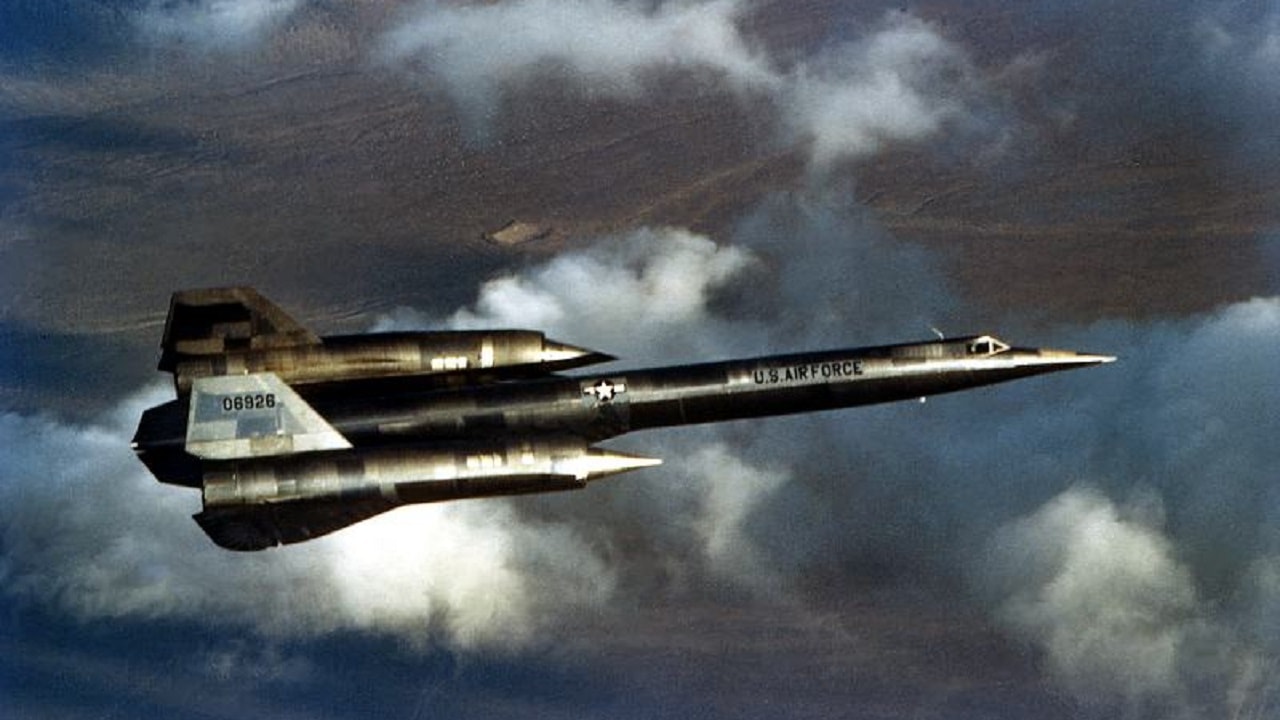
A-12 Oxcart. Image Credit: Creative Commons.
The Oxcart was America’s first stealthy plane. However, it was never completely stealthy—the amount of fuel it had to carry to fly so fast for so long required changes in the airframe design that made it easier to track on radar.
Nevertheless, the innovative design and technologies developed for the A-12 helped lay the foundation for future stealth research.
In 1965, the A-12 was declared fully operational. It attained a sustained speed of Mach 3.2 at 90,000 feet altitude—an unbroken record for piloted jet aircraft.
The A-12 Was Faster Than The SR-71:
The SR-71 is known as the fastest military production aircraft. But what most people don’t realize is that the A-12 was faster.
The Pratt & Whitney J58 engine fitted to the A-12 was the first Air Force engine to operate for extended periods at speeds exceeding Mach 3 and altitudes above 80,000 feet. The same engine was later used on the SR-71.

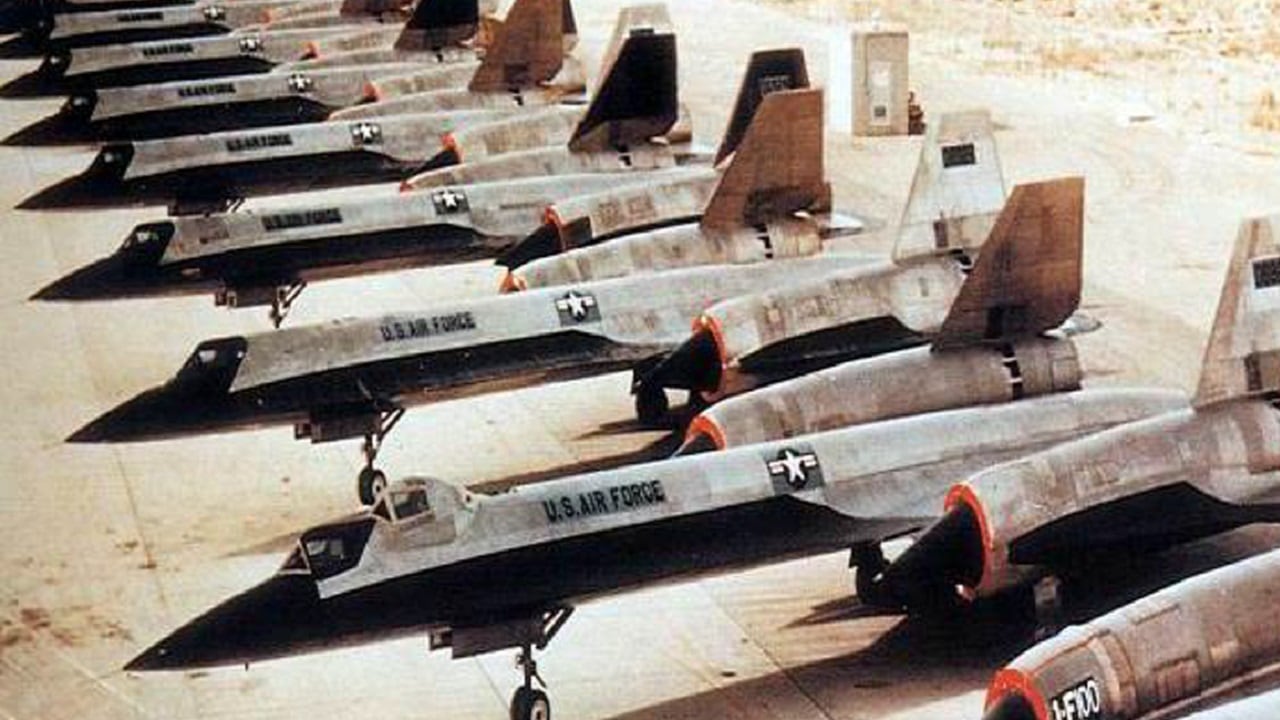
A-12 Spy Plane. Image Credit: Creative Commons.
This engine had a unique capability that involved bleeding a portion of the high-pressure air from the compressor, bypassing the combustion chambers and turbine, and injecting it into the front end of the afterburner.
The air-bleed-bypass system, which fed air directly to the afterburner, operated like a ramjet. Because conventional aircraft fuel would be too volatile at such high temperatures, a new fuel, JP-7, was developed.
“A cesium-laced fuel additive to dramatically reduce the radar signature of the plane’s massive engine exhausts and afterburner plumes by creating an ionizing cloud behind the aircraft to help conceal its entire rear aspect from radar waves,” is how The Drive describes the mix.
The Paint Scheme Was Made Famous:
The Oxcart was painted a deep shade of blue—almost black—after it was learned that this color dissipates heat faster than bare titanium. The A-12 was first flown in 1962, became operational in 1967, and flew for the CIA until late 1968. It was a single-seat aircraft that flew reconnaissance missions over North Korea and Vietnam.
The aircraft was then produced for the U.S. Air Force, which designated it the YF-12—a high-altitude interceptor to defend against supersonic bombers.

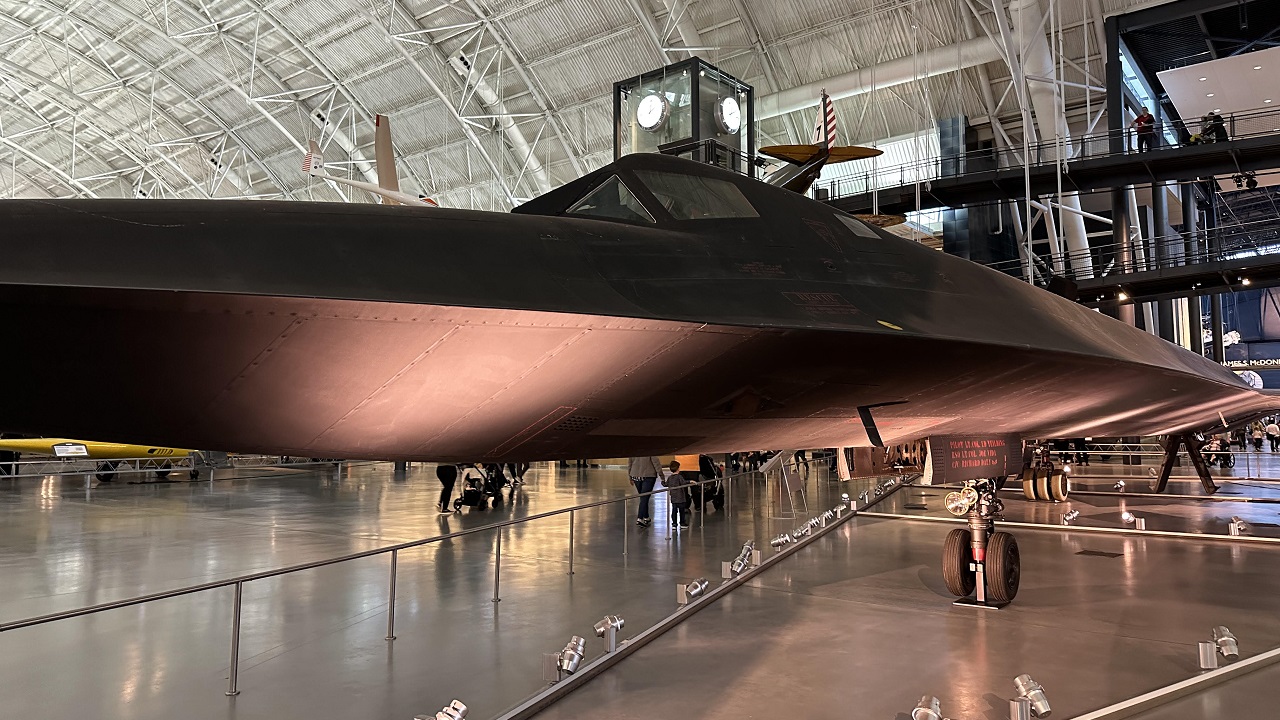
SR-71 Blackbird Photo from Dr. Brent Eastwood at the Smithsonian. 19FortyFive.com Original Image.
However, General Curtis LeMay, the Air Force Chief of Staff, wanted it renamed the SR-71, with the SR referring to the aircraft type as “Strategic Reconnaissance.”
When the program ceased with the CIA, the Air Force purchased 11 of the two-seat versions. It was nicknamed the Blackbird.
A total of 32 SR-71s were built: 29 SR-71As, two SR-71Bs, and one SR-71C. Johnson designed the aircraft with the smallest possible radar cross-section in one of the earliest attempts to achieve stealth. Two Pratt & Whitney J-58 engines powered it.
Iranian Silkworm Missiles Present A Challenge:
During the Iran-Iraq War, the Iranian Revolutionary Guard Corps Navy (IRGCN) foolishly tried to attack U.S. Navy warships and had many of its ships sunk or virtually blown out of the water to be towed back into port.
During this time, the Iranians acquired Chinese-made Silkworm missiles.
Beginning in February 1987, Iran constructed a series of nine Silkworm missile sites ringing the Strait of Hormuz, on Qeshm Island, and near Kishk outside the Gulf.
Any ship entering the Gulf had to pass through the Silkworm missile envelope, and the Pentagon regarded these missiles as a potent threat to convoy operations.
Although the radars were fairly unsophisticated, the Silkworm carried a 1,000-lb warhead.
In 1987, Kadena-based SR-71 crews flew several missions over the Persian Gulf that revealed the Iranian Silkworm missile batteries threatening commercial shipping and American escort vessels.
In October of 1987, Iran conducted three Silkworm missile attacks against international shipping, but never fired any of them against U.S. Navy warships—perhaps learning a lesson from earlier mistakes.
The Iran mission provided critical intelligence to the United States and is one of many accomplishments that went underreported during the Blackbird’s stellar career.
Sixty-Two Years Later, The SR-71 Is Still The One:
The SR-71 first flew in 1964. President Lyndon B. Johnson had just taken office after President Kennedy was assassinated less than a year before. The “British Invasion” was in full swing, with the Beatles on the Ed Sullivan Show. The Ford Mustang and the G.I. Joe were introduced.
The SR-71 set the world record for the quickest flight between London and New York in 1974. It also became the fastest air-breathing manned aircraft in 1976. The SR-71 was retired in 1989 for political reasons, and NASA used it as a research platform until 1999. It still holds many aviation records.
The Special Reconnaissance aircraft was the target of more than 4,000 missiles launched at it during its service, and was never hit. It is still the king of the air-breathing aircraft.
The Blackbird may soon have a replacement, as Lockheed Martin and the Skunk Works are reportedly working on the SR-72 Son of Blackbird.
About the Author: Steve Balestrieri
Steve Balestrieri is a National Security Columnist. He served as a US Army Special Forces NCO and Warrant Officer. In addition to writing on defense, he covers the NFL for PatsFans.com and is a member of the Pro Football Writers of America (PFWA). His work was regularly featured in many military publications.