
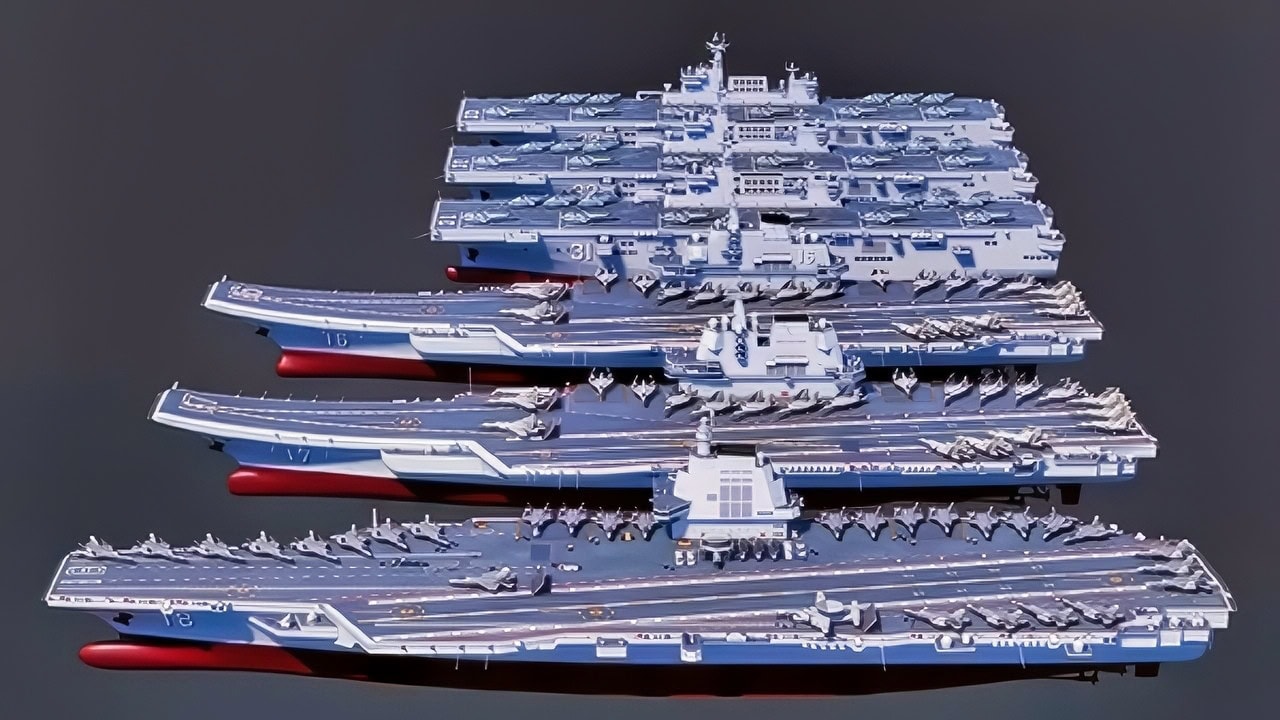
In its 2020 China Military Power Report, the U.S. Department of Defense acknowledged that Beijing had already surpassed the United States in total naval fleet size, with approximately 350 ships compared to about 293 in the U.S. Navy at the time. By late 2021, a Pentagon report cited China as operating around 355 vessels, explicitly describing it as the world’s largest navy.
Before the Pentagon officially acknowledged it, the trend had already been noticeable for years. The crossover is believed to have occurred sometime between 2015 and 2020, as China’s shipbuilding industry accelerated production while the U.S. fleet declined to fewer than 300 deployable ships. And from there, the gap only widened. By 2023, Pentagon reporting put China’s fleet at more than 370 ships.
For years, analysts had warned that China’s industrial base and production rates would push it past the United States in raw numbers, and none of this caught policymakers off guard. And yet, it happened. It was allowed to happen.
But what does that mean for the United States, and is the People’s Liberation Army Navy (PLAN) a threat to the U.S. Navy?
What A “Bigger” Fleet Really Means: China vs. U.S. Navy
China’s fleet size advantage is two-fold: it is larger in volume and arguably more diverse. The PLAN’s 370-plus ships include destroyers, frigates, corvettes, amphibious ships, submarines, and aircraft carriers.
Its modern fleet is built around a large number of relatively new ships, with much of the force having been launched since 2010. It is the product of a rapid modernization effort and is not composed of legacy platforms, making it far newer than the United States’.
Among its most critical vessels are the Type 055 large surface combatants, which are often compared to cruisers, and its Type 052D destroyers, which form the backbone of the fleet.
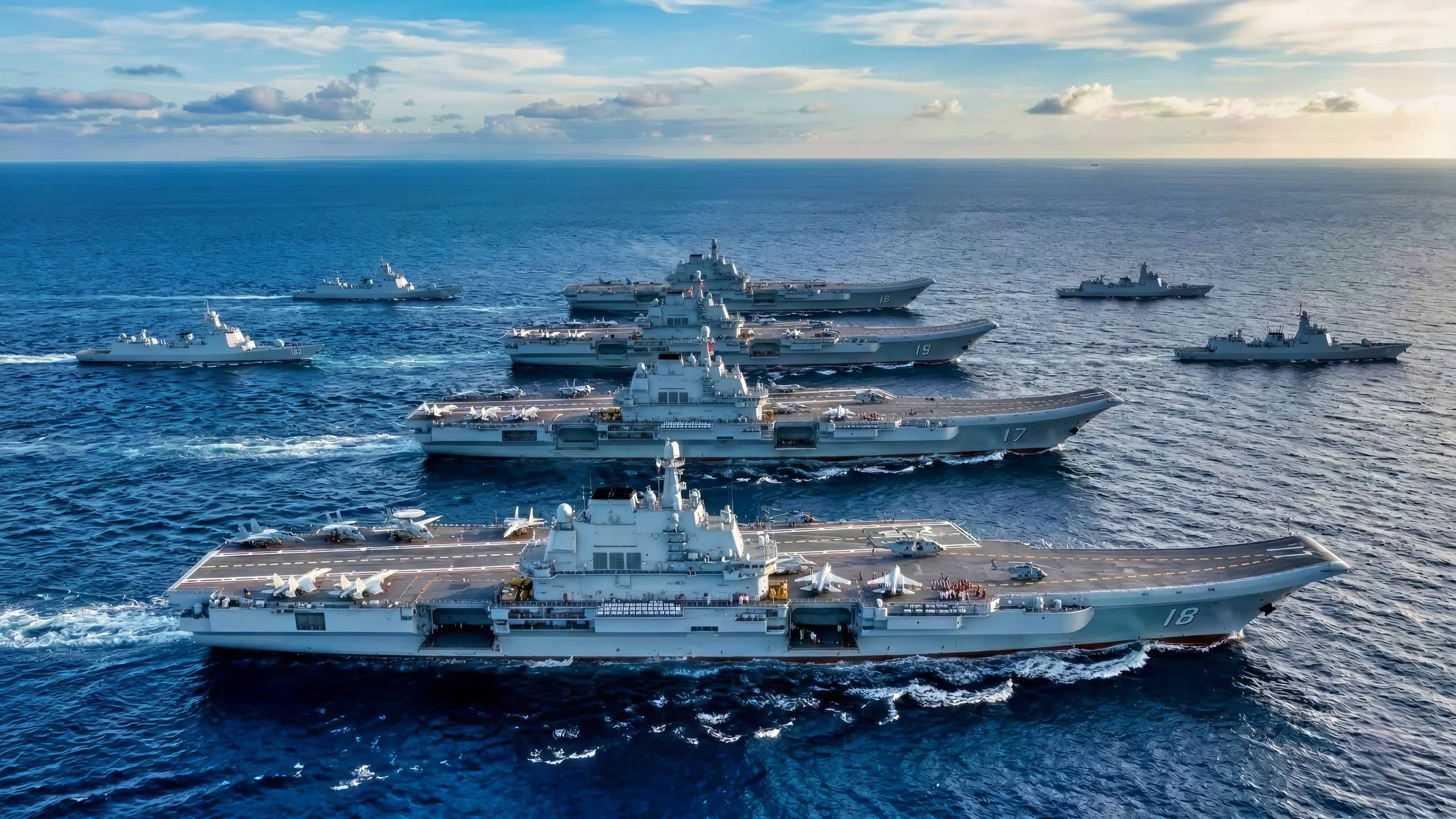
China Aircraft Carrier Photo. Banana Nano Photo.
Type 054A frigates and smaller corvettes also dramatically increase the total ship count – and while China has not confirmed the precise number in service, estimates put it at somewhere around 40. There is also a growing amphibious force, including Type 075 landing helicopter docks, and a mixed submarine fleet that combines nuclear-powered and diesel-electric boats.
Perhaps most significantly, though, China now operates three aircraft carriers, though only one is configured with advanced launch systems – the Type 003 Fujian – and is currently in testing.
Meanwhile, Type 004 is in development – and so is Type 005. Not only does China have the largest navy, but it is also growing.
The U.S. Navy, meanwhile, operates far fewer ships that are significantly larger and more capable. Even with much of the fleet made up of older designs, the U.S. Navy is far more advanced – for now. It includes 11 nuclear-powered aircraft carriers, each capable of deploying large air wings. There are more than 70 Arleigh Burke-class destroyers, a submarine force that is centered on nuclear-powered attack and ballistic missile submarines, and amphibious assault ships designed for expeditionary operations.
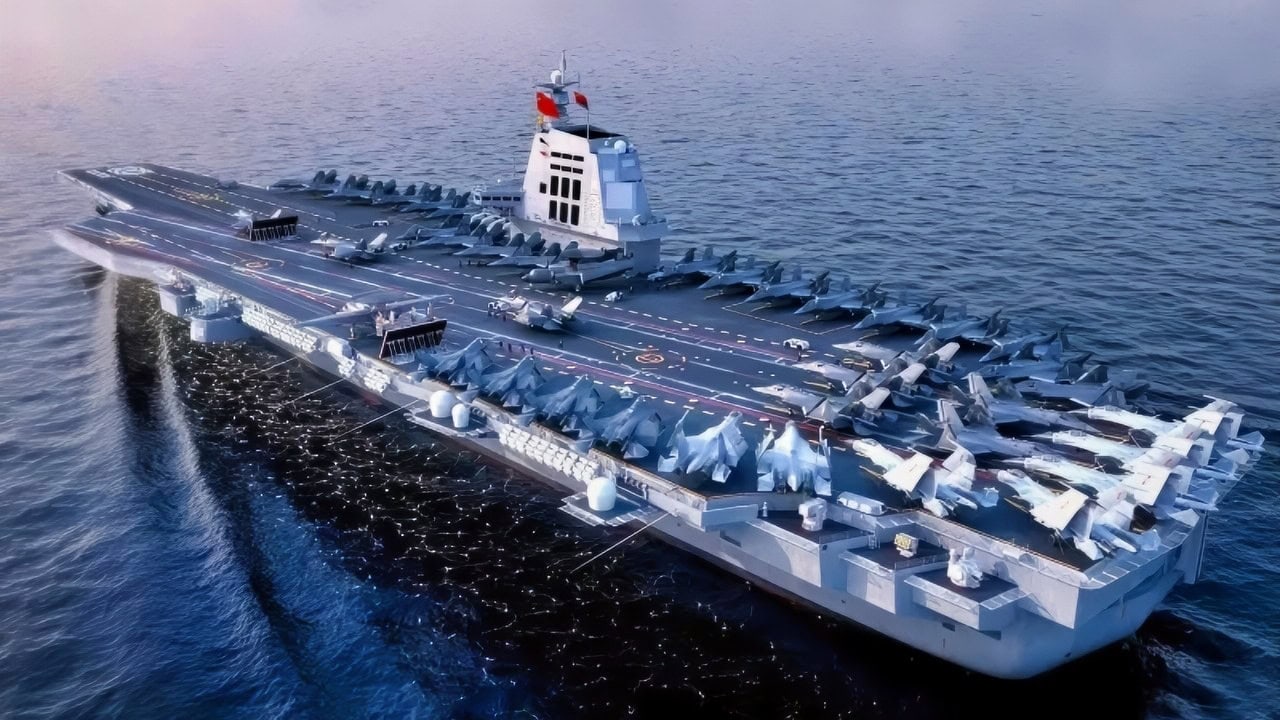
China Aircraft Carrier Mock Up Image.
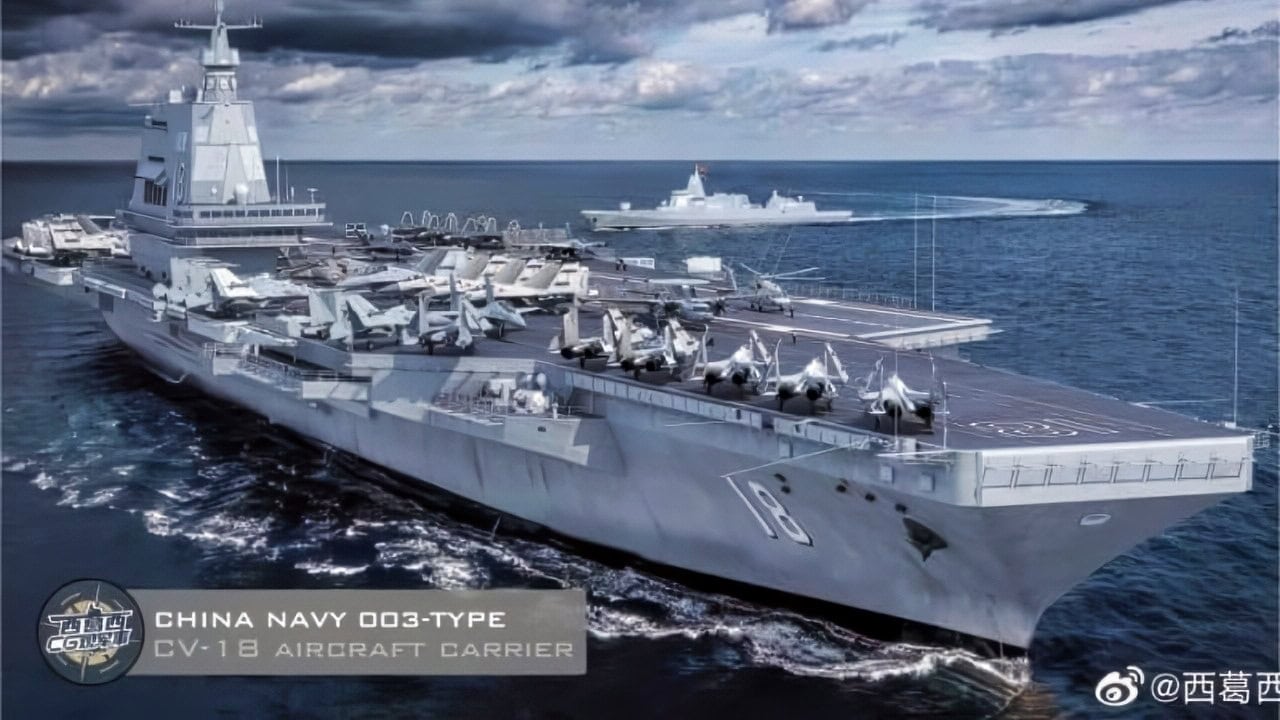
China Aircraft Carrier Type 003 Conventional Supercarrier. Image Credit: X Screenshot.
The difference between the two navies can be quantified, but doing so would be a disservice to the U.S. Navy’s capabilities. Really, it is a structural comparison, because China’s fleet includes more smaller ships designed for regional operations, while the U.S. fleet includes far fewer but significantly larger platforms designed for global deployment. And there lies the difference.
The United States maintains a major advantage in total displacement tonnage, with a fleet that is nearly twice the size of China’s by weight.
Why China Is Building a Blue-Water Navy
China’s naval expansion is intended to strengthen its regional operations, continue its existing strategies, and build on them. The rapid production of new vessels and the development of new nuclear-powered supercarriers are part of an ongoing strategy to build a true blue-water navy that competes with the United States.
In April 2018, President Xi Jinping announced that China would develop a true “world-class” navy during a naval parade.
The event was intended as a public demonstration of China’s growing maritime capability, and in the almost decade since then, development has moved at an astonishingly fast pace.
But the roots of this strategy actually go back further. Liu Huaqing, often described as the architect of the modern Chinese naval strategy, laid out the framework for Chinese expansion decades ago.
The former commander of the People’s Liberation Army Navy, who served from 1982 to 1988 and later served as vice chairman of the Central Military Commission, developed a phased maritime strategy that established China’s initial intent to control the First Island Chain by 2000. Then, it would expand its operational reach to the Second Island Chain (a line of islands between Japan and reaching toward Palau) by roughly 2020, and after that, develop a global, blue-water navy capable of operating worldwide by the mid-21st century. So far, Beijing is on track.
China is also building the infrastructure required for sustained naval operations, including facilities such as its base in Djibouti and a growing fleet of support ships. Its blue-water naval capability is still not there, but the trajectory shows that, with the launch of several new supercarriers in the coming years, it will be soon.
Where the U.S. Still Leads
The U.S. retains its advantage not just in tonnage but also in its carrier aviation. U.S. carriers deploy fully integrated air wings that include strike fighters, electronic warfare platforms, and airborne early warning aircraft worldwide.
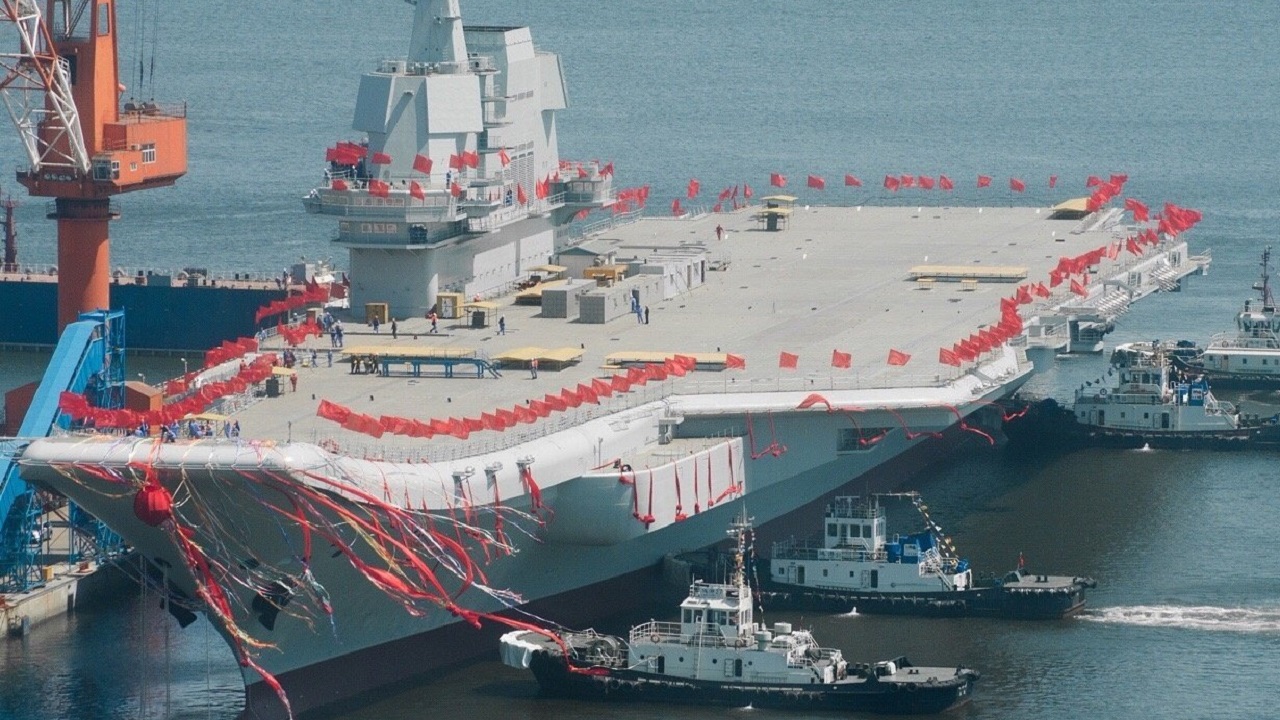
Fujian, China’s new aircraft carrier. Image Credit: Chinese Internet.
China’s carrier aviation is still developing and has not yet demonstrated the same level of operational integration – but it is certainly on its way to fielding similar technologies. The scale isn’t there now, but it is coming – and the Pentagon assesses that China could reach its goal of fielding nine aircraft carriers by 2035.
There is, however, another major gap: submarines.
The U.S. Navy’s nuclear-powered submarine fleet remains quieter and more survivable, giving it a decisive advantage in undersea warfare. China is also expanding its submarine force and is still working to close the gap.
But while China’s industrial base continues to pump out new vessels, it’s important to recognize that those fleets are almost worthless without logistics and experience. The United States operates a global network of bases and support infrastructure that allows it to sustain naval operations worldwide, while China’s overseas presence is limited and still developing.
In terms of experience, the U.S. Navy has conducted continuous operations in multiple theaters over the past two decades and has already deployed its aircraft carriers for two major operations in the last year alone. The PLAN has expanded rapidly, but it has relatively little real-world combat experience.
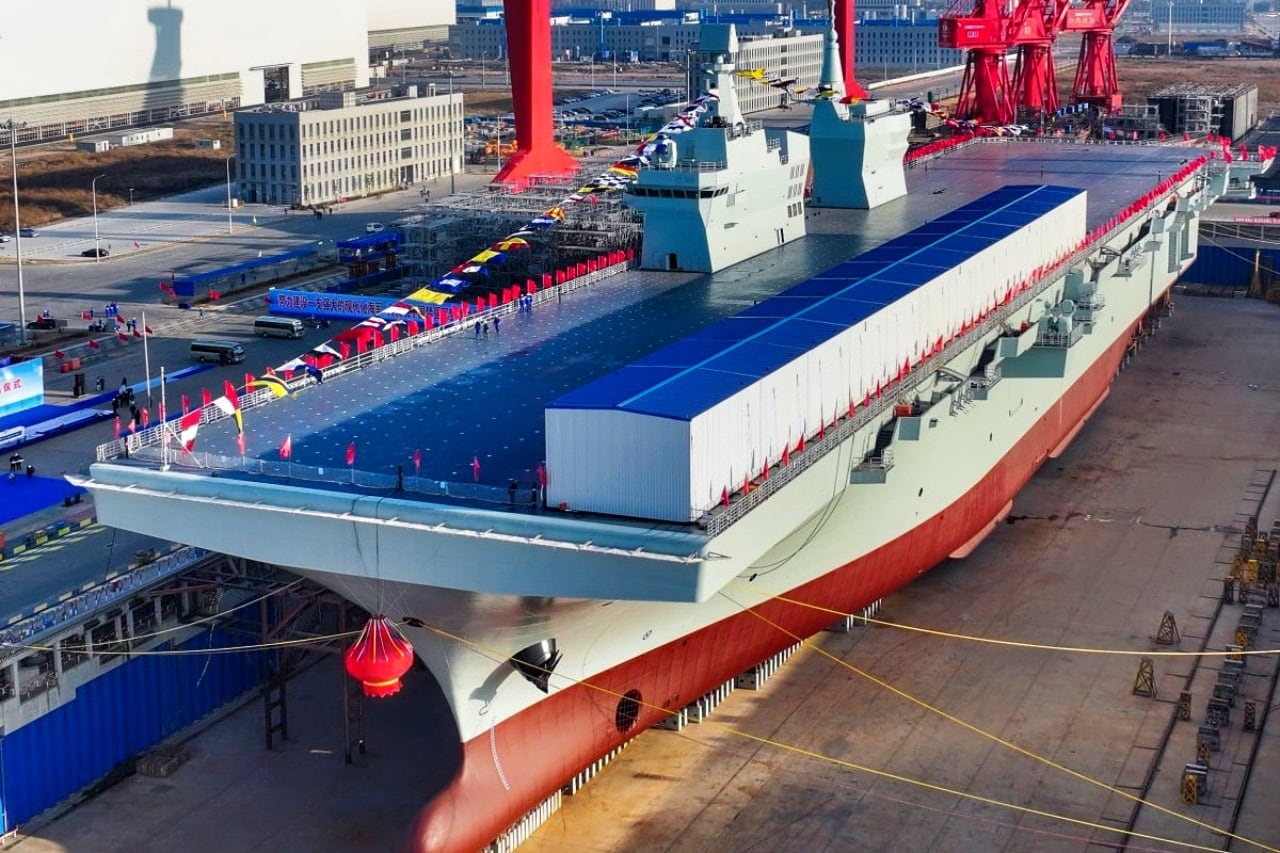
China Type 076 Assault Ship. Image Credit: Chinese State Media.
Does that mean China’s growing navy is not a threat? Well, no. Numbers alone make it far more competitive, and Beijing is presently building the infrastructure and logistics required to support expeditionary operations.
What’s more, the proliferation and advancement of automated and Artificial Intelligence-backed technologies could close the experience gap in the coming decades.
It’s clear that China does, in fact, pose a threat – maybe not now, but in the near future, and particularly if the United States does not rapidly expand its own industrial output.
About the Author: Jack Buckby
Jack Buckby is a British researcher and analyst specializing in defense and national security, based in New York. His work focuses on military capability, procurement, and strategic competition, producing and editing analysis for policy and defense audiences. He brings extensive editorial experience, with a career output spanning over 1,000 articles at 19FortyFive and National Security Journal, and has previously authored books and papers on extremism and deradicalization.