
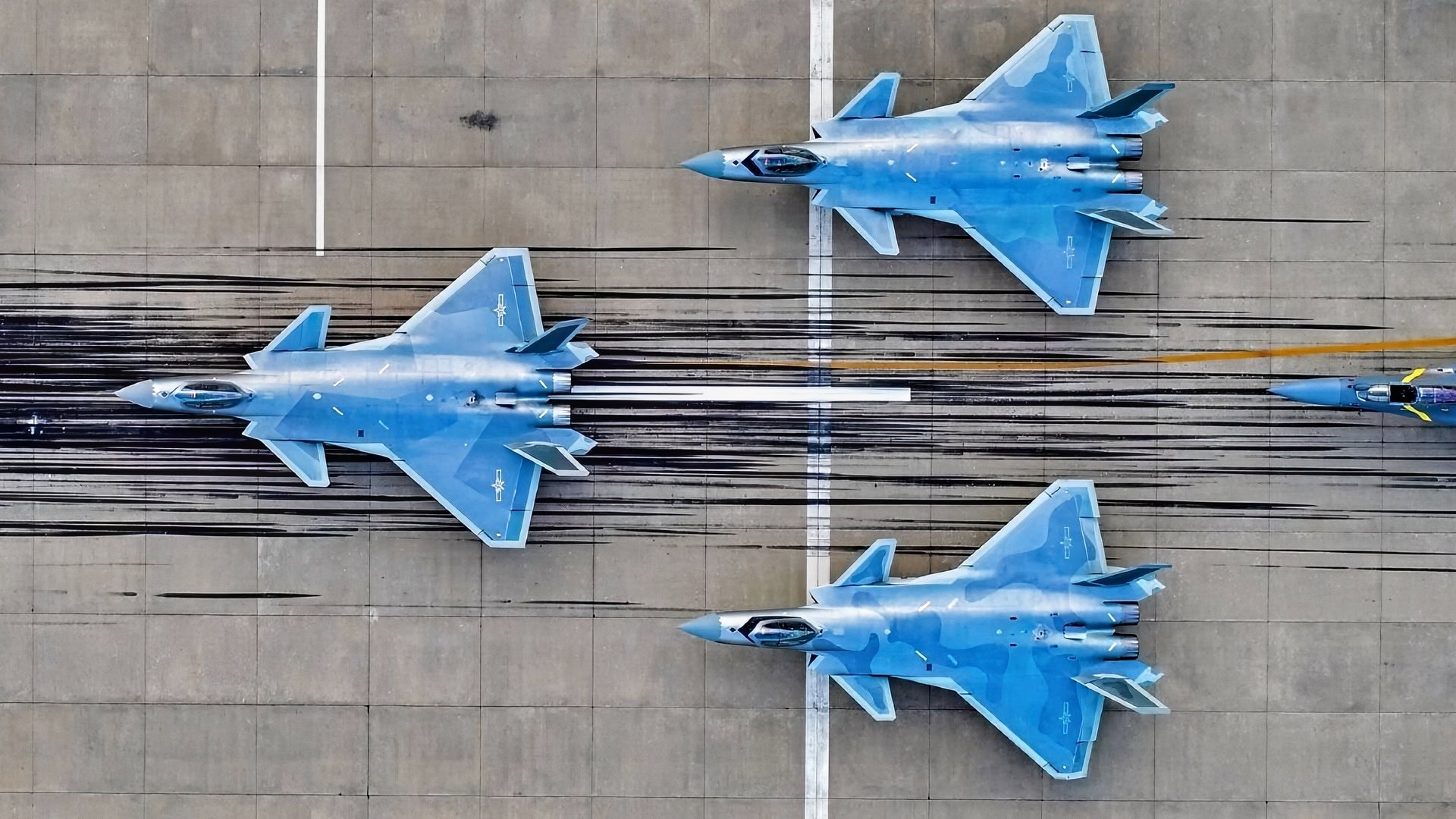
China’s Carrier Killer J-20S Doesn’t Actually Need to Sink Carriers
In November 2022, China publicly unveiled the twin-seat variant of its flagship fighter, the J-20S, at the Zhuhai Airshow, marking the first time a two-seat fifth-generation combat aircraft had been shown in its operational configuration and the first official confirmation of its existence.
Since then, reports have indicated that the aircraft has well surpassed its status as a demonstrator and is now approaching, or has entered, limited operational service within the People’s Liberation Army Air Force.
The J-20S is based on the J-20 stealth fighter – China’s first fifth-generation aircraft, developed by the Chengdu Aerospace Corporation, which entered service in 2017-2018.
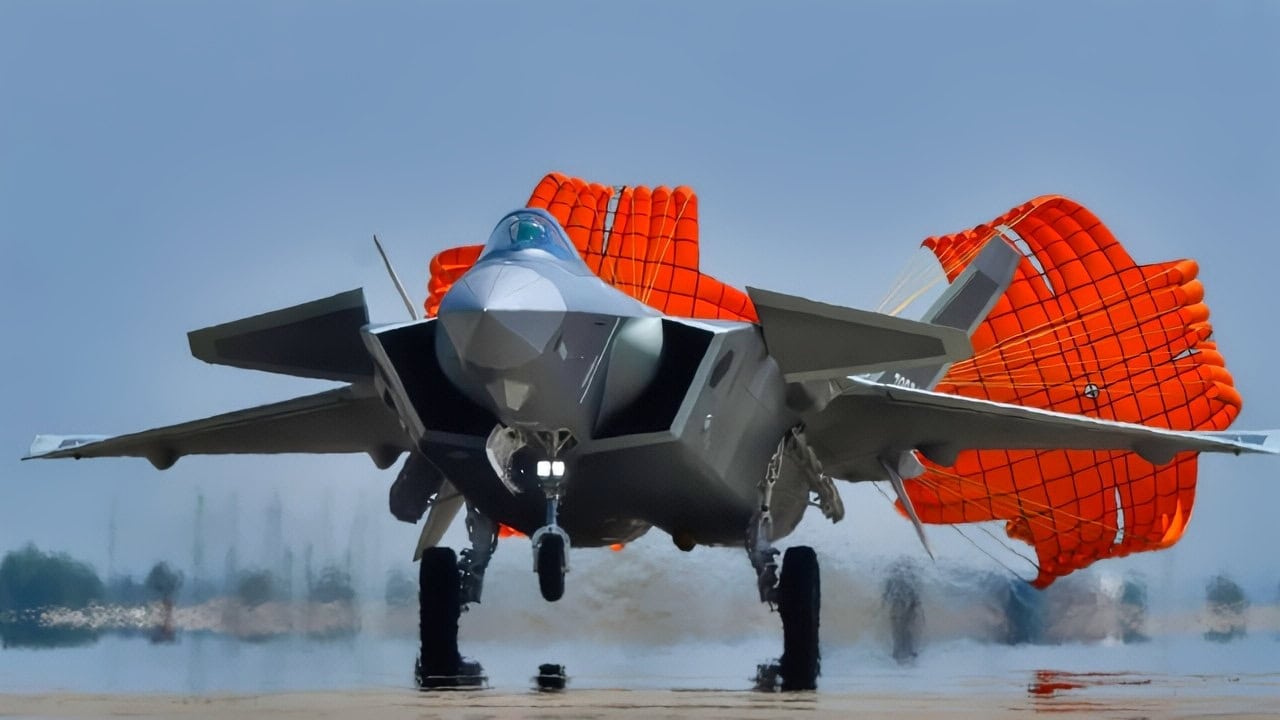
J-20 Stealth Fighter Landing. Image Credit: Creative Commons.
Fifth-generation fighters like this are defined by a combination of stealth and sensor fusion, and the J-20 does that and more. It features networked warfare capability, allowing it to operate as part of a wider combat system, much like Lockheed Martin’s F-35 Lightning II.
What really distinguishes the J-20S is its second crew position. Adding that additional operator – typically referred to as a weapons systems officer – allows the aircraft to manage more complex missions.
Pilots can fly the aircraft while the weapons systems officer handles real-time targeting and electronic warfare coordination. The second pilot also simplifies handling unmanned systems. That design choice, then, offers a look at China’s intent and long-term strategy, indicating that data processing and network integration are now priorities for Chinese aerospace efforts and future combat capability.
Among the reasons China is looking for advanced capabilities like this is its intent to challenge American naval dominance. Modern aircraft carriers, operating as part of a carrier strike group that includes escorts like destroyers and submarines, are among the most heavily defended assets in the world.
But their survivability depends on their ability to remain outside threat zones, project power in ways that prevent adversaries from attacking, and intercept long-range threats. The J-20S is designed to be a stealthy platform and a crucial component of a targeting network supporting long-range anti-ship missiles.
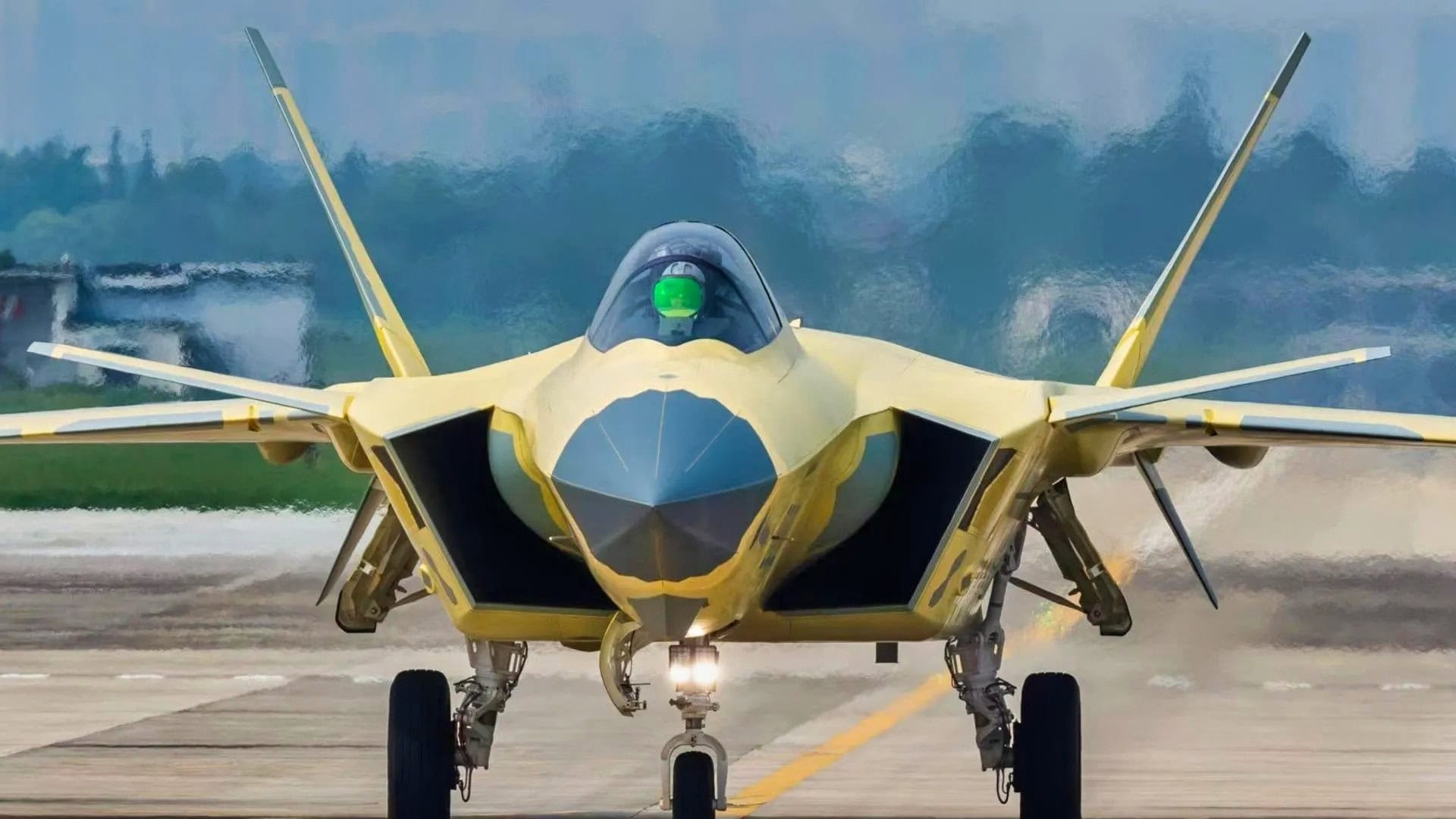
China J-20 Fighter. Image Credit: Creative Commons.
The J-20S and Why China Built It
The baseline J-20 was designed as a long-range, stealthy air superiority fighter with secondary precision-strike capability. More than 300 aircraft have reportedly been built so far, and the platform is now deployed across multiple Chinese air force brigades, including units positioned near the East and South China Seas.
The J-20S variant introduces the second cockpit seat, making it a world first, with the weapons systems officer handling targeting and electronic warfare inputs. But while this tells us a lot about current fifth-generation capabilities, it really actually informs us about the future, and what China – and other global powers – are preparing for next.
A second seat is crucial for manned-unmanned teaming, which will define the next generation of fighter jets. The concept is this: crewed aircraft with advanced networking capabilities are still flown, but they are joined by a number of unmanned systems, sometimes referred to as “loyal wingmen,” that can be controlled directly or autonomously.
Those drones will be capable of conducting reconnaissance or electronic attack, allowing crewed systems to remain as far away from contested airspace and conflict as they may need, thereby reducing the risk to human pilots. Drones may also be capable of conducting strike missions while manned aircraft remain further from danger. A press release published by China Daily quoted Song Zhongping, a military affairs commentator and former PLA officer, describing the jet’s capabilities.
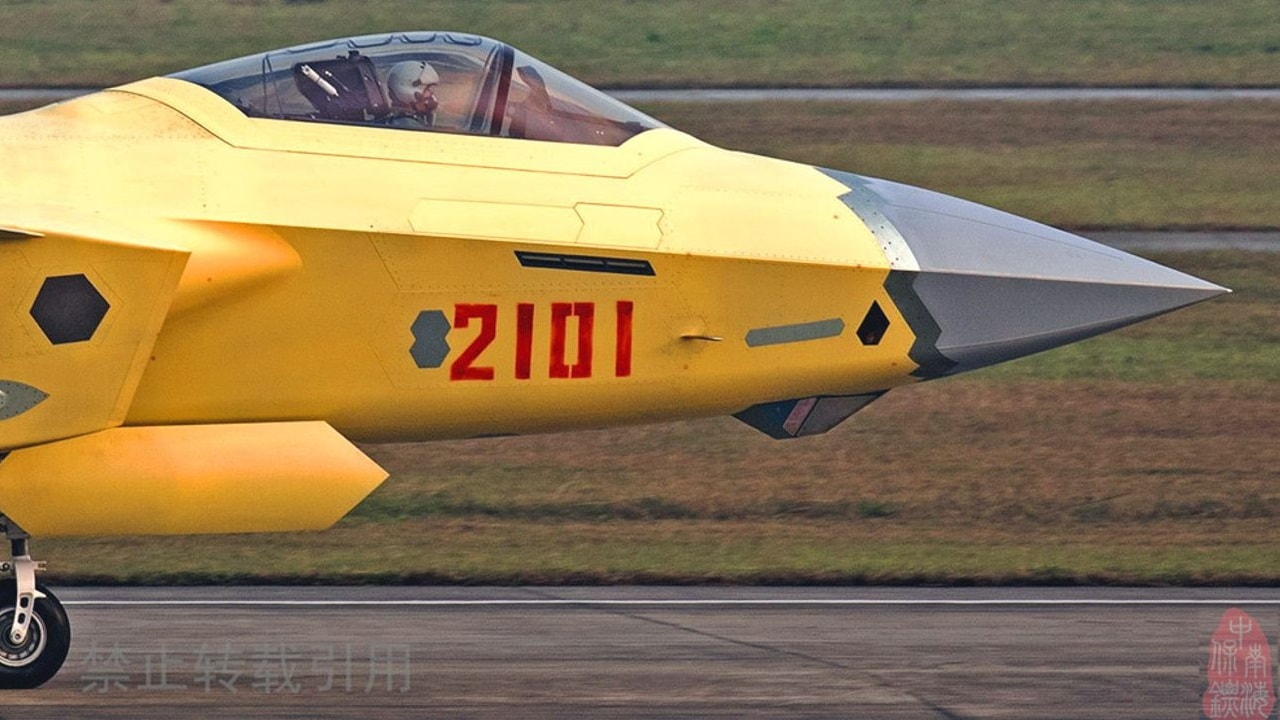
J-20 Stealth Fighter. Image Credit: Chinese Military.
“According to n introduction from the AVIC, the J-20S has good situational awareness capability, and that means it can act as a small-sized early-warning platform. The new model can also guide drones to carry out strikes against targets. All these new functions promise longer detection and fighting range,” he said.
Another former PLA Air Force official noted that the twin-seat variant also features a “backup flight-control system installed for the operator in the rear seat to use in case the main system malfunctions or is damaged in action, or the pilot is incapacitated.”
It’s clear: China is building autonomous systems for today, and preparing for more advanced systems in the future – just like the United States.
But more than that, the J-20S is now a carrier killer, meaning Beijing is not just challenging American aerospace superiority but also its naval might.
The J-20S “Carrier Killer”
While the J-20S itself is not expected to be capable of destroying a U.S. aircraft carrier on its own, it does play a critical role in the “kill chain” – the process of detecting, tracking, targeting, and then ultimately striking targets.
China has invested heavily in anti-ship ballistic missiles, such as the DF-21D, often referred to as a “carrier killer,” which has a range exceeding 1,400 km.
The missile is specifically designed to target moving ships at sea.
China, then, has the capability of targeting ships – but there are at least a couple of problems.
First is the fact that modern carriers are defended by their strike groups and layered air defense systems – but that isn’t entirely relevant here.
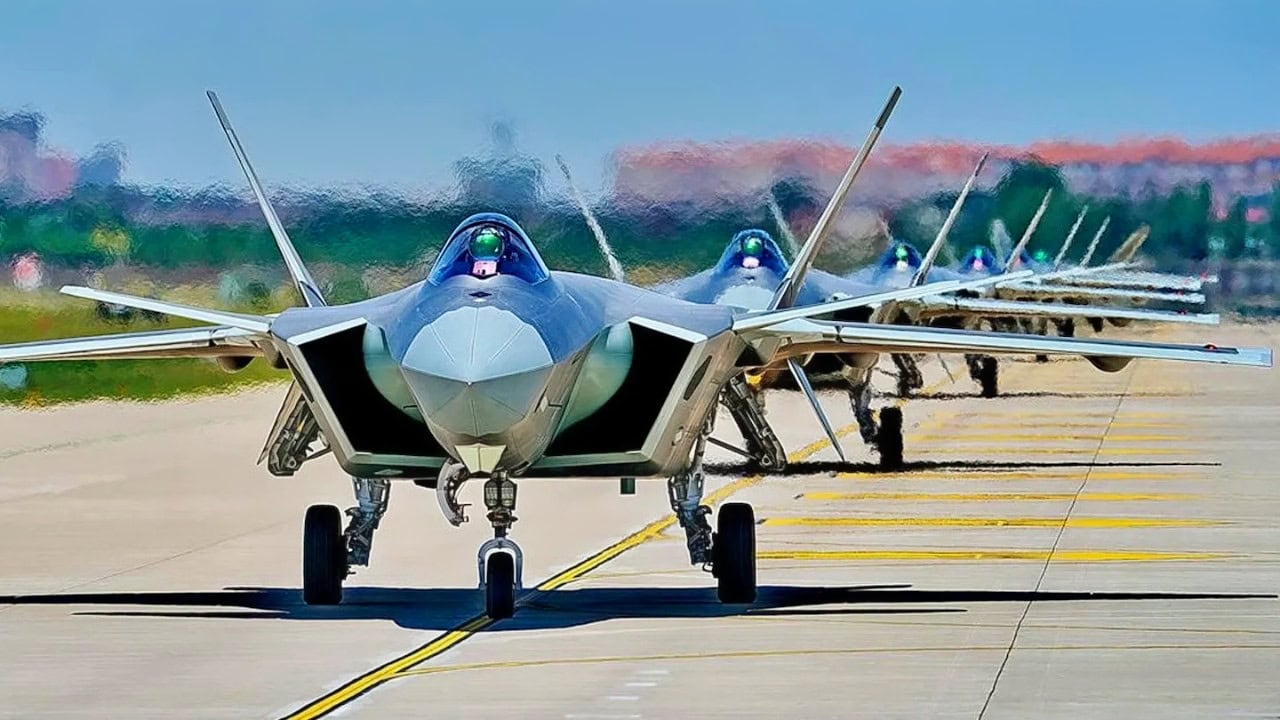
J-20 Fighter from PLAAF China. Image Credit: Creative Commons.
What matters is that the missiles alone are not enough; they need a platform to identify, track, and target naval assets. Missile launchers need accurate targeting data for long enough to guide the weapon, and that’s where the J-20S comes in. Its stealth characteristics allow it to operate closer to contested waters without early detection, while its onboard sensors and radar provide the long-range detection capability.
Reports suggest that the aircraft’s AESA radar (Active Electronically Scanned Array) may have an extended detection range due to its larger radome and additional transmit/receive modules, thereby improving its ability to track targets at greater distances. And that second crew member comes into play here, enabling continuous tracking and data management – helpful when engaging moving naval targets. The aircraft can then pass targeting data to other platforms, including Chinese missile forces or strike aircraft, or even satellites.
In effect, the J-20S serves as a forward sensor and a command node. For U.S. forces, this particularly matters in the context of the First Island Chain, which stretches from Japan through Taiwan and to the Philippines, where carriers operate within range of Chinese sensors and missiles.
Why China Wants A Carrier Killer
For China, possessing military assets that may be technically capable of striking a U.S. aircraft carrier is one part prestige, five parts strategy. For decades, U.S. aircraft carriers have been the central tool of American power projection, enabling rapid deployment of air power anywhere in the world. In a Taiwan contingency or a conflict in the South China Sea, carriers would likely play a central role in U.S. operations. China’s response has been to build systems designed to deny access to those forces – what is commonly referred to as anti-access/area denial (A2/AD). This includes missiles, submarines, and increasingly, aircraft like the J-20S.
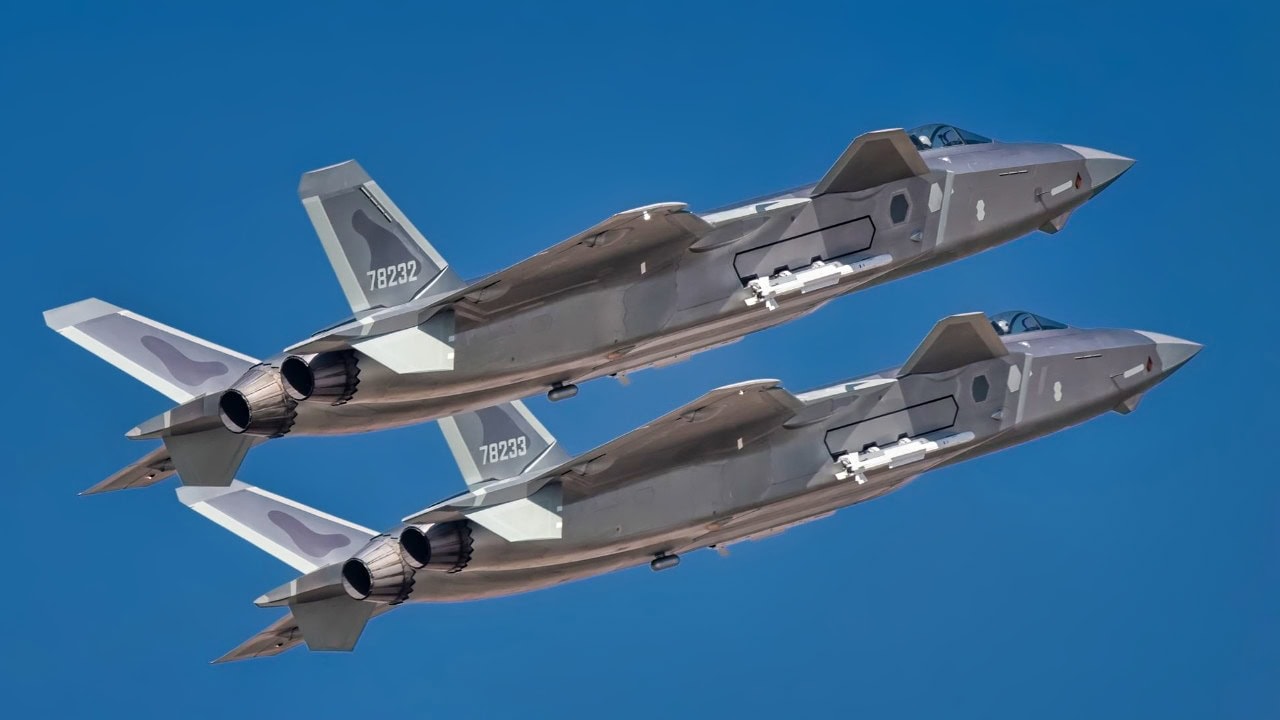
J-20 Mighty Dragon. Image Credit: Creative Commons
Evidence of that focus is longstanding, with satellite imagery showing China constructing full-scale mock-ups of U.S. carriers in desert test ranges, likely for refining targeting systems.
The goal is not necessarily to destroy every carrier, but to make operating them so risky that they are forced to remain further from the battlefield. That, in turn, reduces sortie rates and limits strike options, weakening America’s ability to respond.
The J-20S does not need to sink a carrier itself to change the balance, and China knows it.
All it needs to do, for now, is make sinking a carrier technically possible.
MORE – Canada Is In F-35 Limbo
MORE – The F-22 and J-20: Who Wins a Fight?
About the Author: Jack Buckby
Jack Buckby is a British researcher and analyst specializing in defense and national security, based in New York. His work focuses on military capability, procurement, and strategic competition, producing and editing analysis for policy and defense audiences. He brings extensive editorial experience, with a career output spanning over 1,000 articles at 19FortyFive and National Security Journal, and has previously authored books and papers on extremism and deradicalization.

