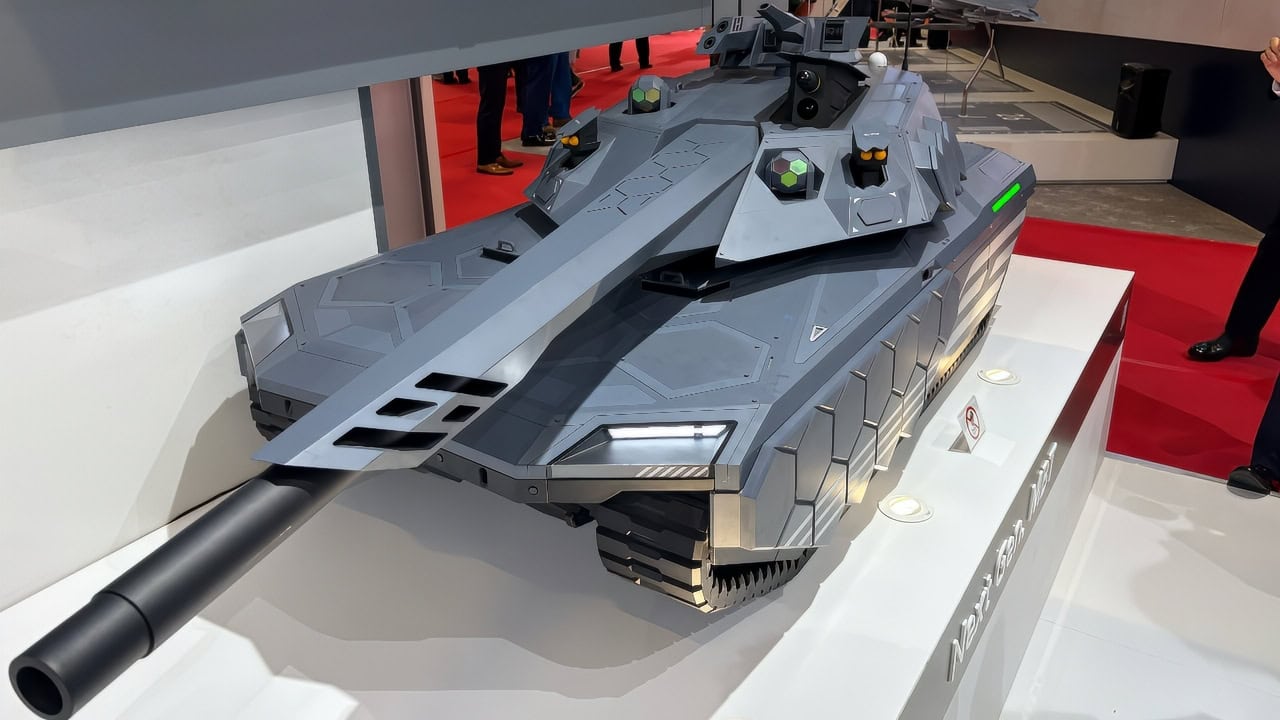
The K3 is a next-generation main battle tank (MBT) currently under development in South Korea (ROK) by Hyundai Rotem in cooperation with the government-run Agency for Defense Development (ADD). The ADD is an organization roughly analogous to the U.S. Government’s Defense Advanced Research Projects Agency (DARPA). Some even say the K3 looks like the B-21 Raider for a special reason – it looks rather ‘stealth‘.
The K3 is designed to replace the current and in-production K2 Black Panther MBT, which thus far has been a best-seller for the Republic of Korea (ROK) defense company.
The K3 will not be an upgrade to the K2 Black Panther Tank, as it will not be to the K2 what the old U.S. M60A3 was to its predecessors, say company representatives. Rather, it will be a new-generation platform, an unprecedented developmental step in the history of military hardware.
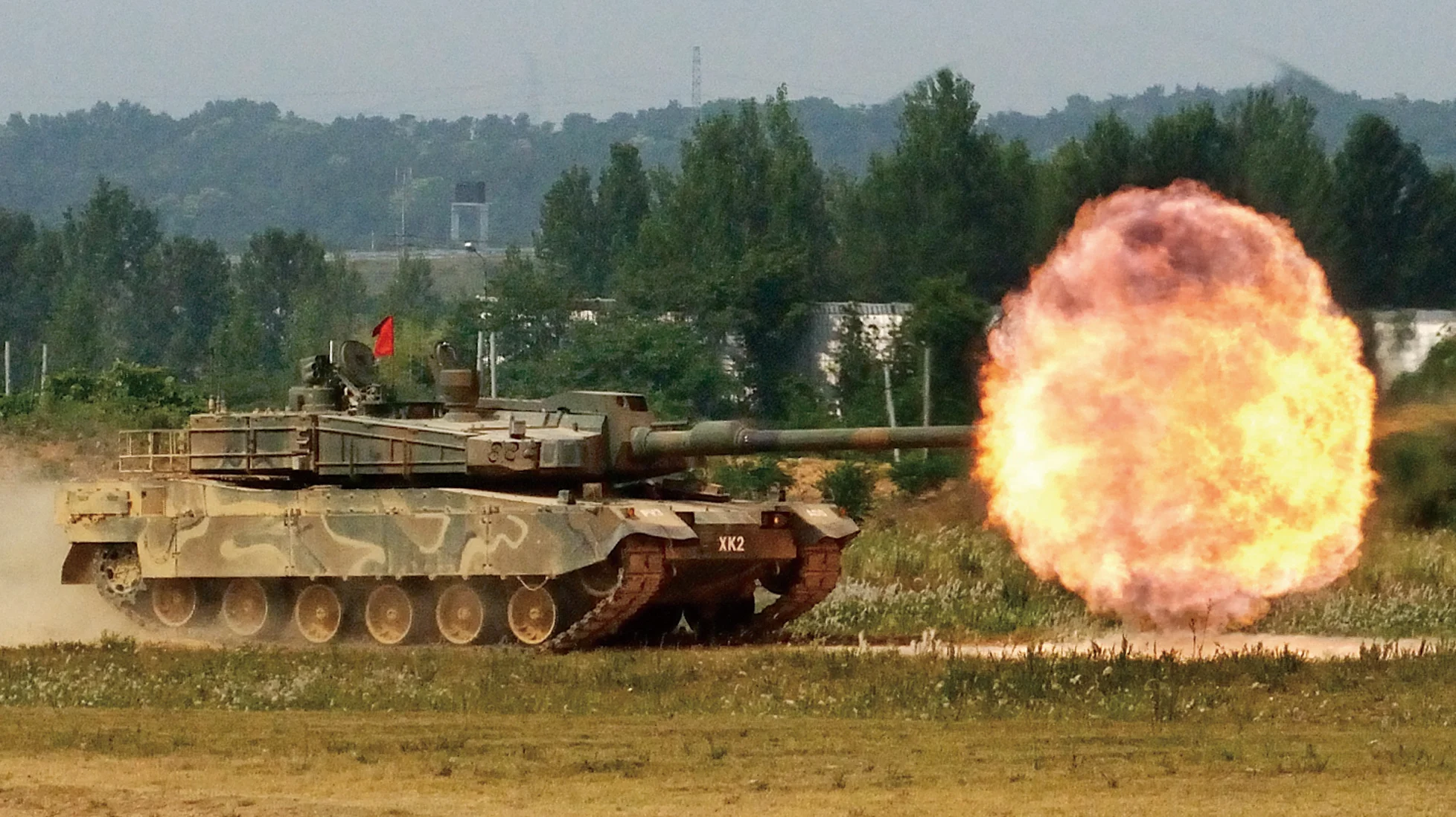
K2 Black Panther, the most expensive tank on Earth.
“An analogy that you could make about the K3 is that it represents to the design of MBTs what advanced defense electronics have done for tactical combat aircraft,” said a retired U.S. aircraft and missile systems designer.
“If you look at the fighter aircraft we have today, what do you see? The aircraft does not fly any faster than previous fighter designs. They do not carry more weaponry than older fighters– in many cases, they carry less. Overall, these new-age aircraft are more fuel-efficient, and sometimes they are more maneuverable, but that is about it,” he continued.
“What makes the difference is that they have better sensors so that they detect the enemy at greater distances, they are carrying weapons that can hit targets at greater ranges with higher accuracy, they have new-age self-protection systems like electronic warfare suites and their exteriors are made from materials that make it harder for the enemy’s sensors to find them and achieve an effective weapons lock.”
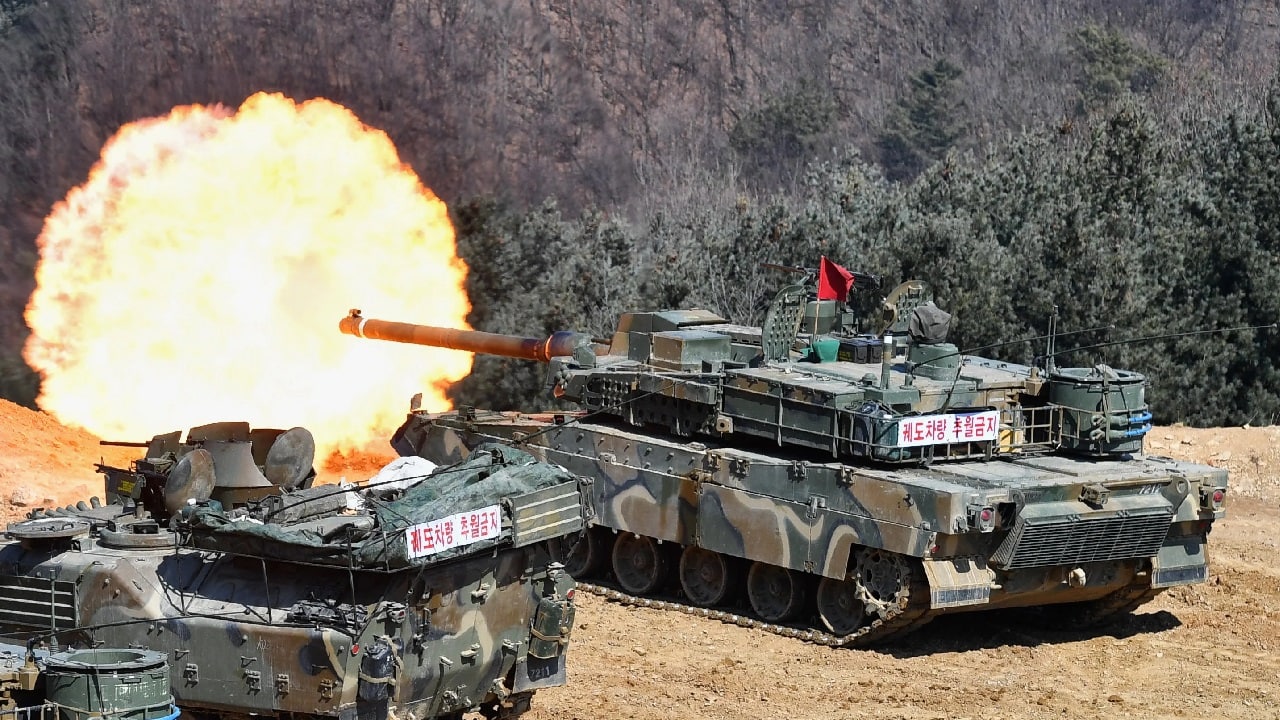
K2 Black Panther. Image Credit: Creative Commons.
“The point is that it is not external features or propulsion performance that drives the design of the platform — in this case, an aircraft. It is what is inside — the onboard systems make the difference, and that is what drives the design.
With the K3, the South Koreans have reached that era or generation, and they have reached it ahead of almost everyone else,” he concluded.
What Features Distinguish the K3’s Weapons and Sensors
There are several aspects of the K3 that one could call its “signature calling cards,” and synergistic combinations are created among them. The result is a weapons platform that exhibits combat capabilities “greater than the sum of its parts,” as the saying goes.
Several characteristics and design details make the K3 stand out as a next-generation system capable of achieving this level of performance.
The first of these would be its 130mm main gun. It follows the trend, now for several years, toward a smoothbore design. This feature gives rounds fired from it a “flat” trajectory, rather than an arc, as tank shells fired from a barrel with traditional “riflings” inside that “spin” the projectile.
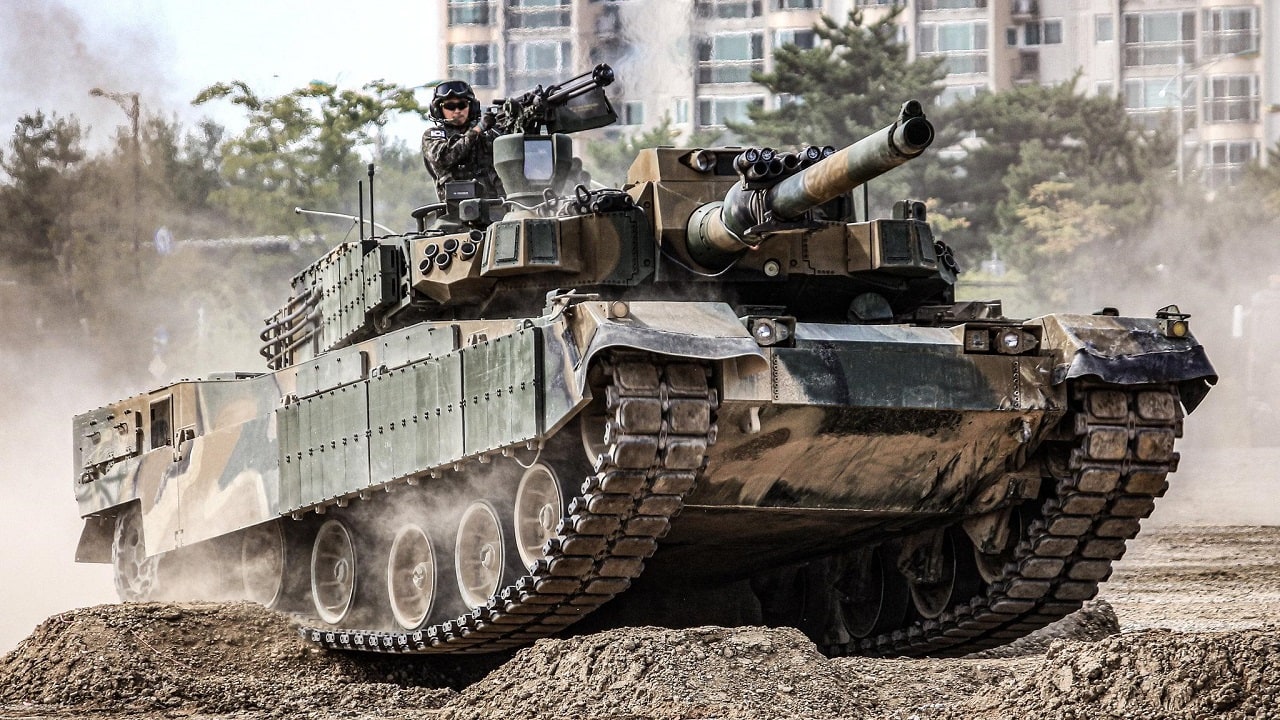
K2 Black Panther. Image Credit: Creative Commons.
Like many recent tank designs, K3 features an autoloader with a 3.5-second reload time. The turret also follows the trend of numerous new-age armored vehicle designs by being an unmanned, remote system.
The tank also has a secondary 30 mm cannon, both weapons assisted by AI-powered targeting protocols. The weapon systems are controlled from inside the MBT’s main chassis by an operator at a computer-driven console.
Secondly, the K3 typifies a present-day trend in weapon system design — the use of AI. Additionally, the AI supports the entire sequence of events from target identification and acquisition through interrogating the target, developing a firing solution, and firing or launching a weapon. In the old days, the weapons design community called this type of offering “soup to nuts.”
To that end, the K3 is working with an AI-based C4ISR constellation of onboard and offboard technologies. They work in concert to empower it to act as a mobile armored command node.
In that respect, and to use another analogy with the world of combat aviation, the K3 is supposed to function as a battlefield management platform. It is a “quarterback” in the same way the F-35 is billed as an airborne battlespace command platform.
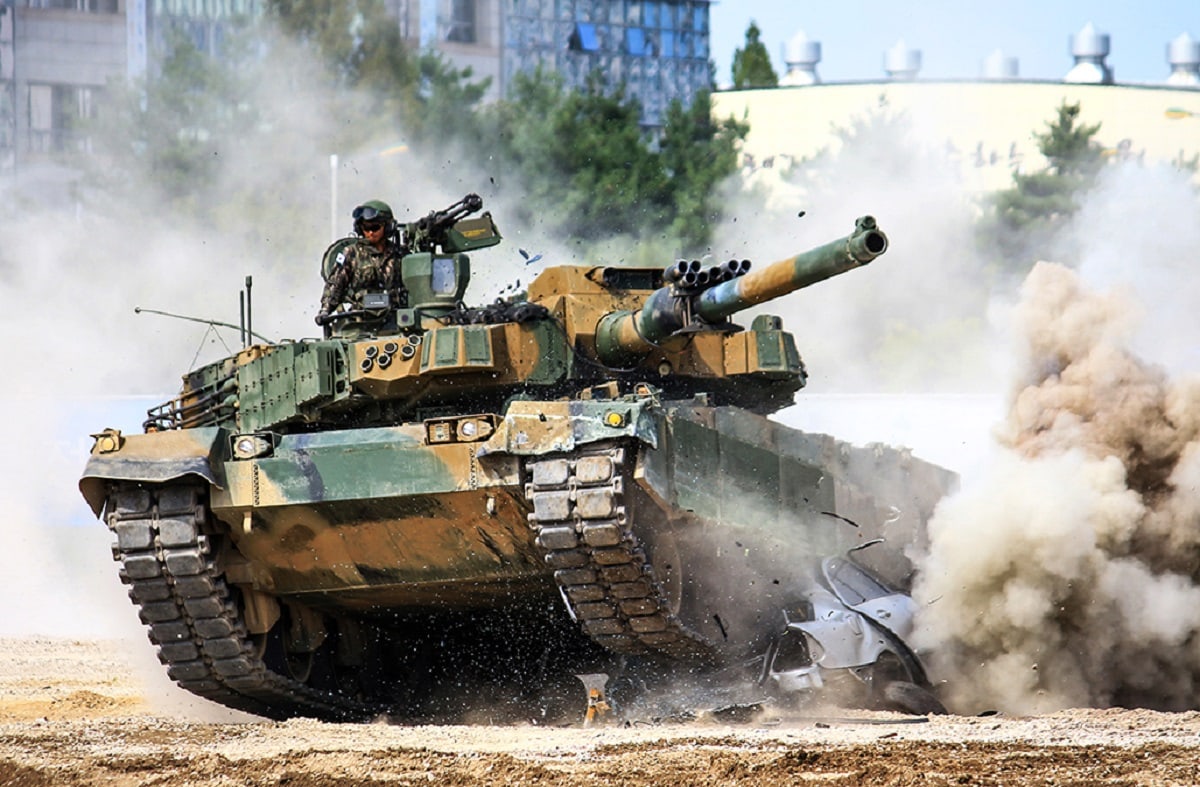
K2 Black Panther. Image: Creative Commons.
The K3’s integration of offboard sensors includes incorporating input from drones (UAVs) and ground robots. The ground robots, which are becoming increasingly common on the battlefield in Ukraine, play a role similar to that of airborne, unmanned, collaborative combat aircraft.
Using these systems as offboard sensors extends the K3’s situational awareness, enabling it to “see” kilometers ahead of its location and beyond the range of its onboard sensors.
And again, with another aspect of how AI enhances the tank’s performance, the K3 employs AI to process external data from all sensors — both onboard and offboard- and creates a combination designated “manned-unmanned teaming” (MUM-T).
Propulsion and Signature Management
The K3 features another new, never-before-used hydrogen-based hybrid engine for the tank’s powerplant. It is described as a “hydrogen fuel cell propulsion system to enable silent operation but also one that generates high speed.”
Some sources that have reported on the program state that the initial models potentially “could be using a hybrid diesel-hydrogen system initially” until a more advanced hydrogen-powered propulsion can be perfected. The end objective for the designers is a hydrogen fuel cell propulsion system design that permits the tank to operate with dramatically reduced noise.
Reduced noise is achieved with the same hydrogen-fuel-cell propulsion design. The result is a nearly silent operation that is well below that of the diesel-powered or turbine-engine tank designs in service today. It also produces a lower heat signature even at high speeds.
Another major benefit, besides the dramatic reduction in both acoustic and heat signatures, is that, with fewer moving parts, the tank’s aggregate weight is composed primarily of weaponry and ammunition rather than onboard mechanical systems.
Yet another design feature that reduces the tank’s signature is its smooth, semi-blended, and seamless exterior armor shell. The advanced next-generation modular armor is a combination of materials.
It draws inspiration from the layered armor design of ceramic, composite, and steel elements, a main feature of the US M1 Abrams tank when it was first introduced.
That advanced composite, “Chobham” armor, is composed of layered ceramic tiles, a metal framework, and backing plates. The structure works by shattering kinetic-energy penetrators against the hard, abrasive ceramic surface and absorbing the resulting energy.
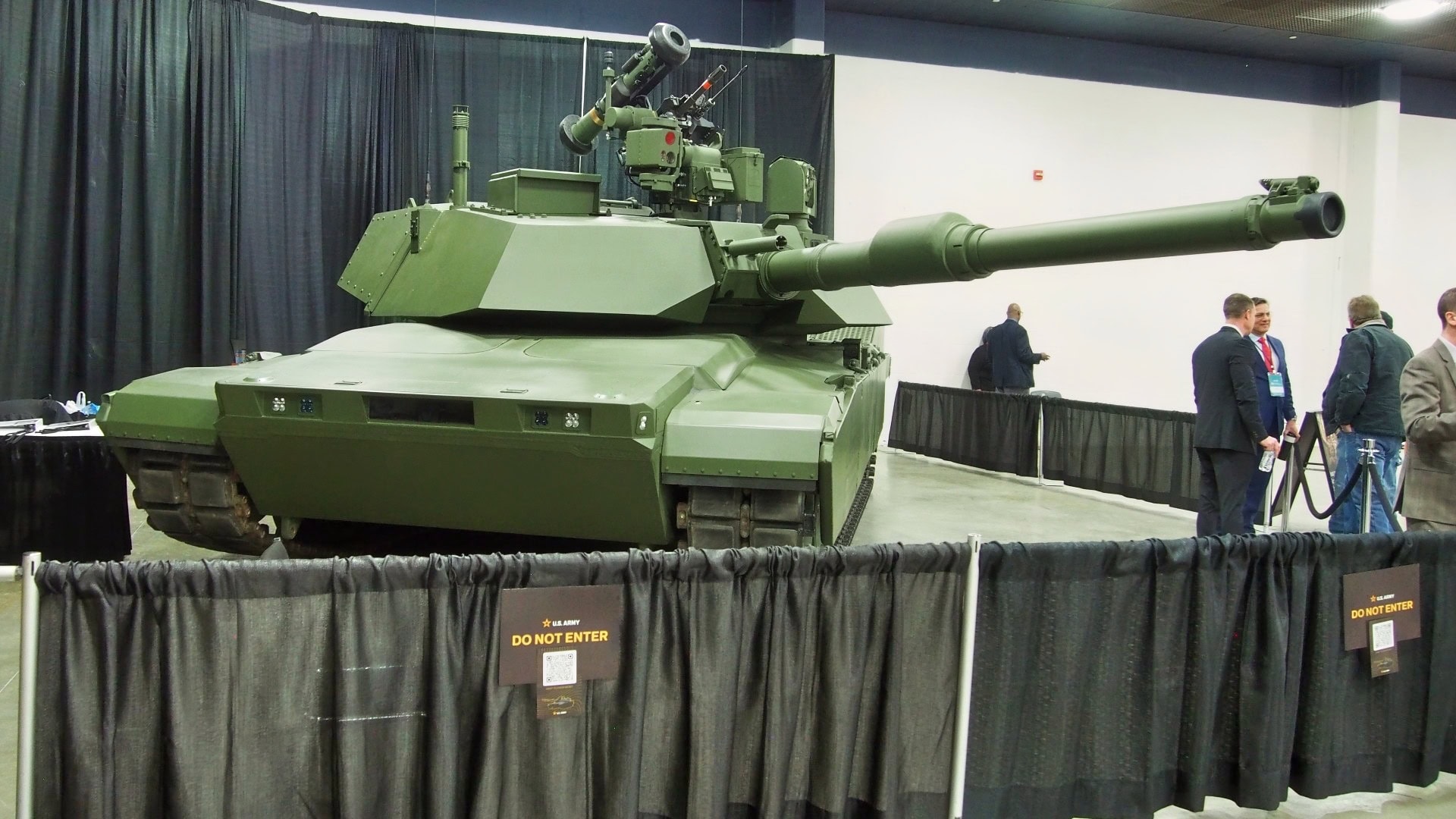
M1E3 Abrams Tank. Taken by 19FortyFive.com
Then the layered, modular design helps mitigate armor-piercing threats and reduces spiraling. The combination of these materials and the manner in which they are “knitted” together neutralizes much of the lethality of many anti-armor munitions.
The use of new-age materials, which at the same time have almost no separate panel sections that would reflect modern-day sensors, also increases the stealthy quality of the design.
In this respect, the K3’s exterior design requirements resemble those of many stealth aircraft. By making the tank much more difficult to detect at beyond-visual-range and having such a low signature, the anti-tank weapons of the present would have difficulty locking onto and firing at such a target.
Predictably, this profile of the K3 and these stealthy aspects have generated commentary comparing it to the B-21 Raider stealth bomber.
Defensive Systems and Crew Survivability
The K3 is also equipped with one of the most advanced suites of defensive systems of any armored vehicle in modern history. It is a combination of both passive and active defensive aids that provides 360-degree virtual-reality situational awareness.
These defensive systems combine hard-kill and soft-kill. The system integrates radar-guided hard-kill interceptor missiles that are designed to destroy incoming anti-tank projectiles. They are combined with soft-kill jammers that disrupt or effectively neutralize enemy targeting systems.
One of the main elements in the defensive modules is an active protection system (APS) that employs a 360-degree artificial intelligence situational awareness module for fast threat identification and automatic engagement. This increases accuracy within the APS engagement envelope and reduces the integrated system’s reaction time.
There is also a specialized drone-jamming suite backed by anti-drone technology to counter unmanned threats. The entire suite is designed with provisions for jamming resistance, enabling it to operate on high-intensity, AI-driven, multi-domain battlefields.
The crew survivability aspects of the K3 are another factor that has placed it in the category of a platform designed for the modern-day battlefield. One element is the vehicle’s almost space-age armor, which negates much of the lethality of most modern anti-tank ordnance.
The other aspect involves separating the crew and ammunition compartments and installing shielding between them to prevent any incoming round from causing the ammo to explode and destroying the entire vehicle and those inside.
What The Experts Told Us
19FortyFive spoke with a retired U.S. Army flag officer who served on the design team for the original US M1 Abrams. He explained that “in the US, we were the first to recognize that separating people from ammunition was one of the keys to crew survivability.”
“If you look at the photos from the conflicts that the U.S. fought against Iraq, you see a tremendous number of burned-out and ruptured [Russian-design] tank hulls with the turrets blown off. That is because they [the Iraqis] were storing the ammo inside the crew compartment. As soon as a round entered the turret, it would ignite that unexpended ammo, and that would be the end of the tank and those inside of it,” he said.
“Some of the tank designers, since – like the Russians with the T-14 – have taken the same path as the U.S. Now the South Koreans have as well. What these militaries understand is that if the crew realizes that they have a greatly improved chance of survival if the tank takes a round, that is a huge motivating factor,” he explained.
Production and Introduction into Service
Hyundai Rotem unveiled the K3 prototype concept for the first time at Eurosatory 2024 at the Villepinte Exposition Center, outside Paris. Since then, it has been shown at several other venues, including Poland’s MSPO 2025.
The company has been looking not just for sales but also for opportunities to set up production lines outside of Korea. Central European states that are former Warsaw Pact nations under the Soviet umbrella also have several production sites for Russian-designed MBTs adaptable to K3 production.
Hyundai-Rotem aims to have the tank deployed and in service by 2040, if not earlier. At this point, say company spokesmen, the program “is going to be ahead of other nations who have been traditional powerhouses in the armored vehicle community – the US, Germany, France.”
“What we are talking about is South Korea, which has already established itself as a player in the international combat aircraft market, and is going to be assuming a similar role in the land systems and armored vehicle world as well,” they said. “Our industry is streamlined and integrated [with our government institutions] in a way that many other nations are not. And it is one of Korea’s greatest advantages.”
About the Author: Reuben F. Johnson
Reuben F. Johnson has thirty-six years of experience analyzing and reporting on foreign weapons systems, defense technologies, and international arms export policy. Johnson is the Director of Research at the Casimir Pulaski Foundation. He is also a survivor of the Russian invasion of Ukraine in February 2022. He worked for years in the American defense industry as a foreign technology analyst and later as a consultant for the U.S. Department of Defense, the Departments of the Navy and Air Force, and the governments of the United Kingdom and Australia. In 2022-2023, he won two awards in a row for his defense reporting. He holds a bachelor’s degree from DePauw University and a master’s degree from Miami University in Ohio, specializing in Soviet and Russian studies. He lives in Warsaw.