
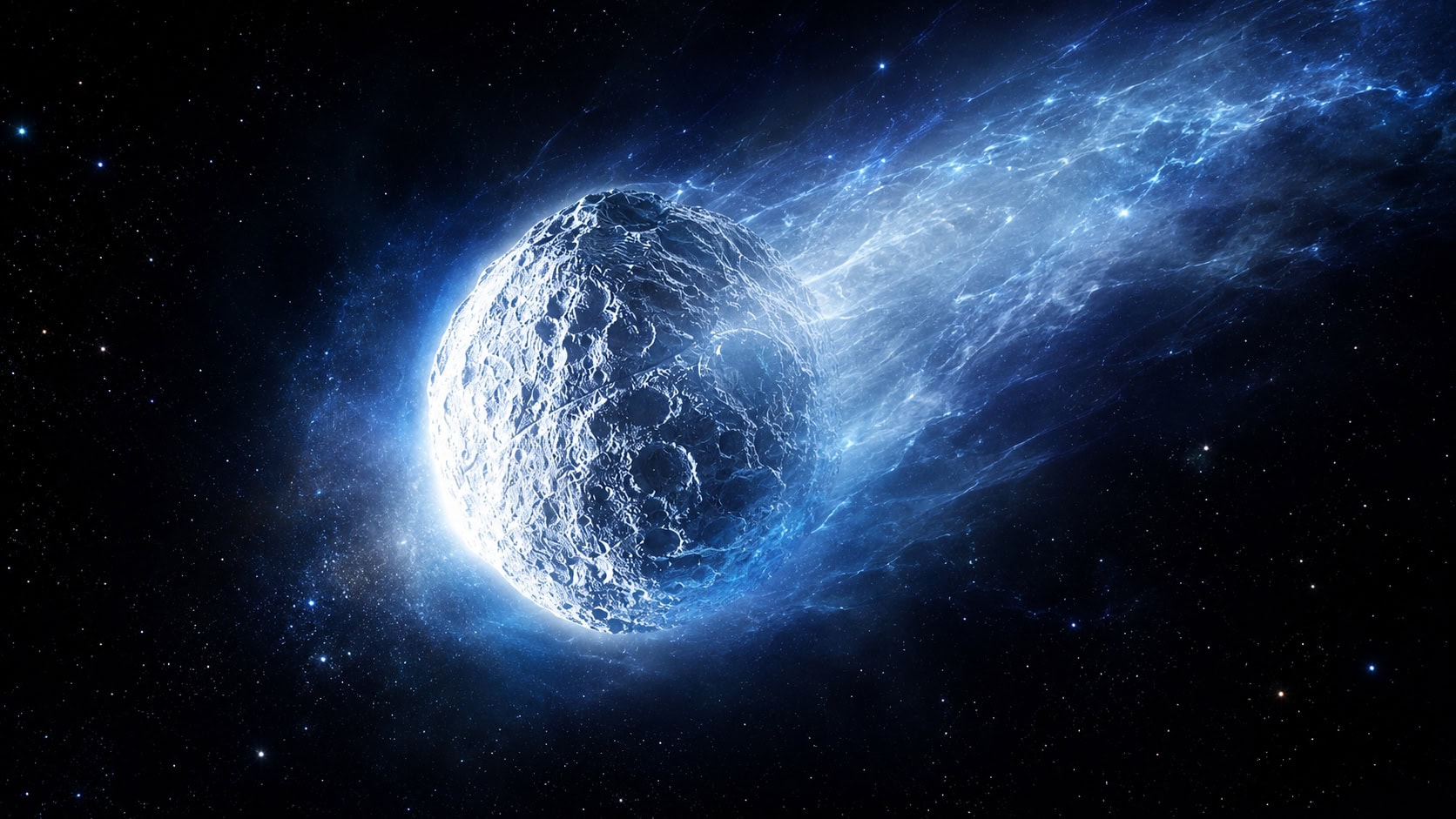
Almost a year after its discovery, the interstellar object known as 3I/ATLAS hit the headlines again. Researchers announced in early 2026 that the object may be 12 billion years old, potentially making it older than our Sun and one of the oldest known comets ever observed by humanity.
And it is just the latest in a long string of interesting turns that make 3I/ATLAS one of the most curious space objects we’ve ever seen.
Space Shuttle at Smithsonian. Image taken by 19FortyFive back in 2025.
Before researchers announced their findings, 3I/ATLAS was already historic.
When it was first detected on July 1, 2025, by the Asteroid Terrestrial-impact Last Alert System (ATLAS) in Chile, scientists said the object was only the third-ever confirmed interstellar object to pass through our Solar System.
And unlike most comets, which usually orbit the Sun, 3I/ATLAS appears to have originated around another star.
That means it has likely spent billions of years traveling through interstellar space before it briefly entered our Solar System.
The discovery went viral very quickly.
It caused one of the biggest international observing campaigns in modern astronomy, prompting both scientists and amateur researchers to publicly speculate about its origins and nature.
NASA and the European Space Agency, among others, began focusing on the object in hopes of learning as much as possible about it.
Beyond its origin and composition, the object drew unusually wide attention when a small number of researchers publicly raised the possibility that it could be artificial rather than a natural comet. Most astronomers were skeptical from the start, and as the data came in, it confirmed that 3I/ATLAS is a natural comet.
Space Shuttle at Smithsonian. Image taken by 19FortyFive back in 2025.
Those spectacular claims were eventually proven wrong.
What Researchers Said
According to an assessment of the comet’s isotopic composition, 3I/ATLAS is believed to be between 3 and 11 billion years old.
Other assessments put its age as high as 12 billion years. According to astronomers Aster Taylor and Darryl Seligman of the University of Michigan and Michigan State University, the comet’s “kinetic” age is somewhere within this range, with the highest potential age being supported by a study led by Martin Cordiner of NASA.
According to Cordiner, who used the James Webb Space Telescope’s Near-Infrared Spectrograph (NIRSpec) to study the comet, it could be as much as 12 billion years old.
The research focused on deuterium, a heavy form of hydrogen, and specifically on the ratio of deuterium to ordinary hydrogen in the water that makes up the comet
Webb’s measurements showed that the chemistry of 3I/ATLAS differs from that of comets formed in our own Solar System, reinforcing the conclusion that it came from somewhere else entirely.
The Third Of Its Kind
3I/ATLAS gets its name from the fact that it is the third confirmed interstellar object to ever be discovered passing through the Solar System.
Space Shuttle at Smithsonian. Image taken by 19FortyFive back in 2025.
The “I” that follows “3” stands for “Interstellar,” while ATLAS refers to the Asteroid Terrestrial-Impact Last Alert System telescope network that was used to discover it.
It follows the same naming convention as the previous two confirmed interstellar visitors: 1I/Oumuamua, discovered in 2017, and 2I/Borisov, discovered in 2019. The comet also received a separate comet designation, C/2025 N1 (ATLAS).
Astronomers determined that the comet was traveling on a hyperbolic trajectory, meaning it was moving too fast to be gravitationally captured by the sun as a planet would be.
That means it is not part of the Solar System, and that, even if it passes through, it will never become part of our Solar System.
For six years after 2I/Borisov was discovered, no interstellar objects were observed in the sky, and during that time, scientists and engineers had developed far more advanced telescopes that made it possible to study interstellar visitors in greater detail.
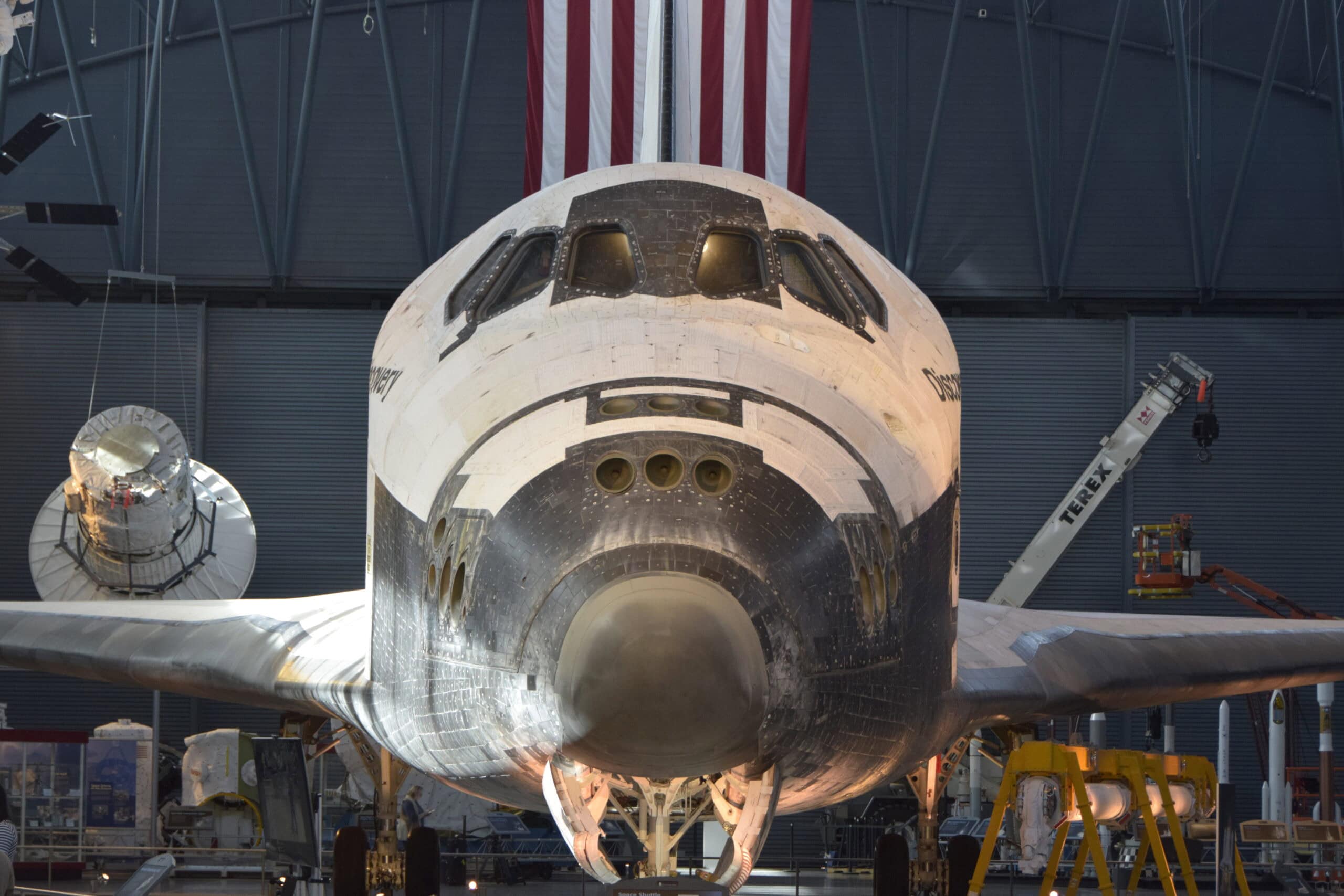
Space Shuttle at the Smithsonian. Image taken by 19FortyFive back in 2025.
That’s another reason why 3I/ATLAS received so much more attention.
Why Scientists Started Watching
Unlike the two comets that came before it, which generated years of debate because of their strange characteristics, 3I/ATLAS quickly developed a very visible coma and tail.
“Coma” refers to the glowing cloud of gas and dust that surrounds the comet, while the tail refers to the same dust and cloud that trails it.
Typically, those features develop later as comets leave interstellar space and approach a sun.
The features allowed astronomers to study gases and particles escaping the comet much earlier, and therefore determine its chemical composition.
Where Is it Now?
A year on, and scientists have learned a lot. 3I/ATLAS has given astronomers the greatest look yet at a visitor from interstellar space.
The James Webb Space Telescope and ground-based observatories have shown that 3I/ATLAS is rich in carbon dioxide, other carbon compounds, and water ice, the composition of a natural comet, putting the earlier artificial-origin speculation to rest.
After passing through the inner Solar System and reaching the closest point to our Sun in October 2025, the comet began heading back to interstellar space and continues on its hyperbolic trajectory.
About the Author: Jack Buckby
Jack Buckby is a British researcher and analyst specializing in defense and national security, based in New York. His work focuses on military capability, procurement, and strategic competition, producing and editing analysis for policy and defense audiences. He brings extensive editorial experience, with a career output spanning over 1,000 articles at 19FortyFive and National Security Journal, and has previously authored books and papers on extremism and deradicalization.