
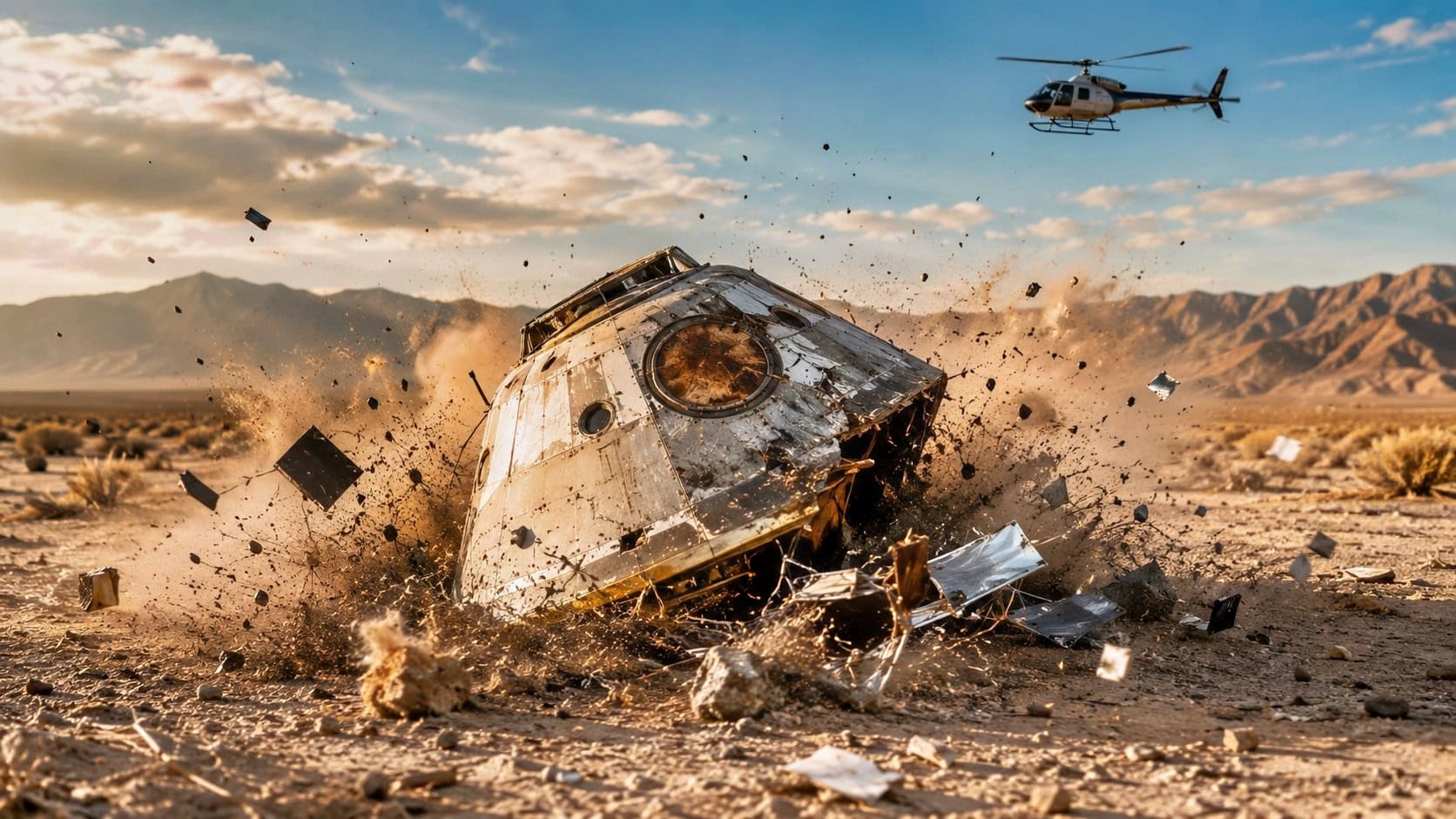
NASA’s Genesis spacecraft did something no mission had done since Apollo. It flew out beyond the Moon, spent more than two years catching atoms streaming off the Sun, and brought them home, the first American mission to return material from space since the lunar landings and the first ever to bring back samples from beyond the Moon. The samples were meant to be caught in mid-air over the Utah desert by a helicopter. Instead, the return capsule’s parachute never opened, and it slammed into the ground at nearly 200 miles per hour, splitting apart and scattering its shattered collectors in the mud. The cause was almost too simple to believe. A set of switches that were supposed to sense the capsule slowing down and fire the parachute had been installed backward, following a flawed design that layer after layer of review failed to catch. And then, against the odds, scientists picked the broken pieces out of the crater, cleaned them, and pulled the mission’s most important discovery out of the wreckage.
NASA’s Mission To Catch The Solar Wind
19FortyFive Original Photo of the Apollo 11 Lander at the Smithsonian in Washington, DC. Taken on 6/24/2026.
Genesis launched in August 2001 and flew to a gravitationally stable point about a million miles from Earth, on the sunward side, where it opened a set of collector arrays and waited. For roughly two and a half years, it gathered the solar wind, the thin stream of charged particles that the Sun constantly throws off in every direction.
The haul was almost nothing by weight, around half a milligram, some 10^20 particles that buried themselves into wafers of silicon, gold, sapphire, and other ultra-pure materials chosen so the Sun’s atoms could later be told apart from any contamination.
That tiny sample was the whole point. The Sun holds more than 99 percent of the mass of the solar system, so its composition is very close to the composition of the original cloud of gas and dust that everything else, including Earth, formed from.
By measuring the precise mix of isotopes in the solar wind, scientists hoped to read the baseline chemistry of the solar system as it was 4.6 billion years ago. Genesis even collected the fast and slow solar wind separately, on different regimes, to sort out how the Sun’s outflow varies. Calling the cargo “pieces of the Sun” is close to literal, since the solar wind is matter that came off the Sun itself.
The Fireball And The Catch That Never Happened
On the morning of September 8, 2004, the return capsule separated from the spacecraft and entered the atmosphere over northern Oregon at about 24,700 miles per hour, bright enough to be seen as a fireball in daylight.
Because a hard parachute landing might have jostled the delicate collectors, the recovery plan was elaborate and had been rehearsed many times. A drogue parachute was to pop out about 21 miles up, a large parafoil was to deploy lower down to leave the capsule gliding gently, and then a helicopter trailing a five-meter hook, with a second helicopter standing by, was to swoop in and snag the parachute in mid-air before the capsule ever touched the ground.
Blue Origin Capsule at the Smithsonian in Washington, DC. 19FortyFive.com Image Taken on 6/24/2026.
None of it happened. The drogue never came out, the capsule began to tumble, and it fell the rest of the way, slowed only by air resistance. It hit the Dugway Proving Ground at about 193 miles per hour and broke open on impact, with the inner sample canister breached and partly buried in the desert floor.
The damage was less catastrophic than the speed suggested, cushioned somewhat by soft, muddy ground, but the collectors were exposed to Utah dirt, and most of them shattered. Unfired pyrotechnics from the parachute system and toxic fumes from the capsule’s batteries kept the recovery team back from the wreck while they made it safe.
A Switch Installed Backward
NASA convened a Mishap Investigation Board, and what it found was the kind of error that makes engineers wince. The capsule sensed its own deceleration using small gravity switches, each essentially a plunger on a spring. When the capsule slammed into the atmosphere and began braking hard, the force was supposed to push the plunger onto an electrical contact, the way a seat belt presses against you when a car brakes suddenly.
The switch was designed to make contact at 3g, hold it through the peak loads of reentry, and then break it again as the capsule slowed, which is what would have started the parachute sequence.
Because the switches faced the wrong way, the deceleration never pushed the plunger onto the contact, and the signal to deploy never came.
The detail that turned a mistake into an indictment was the redundancy. The capsule carried two pairs of these switches precisely so that if one set failed, the other would still fire the chute. But all four switches were installed backward, every one of them, because they had all been built to the same flawed Lockheed Martin design. The backup was identical to the primary, which meant it carried the identical defect, and the redundancy that was supposed to make the system safe protected nothing.
The Test That Would Have Caught It
The deeper problem was not one person flipping a part. The Board found that four separate pre-launch processes failed: the design process that inverted the switch, and the design review, verification, and validation processes that all failed to catch it. The design had been carried over from an earlier capsule, Stardust, which used the same general approach and would later land successfully.
But the Genesis version was not identical. The box holding the switches was different, so the electronics had to be arranged differently to fit, and that change in orientation was where the error crept in.
Worst of all, the error was catchable. A centrifuge test run for Stardust would have detected the error on Genesis, but it was never performed, partly because the team wrongly treated the modified design as proven heritage hardware and partly because of a schedule slip.
The switches were checked to confirm they still flipped, but not in a way that would have revealed they were facing the wrong direction to actually trigger the chute. Michael Ryschkewitsch, who chaired the Board, said the lesson could not simply be “don’t install the switches upside down,” because the real failure was a process that let an untested design change reach the launch pad. Hearing that a test can be skipped because the hardware is heritage, he noted, is a dangerous thing to say.
The Board also placed part of the blame on the “Faster, Better, Cheaper” philosophy that had shrunk the team and its margins, and pointedly tied Genesis to the same pattern that had doomed the Faster, Better, Cheaper approach on the Mars Climate Orbiter and Mars Polar Lander a few years earlier.
The Science Pulled From The Crater
By any normal measure, a quarter-billion-dollar spacecraft that crashes into the desert is a total loss, and Genesis cost about $264 million. But the science team refused to write it off. Most of the roughly 3,000 glassy collector plates were broken, yet some survived intact.
The buried solar-wind atoms were embedded at a fixed depth below the surface of each wafer, so much of the contamination sat on top and could be cleaned or measured around. Two days after the crash, mission scientist Roger Wiens said that because much of the inner canister was intact, the team should be able to “meet many, if not all, of our primary science goals.”
That optimism held up. Within months, scientists at the Johnson Space Center recovered the four solar-wind collectors from an instrument called the concentrator, the piece carrying the highest-priority samples, and found them in excellent condition. The painstaking work of cleaning fragments and analyzing the implanted atoms proceeded, and Genesis ultimately achieved its major objectives despite the wreck.
What The Sun’s Atoms Revealed
The payoff was a genuine surprise about how the solar system is built. Analyzing the salvaged samples, a team led by Kevin McKeegan of UCLA found that the Sun is roughly 7 percent more oxygen-16-enriched than the Earth, the Moon, Mars, and meteorites.
Since the Sun’s makeup stands in for the average of the whole solar system, the implication was that essentially all the rocky material in the inner solar system was shifted toward the heavier oxygen isotopes by some process that acted after the Sun had already formed.
In plain terms, the planets are not simply small chemical copies of the Sun they orbit, and something rearranged the building blocks before they came together into worlds.
The leading explanation involves sunlight altering the chemistry at the edges of the early solar nebula, though McKeegan was careful that the question is not closed. A separate team led by Bernard Marty in France found a matching story in the nitrogen, with the Sun’s nitrogen also differing sharply from Earth’s. McKeegan summed up the result by saying it was the center of everything that Earth turned out not to be.
The mission that augured into the Utah mud because of a backward switch still answered the question it was built to ask, pulled, atom by atom, out of a crater.
About the Author: Harry J. Kazianis
Harry J. Kazianis (@Grecianformula) was the former Senior Director of National Security Affairs at the Center for the National Interest (CFTNI), a foreign policy think tank founded by Richard Nixon based in Washington, DC. Harry has over a decade of experience in think tanks and national security publishing. His ideas have been published in the NY Times, The Washington Post, The Wall Street Journal, CNN, and many other outlets worldwide. He has held positions at CSIS, the Heritage Foundation, the University of Nottingham, and several other institutions related to national security research and studies. He is the former Executive Editor of the National Interest and the Diplomat. He holds a Master’s degree focusing on international affairs from Harvard University.

