
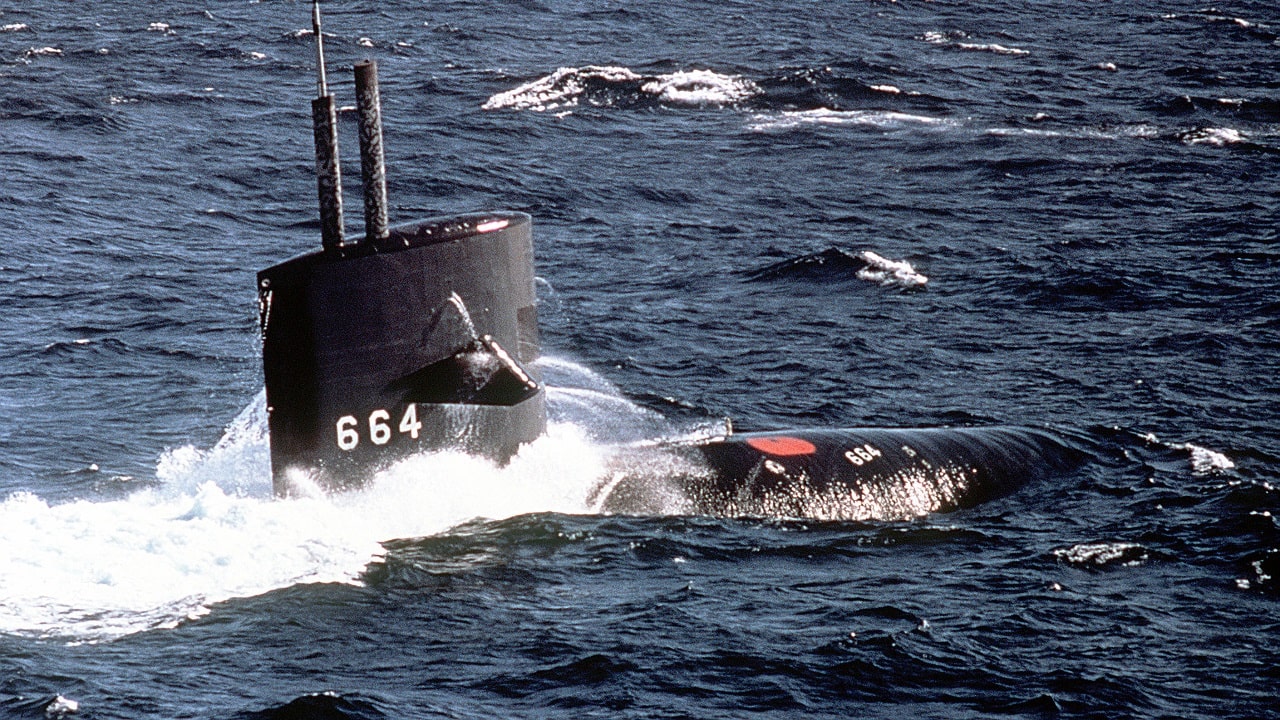
Around 20 years ago, a long-retired Electric Boat engineer who built many of the Cold War’s best U.S. Navy attack submarines told me something pretty blunt that stuck with me to this day: “I loved the Sturgeon-class submarines. I loved building them, and I loved hearing what they did to the Russians for decades. It put a smile on my face.”
Knowing this history, I instantly agreed. For most of the Cold War, the quietest and most dangerous work the U.S. Navy did took place beneath the surface, carried out by submarines whose missions remain partly classified decades later. The boats that did much of that work were the Sturgeon-class, a fleet of 37 nuclear-powered attack submarines that trailed Soviet missile boats, loitered off Soviet coasts, and tapped undersea cables within Soviet waters. They were the workhorses of the undersea force for nearly three decades. Then, with years of design life remaining, the Navy retired the entire class and sent most of the boats to be scrapped or sunk, with almost none preserved.
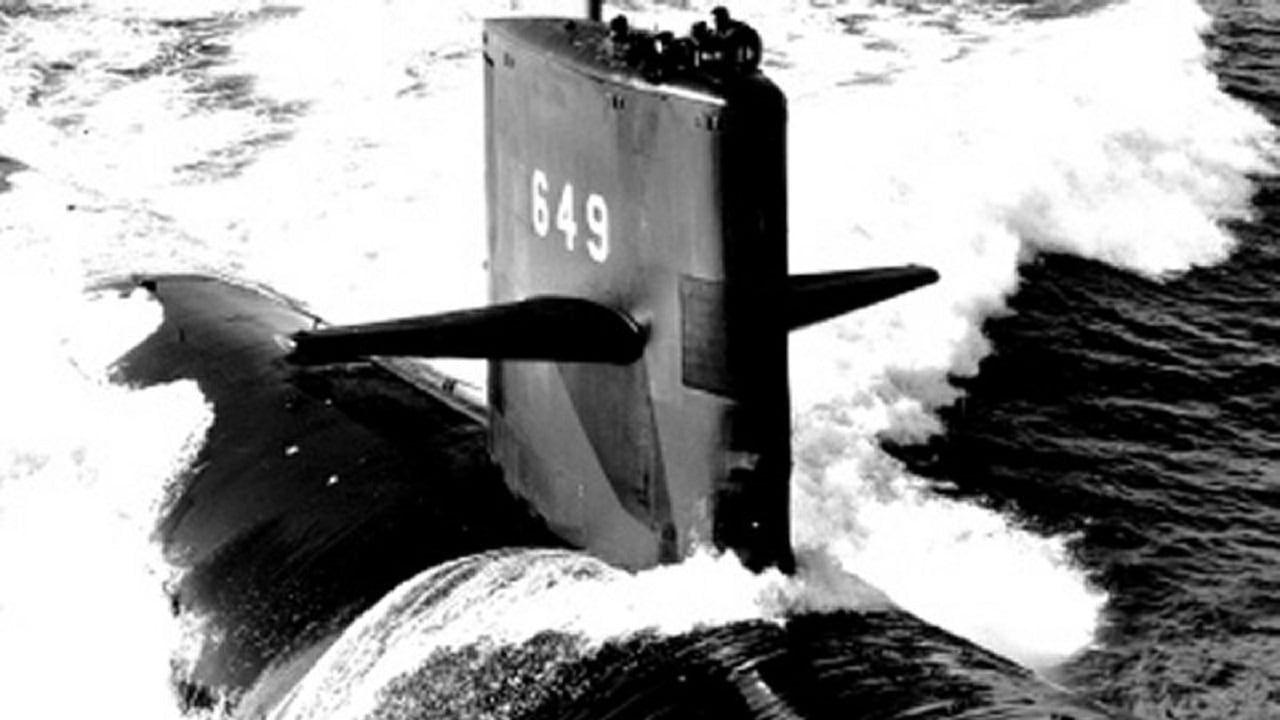
USS Sunfish SSN-649. Sturgeon-Class Submarine.
The Navy’s Cold War Workhorse
The Sturgeon class, known in the fleet as the 637 class after the hull number of the lead boat, was the largest group of nuclear attack submarines the United States had built to that point, and remains the second-most-numerous class of nuclear-powered warships ever, behind only the Los Angeles class that followed it. The lead ship, USS Sturgeon, was commissioned in March 1967, and the boats were built across several shipyards from the mid-1960s into the mid-1970s. They were an evolutionary step beyond the Thresher and Permit classes that preceded them, designed in the shadow of the loss of USS Thresher in 1963, a disaster that killed all 129 aboard and prompted the Navy’s rigorous SUBSAFE safety and quality program, which the Sturgeons were among the first to fully embody.
The design reflected hard choices about what a hunter-killer submarine most needed. The Sturgeons carried a much larger sail than earlier boats, which housed a second periscope and additional masts for intelligence gathering, helped keep the submarines from broaching in heavy seas, and whose fairwater planes could rotate to the vertical, letting the boats surface through thin Arctic ice.
Because the larger sail and heavier displacement cost speed, the class topped out around 26 knots submerged, a couple of knots slower than its predecessors. The Navy accepted that trade because the priority had shifted decisively toward quieting, the ability to hear the enemy first and to remain unheard.
Built To Hunt Submarines And Listen
At the heart of the boat was its sonar. The Sturgeons carried a large spherical sonar array filling the bow, which pushed the torpedo tubes to the sides of the hull, angled out to fire, and later boats and refits added the more capable BQQ-5 system and towed sonar arrays that trailed behind the submarine like a long underwater antenna. That combination made the class a quiet, mobile extension of the seafloor listening network the Navy had strung across key ocean chokepoints, able to take a distant cue and turn it into a covert trail of a Soviet boat.
The four torpedo tubes fired the Mark 48 torpedo and the nuclear-tipped SUBROC anti-submarine missile, and many boats later gained the Harpoon anti-ship missile and the Tomahawk cruise missile.
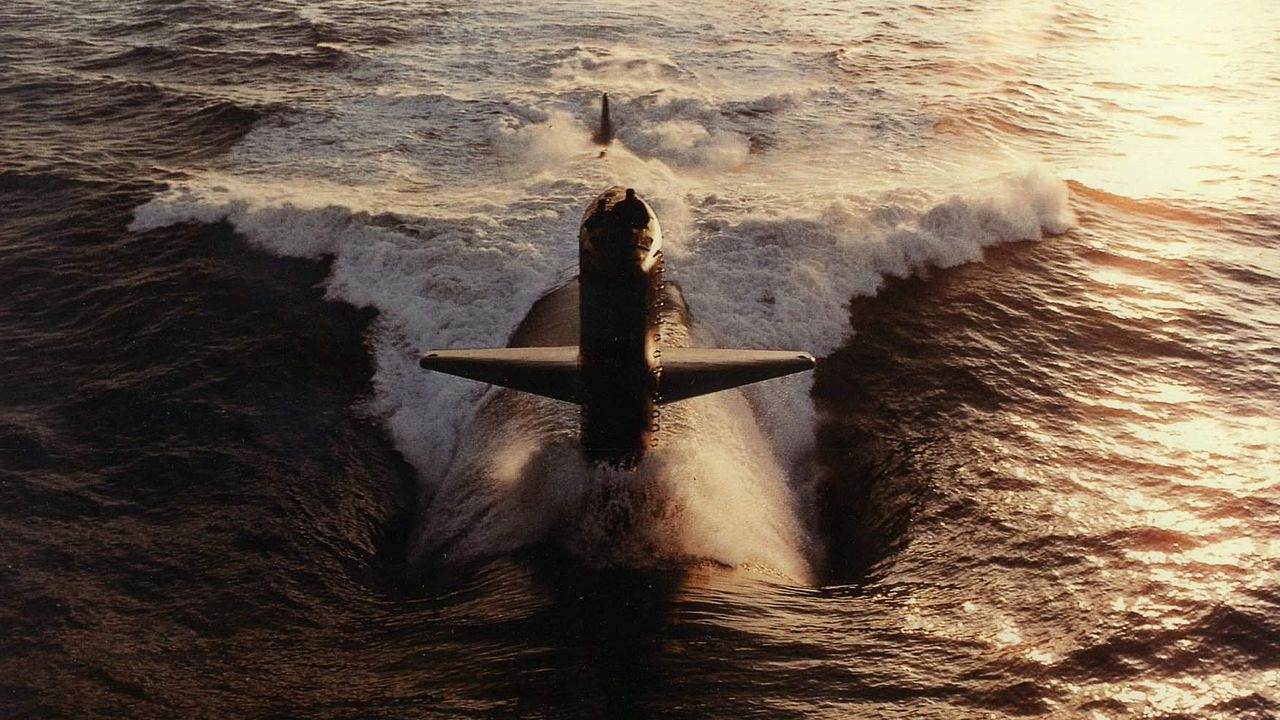
Sturgeon-Class submarine. Image Credit: Creative Commons.
What set the Sturgeons apart was less their weapons than their patience and their ears. The roomy hull, the sensor fit, and the quieting made them ideal for surveillance and intelligence collection, and the class became, in the words of one defense reference, “the platform of choice” for many of the Cold War missions for which submarines are now famous. They worked under the ice, shadowed Soviet exercises, and sat off Soviet ports, gathering electronic and acoustic intelligence, attracting almost no public attention.
Trailing Soviet Boomers And Tapping Their Cables
Some of that work has since been declassified, and it explains why the class mattered disproportionately to its firepower. In 1978, the Sturgeon-class USS Batfish tracked a Soviet ballistic-missile submarine through the Atlantic for days, learning how and where the Soviets ran their deterrent patrols and giving the United States a clearer picture of any warning it would have before a missile launch. Trailing an enemy boomer undetected was among the most demanding tasks in the undersea force, and it was the kind of mission the Sturgeons were built for.
The most storied work involved Soviet undersea cables. Operation Ivy Bells, begun in 1971, placed recording devices on a communications cable on the floor of the Sea of Okhotsk, deep inside waters the Soviets considered their own, allowing American intelligence to capture Soviet naval communications.
The operation began with USS Halibut, a converted missile submarine rather than a Sturgeon, whose divers found the cable and wrapped a tap around it without cutting into it, as public accounts describe.
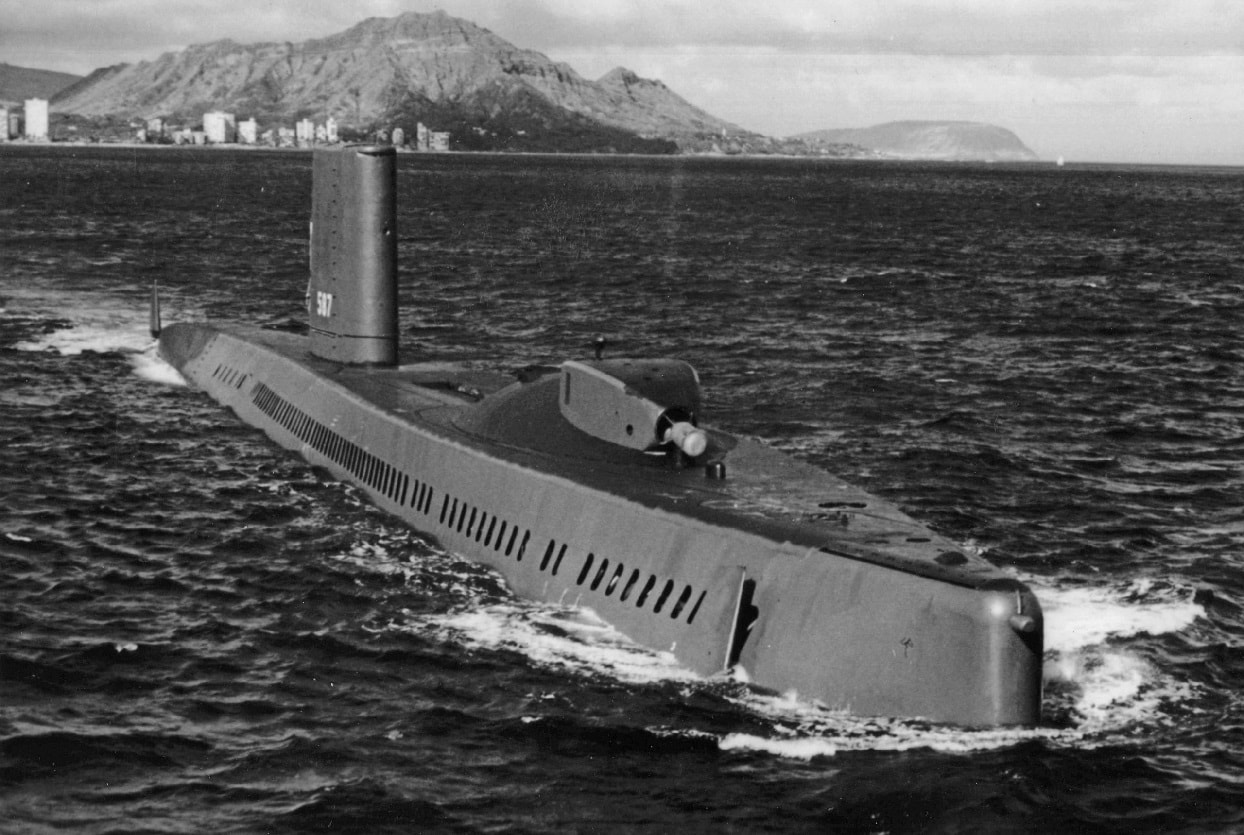
Halibut (SSGN-587) with Diamond Head in the background in late 1965. Note her topside thruster and she has no DSVR (Deep-Submergence Rescue Vehicle) habitat which was later fitted to the topside at the rear of the boat.
As Halibut aged out, the Sturgeon-class USS Parche took over the cable work and became the most famous spy submarine the Navy ever operated. Parche received a 100-foot hull section packed with specialized equipment, ended its career as the most decorated vessel in U.S. naval history, and reportedly carried scuttling charges to destroy itself and its secrets if capture ever loomed, a story laid out in earlier coverage of the boat. The Okhotsk operation was ultimately betrayed in 1980 by a former National Security Agency employee, Ronald Pelton, who sold its existence to the Soviets, and much of what the Sturgeons did in those years remains classified to this day.
The Long-Hull Boats And The Special-Operations Mission
The class was never static, which is part of why it endured. Beginning with USS Archerfish, the last nine boats were lengthened by ten feet to make room for more equipment and better habitability, the so-called long-hull Sturgeons. Six or seven boats were modified to carry a Dry Deck Shelter, a chamber fixed to the hull that let the submarine launch and recover Navy SEAL swimmers and their delivery vehicles for covert insertion ashore.
Two further boats, the turbo-electric Glenard P. Lipscomb and the exceptionally quiet Narwhal with its natural-circulation reactor, were one-off designs built alongside the class to test propulsion ideas. The basic hull proved adaptable enough to absorb it all, from special-operations gear to the deep-ocean engineering fit that turned Parche into something closer to a research and espionage vessel than an attack boat.
Retired Early To Save Money
The Sturgeons were designed for 20-year lives, later extended by study to 30 years with the possibility of more, yet many were retired well short of that. The driving reason was money. Keeping a nuclear submarine in service eventually requires refueling its reactor, an expensive, time-consuming overhaul, and the Navy chose to decommission older Sturgeons rather than pay to refuel boats whose Cold War mission had eased after the Soviet collapse.
The first to go, USS Sea Devil, was decommissioned in 1991, and the last, the famous Parche, in 2005, by which point the Los Angeles, Seawolf, and Virginia classes had taken over the work. Almost none of the 37 were preserved. Unlike storied surface ships turned into museums, nuclear submarines are difficult and costly to make safe for display, and most of the Sturgeons were broken up through the Navy’s reactor-recycling program or expended, their long careers ending quietly, as earlier accounts of the class have noted.
The Shortfall They Left Behind
That history reads differently now that the Navy is short of exactly the kind of boat the Sturgeons once provided in abundance. The service has a stated requirement for 66 attack submarines and currently fields roughly 47, with the force projected to sink to about that level near the end of the decade and to stay below the requirement for years. The Virginia-class boats meant to fill the fleet are being built far too slowly, at roughly 1.2 to 1.3 per year against a need for two, and the Chief of Naval Operations told Congress this spring that shipbuilders are not expected to reach the two-per-year rate until around 2032.
The pressure is compounded by the AUKUS agreement, under which the United States plans to sell three to five Virginia-class boats to Australia in the 2030s, and by the reality that the Navy is decommissioning older Los Angeles-class boats faster than it can commission new ones.
The Sturgeons were the answer to a similar problem a generation ago, a class built in enough numbers to put a quiet, capable hunter wherever the Navy needed one, from the Arctic to the western Pacific.
Those boats would be more than 50 years old today, long past useful service, so the point is not that they should still be on patrol. The Navy once kept 37 of them at sea for the hardest missions in the ocean, and it now struggles to hold 47 attack submarines of all kinds against a need for 66, even as the seabed intelligence work the Sturgeons pioneered, the tapping and protecting of the cables that carry the world’s communications, has only grown more important.
About the Author: Harry J. Kazianis
Harry J. Kazianis (@Grecianformula) was the former Senior Director of National Security Affairs at the Center for the National Interest (CFTNI), a foreign policy think tank founded by Richard Nixon based in Washington, DC. Harry has over a decade of experience in think tanks and national security publishing. His ideas have been published in the NY Times, The Washington Post, The Wall Street Journal, CNN, and many other outlets worldwide. He has held positions at CSIS, the Heritage Foundation, the University of Nottingham, and several other institutions related to national security research and studies. He is the former Executive Editor of the National Interest and the Diplomat. He holds a Master’s degree focusing on international affairs from Harvard University.

