
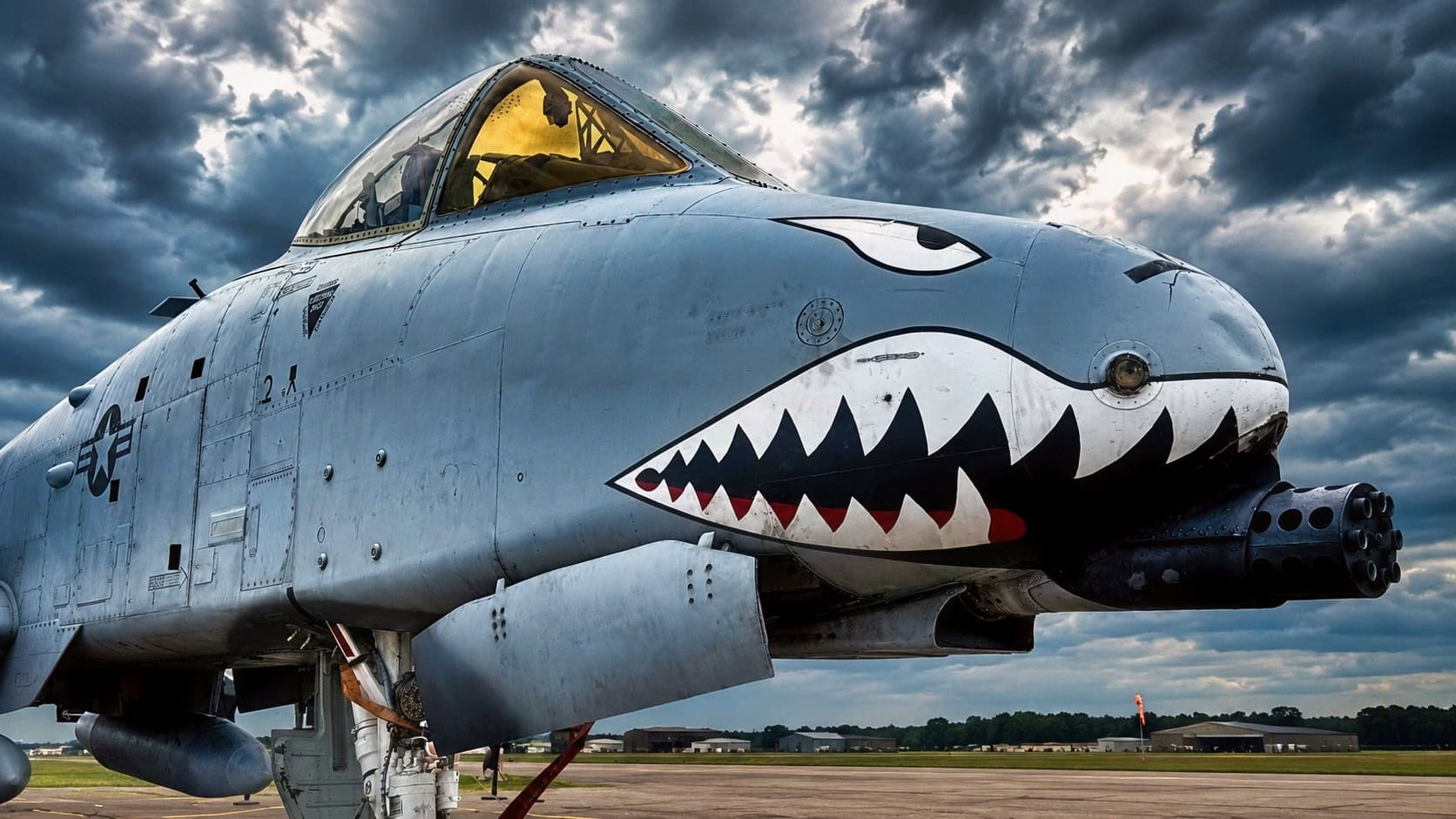
The Air Force recently reversed course and announced that the A-10 Thunderbolt II will remain in service until 2030.
On paper, that appears to end years of debate over the aircraft’s retirement. But according to a recent opinion piece in The War Zone by retired Air Force officer Paul “Gu$” Garcia, the announcement may be largely symbolic unless the service also funds the infrastructure needed to keep the aircraft combat capable.
Garcia’s central argument is that extending an airframe means little if the pilots, maintainers, schoolhouses, depot maintenance, and operational test organizations disappear first.
Changing the Date on A-10 Warthog
U.S. Air Force leadership now says the A-10 will remain operational until 2030. Garcia argues the FY2027 budget tells a different story.
He points to the lack of meaningful modernization funding, reduced depot maintenance, continued “sunset” planning, and institutional momentum still geared towards retirement.
In Garcia’s view, the aircraft may technically survive while its supporting ecosystem quietly disappears.
As Garcia points out, aircraft don’t fight wars alone; rather, combat capability resides in a larger network, including instructor pilots, weapons officers, maintainers, logistics pipelines, operational test teams, training squadrons, and the institutional knowledge accumulated over decades.
Once those people disperse, rebuilding the force later becomes expensive, and possibly, impossible.
The Case for Renewal
Garcia argues that recent operations challenged the assumptions that the Warthog had become obsolete. During recent Middle East operations, A-10’s reportedly performed maritime strike support, armed reconnaissance, close air support, combat search-and-rescue escort (“Sandy”) missions, and protection of downed F-15E crews.
Garcia’s point is that these were not hypothetical missions—they were operational requirements performed in combat.
Garcia contends that the A-10 has quietly evolved beyond its Cold War reputation; he highlights roles including austere operations, distributed basing, highway landings, rapid combat regeneration, maritime strike experimentation, weapons integration, and Agile Combat Employment concepts.
One of Garcia’s more interesting arguments is that the A-10 has become an unusually effective platform for experimentation, citing examples such as the integration of APKWS rockets, Small Diameter Bombs, ADM-160 MALD, beyond-line-of-sight communications, network-enabled command-and-control, and new maritime strike capabilities.
Because much of the aircraft’s architecture is government-owned, upgrades can reportedly be fielded faster than on more complex fighter fleets.
Existing Vulnerabilities
Garcia identifies the training enterprise as perhaps the A-10’s greatest vulnerability. The 357th Fighter Squadron, the former A-10 schoolhouse, is scheduled to shut down after graduating its final class.
But Garcia argues that no replacement-Sandy qualification exists, and no successor training pipeline has been established. This means expertise leaves with experienced instructors and, eventually, capability will disappear—long before the aircraft themselves are retired.
Garcia also challenges the assumption that retiring the A-10 automatically saves money.
His reasoning is that missions still have to be flown, that replacing A-10 sorties with higher-end fighters would increase operating costs, that A-10 retirement would force specialized missions to migrate to already-stressed fleets, and that taxpayers have already funded extensive wing-replacement programs extending structural life well into the 2030s.
Which is all to say that replacing the A-10’s mission won’t be cheap.
Garcia compares the issue to broader force-structure decisions. He notes the F-22 fleet was cut far below original plans before a successor was available, and that once industrial capacity and expertise disappear, restoring them becomes extraordinarily difficult.
His warning is that the Air Force risks repeating that pattern with the A-10—not by retiring the aircraft outright, but by dismantling the ecosystem that makes the aircraft useful.
Garcia’s Recommendation
Garcia’s recommendation is straightforward: if the Air Force intends to keep the A-10 until 2030, it must fund that decision.
That means preserving depot maintenance, training squadrons, operational testing, instructor cadres, and logistics; it means more than simply parking aircraft on flight lines.
Whether or not one agrees with Garcia’s conclusions, his article reframes the debate away from the aircraft itself and toward a broader question of force management, noting that preserving combat capability requires sustaining the people and institutions behind the platform, not just extending the airframe’s service life.
About the Author: Harrison Kass
Harrison Kass is a writer and attorney focused on national security, technology, and political culture. His work has appeared in Tablet, City Journal, The Hill, The Spectator, and The Cipher Brief. He holds a JD from the University of Oregon and a master’s in Global & Joint Program Studies from NYU. More at harrisonkass.com.