
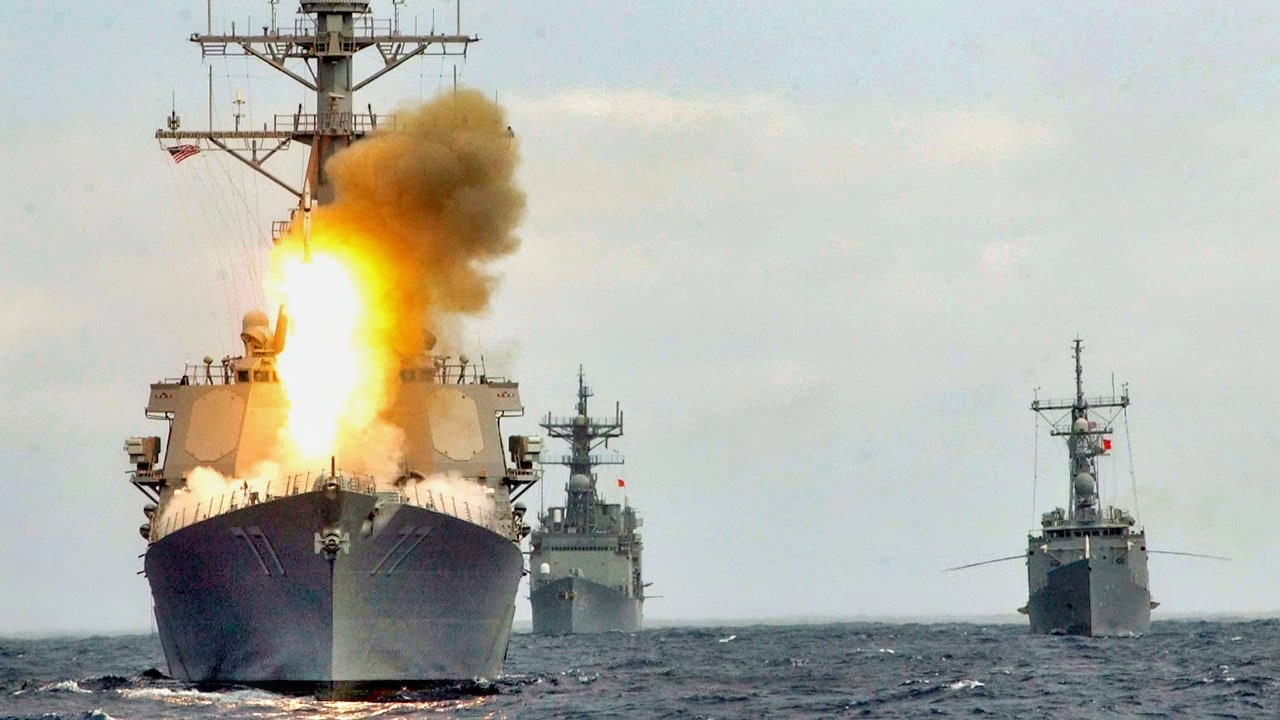
The U.S. Navy spent the 1970s defending a destroyer that many in Congress considered a waste of money. The Spruance class was enormous for a destroyer, yet it went to sea carrying little more firepower than a frigate, and lawmakers said so loudly. Within a decade, those same ships were launching Tomahawk cruise missiles, and the hull beneath them had become the basis for the Navy’s Aegis cruisers. Then, with years of service remaining, the Navy retired the entire class and sank most of the ships as gunnery targets. With the surface fleet now short of hulls and straining to build replacements, that decision looks more costly every year.
A Destroyer Critic Called An Empty Hull
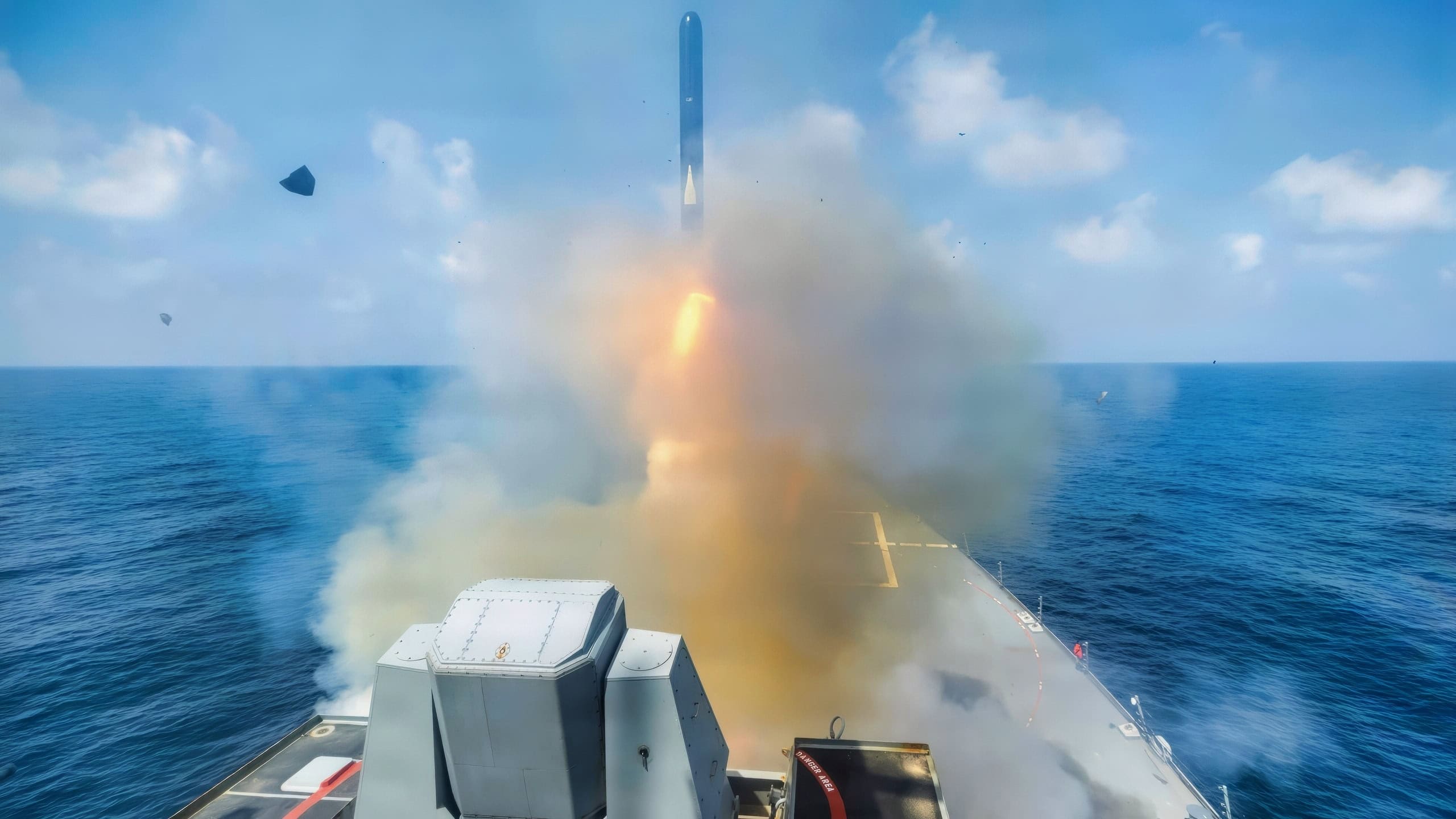
Arleigh Burke-class guided-missile destroyer USS Spruance (DDG 111) fires a Tomahawk Land Attack Missile (TLAM) in support of Operation Epic Fury, Feb. 28, 2026. (U.S. Navy photo)
The Spruance class was conceived in the late 1960s to replace the Navy’s worn-out World War II destroyers and to hunt the growing Soviet submarine force. Thirty-one ships were built, all at the Litton-Ingalls yard in Pascagoula, Mississippi, under a single-shipyard contract awarded in 1970, intended to capture the savings of mass production. The lead ship, USS Spruance, was commissioned in September 1975, and the last, USS Hayler, in 1983.
What drew the criticism was the armament. A ship of more than 7,000 tons full load, larger than a World War II light cruiser, first put to sea with two 5-inch guns, a single launcher for anti-submarine rockets, and a short-range Sea Sparrow launcher for air defense, a fit comparable to a much smaller frigate.
Members of Congress looked at the long, mostly empty decks and concluded that the Navy had bought an expensive ship that was weak for its size, particularly compared with Soviet designs bristling with anti-ship missiles.
The label “empty hull” followed the class for years. It did not help that the ships carried the “DD” designation historically used for gun destroyers, even though their intended main battery was missiles and sensors rather than visible weapons.
Built Big On Purpose
The criticism missed the point about the size. The Navy had deliberately designed a hull far larger than the mission of the moment required, leaving room to add weapons and equipment that did not yet exist. The Naval History and Heritage Command’s official history of the lead ship records that the destroyer displaced nearly twice as much as its World War II predecessors, describing the oversized hull as “an intentional concept” meant to allow the ship to take on additional systems as they became available. The empty deck space that the critics mocked was the design feature.
The class broke ground in other ways. The Spruances were the first major surface combatants in the U.S. Navy powered entirely by gas turbines, four General Electric LM2500 engines derived from jet aircraft powerplants, which gave them quick starts and easier maintenance than the steam plants they replaced.
Built around anti-submarine warfare, they carried advanced sonar and were engineered for quiet running, earning the lead ship the crew’s nickname “The Quiet Warrior,” and each could operate two helicopters from a flight deck and hangar, a significant reach extension for submarine hunting. The roominess that looked like waste was what made the rest possible.
The Margin Pays Off: Tomahawk And The VLS
The growth margin began paying dividends within a decade. Starting in the mid-1980s, seven ships received Armored Box Launchers for the Tomahawk cruise missile, giving the class a long-range land-attack punch it had never been designed to carry.
Then came the more important change: two dozen of the ships had their anti-submarine rocket launcher removed and a 61-cell Mark 41 Vertical Launch System installed forward, the same launcher used on the Navy’s Aegis cruisers and destroyers, capable of firing Tomahawks in quantity. A class built to chase submarines had become a fleet of cruise-missile shooters, and during Operation Desert Storm in 1991, Spruance-class destroyers fired 112 Tomahawks at targets inside Iraq.
The hull proved even more valuable as a starting point for other ships. The Ticonderoga-class Aegis cruisers, the backbone of the fleet’s air defense for decades, were built on the same basic hull and machinery as the Spruance. So were the four Kidd-class destroyers, which had been ordered by Iran under the Shah, taken over by the U.S. Navy after the 1979 revolution, and later sold to Taiwan. The destroyer that Congress had called underarmed turned out to be one of the most adaptable surface-combatant designs the Navy had ever fielded.
Retired In Their 20s And Sunk As Targets
The end came quickly and early. The Navy decommissioned the seven ships that never received the vertical launch system in 1998, then retired the rest between 2000 and 2005, finishing with USS Cushing in September 2005.
Most of the hulls were less than 25 years old. The Navy justified the accelerated schedule on cost grounds, estimating savings of roughly $28 million a year by taking the ships out of service, and judged their aging air defenses inadequate against the threats it expected.
What happened to the ships afterward is the part that still rankles among naval observers. Almost none were preserved, and unlike many storied classes before them, none became museum ships. A few were scrapped. Most of the rest were expended as targets in live-fire exercises, deliberately sunk so the Navy could test weapons against a real warship.
The one notable survivor, the ex-Paul F. Foster, was converted into a remotely operated Self Defense Test Ship. The comparison that makes the disposal look wasteful is close at hand: the Ticonderoga cruisers, built on the same hull and the same engineering, received a service-life extension in 2003 that kept many of them in service for around 35 years. Had the two dozen vertical-launch Spruances been given similar upgrades rather than sunk, they could have served into the late 2010s or beyond.
Why It Wasn’t Crazy At The Time
The decision was not as foolish as hindsight makes it look. The class had been built to counter Soviet submarines, and by the mid-1990s, the Soviet Union was gone and much of its submarine fleet was rusting in port, which removed the central reason the ships existed. The Arleigh Burke-class destroyers entering service were more capable in air and missile defense thanks to their Aegis combat system, and the Navy considered them cheaper to operate and more versatile across missions. Post-Cold War budgets were shrinking, the nuclear-armed version of the Tomahawk had been withdrawn, and keeping an older, single-mission-heavy class running looked like a poor use of money.
The trade had a hidden cost, however. The Spruances were dedicated anti-submarine, anti-surface, and land-attack ships, with a second 5-inch gun and ample magazine space that the Burkes lacked. The Burkes replaced them mainly in the air-defense role, while their anti-submarine and naval-gunfire capabilities became secondary duties on ships increasingly tasked with fleet air defense and ballistic-missile defense. The Navy retired a specialized capability and only partly rebuilt it.
The Lesson For Today’s Shrinking Fleet
That history now reads as a cautionary tale because the Navy is short of exactly the kind of hull it threw away. The Congressional Budget Office estimates that if the service and its shipyards still built ships as quickly as they once did, the fleet would exceed 300 ships today, and that between 2026 and 2030 the gap between the fleet the Navy has and the one it would otherwise have averages about 20 ships, most of them destroyers and submarines, the vessels that would matter most in a conflict with China. The CBO cites a direct precedent for how such gaps form: the Navy stopped building Arleigh Burke destroyers at the end of 2005 to start the Zumwalt program, which was curtailed after costs ballooned, leaving a gap in destroyer production.
The Arleigh Burke has carried the surface fleet since the 1990s and is now being asked to do so well past its intended run, and the design is reaching its limits in space, power, and cooling for new systems. That is precisely why the Navy’s planned next-generation destroyer, the DDG(X), is being designed with large margins for growth built in, the same philosophy that made the Spruance so adaptable.
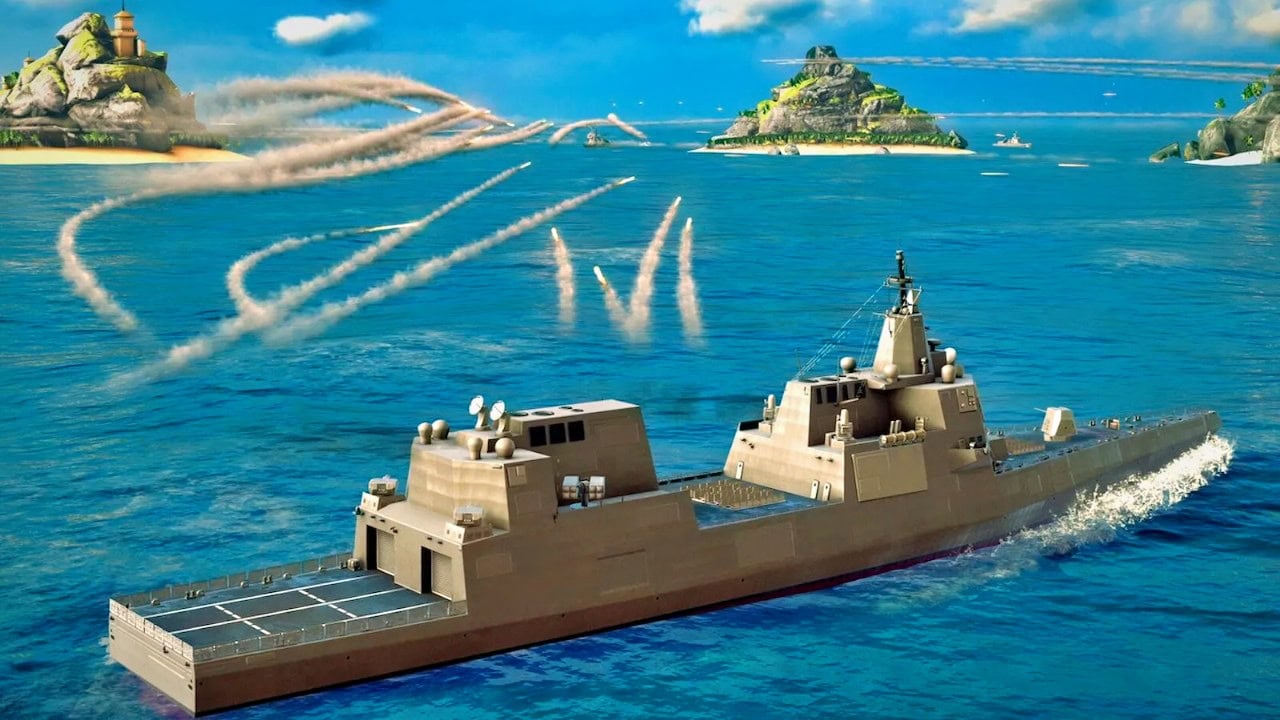
DDG(X) image created by artist. Image Credit: Creative Commons.
The DDG(X) is not expected to start construction until the early 2030s, and its future is uncertain: after the administration announced a proposed new “Trump-class” guided-missile battleship in December 2025, press reports indicated the Navy might suspend the destroyer program, though as of those reports, the battleship remained a proposal without funding or congressional approval.
The shortfall has already produced one hard decision that echoes the Spruance debate. The Navy canceled the Constellation-class frigate program, with Navy Secretary John Phelan concluding that the ship cost roughly 80 percent as much as an Arleigh Burke for about 60 percent of the capability, and that the service might as well “build destroyers.” The episode underscored a lesson the Spruance taught a generation earlier: that mission focus and room to grow matter more than a low sticker price, and that capability surrendered is hard and slow to buy back.
Those hulls would be more than 40 years old today, too old to matter in a fight, and no one is suggesting they should still be at sea. The lesson sits in the decision itself. The Navy disposed of capable, paid-for warships to save a modest sum each year, and three decades later, it finds itself short of precisely the kind of hull it sank, while designing its next destroyer around the same room-to-grow principle the Spruance proved.
About the Author: Harry J. Kazianis
Harry J. Kazianis (@Grecianformula) was the former Senior Director of National Security Affairs at the Center for the National Interest (CFTNI), a foreign policy think tank founded by Richard Nixon based in Washington, DC. Harry has over a decade of experience in think tanks and national security publishing. His ideas have been published in the NY Times, The Washington Post, The Wall Street Journal, CNN, and many other outlets worldwide. He has held positions at CSIS, the Heritage Foundation, the University of Nottingham, and several other institutions focused on national security research and analysis. He is the former Executive Editor of The National Interest and The Diplomat. He holds a Master’s degree focusing on international affairs from Harvard University.

