
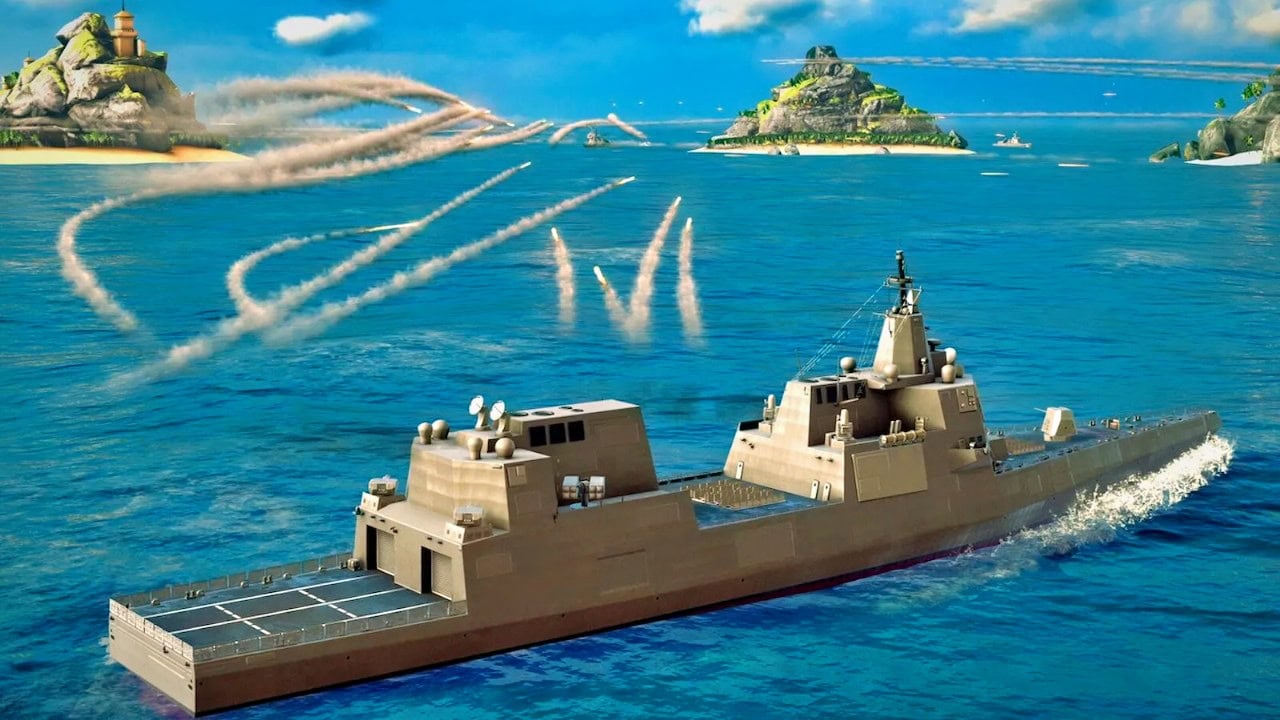
Summary and Key Points: The BBG(X) Trump-class battleship concept is colliding with a separate modernization priority: the DDG(X) next-generation destroyer.
-Critics argue the two programs overlap, risking waste and shipbuilding strain, while supporters argue redundancy is strategic insurance.
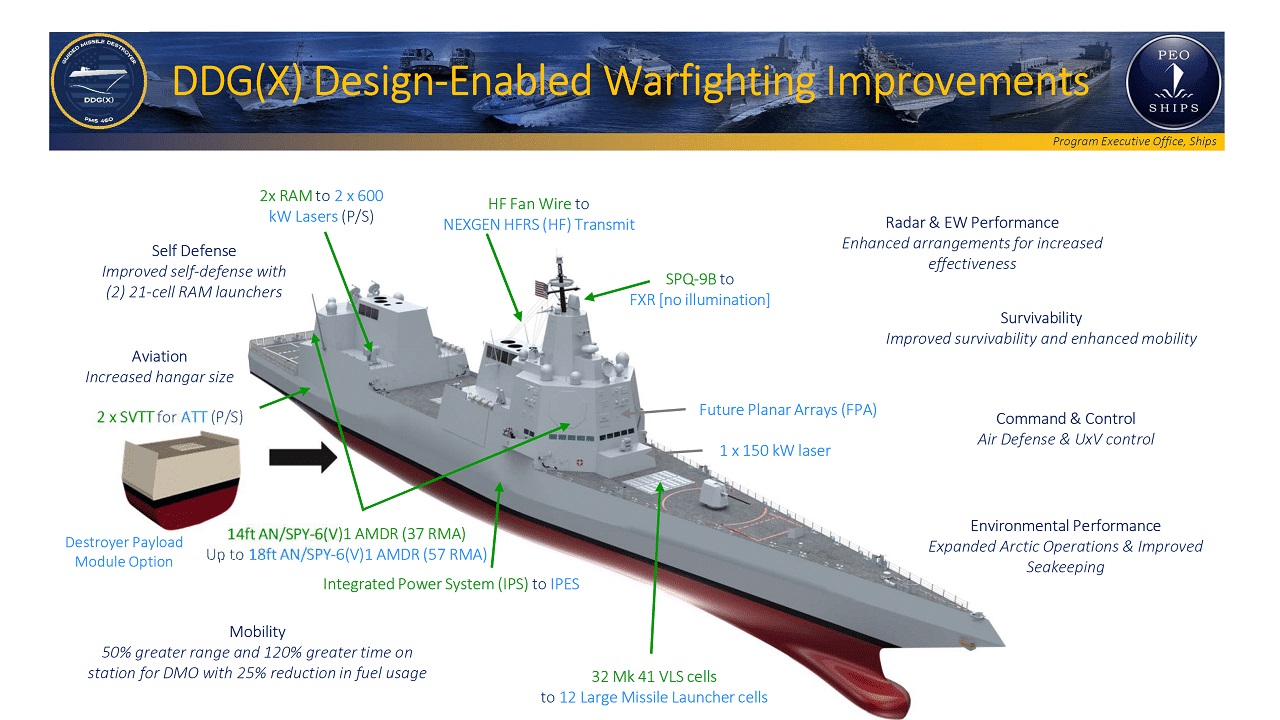
DDG(X). Image Credit: U.S. Navy.
-On paper, the designs diverge sharply. BBG(X) is envisioned as a massive 39,000-ton flagship with a large missile battery, hypersonic strike capability, and advanced weapons such as a railgun and high-power lasers.
-DDG(X) is presented as a far smaller 14,500-ton surface combatant centered on a flexible VLS loadout and core escort capabilities.
Trump-Class Battleships and DDG(X) Destroyers: Are They Compatible or a Mere Redundancy?
U.S. President Donald Trump’s vision of a Golden Fleet—a semantic homage to the Great White Fleet of the Teddy Roosevelt presidency—is barely in the early concept stage. This is also true of the announced future Trump-class BBG(X) guided-missile battleship program. There are no keels laid yet, but the vision is already generating a firestorm of controversy.
Much of the discord comes down to petty partisan politics, but there are legitimate concerns about the neo-battleship concept. One of these is the lack of stateside shipbuilding facilities, a problem acknowledged in Trump’s Executive Order 14269, “Restoring America’s Maritime Dominance.”
Another valid concern is whether the BBG(X) might come at the expense of another budding U.S. Navy surface warfare program: the DDG(X) next-generation guided-missile destroyer.
Semantic Sidebar
For semantic clarification of the many terms and acronyms the topic of ship classes forces upon readers, turn to a New Year’s Day 2026 article by USNI News: “In the designation BBG(X), BB means battleship, G means guided missile ship (i.e., a ship with a medium- or long-range air defense system), and (X) means the design of the ship has not yet been fully developed.”
This means DDG(X) is a guided-missile destroyer that hasn’t been fully developed yet.
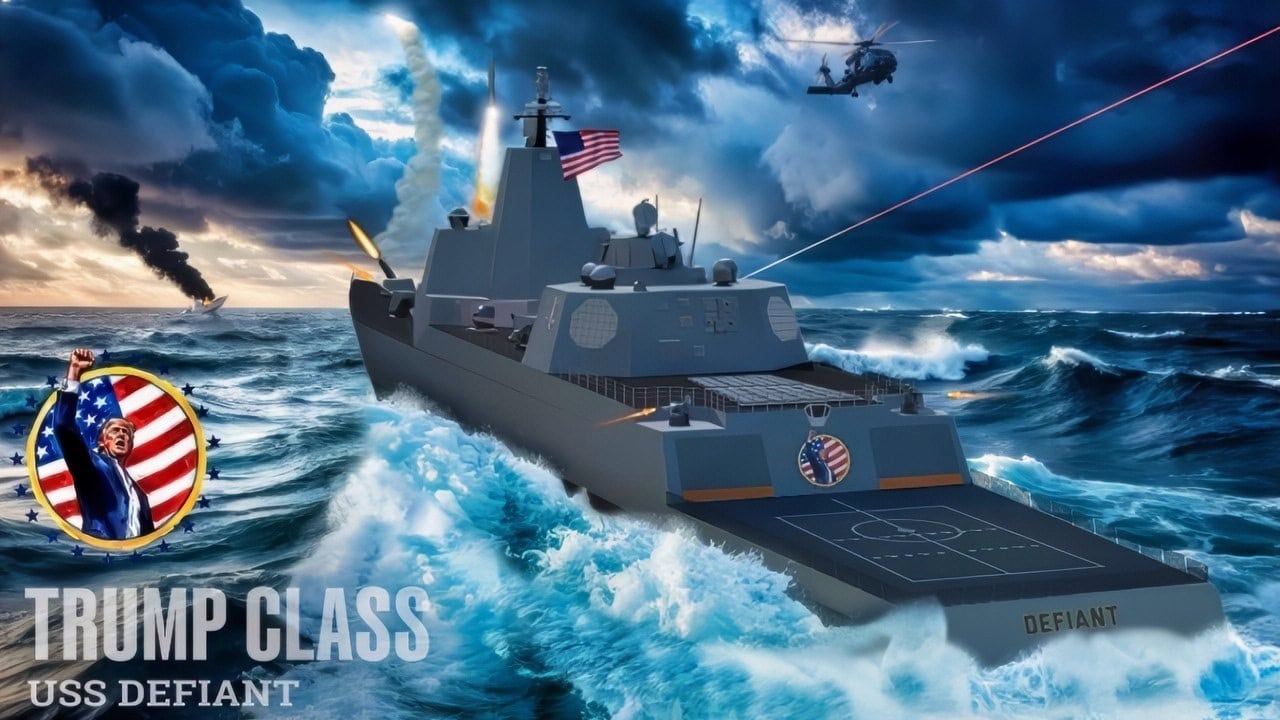
Trump-Class Battleship. Image Credit: Creative Commons/White House Photo.
Head-to-Head: Trump-Class vs. DDG(X) Prospective Tech Specs and Vital Stats
Some critics say there is too much overlap between the two would-be warship classes, meaning that to build them both would create unnecessary redundancy and waste taxpayers’ money). But how accurate is the claim?
The Trump-class battleships are projected to have a displacement of 39,000 tons, a hull length of 840–880 feet, and the following ordnance package:
-Primary Armament: Surface-Launched Cruise Missile-Nuclear (SLCM-N) system, a 12-cell Conventional Prompt Strike (CPS) hypersonic missile system, and a 128-cell Mark 41 vertical launching system (VLS).
-Secondary Armament: 1 x 32-megajoule electromagnetic railgun, 2 x 5-inch (127-mm) guns, and a pair of 300kW lasers.
-Tertiary (Defensive) Armament: 2 x RIM-116 Rolling Airframe Missile (RAM) launchers, 4 x 30mm guns, 4 x Optical Dazzling Interdictor, Navy (ODIN) lasers, and 2 x anti-drone systems.
Meanwhile, the DDG(X) warships displace 14,500 tons, have a hull length of 597 feet, and include the following armament package:
-5-inch/62 caliber BAE Systems Mk 45 Mod 4 guns.
-3 × 32 Mark 41 Vertical Launching System (VLS) with 96 cells (swappable with larger VLS systems).
-2 × 21-cell (42 cells total) RIM-116 Rolling Airframe Missile launchers.
-2 × Mark 32 Surface Vessel Torpedo Tubes.
By now, it should be obvious that the two warship classes are very different.
Trump Class AND DDG(X): The Case for Coexistence Part I (An Aviation Analogy)
Even if funding both warship classes created substantial overlap, that’s not necessarily a bad thing. To quote former West Point military history professor and current American Enterprise Institute resident scholar Frederick W. Kagan, “Redundancy is inherently a virtue in war.”
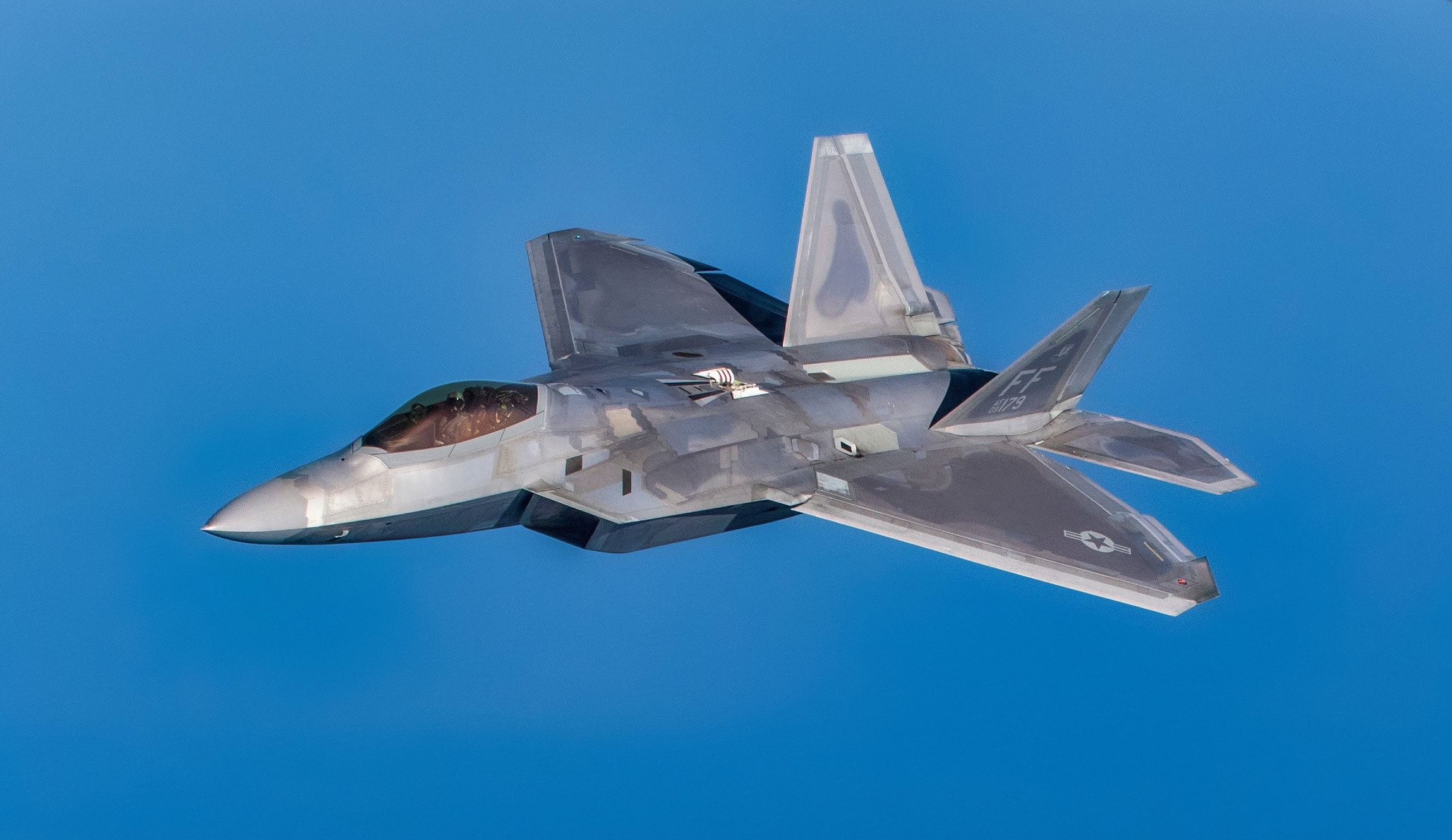
An F-22 Raptor assigned to the 192nd Fighter Wing, Virginia Air National Guard, Virginia flies over the Georgia coast during an air combat exercise at Sentry Savannah on May 5, 2022. Sentry Savannah is a joint force integrated exercise of fourth- and fifth-generation fighter jets, designed to showcase the Air Force’s air combat readiness in preparation for tomorrow’s fight. (U.S. Air Force photo by Senior Airman Erica Webster)
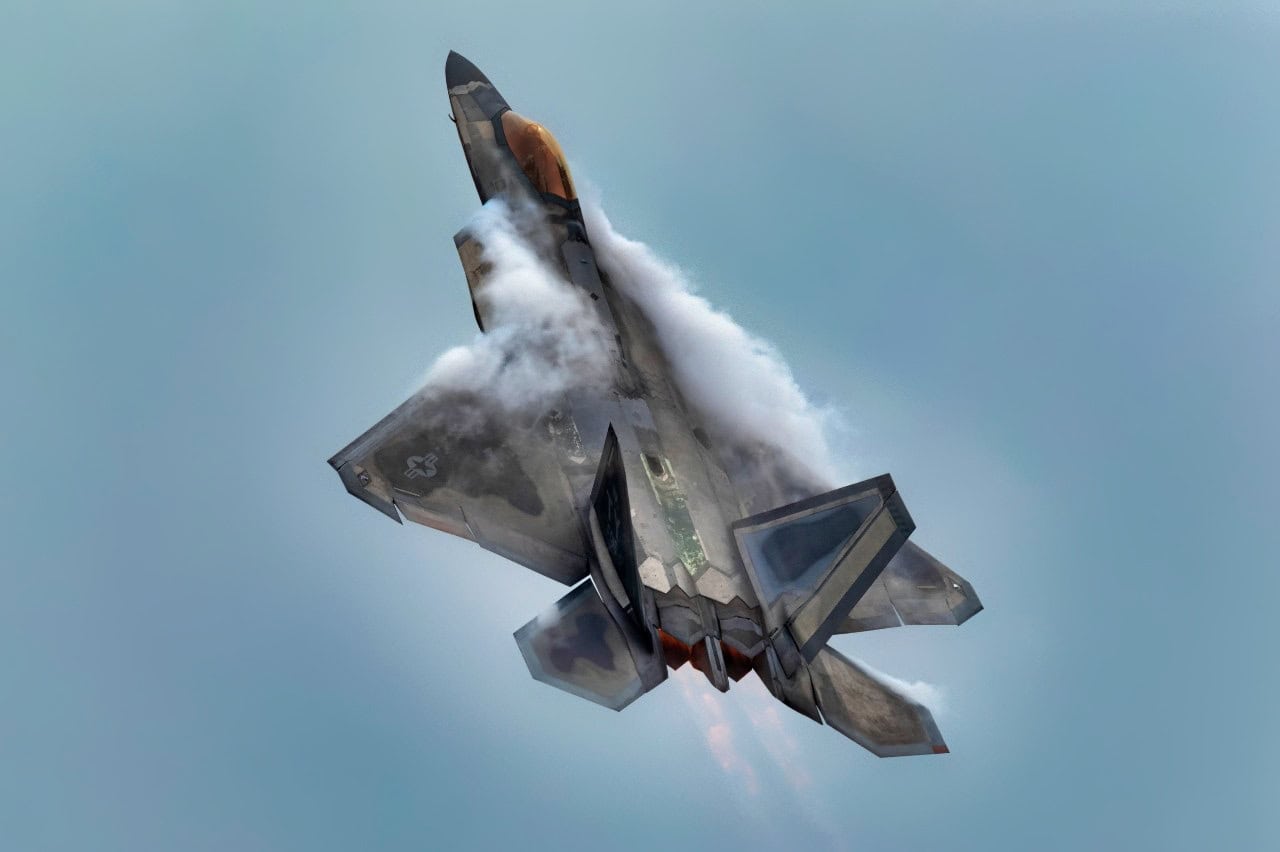
U.S. Air Force Maj. Josh Gunderson, F-22 Demo Team commander, performs maximum power takeoff during a demonstration for the 67th National Security Forum at Maxwell-Gunter Air Force Base, Montgomery, Alabama, May 11, 2021. The F-22 Raptor’s two Pratt and Whitney F119 Turbofan engines bring a combined 70,000 pounds of thrust, allowing the aircraft to takeoff straight into the vertical. (U.S. Air Force photo by Staff Sgt. Don Hudson)
Fifth-generation stealth fighters offer a case in point. The United States has two such fighters—the F-22 Raptor and the F-35 Lightning II—and for good measure, they’re both built by the same firm, Lockheed Martin’s “Skunk Works” division.
These stealth fighters actually complement one another. The F-22 is the best pure air-superiority fighter in the world, while the F-35 does not have the same measure of dogfighting capabilities. The Lightning II is more of a multirole fighter, meaning it is able to perform optimally in the air-to-ground role as well as in air-to-air combat.
Trump Class AND DDG(X): The Case for Coexistence Part Deux (Naval Analogy)
Warplanes and warships might be an apples-to-oranges comparison.
So we can use a much more closely connected analogy: battleships. The Iowa-class battleships were the last U.S. Navy battlewagons to be fully assembled and commissioned—in 1944, the penultimate year of World War II—and they were also the last battleships from any country to fire their guns in anger. Many experts consider the Iowas to be the crème da la crème of the battleship world.
Yet none of the Iowa battleships ever sank an enemy battleship, although the lead ship of the class, the USS Iowa (BB-61), did sink the Imperial Japanese Navy cruiser Katori. The only one-on-one battleship kill of World War II was scored by a North Carolina-class battleship, the USS Washington (BB-56), against the IJN Kirishima. And history’s last ever battleship vs. battleship engagement, the Battle of Surigao Strait phase of the Battle of Leyte Gulf, was won by warships of the Pennsylvania, Colorado, Tennessee, and New Mexico super-dreadnought classes.
It would be difficult to seriously suggest that these overlapping classes of battleships were a bad thing for the U.S. Navy. And I for one would welcome as much redundancy as possible in a potential war against China’s People’s Liberation Army Navy.
About the Author: Christian D. Orr, Defense Expert
Christian D. Orr is a Senior Defense Editor. He is a former Air Force Security Forces officer, Federal law enforcement officer, and private military contractor (with assignments worked in Iraq, the United Arab Emirates, Kosovo, Japan, Germany, and the Pentagon). Chris holds a B.A. in International Relations from the University of Southern California (USC) and an M.A. in Intelligence Studies (concentration in Terrorism Studies) from American Military University (AMU). He is also the author of the newly published book “Five Decades of a Fabulous Firearm: Celebrating the 50th Anniversary of the Beretta 92 Pistol Series.”