
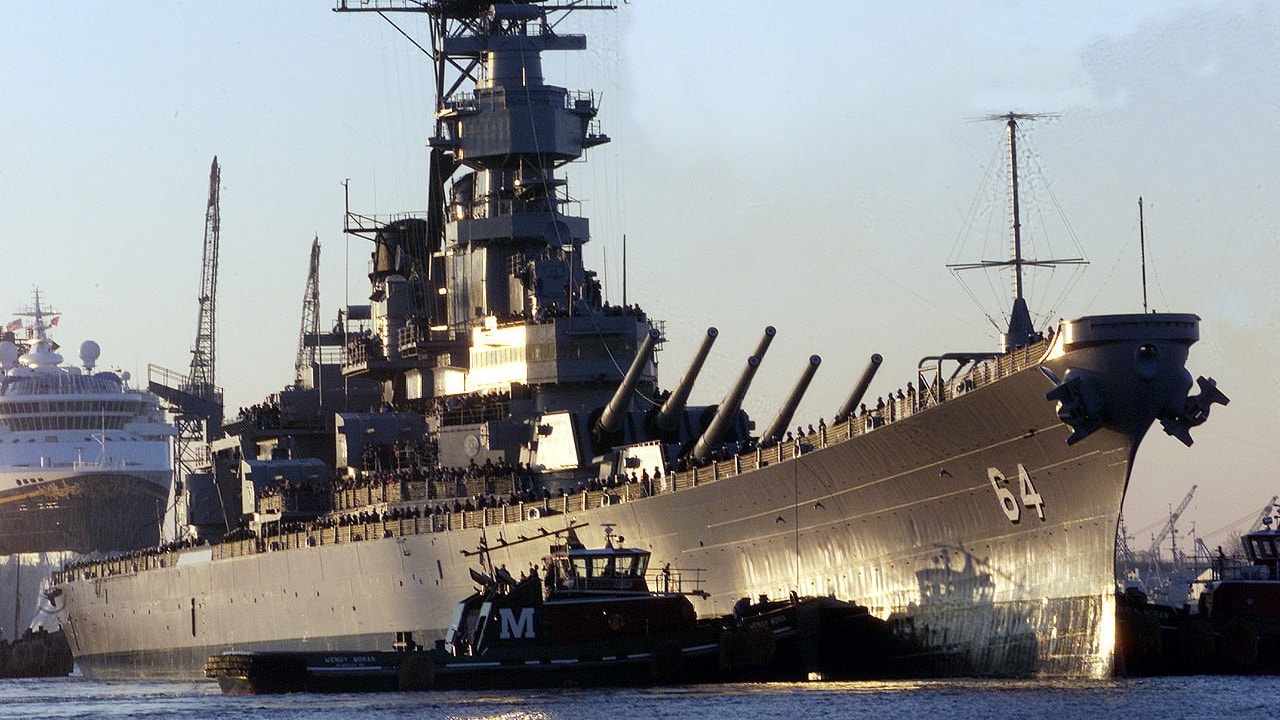
Summary and Key Points: Trump’s “Golden Fleet” vision includes a Trump-class battleship armed with 32-megajoule railguns promising shots out to 100 nautical miles.
-The problem is maturity and is a big problem for the new warship: railguns demand massive shipboard power, generate extreme heat, and raise durability concerns such as rapid barrel wear and maintenance burdens in combat.
-The piece argues that even advanced ships struggle when complex new systems are rushed, citing the Gerald R. Ford’s painful learning curve.
Rather than betting big on an unproven gun, it recommends prioritizing Aegis improvements, lasers, and hypersonic weapons to survive the coming “kinetic missile fight.”
-Clearly, the Trump-class has a new enemy: high weapons expectations that might not be easily fulfilled.
100 Nautical Miles of Firepower: The Railgun Problem on Trump-Class Battleships
We have seen that President Donald Trump has his Golden Dome missile defense protective screen in the works.
The man simply likes using the term “gold” because now the mercurial Commander-In-Chief wants a new “Golden Fleet” that will harness the power of U.S. warship building to make the Navy relevant for decades.
New ships are badly needed to keep up with China, which has the world’s largest navy.
Just How ‘State of the Art’ Is the Railgun?
One interesting aspect of the Golden Fleet is that there could be a new Trump-class battleship someday. The president has also said this modern dreadnought would be equipped with “state-of-the-art” railguns.
The president wants 20 to 25 of his proposed Trump-class battleships. These would have 32-megajoule railguns on the bow of each ship. The idea is to fire a powerful railgun round that could travel up to 100 nautical miles.
I Was an Early Proponent of Railguns
Trump may not know this, but the Navy has struggled with the contraption.
I often taught my students before the 2020s that railguns would be serviceable on all Navy warships by 2030.
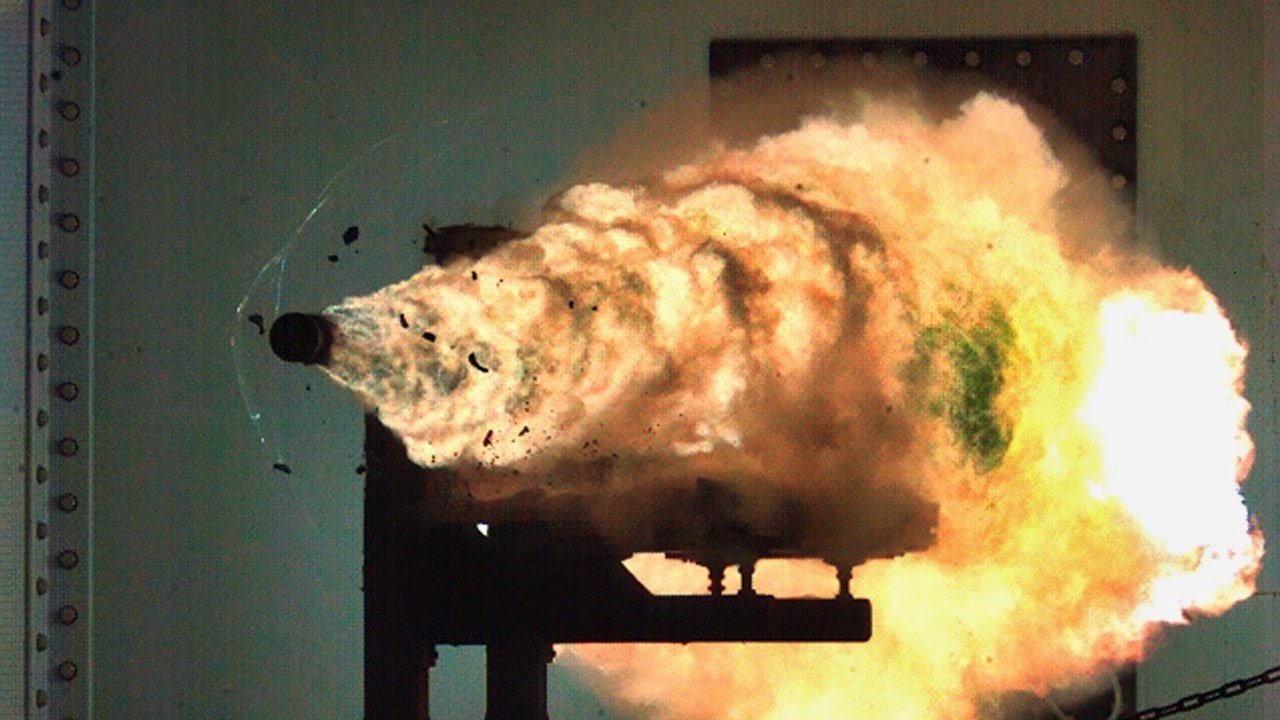
(Jan. 31, 2008) Photograph taken from a high-speed video camera during a record-setting firing of an electromagnetic railgun (EMRG) at Naval Surface Warfare Center, Dahlgren, Va., on January 31, 2008, firing at 10.64MJ (megajoules) with a muzzle velocity of 2520 meters per second. The Office of Naval Research’s EMRG program is part of the Department of the Navy’s Science and Technology investments, focused on developing new technologies to support Navy and Marine Corps war fighting needs. This photograph is a frame taken from a high-speed video camera. U.S. Navy Photograph (Released)
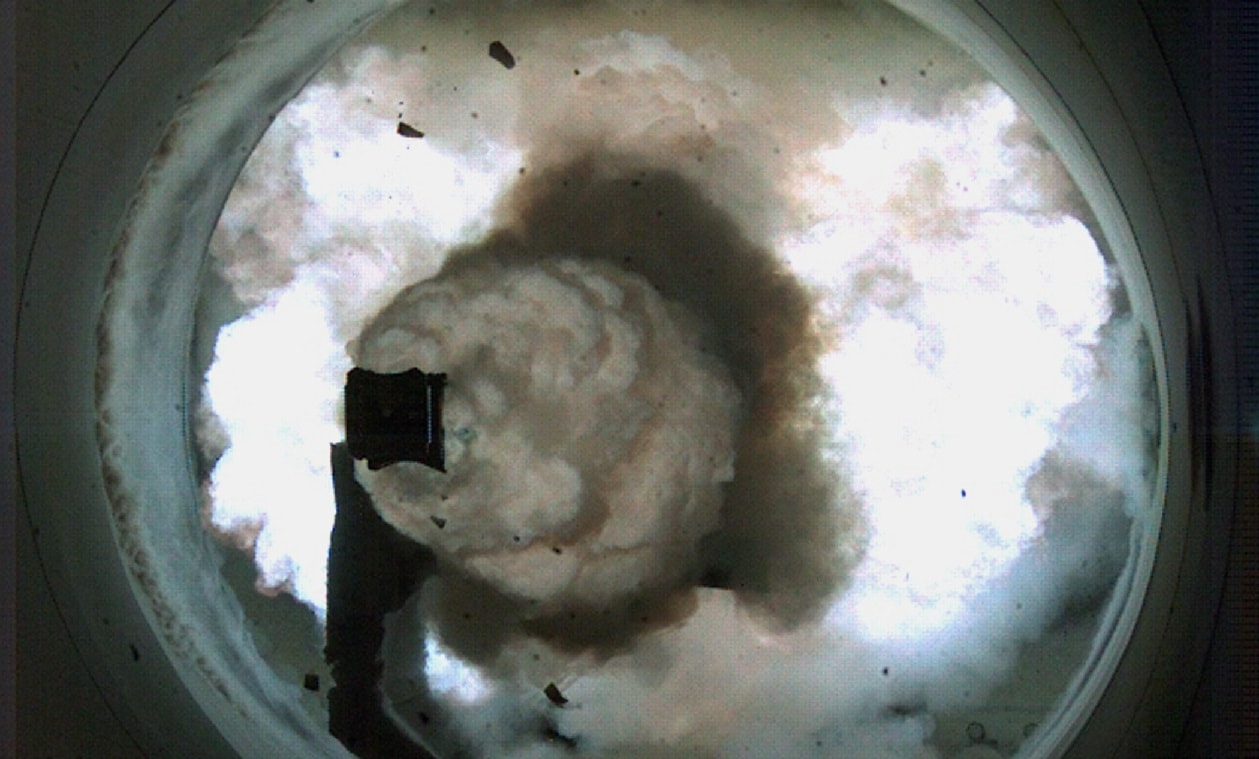
DAHLGREN, Va. (Dec. 10, 2010) High-speed camera image of the Office of Naval Research Electromagnetic Railgun located at the Naval Surface Warfare Center Dahlgren Division, firing a world-record setting 33 mega-joule shot, breaking the previous record established Jan. 31, 2008. The railgun is a long-range, high-energy gun launch system that uses electricity rather than gunpowder or rocket motors to launch projectiles capable of striking a target at a range of more than 200 nautical miles with Mach 7 velocity. A future tactical railgun will hit targets at ranges almost 20 times farther than conventional surface ship combat systems. (U.S. Navy photo/Released)
I also wrote a book in 2021 about future warfare that explained how railguns would be ubiquitous. It seems I was ahead of my skis. The Navy has tried to bring the rail gun into service, but the weapon is not ready for prime time.
Stops and Starts of the Weapon System
The Navy has reviewed the implementation of the armament and put the brakes on its development. Trump may have breathed life into what could be a new success story or might be an example of a failed experiment with a piece of technology that is not fully mature.
Other Weapons Are Needed Too
The Navy also has other defense needs, and the money saved from cancelling the railgun might be better spent on lasers and hypersonic missiles. Plus, there needs to be improvements to the Aegis Weapon System to defend against China and Russia’s own hypersonic weapons.
Railguns were supposed to be installed in naval ships in 2021, but that didn’t happen. One problem is that the existing electrical generation system on American warships would not be sufficient to power the rail gun.
How Do Railguns Work?
However, a new battleship could be configured to produce enough electricity to “juice” a rail gun. Rail guns also require immense electromagnetic forces using the “Lorentz force” to hurl projectiles without gunpowder. The round goes much faster and further than shells fired by conventional naval guns.
Railguns also have substantial recoil and produce immense amounts of heat. “Solving that problem would likely require technological advances that would have to be made as part of the new battleship’s design and construction,” according to Task and Purpose.
Trump Is Audacious Like Elon Musk
Trump is undeterred, as usual, and wants his new battleship produced in the next two or three years. That is a blistering pace for any naval acquisition program, especially with an altogether new design and difficult innovations. This reminds me of the kind of ambitious goals Elon Musk sets for his companies, like Tesla and SpaceX. The bluster can inspire a workforce or stymie it with unmeetable challenges.
The Long Saga of the USS Gerald R. Ford
The newest aircraft carrier in the fleet, the USS Gerald R. Ford, took at least 8 years to build, and it struggled with its catapult system and elevators – two systems that should not have encountered such difficulties in production.
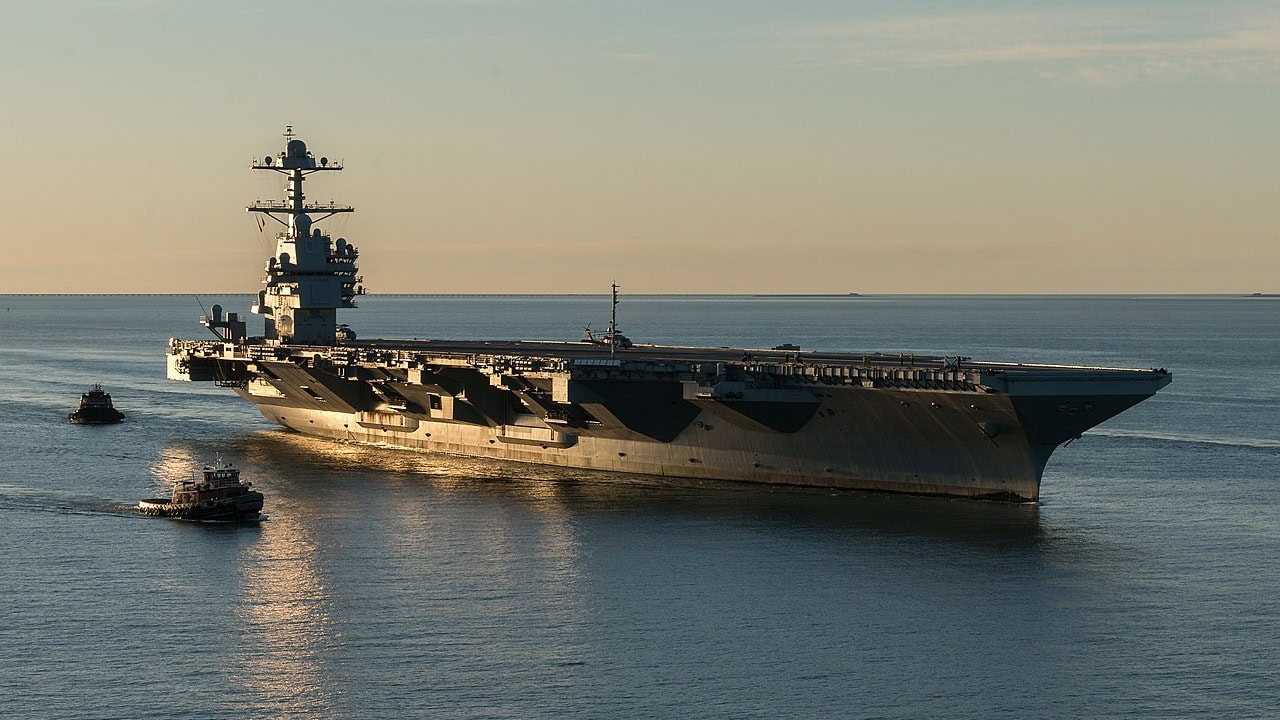
From 2017 – The aircraft carrier Pre-Commissioning Unit (PCU) Gerald R. Ford (CVN 78) pulls into Naval Station Norfolk for the first time. The first-of-class ship – the first new U.S. aircraft carrier design in 40 years – spent several days conducting builder’s sea trails, a comprehensive test of many of the ship’s key systems and technologies. (U.S. Navy photo by Matt Hildreth courtesy of Huntington Ingalls Industries/Released)
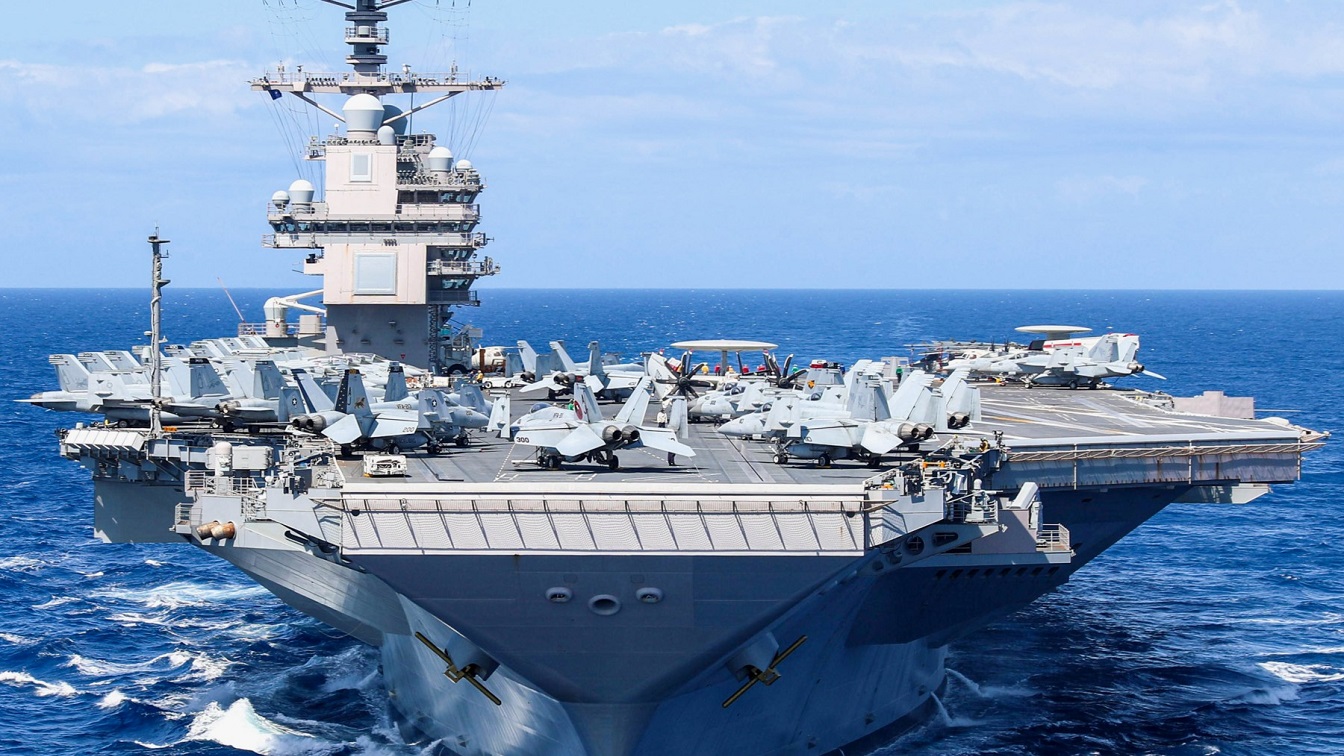
Ford-Class. Ford-Class Aircraft Carrier USS Ford.
The rail gun’s barrel would probably heat up so much that it would need to replace the tube. This would be a problem in combat and a hurdle that needs to be overcome if rail guns are to become a common addition to ships. Perhaps the rail gun could use a different type of kinetic warhead on the projectile, which would not heat the gun up as much.
Kinetic Missile Fight Requires More Defense Than Offense
After my initial enthusiasm, I have doubts about the rail gun. I would rather see directed energy systems onboard naval warships that could fry incoming missiles. Future warfare will consist of what I call the “Kinetic Missile Fight.”
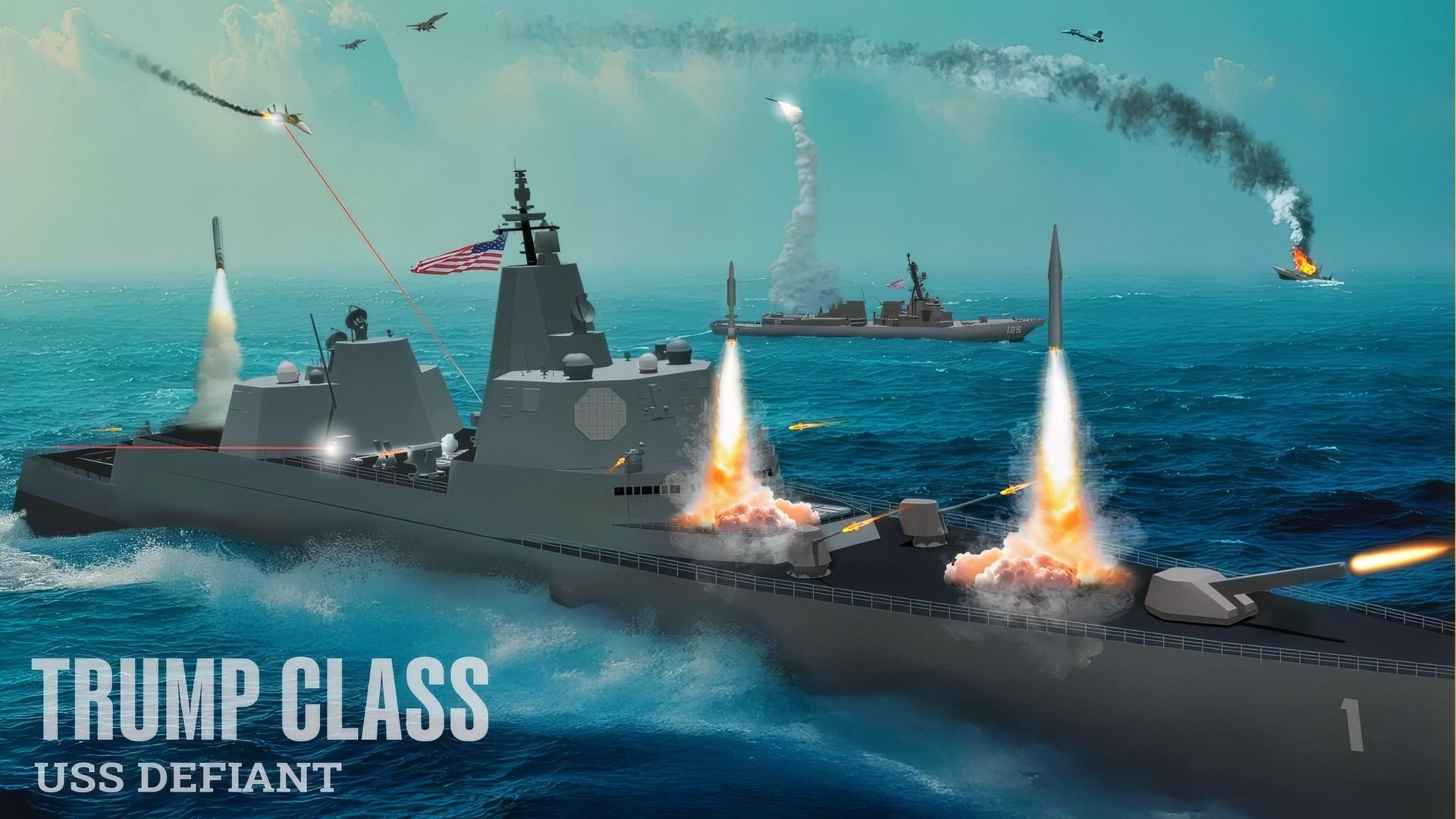
Trump-Class Battleship USS Defiant. Image Credit: Creative Commons.
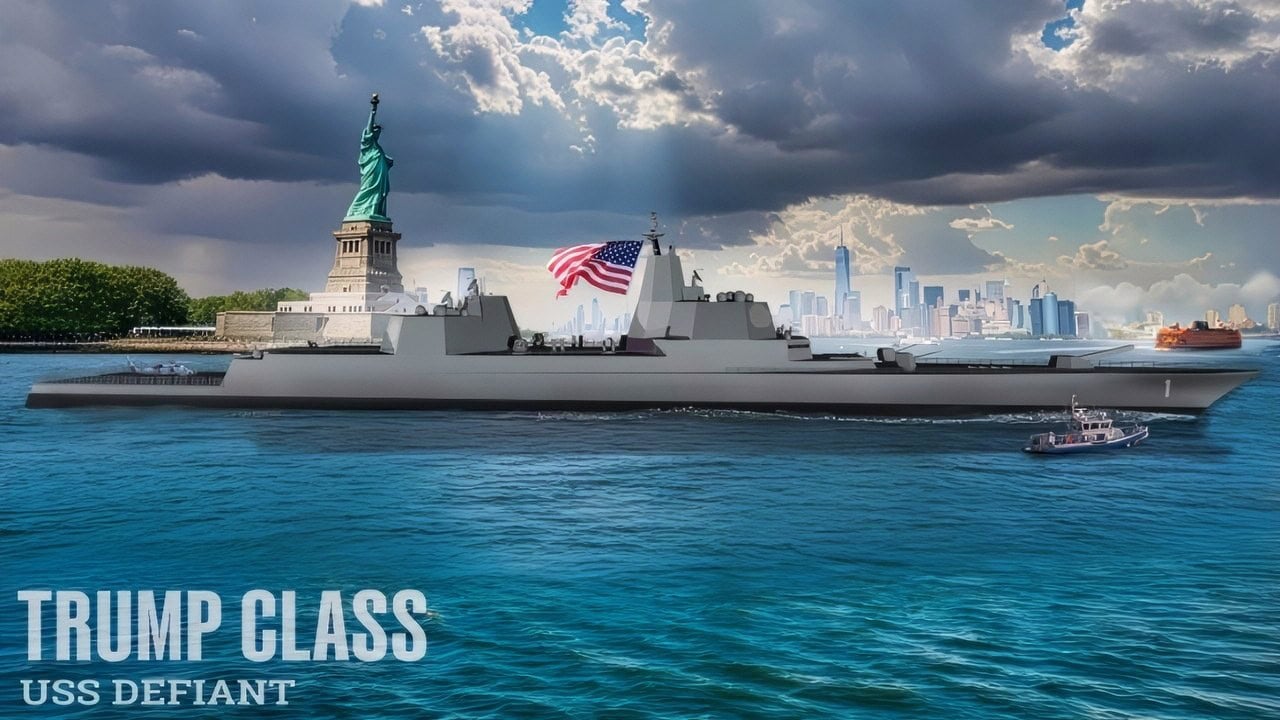
Trump-Class Battleship. Image Credit: Creative Commons/White House.
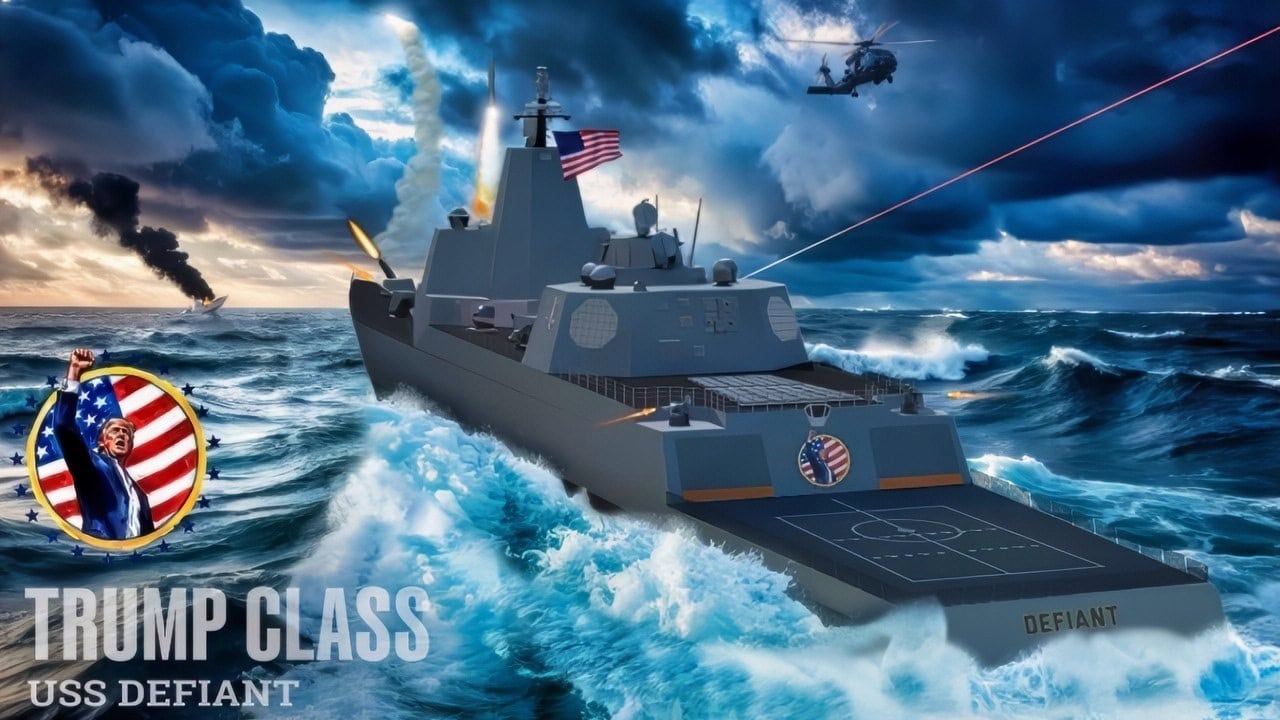
Trump-Class Battleship. Image Credit: Creative Commons/White House Photo.
The Aegis Weapon System will be increasingly busy fighting the Chinese or Russians, who are loaded with anti-ship ballistic missiles, many of them hypersonic. I want a better defensive system – especially when it comes to outlasting an enemy missile barrage that could overwhelm the Aegis screen.
Keep the Pause Button Pressed on Railguns for the Trump-Class Battleship
Going on offense with a rail gun is intuitively appealing. There could be ship-on-ship warfare after all, and a gun with ultra-long range would be valuable. If I were advising the president, though, I would continue to keep the rail gun on pause.
More data needs to be collected, and a larger study should be conducted to determine whether this is feasible without incurring ponderous, expensive delays. If the Navy has trouble with catapults and elevators on carriers, it could also be set back by a time sucking use of rail guns that may not work in the long haul.
This would be problematic and stifle the president’s creativity, who may not realize that the railgun sounds good in theory but, in reality, could be an albatross that strangles the life out of the new Trump-class battleship.
If he wants more than 20 vessels in 2.5 years, there can be no expensive, lengthy delays.
About the Author: Brent M. Eastwood
Author of now over 3,000 articles on defense issues, Brent M. Eastwood, PhD is the author of Don’t Turn Your Back On the World: a Conservative Foreign Policy and Humans, Machines, and Data: Future Trends in Warfare plus two other books. Brent was the founder and CEO of a tech firm that predicted world events using artificial intelligence. He served as a legislative fellow for US Senator Tim Scott and advised the senator on defense and foreign policy issues. He has taught at American University, George Washington University, and George Mason University. Brent is a former US Army Infantry officer. He can be followed on X @BMEastwood.