
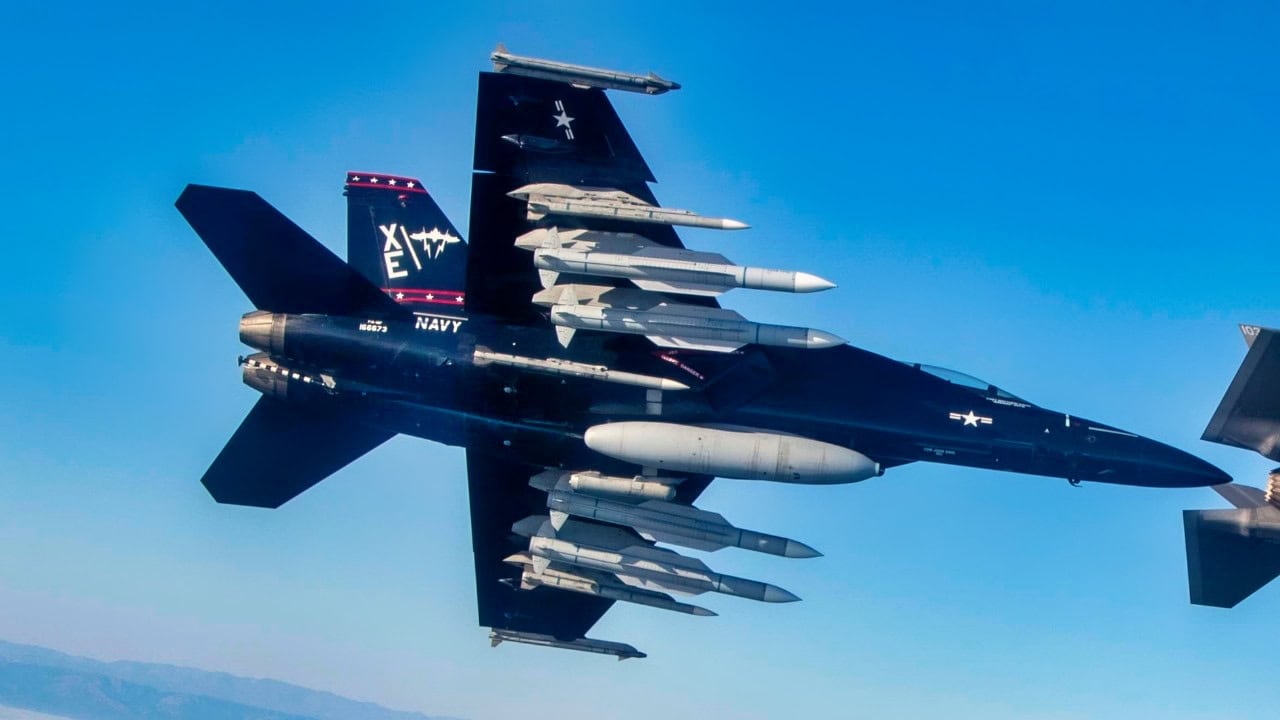
According to recent reports, the U.S. Air Force (USAF) is seeking a new long-range missile. Creatively named “Air Force Long Range Weapon” (AFLRW), this new missile is set to have a range of 1,000 nautical miles (1,150 regular miles).
The USAF is scheduled to review candidates for the AFLRW in August at a classified two-day industry event at Eglin Air Force Base in FL.

LRSO from Sandboxx News.
The U.S. has recently been investing in its stockpile of standoff munitions to counter China in the Pacific.
The CCP itself has been steadily increasing its arsenal of intermediate- to long-range missiles of various types. Any potential conflict that rages in the Pacific will likely depend on who can strike the deepest into enemy territory from furthest away.
A New Missile For the Air Force
On June 24, just a few days ago, the USAF posted a notice from the Air Force Lifecycle Management Center seeking a manufacturer for the AFLRW.
“The AFLRW is aimed at addressing the next generation of Air-Launched Standoff Weapon variants in line with Department of War priorities,” the notice read.
The Air Force is looking for a vendor who can produce a fully assembled and tested round that’s ready to use, managing both subsystem design and manufacturing to meet Weapons Open System Architecture and Government Reference Architecture requirements.
Additionally, the manufacturer must be able to integrate various subsystems into the missile; the exact details of how this is done are not provided.
Most of the details about what the Air Force is looking for in the AFLRW are not given and are probably classified. It is not specified which type of aircraft should carry the missile, nor how large the missile’s payload should be.
There are currently many questions as to what type of missile it actually is. Is it a cruise missile? An air-launched ballistic missile (ALBM)? Is it hypersonic?
Nobody knows right now.
The notice does, however, state that the missiles should be able to strike targets in Defense Planning Scenario 2.1 and 7.1 environments. It also said that the missile should be available in air-to-air and air-to-surface variants.
AFLRW vs LRSO
The AFLRW should not be confused with the AGM-181 Long-Range Stand-Off Weapon (LRSO), which is still in development for the USAF. The LRSO project began in 2015 to replace the AGM-86 Air Launched Cruise Missile (ALCM).
LRSO is a nuclear-tipped cruise missile with an estimated range of around 1,500 miles. It is designed to be carried by the B-52 Stratofortress, B-2 Spirit, and the B-21 Raider.
The contract was awarded to Lockheed Martin and Raytheon to develop the missile. The missile has undergone multiple test launches, although the exact state of the program is heavily classified.
In March of this year, a B-52 was spotted carrying what appeared to be two LRSO missiles on its external hardpoints.
What is interesting about the AFLRW is that it will apparently have both air-to-air and air-to-surface variants, suggesting it will be modular and used for a wide range of applications.
Currently, the AIM-120D AMRAAM is the most advanced air-to-air missile in operation. Designed to replace the AIM-7 Sparrow, the AIM-120D has a range of around 100 miles and is operable by both the F-22 Raptor and the F-35 Lighting II.
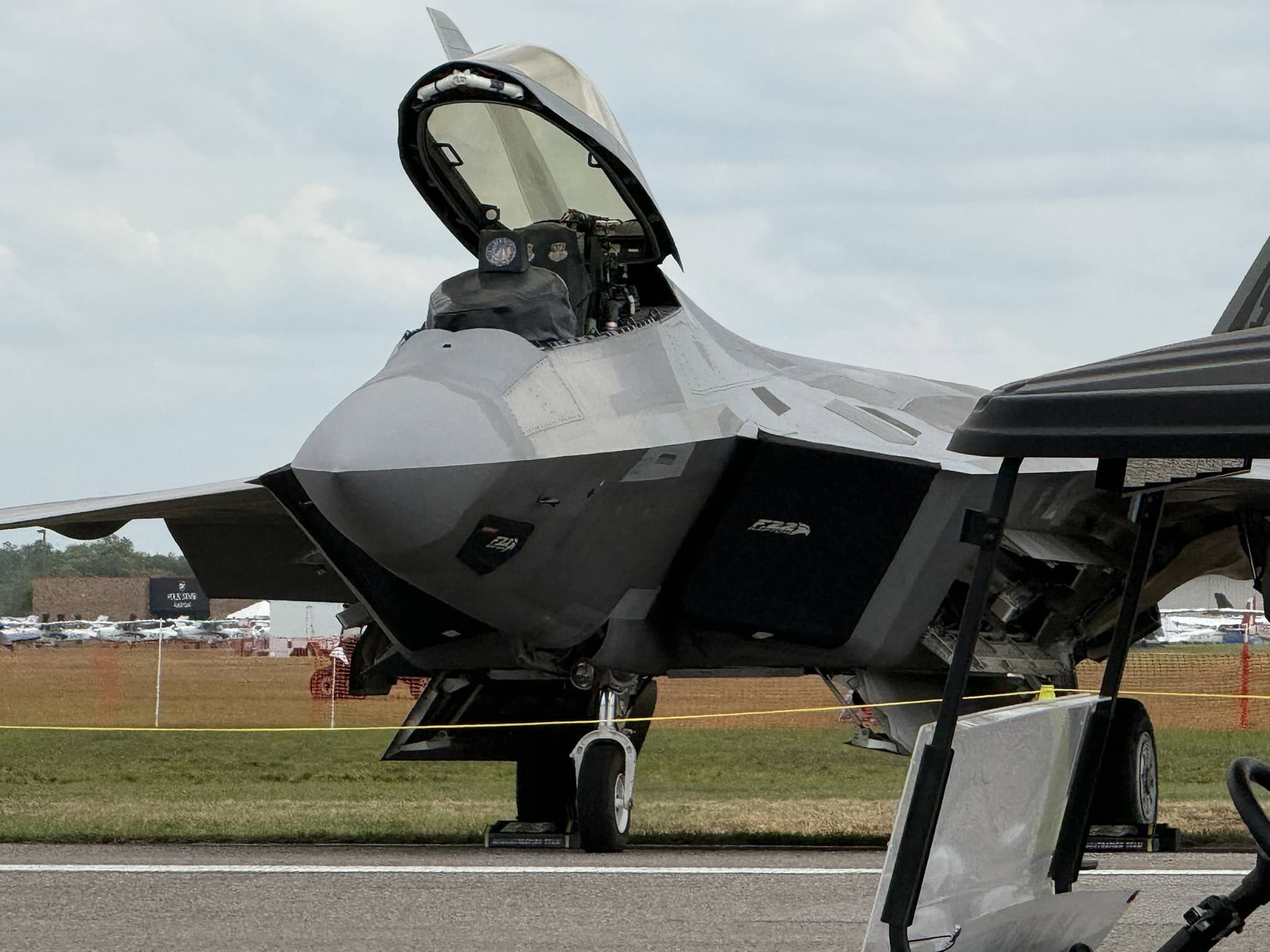
F-22 Raptor. Taken on 4/19/2026 by Harry J. Kazianis for 19FortyFive.com
Again, it is unknown how large AFLRW will be, so it is unclear whether the missile will fit in the internal weapon bays of the F-35 or F-22. If the air-to-air variant still has a range of 1000 miles, it would outclass the likes of the Meteor BVM missile and China’s PL-17.
How Much Will This Cost?
Interestingly, the notice issued by the USAF makes no mention of the missile’s cost, nor does it allude to the AFLRW being a low-cost program.
This runs in stark opposition to many of the DoW’s recent acquisition programs, most of which have emphasized their cost-effectiveness as part of the Family of Affordable Mass Missiles (FAMM) program.
In speaking with the Hudson Institute, Undersecretary of Defense Emil Michael noted that the DoW is taking active steps to procure lower-cost cruise missiles, with recent contracts totaling about $500,000 per missile, compared to a higher-end cruise missile at around $2 million.
With no mention of the FAMM program or the missile’s cost anywhere in sight, it is reasonable to assume that AFLRW will likely fall under the “exquisite” (read: incredibly expensive) type of missile.
With the U.S. preparing for a war in the Pacific, stand-off munitions will be needed in large quantities.
With China’s missiles presumably able to reach Guam, the U.S. will need to invest in its own range of long-range missiles if it hopes to put the same pressure on China.
It is too early to speak about the supposed capabilities of AFLRW, as the missile has not even started development. However, the need for a new long-range missile is obvious. Costs will likely be the biggest concern for this new program.
As price tags increase, productivity inevitably decreases. A fancy missile with near-unlimited range is ultimately useless in a strategic sense if only 10 or 20 are ever available.
About the Author: Isaac Seitz
Isaac Seitz, a Defense Columnist, graduated from Patrick Henry College’s Strategic Intelligence and National Security program. He has also studied Russian at Middlebury Language Schools and has worked as an intelligence Analyst in the private sector.