
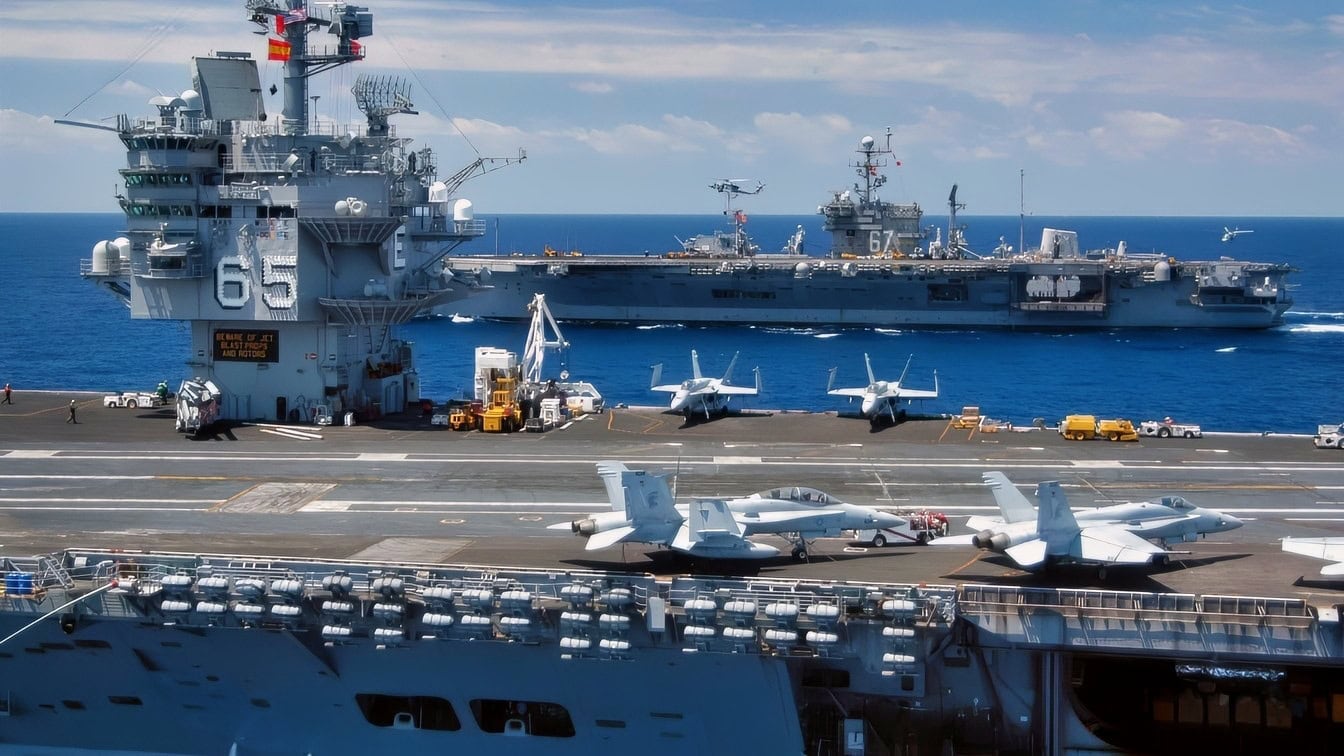
George Takei Was Aboard When USS Enterprise Ran Aground 3,000 Feet From Home – USS Enterprise had crossed the Pacific, spent eight months away and covered 46,500 miles when the danger arrived in the final approach to home. At 9:55 a.m. on April 28, 1983, the nuclear-powered aircraft carrier missed the dredged channel leading to Pier 3 at Naval Air Station Alameda and drove onto a mud bar in San Francisco Bay.
The ship settled in water reported at only 29 feet deep, while her keel normally required about 36 feet of water for safe clearance. Enterprise listed about 10 degrees to port and stopped approximately 3,000 feet from the pier. She had not reached a beach, but the nearly 90,000-ton carrier was firmly planted in bay mud.
About 3,000 relatives and friends were already waiting in light rain for the returning crew and air wing. They could see the sailors lining the carrier and the tugboats gathering around her, but the homecoming remained out of reach for almost six hours.
George Takei was aboard as a Navy guest. The actor had played Hikaru Sulu, helmsman of the fictional starship Enterprise, making his presence an irresistible detail once the real ship stopped moving. Takei was nowhere near the controls. He later supplied the episode’s enduring joke: “Enterprise on the Rocks.”
Enterprise Lost Its Margin Inside a 400-Yard Channel
The grounding exposed how quickly scale becomes a disadvantage in confined water. Enterprise stretched 1,123 feet and used four propellers driven by the most complicated naval power plant of its era. Her eight nuclear reactors made the carrier unique, but propulsion power could not restore maneuvering room after the bow moved beyond a 400-yard-wide channel.
Harbor transits compress every problem: shallow water, limited turning room, nearby structures, and little time to recover from asymmetric thrust. A carrier built for open-ocean speed becomes dependent on precise low-speed control.
A civilian bar pilot had advised the bridge during the harbor entry, but Captain Robert J. Kelly had the conn when Enterprise grounded. Contemporary Navy officials initially said the outboard starboard propeller stopped turning, allowing thrust from the port shafts to push the bow sideways faster than the rudder could correct it. The public record does not provide enough detail to treat that preliminary explanation as the investigation’s final finding.
Kelly accepted responsibility. The accident occurred at the end of the ship’s tenth Western Pacific deployment, during which Carrier Air Wing 11 had logged about 29,000 flight hours and more than 11,000 arrested landings. The grounding in sight of Alameda followed thousands of demanding operations completed far from home.
Tugboats, Ballast and the Tide Finally Moved the Big E
The crew tried to change the carrier’s balance. Sailors were directed toward the port side while water was shifted through ballast tanks, an effort intended to reduce the list and ease the hull away from the mud. Tugboats pushed against the ship and pulled on towlines without immediate success.
Sources differ on the size of the rescue force. The Navy photo caption records nine tugboats; a contemporary TIME account counted eleven. Both agree that the tugs alone were not enough. The tide had to provide the additional lift needed to release the keel.
Enterprise came free at 3:12 p.m. and reached the berth at 4:30. No one was injured. Initial inspections found no major hull damage, although Kelly later acknowledged damage to a propeller blade. The result was an embarrassing delay rather than a threat to the reactors or the survival of the ship.
The 1983 Grounding Was Not the Bishop Rock Collision
The Alameda accident is sometimes confused with a far more serious event two years later. On November 2, 1985, Enterprise struck Bishop Rock at Cortes Bank during an exercise off Southern California. That collision opened the carrier’s outer hull, damaged a propeller and forced about $17 million in emergency repairs.
The 1983 grounding caused nothing close to that destruction. It also bore no resemblance to the 1969 flight-deck fire that killed 28 sailors. Enterprise had survived combat deployments, explosions and years of high-tempo aviation work. At Alameda, a routine harbor approach produced the spectacle of one of the world’s most powerful warships waiting for tugboats and enough water beneath the keel.
The two California accidents nevertheless became part of the carrier’s unusually long operational history. The 1983 episode showed the margin for error near port; the 1985 collision demonstrated how severe the consequences became when a carrier met rock instead of mud.
Captain Kelly’s Career Survived the Grounding
Groundings often end naval commands because the captain remains responsible for safe navigation regardless of who is steering or advising the bridge team. Kelly did not avoid that principle. He accepted full responsibility while the Navy investigated how Enterprise left the channel.
Kelly turned over command of Enterprise on June 17, 1983. His career continued. He later served on the Joint Chiefs of Staff, became a deputy chief of naval operations and reached four-star rank.
On February 15, 1991, Robert J. Kelly became commander-in-chief of the U.S. Pacific Fleet.
About the Author: Harry J. Kazianis
Harry J. Kazianis (@Grecianformula) was the former Senior Director of National Security Affairs at the Center for the National Interest (CFTNI), a foreign policy think tank founded by Richard Nixon based in Washington, DC. Harry has over a decade of experience in think tanks and national security publishing. His ideas have been published in the NY Times, The Washington Post, The Wall Street Journal, CNN, and many other outlets worldwide. He has held positions at CSIS, the Heritage Foundation, the University of Nottingham, and several other institutions related to national security research and studies. He is the former Executive Editor of the National Interest and the Diplomat. He holds a Master’s degree focusing on international affairs from Harvard University.

