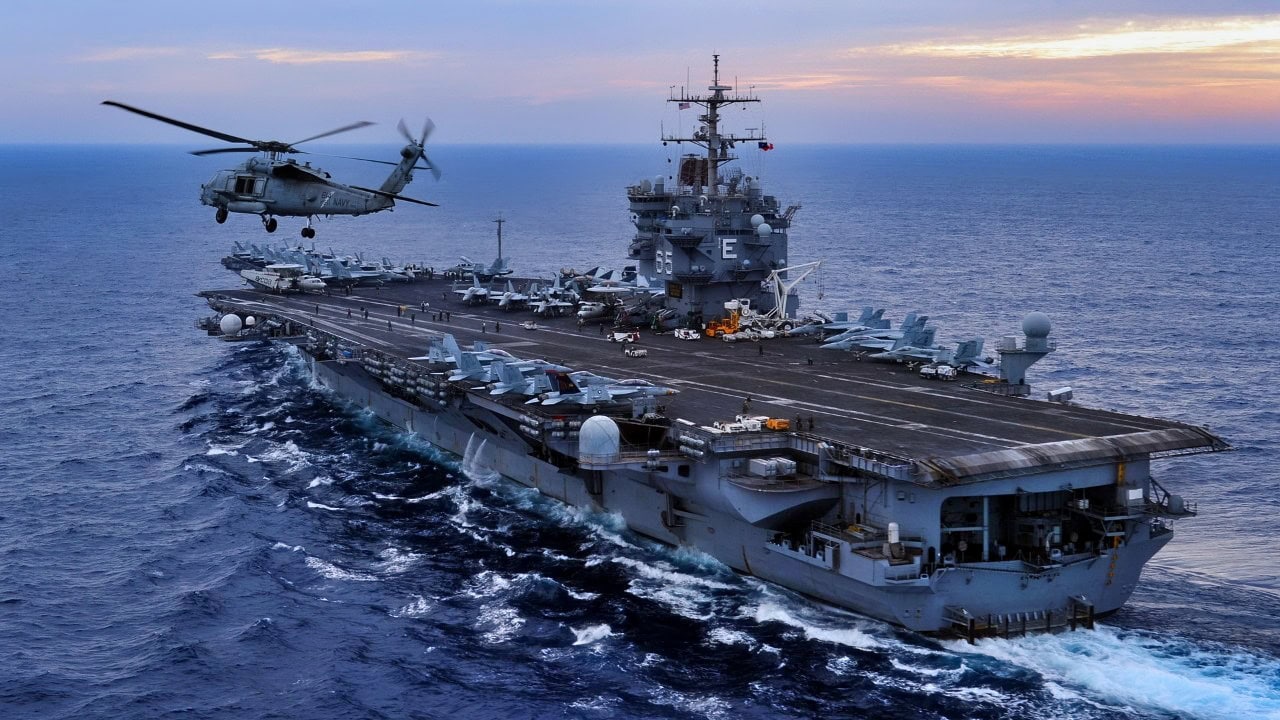
Key Points and Summary: The USS Enterprise (CVN-65), known as “Big E,” was the world’s first nuclear-powered aircraft carrier and the longest warship ever built. Some experts even claim this might be the best aircraft carrier in history.
-Commissioned in 1961, it revolutionized naval endurance with its eight-reactor propulsion system, serving through the Cuban Missile Crisis, the Vietnam War—where it survived a devastating 1969 flight deck fire—and the Global War on Terror.
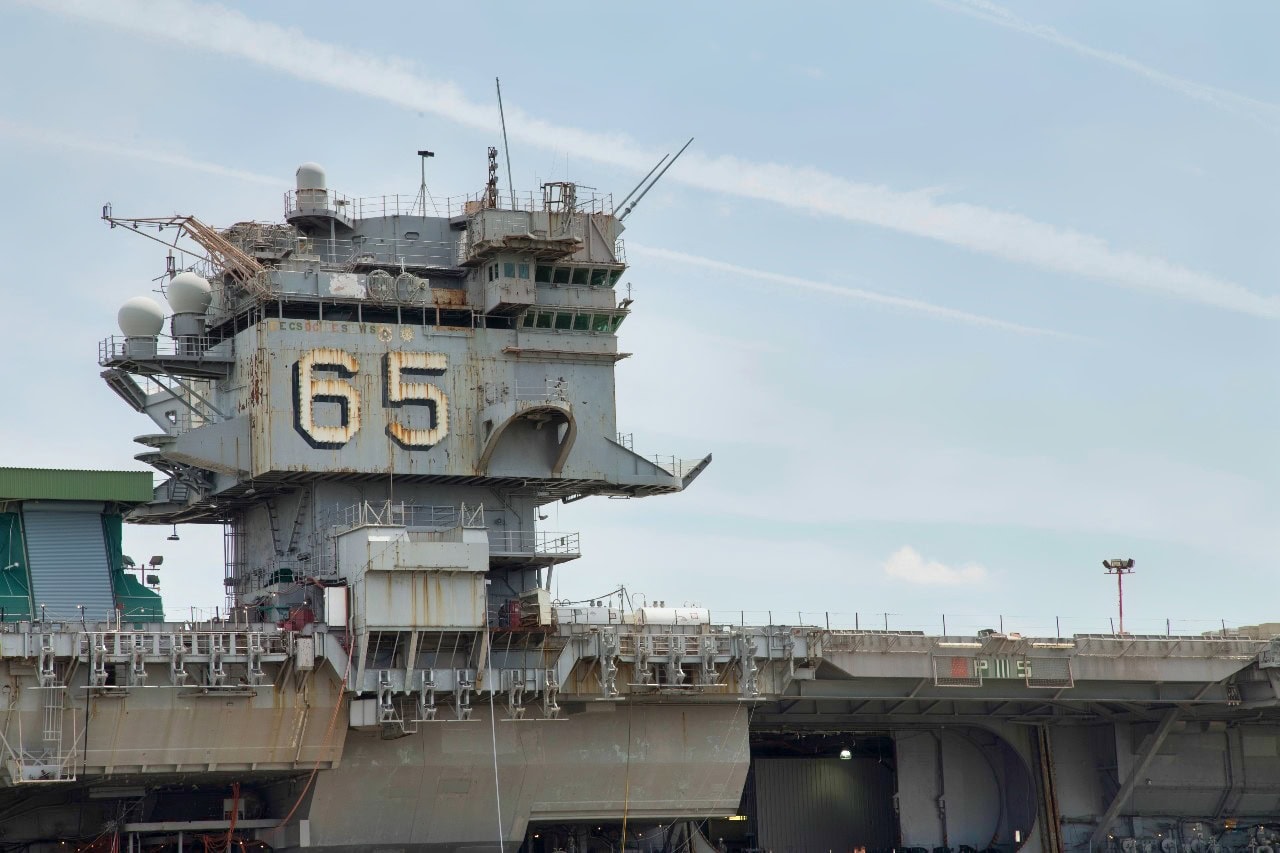
NEWPORT NEWS, Va. (July 15, 2018) — USS Enterprise (CVN 65) sits pierside at Newport News Shipbuilding following its decommissioning in February 2017. (U.S. Navy photo by Mass Communication Specialist 2nd Class Cat Campbell/RELEASED)
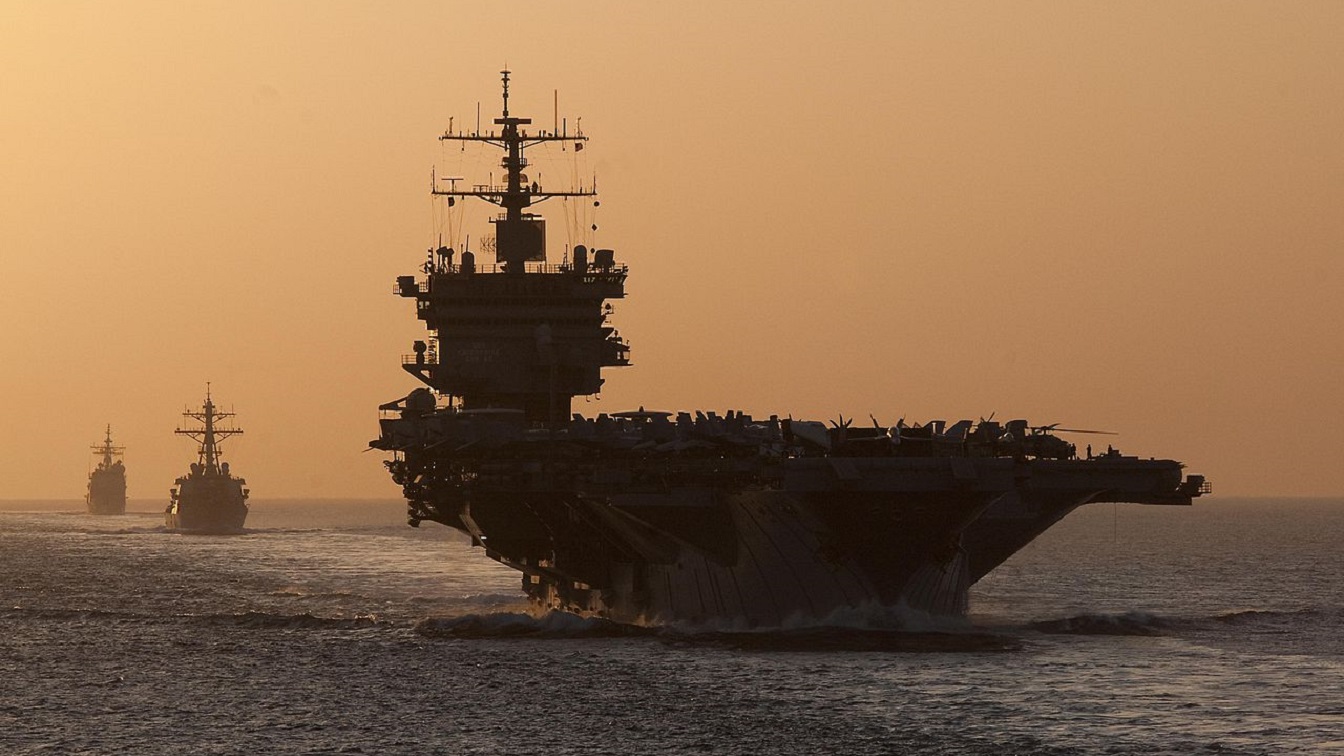
The aircraft carrier USS Enterprise, right, the guided-missile destroyer USS Porter (DDG 78) and the guided-missile cruiser USS Vicksburg (CG 69) transit back to their homeport of Norfolk, Va. Enterprise, Porter and Vicksburg are returning from a deployment to the U.S. 5th Fleet area of responsibility, where the ship conducting maritime security operations, theater security cooperation efforts and support missions for Operation Enduring Freedom. (U.S. Navy photo by Mass Communication Specialist 3rd Class Jeff Atherton/Released).
-Over a 50-year career, the Enterprise redefined carrier doctrine and set the blueprint for all future nuclear vessels before its decommissioning in 2017.
The Legendary History of the USS Enterprise, the First Nuclear-Powered Aircraft Carrier
The USS Enterprise (CVN-65), affectionately known as “Big E,” is one of the most influential carriers in modern naval history.
As the world’s first nuclear-powered carrier, she redefined the limits of naval endurance, the US Navy’s approach to carrier doctrine, and served across the globe for more than five decades. Accepted into service in 1961, Big E saw combat in Vietnam, Iraq, and the Global War on Terror.
From her completion to her retirement in 2012, she was a technological trailblazer and a tremendous asset to the Navy.
Construction and Service
Authorized in the late 1950s, the USS Enterprise was constructed at Newport News Shipbuilding in Virginia, where she was laid down in February 1958. Her design incorporated eight nuclear reactors, a configuration chosen to produce the immense power required to propel a ship of her size at sustained high speed.
When she was launched in September 1960 and commissioned in November 1961, Enterprise was not only the first nuclear-powered aircraft carrier but also the longest warship ever built, a title that she would retain throughout her existence.
Although she had been planned as the first of a class, escalating construction costs led to the cancellation of her sister ships, leaving Enterprise as a unique vessel that nonetheless set the blueprint for all future nuclear carriers.
Right after her commissioning, Big E was thrust into the tumultuous Cold War, where she quickly proved her worth. In October 1962, she took part in US naval operations during the Cuban Missile Crisis, when American forces enforced a maritime quarantine of Cuba in response to the deployment of Soviet nuclear missiles.
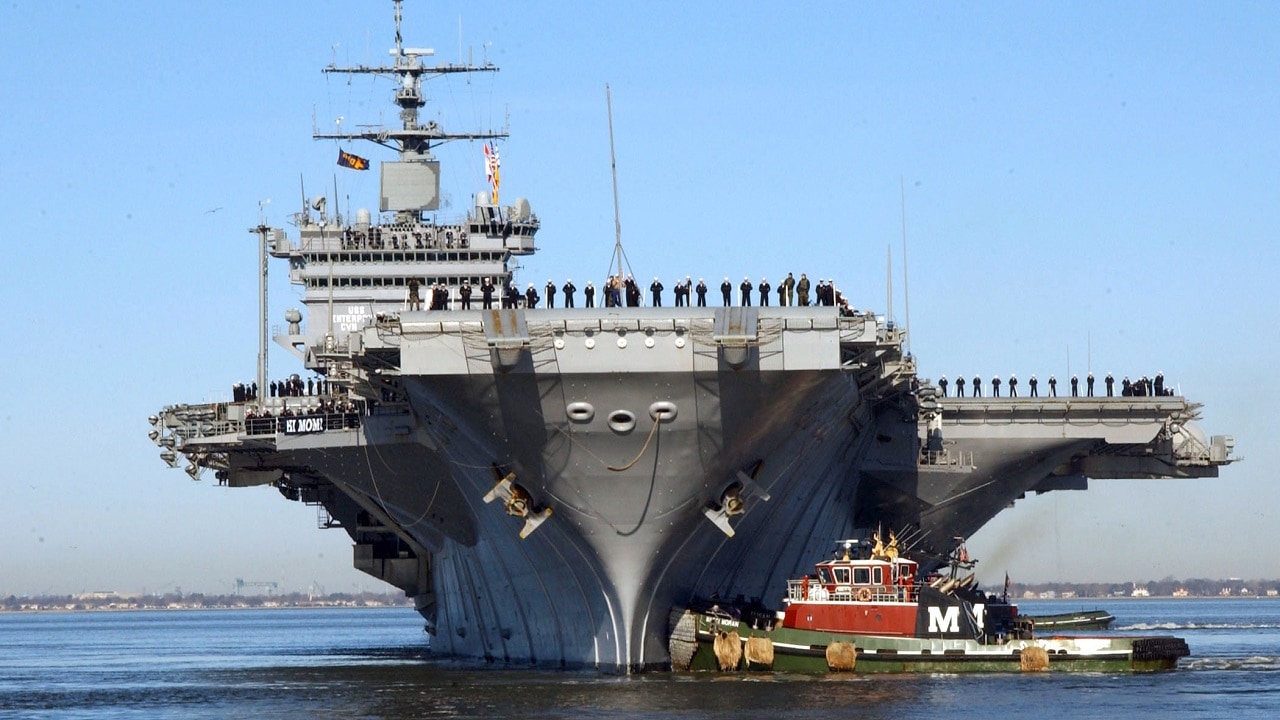
Naval Station Norfolk, Va. (Feb. 29, 2004) – Sailors aboard the nuclear powered aircraft carrier USS Enterprise (CVN 65) “man the rails” as the carrier approaches its pier at her homeport of Naval Station Norfolk, Va. The carrier and its strike group are returning after completing a six-month deployment in support of the global war of terrorism, including Operations Iraqi Freedom and Enduring Freedom. U.S. Navy photo by Photographer’s Mate 3rd Class Sondra Howett. (RELEASED)
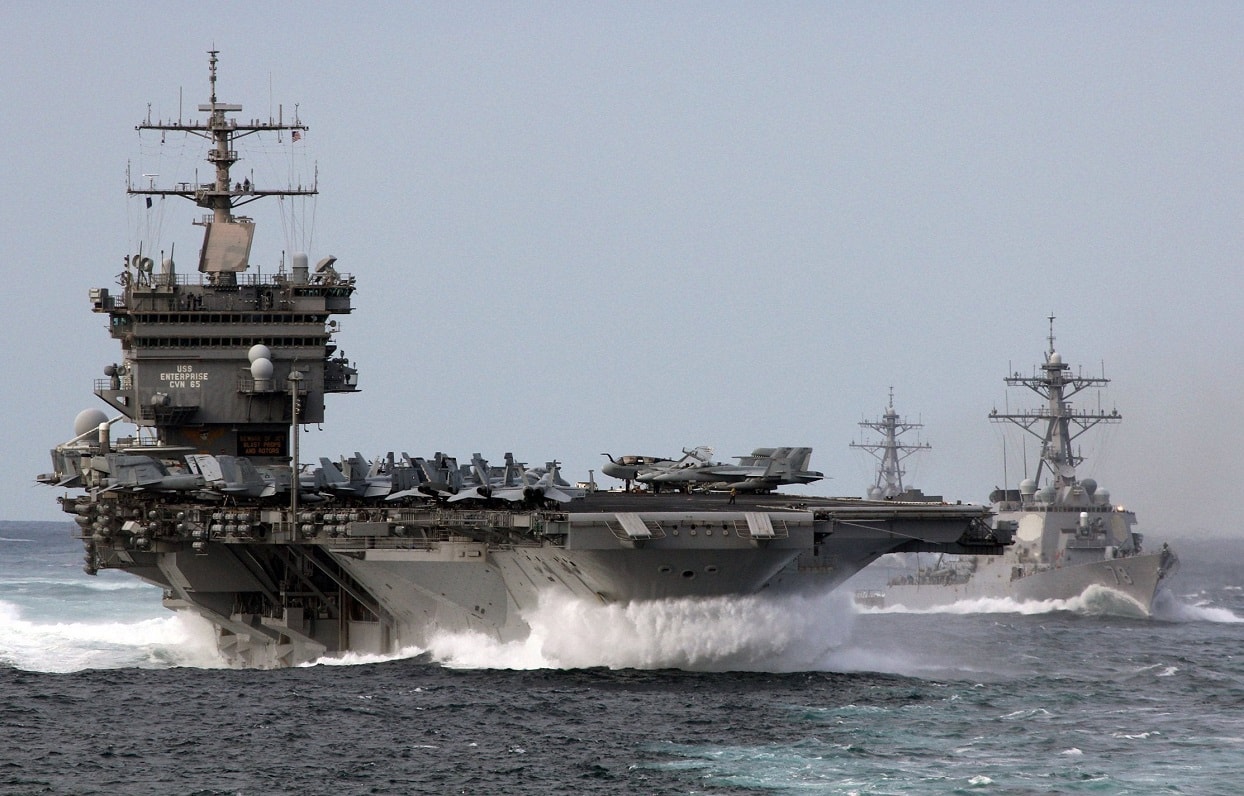
Image: Creative Commons.
The crisis placed extraordinary demands on US naval assets, and Enterprise’s ability to sustain operations without fuel logistics showed off the advantages of nuclear propulsion. In the years that followed, she conducted repeated deployments to the Mediterranean Sea, operating with the Sixth Fleet during a period of frequent Cold War confrontations and crises.
These deployments served not only as deterrence against potential adversaries but also as reassurance to US allies.
Combat in Vietnam
The most demanding chapter of USS Enterprise’s service unfolded during the Vietnam War.
Transferring to the Pacific Fleet in late 1965, she became the first nuclear-powered warship to enter combat when her air wing launched strikes against enemy targets on December 2 of that year.
Operating primarily from the Gulf of Tonkin, Enterprise supported US and allied forces ashore through thousands of combat sorties over multiple deployments.
Her aircraft carried out a wide range of missions, including strike operations, reconnaissance, electronic warfare, and air defense, often flying at a tempo that few other carriers could sustain.
During the Vietnam conflict, Enterprise demonstrated not only the advantages of nuclear endurance but also the inherent dangers of carrier warfare.
In January 1969, she suffered a devastating flight deck fire caused by the accidental detonation of an aircraft rocket.
The explosion triggered multiple secondary detonations, killed twenty-eight sailors, and injured hundreds more.
The incident inflicted severe damage to the ship and her air wing, but through determined damage-control efforts and subsequent repairs, Enterprise returned to operational service.
The disaster became one of the most serious carrier accidents in US Navy history and led to lasting improvements in flight deck safety and ordnance handling procedures.
Post Cold War Service
In the decades following Vietnam, Enterprise remained at the forefront of US naval operations during the late Cold War. She underwent major refueling and overhaul periods that extended her service life far beyond typical expectations for a warship of her era.
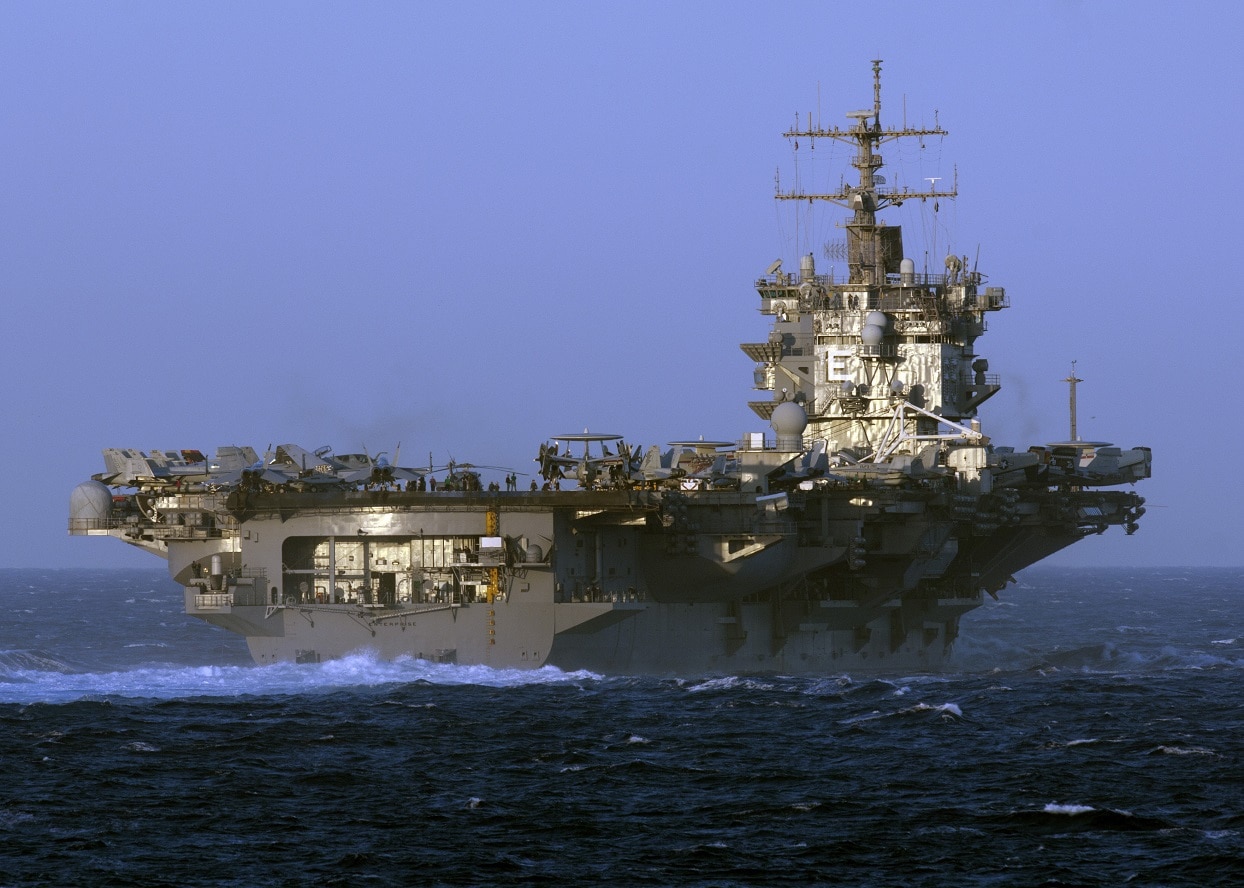
The aircraft carrier USS Enterprise (CVN 65) is underway in the Strait of Gibraltar. Enterprise is completing a deployment to the U.S. 5th and 6th Fleet areas of responsibility in support of maritime security operations and theater security cooperation efforts. The U.S. Navy has a 237-year heritage of defending freedom and projecting and protecting U.S. interests around the globe. Join the conversation on social media using #warfighting. (U.S. Navy photo by Mass Communication Specialist 3rd Class Daniel Meshel)
Throughout the 1970s and 1980s, she deployed regularly to the Western Pacific, Indian Ocean, and Mediterranean, responding to a wide array of crises and contingencies. Her presence during periods of tension on the Korean Peninsula and in the Middle East underscored the carrier’s continuing role as an instrument of deterrence and rapid response.
As the Cold War drew to a close, USS Enterprise once again adapted to a changing strategic environment.
During the 1990s, her air wing supported operations enforcing no-fly zones over Iraq and participated in NATO air campaigns during conflicts in the Balkans. Continuous modernization allowed her to operate advanced aircraft and integrate new command, control, and communications systems, ensuring that even as newer carriers entered service, Enterprise remained entirely relevant.
The GWOT and Retirement and USS Enterprise Retirement from Navy
Following the terrorist attacks of September 11, 2001, Enterprise and her crew entered yet another phase of combat operations.
She deployed in support of Operation Enduring Freedom, launching air strikes against Taliban and al-Qaeda targets in Afghanistan. Later deployments supported operations related to the invasion of Iraq and subsequent regional security efforts. These missions demonstrated the remarkable longevity of the ship and the enduring utility of the carrier strike group concept in a new era of asymmetric conflict.
After more than fifty years of active service, USS Enterprise completed her final deployment in 2012. She was formally deactivated later that year at Norfolk, Virginia, ending one of the longest and most varied operational careers in naval history.
Decommissioning followed in February 2017, closing a chapter that spanned from the height of Cold War rivalry through the dawn of twenty-first-century warfare. As the first nuclear-powered carrier to be decommissioned, defueling her was a long, difficult process that lasted from 2012 to 2017. Even in her deactivation, Enterprise was determined to blaze new trails and set new milestones.
About the Author: Isaac Seitz
Isaac Seitz, a Defense Columnist, graduated from Patrick Henry College’s Strategic Intelligence and National Security program. He has also studied Russian at Middlebury Language Schools and has worked as an intelligence Analyst in the private sector.