
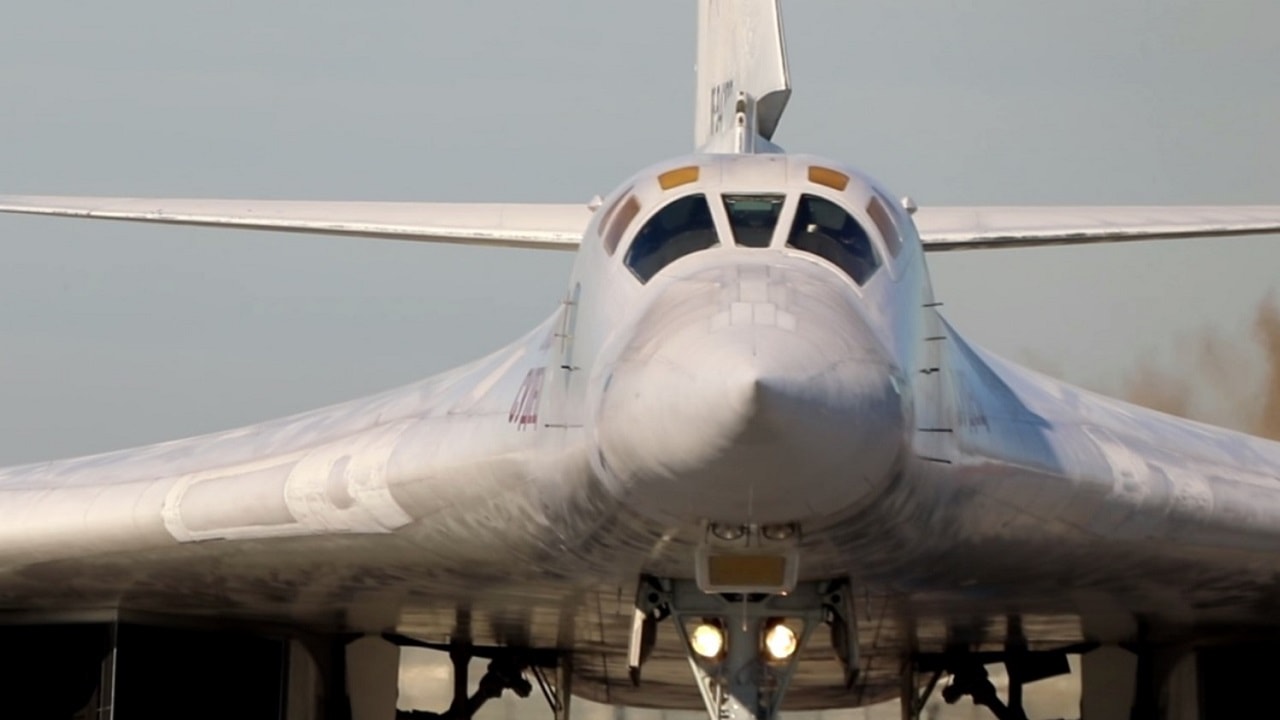
Summary and Key Points: Russia says it delivered two Tu-160M strategic bombers in 2025, without disclosing whether they were newly assembled or modernized Soviet-built aircraft. President Vladimir Putin approved renewed production in 2015, when the Russian Air Force spoke of eventually buying at least fifty; a 2018 contract covered ten, and the first newly assembled example flew in January 2022. The Federation of American Scientists estimated in May 2026 that Russia had fifteen Tu-160 and Tu-160M bombers in its active inventory. Restarting production required digitizing paper-era documentation and restoring vacuum welding for the titanium center section.
Russia Rebuilt the Tu-160 Production Line. The Ukraine War Made the Mach 2 Bomber More Important
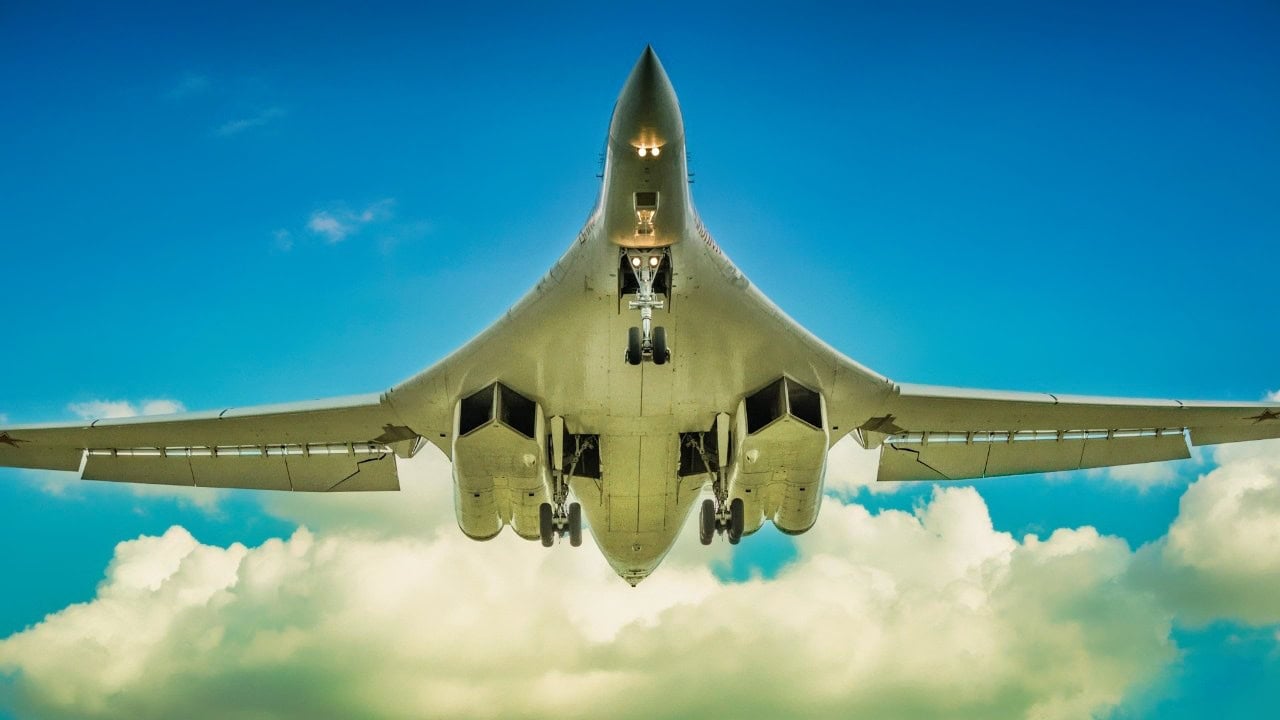
Tu-160 Bomber from Russia. Image Credit: Creative Commons.
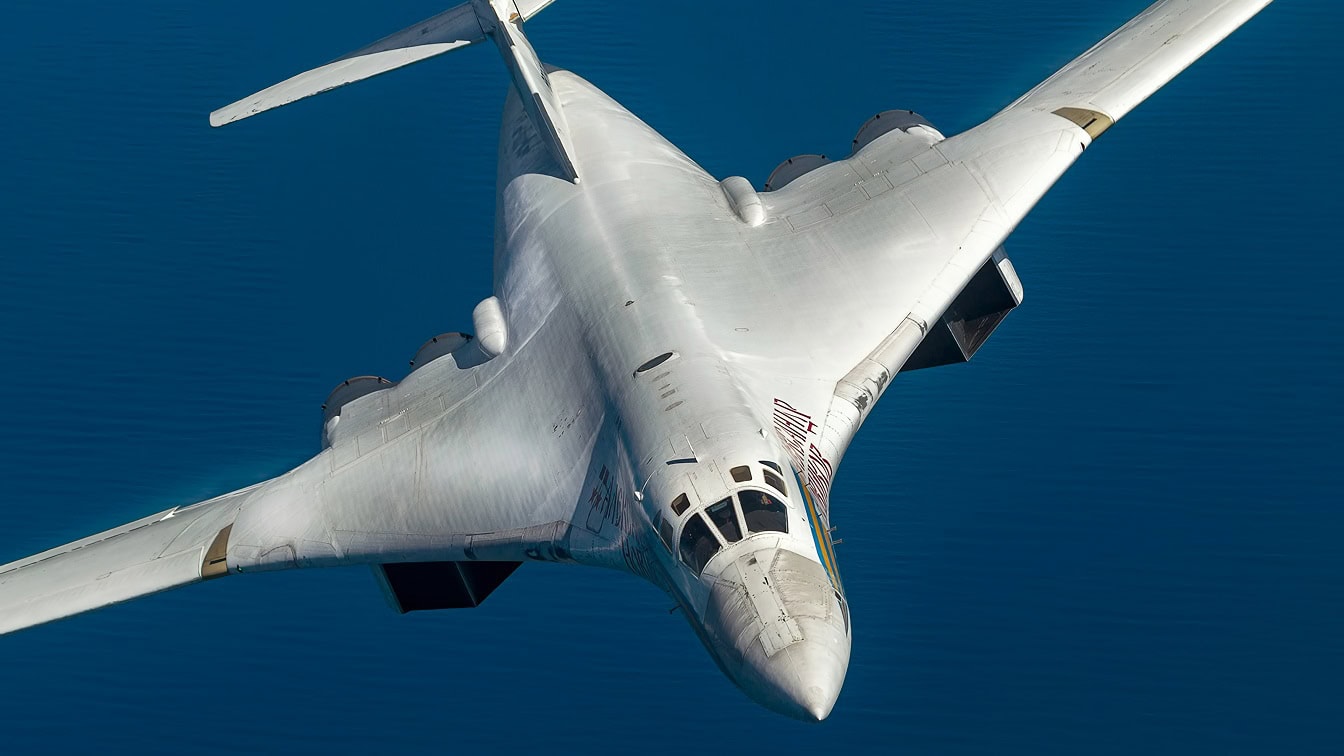
Tu-160 Bomber. Image Credit: Creative Commons.
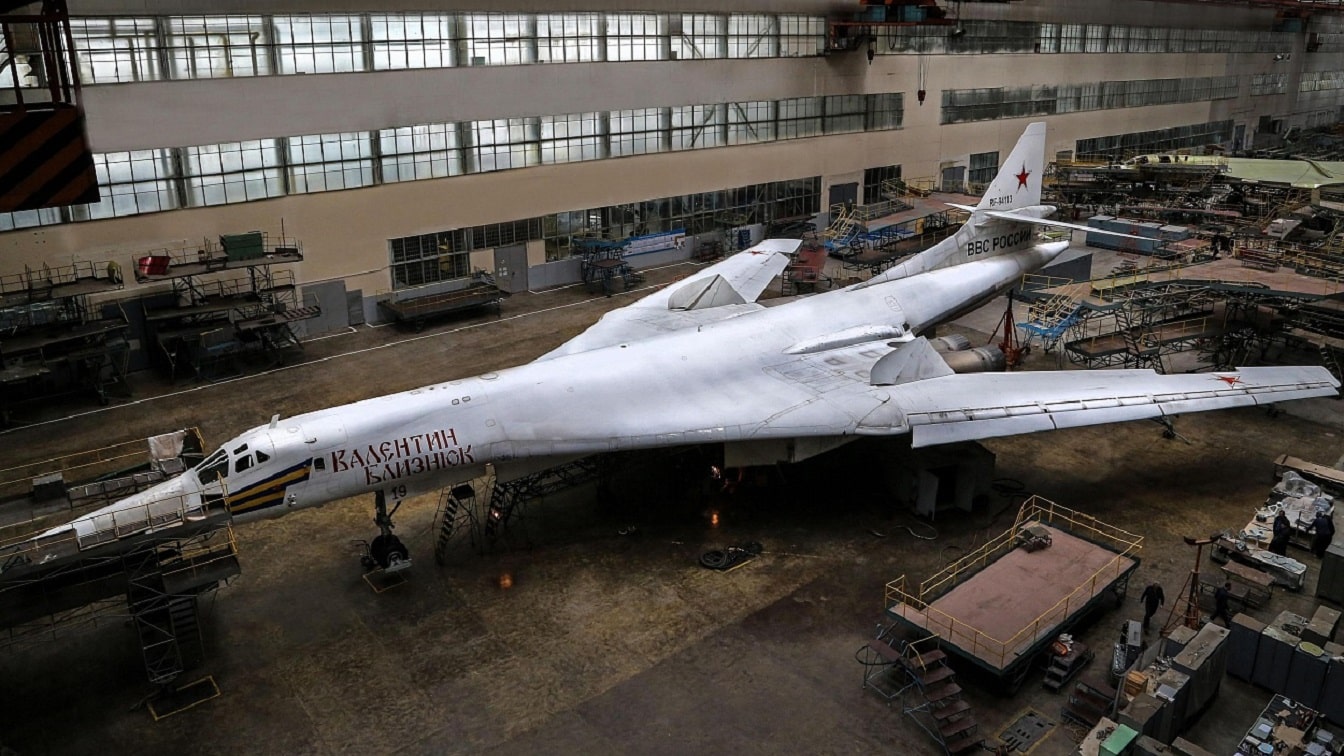
Russia said it delivered two Tu-160M strategic bombers in 2025, adding to a fleet carrying an outsized share of Moscow’s long-range strike mission. Officials did not say whether they were newly assembled or Soviet-built aircraft returned after modernization. The Federation of American Scientists estimated in May 2026 that Russia had 15 Tu-160 and Tu-160M bombers in its active inventory.
The reboot predates the full-scale invasion of Ukraine. President Vladimir Putin approved renewed production in 2015, when the Russian Air Force said it would eventually buy at least 50 aircraft. A 2018 contract covered 10 Tu-160Ms, and the first newly assembled example flew in January 2022. Russia is now modernizing older bombers and building additional aircraft at the Gorbunov plant in Kazan.
The airframe remains extraordinary. The Tu-160 is 54.1 meters long, spans 55.7 meters with its wings extended, and has a maximum takeoff weight of 275 metric tons. Its top speed is about Mach 2.05. Two internal bays carry up to 40 metric tons of ordnance, including 12 air-launched cruise missiles.
Ukraine has changed the meaning of those specifications. Russia does not send the non-stealthy Tu-160 through Ukrainian air defenses. It launches Kh-101 cruise missiles from Russian-controlled airspace, using the range for protection. Ukrainian attacks on bomber bases have also forced Moscow to scatter aircraft and strengthen defenses. The war has validated the Tu-160 as a standoff carrier while exposing how slowly Russia is replacing its strategic bombers.
The Soviet Union Built the Tu-160 for Speed and Missile Payload
The project took shape during a Soviet bomber competition in the 1970s. The first prototype flew in December 1981, and deliveries to the 184th Guards Heavy Bomber Aviation Regiment at Priluki began in 1987. Production ended in 1992 after the Soviet state and the industrial system supporting the aircraft collapsed.
The Tu-160 was often described as Moscow’s answer to the American B-1, but the Soviet aircraft followed a distinct weapons concept. Four NK-32 afterburning turbofans, variable-sweep wings, and a large fuel load gave it the reach to approach a launch area, release long-range missiles, and leave at high speed. Low-observable penetration was never the central choice. That still defines the Blackjack’s place in Russia’s bomber force.
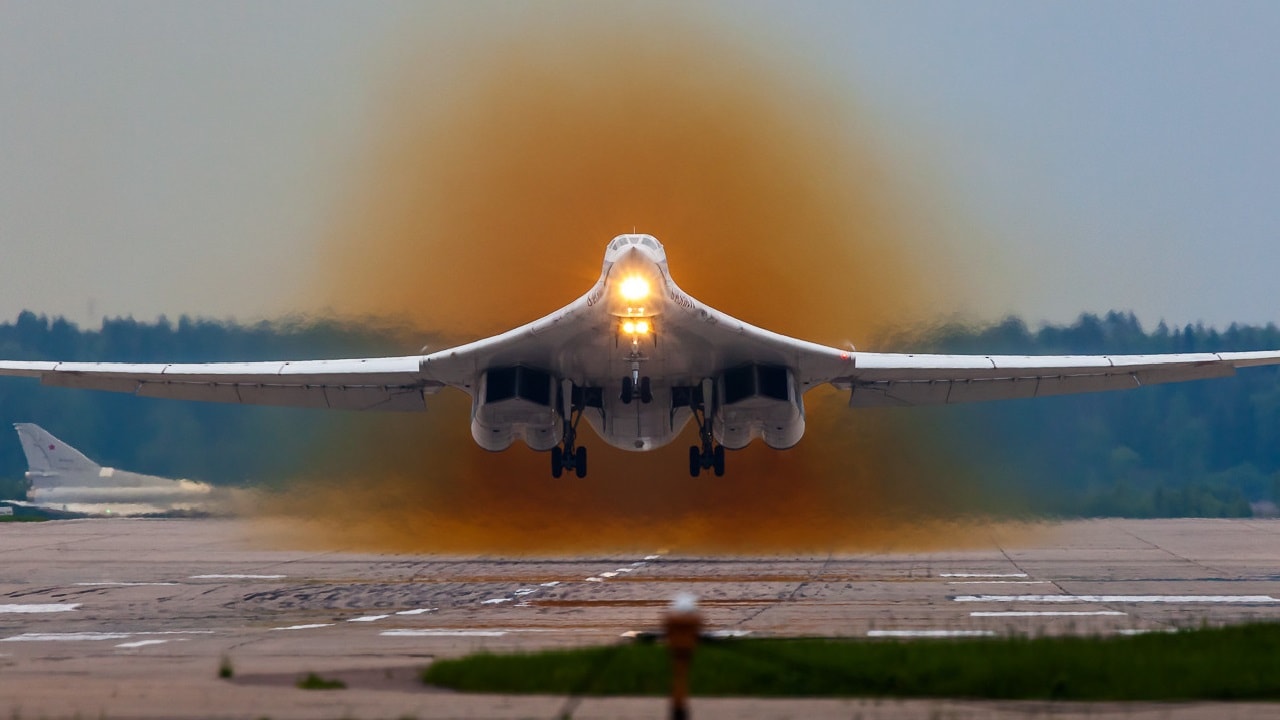
Russian Air Force Tupolev Tu-160 (RF-94113) takes off from Kubinka.
Tu-160 Bomber. Image Credit: Russian Government.
The crew of four sits inside an aircraft whose wings move forward for lower-speed flight and sweep back at high speed. Two rotary launchers in the fuselage hold nuclear Kh-55 or Kh-102 missiles and conventional Kh-101s. The Russian nickname, White Swan, reflects the bomber’s profile and white anti-flash finish.
The Soviet Collapse Split the Fleet Between Russia and Ukraine
The Soviet Union left 19 Tu-160s at Priluki in independent Ukraine. Kyiv had no budget or mission for a strategic bomber force. Under a 1999 debt agreement, Ukraine sent Russia eight Tu-160s, three Tu-95s, and hundreds of cruise missiles. Eleven Ukrainian Tu-160s were dismantled.
Russia preserved a small force at Engels, but the Kazan production line, suppliers and workforce had dispersed. The post-Soviet fleet depended on aircraft built during the 1980s and early 1990s. That scarcity explains why each surviving bomber airframe has become strategically valuable.
Restarting Production Required Rebuilding Lost Industrial Skills
Russia’s 2015 announcement became an industrial reconstruction project. Tupolev digitized paper-era design documentation, restored vacuum welding for the bomber’s large titanium center section, restarted airframe production, and organized a new supplier network. Rostec described those steps in 2023 when the first upgraded prototype entered joint state trials.
The program follows two tracks: existing aircraft receive new equipment and engines, while Kazan assembles additional bombers. Russian announcements often blur the distinction. The two aircraft delivered in 2025 were called Tu-160Ms, but their tail numbers and production histories were not disclosed. That opacity makes fleet growth difficult to verify.
Sanctions, labor shortages, and competition for specialized components have slowed the effort. The Royal United Services Institute found that sanctions and defense-industry management problems were impeding both Tu-160 modernization and the PAK DA program. Russia has restored its strategic bomber production capability, but Kazan has not demonstrated rapid wartime output.
The Tu-160M Replaces the Mission Systems, Not the Airframe
The Tu-160M retains the swing-wing structure while replacing much of the equipment the crew uses to navigate, communicate, detect threats, and employ weapons. Russian sources describe a new radar, digital cockpit, navigation equipment, communications, and electronic countermeasures. The NK-32-02 engine is intended to improve efficiency and range while restoring a critical engine to production.
Russian officials said the first newly built aircraft had 80 percent new or modernized equipment, a figure referring largely to systems rather than structure. The achievement lies in replacing obsolete electronics and rebuilding production for engines and components unavailable after the Soviet collapse. The result gives a Soviet airframe a new mission system.
Each weapons bay holds a six-round rotary launcher, giving the bomber capacity for 12 strategic cruise missiles. The conventional Kh-101 and nuclear Kh-102 form the core loadout. Russia has also discussed the longer-range Kh-BD, though its fielding status and performance remain difficult to verify.
Ukraine Turned the Tu-160 Into a Sanctuary-Based Missile Carrier
The war has not required the Tu-160 to fly at Mach 2 to break through fighter patrols or surface-to-air missile belts. Bombers move to protected launch areas and fire from far outside Ukraine. Russia then combines its cruise missiles with sea-launched weapons, ballistic missiles and drones during large attacks.
The approach reduces in-flight risk but leaves the aircraft exposed on the ground. Ukraine’s June 2025 Operation Spiderweb destroyed seven Tu-95s and hit other long-range aircraft, according to satellite analysis summarized by FAS. No Tu-160 destruction was publicly confirmed, yet Russia subsequently dispersed the fleet across several bases and stopped basing Tu-160s at Belaya.
Ukraine has repeatedly targeted Engels, forcing Russia to move aircraft, add defenses and complicate maintenance and weapons handling. The Tu-160’s value, therefore, depends on dispersal and base security as much as on speed or payload. Two additional bombers provide a limited margin when the fleet must cover conventional strikes, nuclear readiness, training and patrols.
The Tu-160M Is Becoming the Bridge to a Delayed PAK DA
Russia revived the Tu-160 partly because the planned PAK DA offered no near-term replacement. The next-generation bomber is intended to be a subsonic flying wing with lower radar visibility. FAS reported that Kazan was still assembling a first airframe for static ground testing in March 2026, with no clear date for a flying prototype.
The same Kazan industrial base is modernizing Soviet-built Tu-160s, assembling new Tu-160Ms, and preparing the PAK DA. The stealth-bomber effort remains behind the supersonic reboot, while both require specialized engines, avionics, structures, and workers. As of publication, Russia had not released a firm schedule for completing the 10-aircraft Tu-160M contract.
About the Author: Harry J. Kazianis
Harry J. Kazianis (@Grecianformula) was the former Senior Director of National Security Affairs at the Center for the National Interest (CFTNI), a foreign policy think tank founded by Richard Nixon based in Washington, DC. Harry has over a decade of experience in think tanks and national security publishing. His ideas have been published in the NY Times, The Washington Post, The Wall Street Journal, CNN, and many other outlets worldwide. He has held positions at CSIS, the Heritage Foundation, the University of Nottingham, and several other institutions related to national security research and studies. He is the former Executive Editor of the National Interest and the Diplomat. He holds a Master’s degree focusing on international affairs from Harvard University.

