
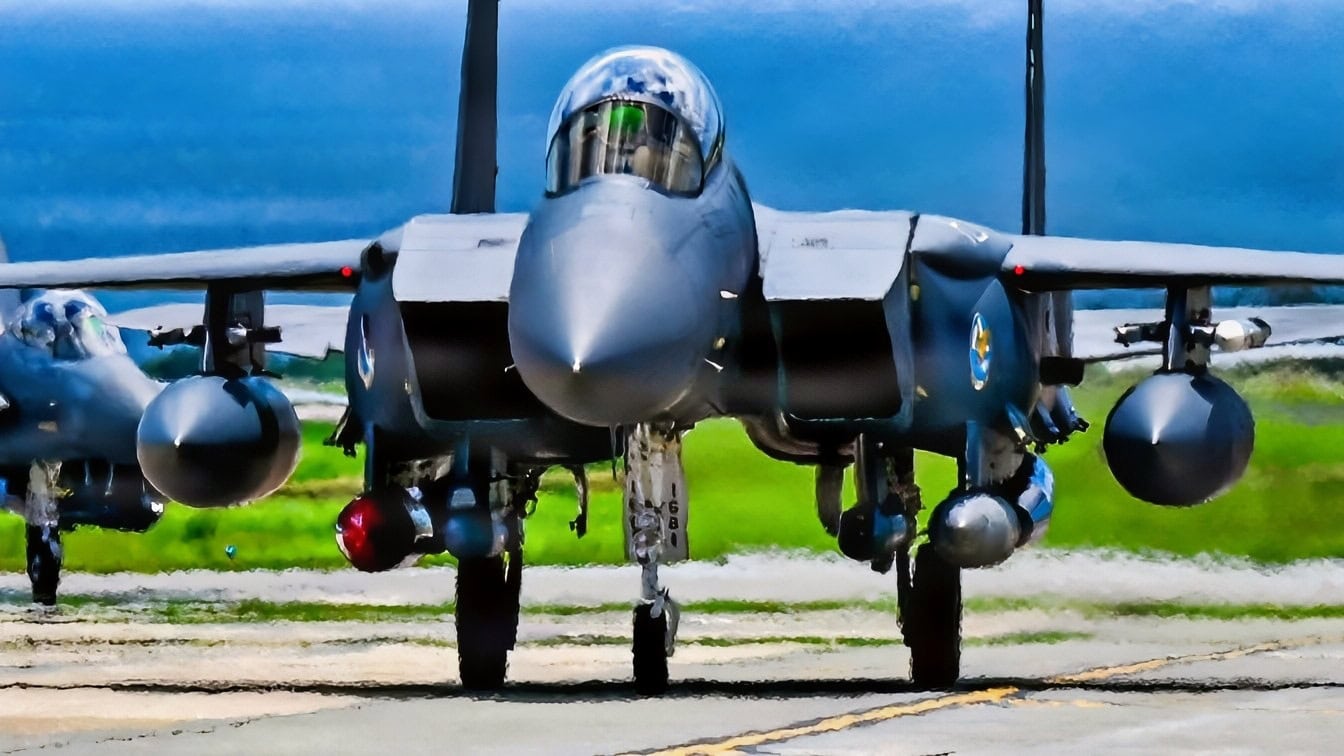
The U.S. Air Force has opened a search for a next-generation infrared eye for its F-15 fleet, publishing a formal notice asking industry to build a modern Infrared Search and Track system. It is market research, not yet a program, but the timing tells the story: the F-15EX buy has nearly tripled, Boeing has already flown a nose-mounted infrared sensor on a test Eagle, America’s export customers have carried built-in versions for years, and the Air Force ran this exact competition once before, a decade ago. This is passive detection coming home.
What We Know: The F-15 Fighter Upgrade
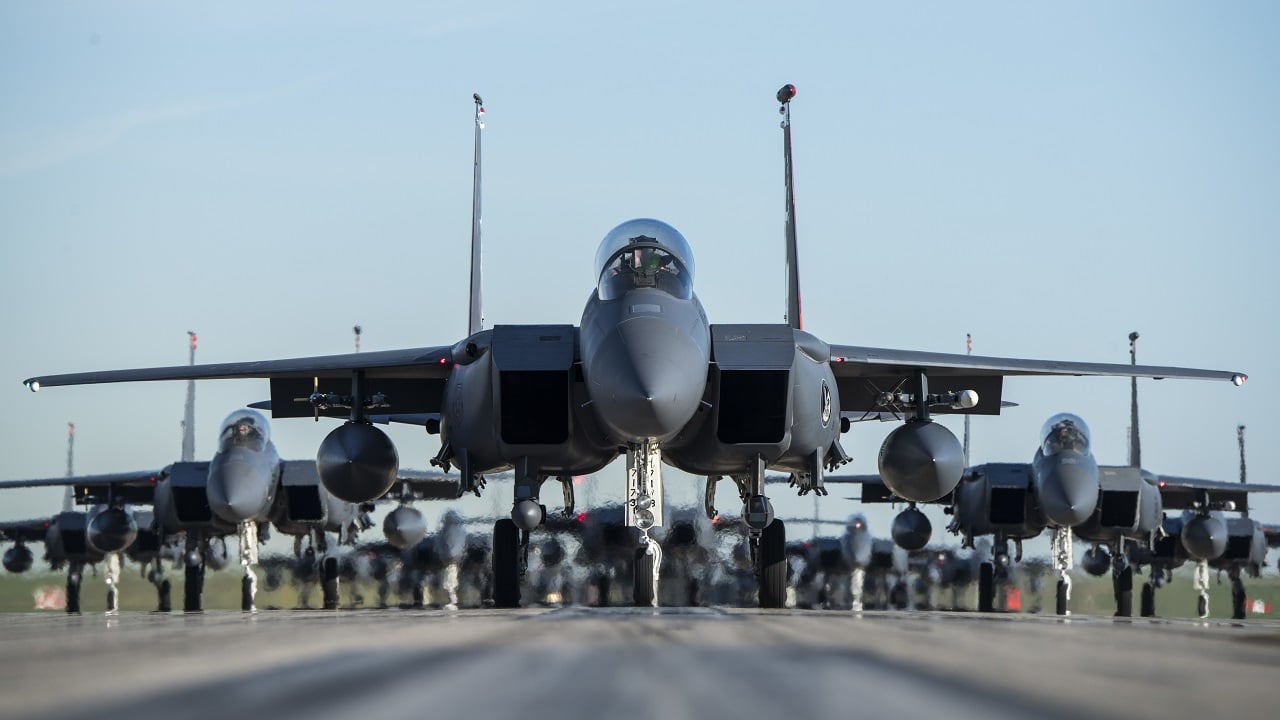
F-15E Strike Eagles taxi into formation June 12, 2019, at Mountain Home Air Force Base, Idaho. This was a rare opportunity to capture the Gunfighter family, including the 391st, 389th and 428th Fighter Squadrons, before a morning flight. (U.S. Air Force photo by Staff Sergeant Jeremy L. Mosier)
The document itself is precise where the buzz is not. The Air Force Life Cycle Management Center’s F-15 Program Office in Dayton published a sources-sought notice on June 26, with industry responses due July 27, seeking companies capable of developing, producing, or integrating an advanced IRST for the Eagle fleet. A sources sought notice is the step before a program exists, the government asking who could build a thing, not buying it, and that distinction matters for anyone tracking how real this is. What it signals is intent, and the intent is unmistakable.
Why Radar Isn’t Enough Anymore
Radar announces itself. Every pulse a fighter emits can be caught by an adversary’s warning receivers long before the radar sees its target, while an IRST simply watches for the heat that no aircraft can avoid making, from engine exhaust to friction-warmed skin. Stealth shaping, built to scatter radio waves, does little against infrared. And the competition has been fielding exactly this: China’s J-20 carries a fully integrated IRST with 360-degree distributed-aperture coverage, while Russia’s Su-35S mounts a sensor credited with detecting a non-afterburning fighter beyond 50 kilometers head-on and 90 from behind. The concept is proven on the American side too: an F-15C has already fired an IRST-cued AIM-120 and scored the intercept, in a test the service celebrated as weapons employment “without being dependent upon RADAR energy.”
The Pod That Ran Out of Road
The F-15 has an IRST today, and its limits explain the notice. The Legion Pod, carrying Lockheed Martin’s IRST21 sensor with a lineage running back through 300,000 flight hours to the F-14 Tomcat, reached initial operational capability with F-15C units in February 2022. But the pod occupies the centerline station, Air Force testing documented maneuvering restrictions it never fully shed, and a single infrared sensor gives bearing without range, a gap patched in 2021 with a datalink fix that triangulates between multiple pods.
The service also paid for a Block II receiver retrofit in 2021, borrowing the Navy’s upgraded configuration. Incremental fixes have run their course. There is even precedent for exactly this moment: a 2015 source-sought drew Northrop’s OpenPod against Lockheed’s Legion, the contest Legion won. This notice is round two. The sharpest irony, as The War Zone has detailed, is that export Eagles solved it years ago: Saudi, Qatari, South Korean, and Singaporean F-15s all carry the embedded Tiger Eyes sensor, descended from the same F-14 hardware, while American Eagles fly with a bolt-on pod.
The Fleet That Makes It Worth It
What changed is the size of the bet. The planned F-15EX fleet has climbed from an 80-jet floor to 267 aircraft with this spring’s budget request, a force built around the APG-82 radar, a new mission computer, and twelve missiles, headed for Kadena and the Pacific even as deliveries only now climb past two dozen. Boeing has already shown where this goes: a nose-mounted IRST flown on an F-15 Advanced Eagle testbed, confirmed by the company as real hardware, wider-viewing than a pod, drag-free, and leaving the centerline for fuel or weapons.
An integrated sensor fused into a fleet the Air Force is buying at full throttle, on an airframe modernized continuously for years, is the obvious destination, and the F-22 is getting its own infrared sensor in parallel.
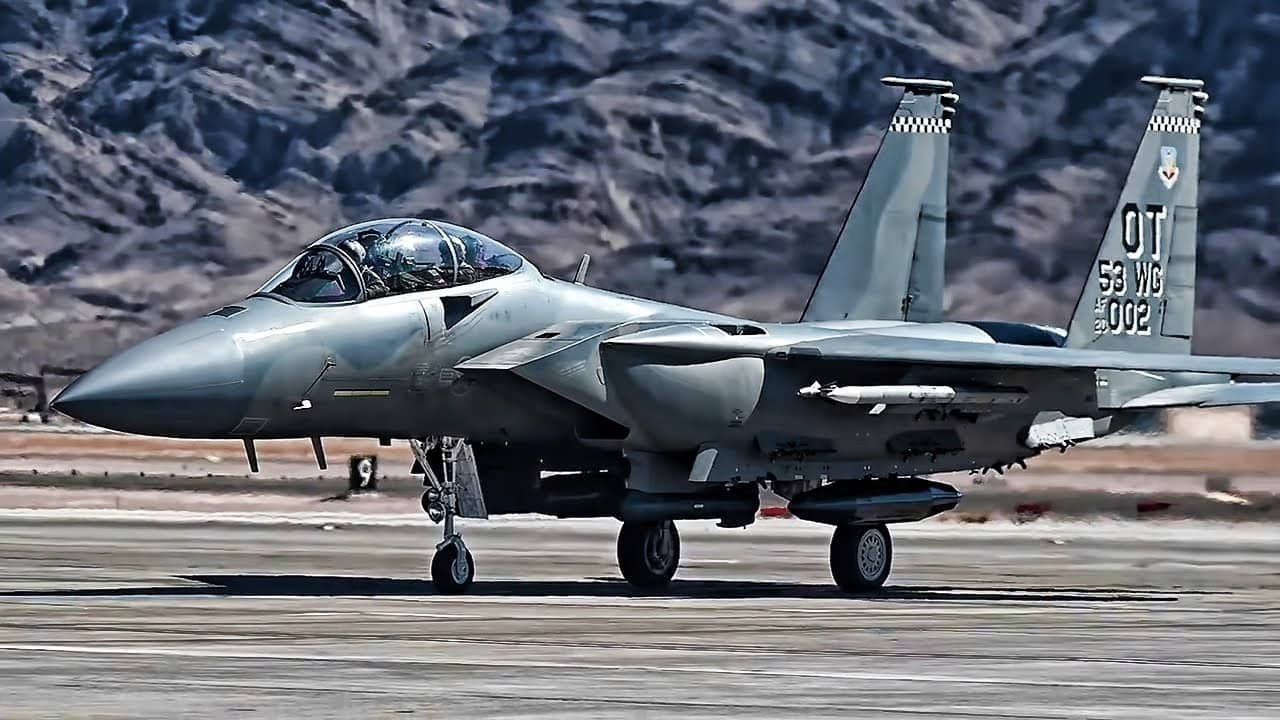
F-15EX Eagle II. Image Credit: Creative Commons.
The caveats are the notice’s own: no funding line, no timeline, no program of record yet, and infrared has physics limits radar does not, fading in weather and needing fusion for weapons-quality range. But the direction is set.
The Air Force that deleted infrared trackers from its interceptors when radar seemed sufficient is reinstating them in its oldest fighter line, and industry has until July 27 to raise its hand.
MORE – The Navy Wants Nuclear Submarine Drone Motherships
About the Author: Harry J. Kazianis
Harry J. Kazianis (@Grecianformula) was the former Senior Director of National Security Affairs at the Center for the National Interest (CFTNI), a foreign policy think tank founded by Richard Nixon based in Washington, DC. Harry has over a decade of experience in think tanks and national security publishing. His ideas have been published in the NY Times, The Washington Post, The Wall Street Journal, CNN, and many other outlets. He has held positions at CSIS, the Heritage Foundation, the University of Nottingham, and several other institutions related to national security research and studies. He is the former Executive Editor of the National Interest and the Diplomat. He holds a Master’s degree focusing on international affairs from Harvard University.

