
Four Iowa-Class Battleships Fired More Than 14,700 16-Inch Shells in Korea: Every completed Iowa-class battleship served against North Korea: USS Missouri, USS New Jersey, USS Wisconsin, and USS Iowa. Missouri arrived first in September 1950. New Jersey followed in May 1951, Wisconsin in November 1951, and Iowa in April 1952. The ships rotated through the theater until New Jersey delivered the final battleship bombardment of the conflict on July 27, 1953.
The public records do not provide a uniform class total, but the documented lower bound exceeds 14,700 rounds from the 16-inch guns. Missouri fired 6,756, New Jersey at least 3,000, Wisconsin 977, and Iowa reached its 4,000th heavy round before its deployment ended. Missouri alone added 12,422 5-inch shells; the other three used thousands more against rail lines, tunnels, bridges, bunkers, coastal guns, and troop concentrations.

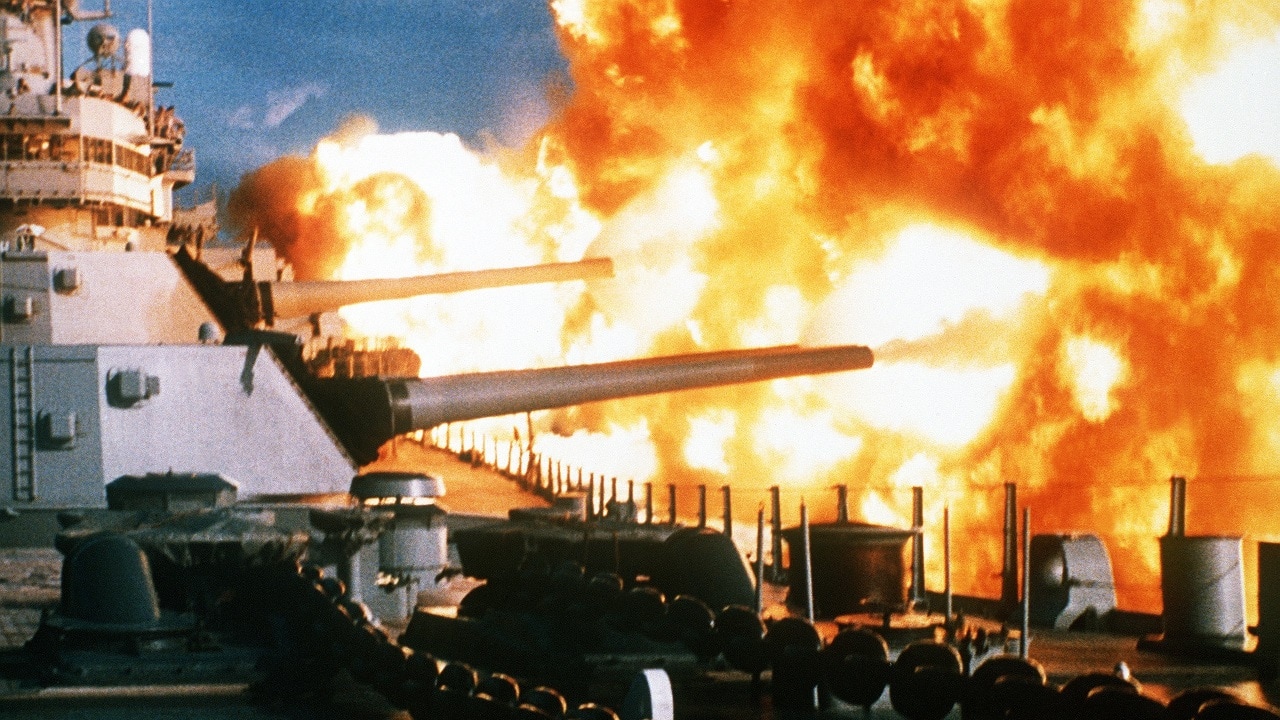
USS Missouri Iowa-Class Battleship Broadside. Image Credit: Creative Commons.
North Korean artillery hit two of the ships. New Jersey suffered a direct strike on its forward turret and a separate airburst that killed one sailor and wounded three. Wisconsin took a 155 mm round near a starboard anti-aircraft position, injuring three sailors and damaging a gun mount, deck planking, wiring, and ventilation. Neither battleship was forced off station by the damage.
The Iowa class did not fight an enemy battleship, cruiser, or destroyer in Korea. United Nations forces controlled the surrounding seas, and North Korea had no surface fleet capable of challenging them. The nine 16-inch rifles aboard each ship were therefore used as long-range artillery, bringing heavy fire to a narrow band of coastline reachable from the Sea of Japan.
The Korean War Returned Three Iowa-Class Battleships From Reserve
Missouri was the Navy’s only active battleship when North Korea invaded South Korea on June 25, 1950. New Jersey, Wisconsin, and Iowa had entered reserve during the postwar drawdown. The new war restored a mission for ships built around speed and heavy naval gunfire.
New Jersey was recommissioned on November 21, 1950. Wisconsin followed on March 3, 1951, and Iowa on August 25. The Navy then built a rotation around the class, moving one ship toward Korea as another crossed the Pacific, trained, or entered maintenance. By spring 1952, every completed member of the four-ship Iowa class had returned to active service.
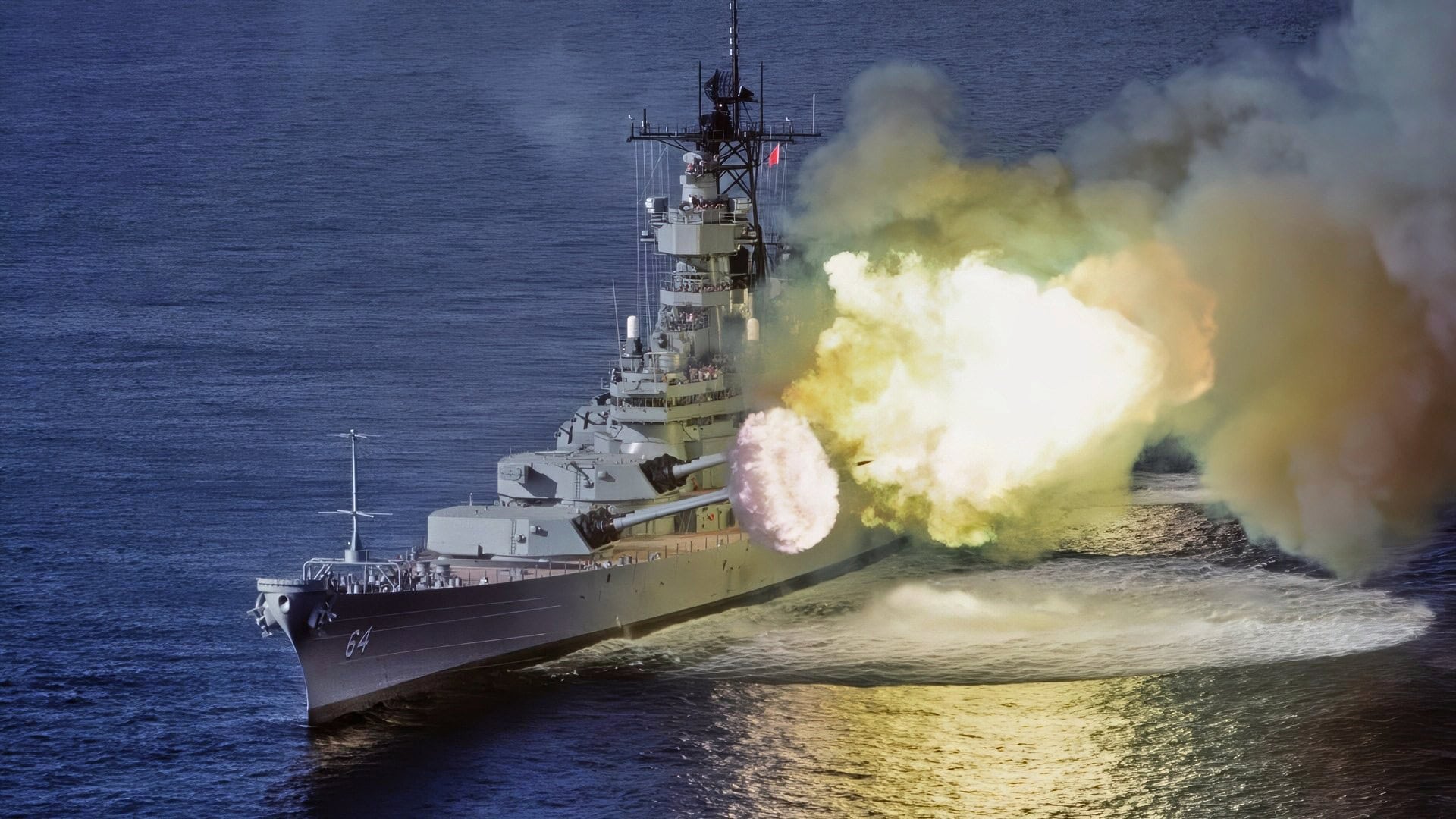
Iowa-Class Battleship Firing Guns. Image Credit: Creative Commons.
The 16-inch/50-caliber Mark 7 fired a 1,900-pound high-capacity shell for shore attack and a 2,700-pound armor-piercing projectile. A full high-capacity broadside placed 17,100 pounds of projectiles in flight. The twenty 5-inch/38 guns fired faster, handled exposed targets, and supplied illumination during night fighting.
USS Missouri Fired 6,756 16-Inch Rounds Across Two Deployments
Missouri left Norfolk on August 19, 1950, and opened fire near Samchok on September 15. Its first Korean mission used 52 heavy projectiles and damaged two railroad bridges. The battleship later supported operations around Inchon, attacked transportation and industrial targets along the east coast, and covered the Hungnam evacuation after the withdrawal from the Chosin Reservoir.
The Missouri memorial’s deployment records provide unusually complete ammunition figures. Between September 1950 and March 1951, the ship fired 2,895 16-inch rounds and 8,043 rounds from the 5-inch battery. Its second deployment, from September 1952 through March 1953, added 3,861 heavy rounds and 4,379 5-inch shells.
The two tours produced 6,756 main-battery rounds and 12,422 secondary-battery rounds. On March 10, 1953, Missouri answered shore batteries with 998 5-inch shells, its largest one-day expenditure from those weapons. Its final Korean fire mission came on March 25, when the ship sent 102 16-inch and 61 5-inch rounds toward targets near Kojo.
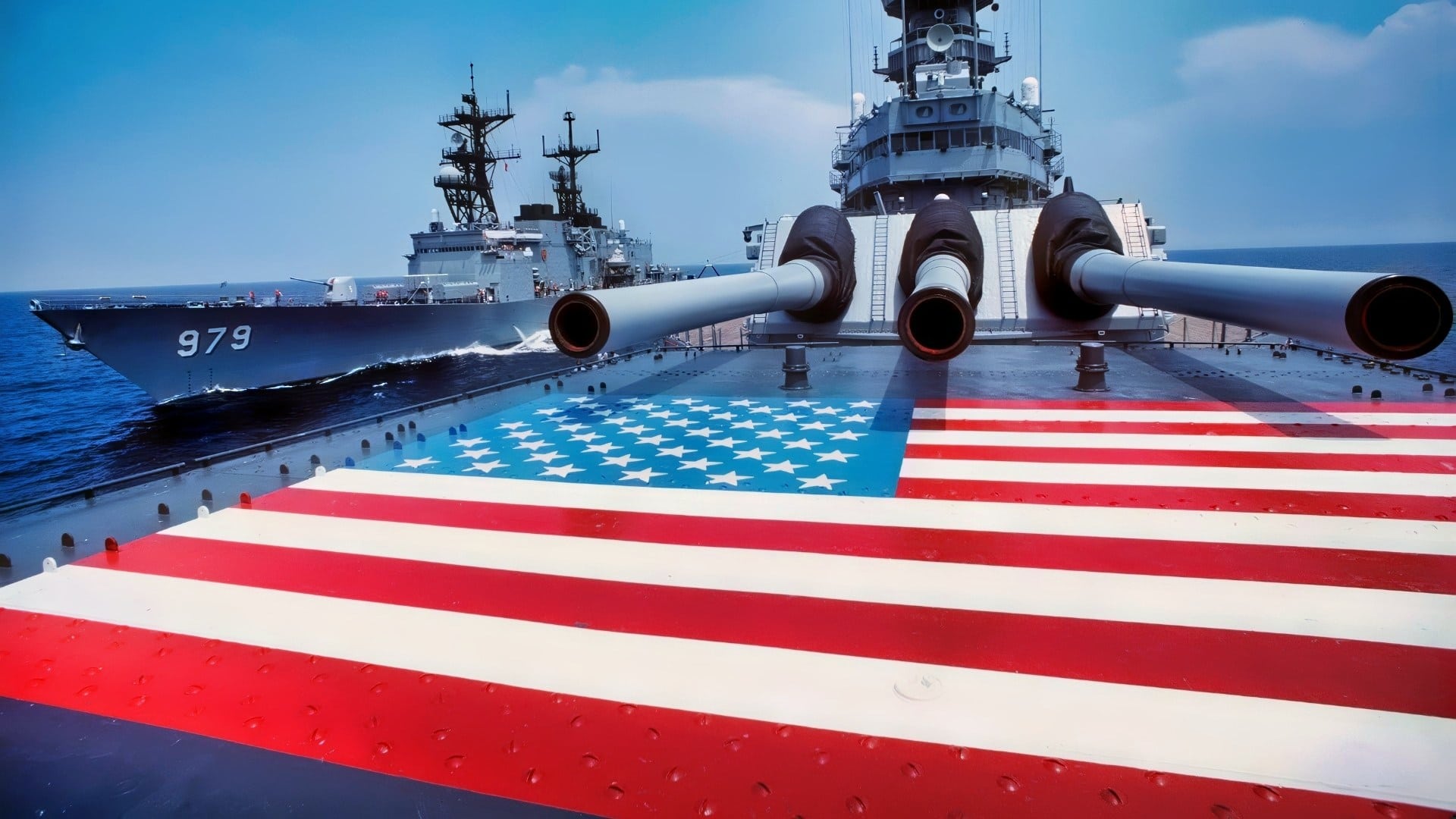
Iowa-Class U.S. Navy Battleships Flag. Image Credit: Creative Commons.
North Korean batteries fired on Missouri on March 5 and again on March 10. The ship’s published history records no hit. Missouri departed before the armistice and did not return to combat in Korea.
USS New Jersey Fired Nearly 10,000 Rounds and Lost One Sailor
New Jersey reached the Korean coast in May 1951 as Seventh Fleet flagship. On May 21, while bombarding Wonsan, a North Korean round struck Turret I. The impact left only superficial damage on the armored structure. Another shell burst nearby, scattering fragments that killed Seaman Robert Oesterwind and wounded three shipmates. The armor protected the ship, while sailors in exposed positions remained vulnerable.
New Jersey returned fire and silenced the battery. During its two Korean deployments, the ship operated around Wonsan, Kansong, Hungnam, Songjin, and Chongjin, alternating between carrier protection and bombardment. Its helicopters recovered downed aviators while the guns struck trains, rail junctions, tunnels, supply areas, and artillery positions.
Naval History and Heritage Command records nearly 10,000 rounds fired during the two tours, including more than 3,000 16-inch projectiles. The first deployment alone consumed about three times the heavy ammunition New Jersey had fired throughout World War II.
New Jersey returned to Korea in April 1953. On July 27, as the armistice took effect, its guns delivered the last bombardment by an American battleship during the war. Other ships continued firing until the cease-fire deadline, including the cruiser USS Saint Paul, credited with the final naval round.
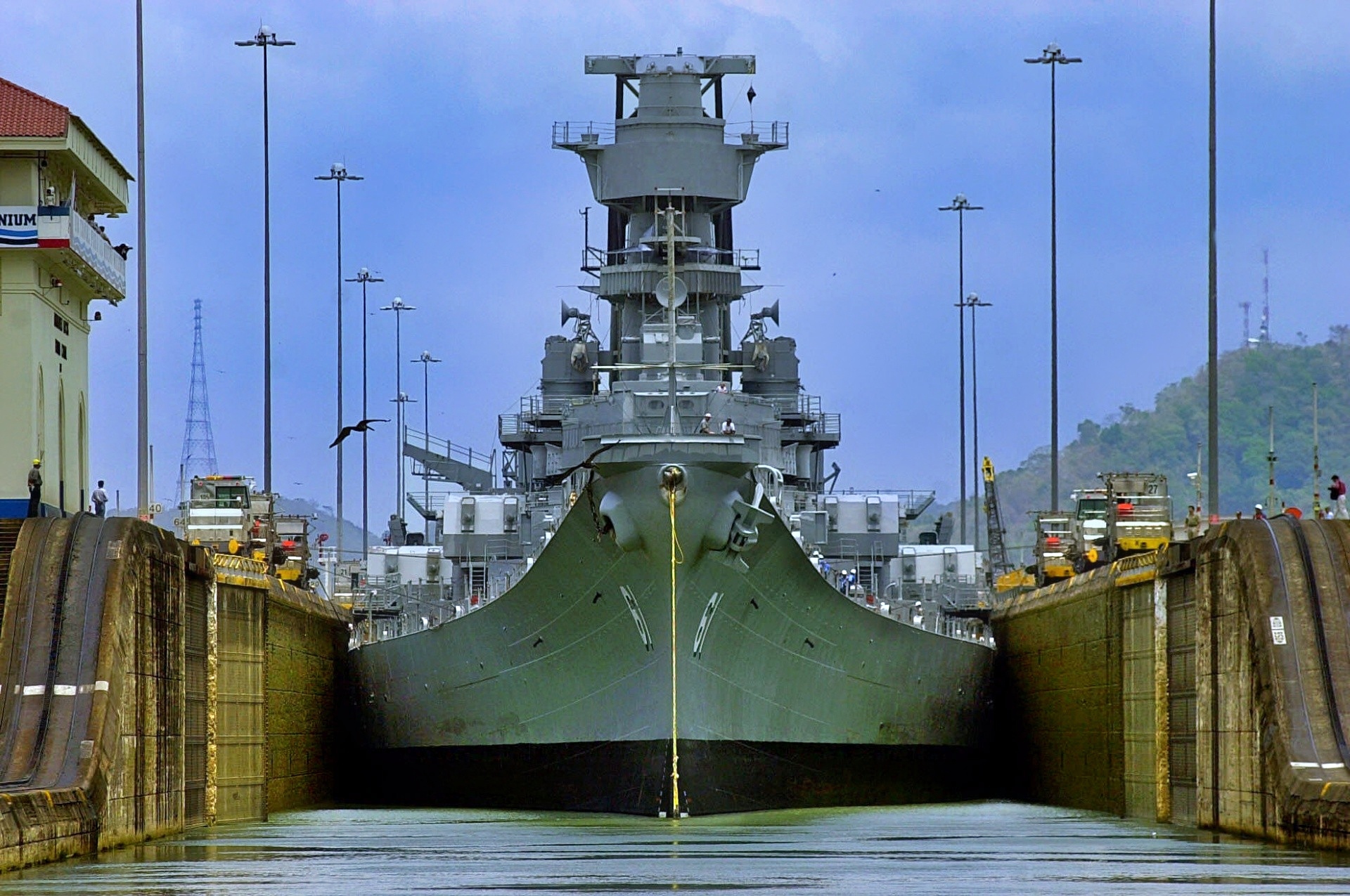
USS Iowa Battleship. Image Credit: Creative Commons.
USS Wisconsin Fired 977 Heavy Shells and Took a 155 mm Hit
Wisconsin relieved New Jersey in November 1951 and supported the Republic of Korea I Corps and the U.S. 1st Marine Division. A National Register history credits Wisconsin with 977 main-battery rounds fired at an average range of 16 miles. Its crews also fired illumination projectiles to expose nighttime attacks.
Four North Korean shells came toward Wisconsin near Songjin on March 15, 1952. One landed on the starboard side near a 40 mm position, injuring three sailors. The explosion damaged the mount, tore into the teak deck, cut electrical cables and affected ventilation ducts. It was the only enemy-inflicted damage recorded during the ship’s career.
Wisconsin answered with a 16-inch salvo and stayed on station. The incident showed the mismatch between a field-artillery shell and a battleship designed to withstand heavy naval gunfire. Iowa relieved the damaged Wisconsin on April 1.
USS Iowa Fired 16,689 Main and Secondary Rounds in One Tour
Iowa became Seventh Fleet flagship after arriving in April 1952. Its targets included Wonsan, Songjin, Hungnam, Kojo and Chongjin. The battleship attacked industrial facilities, bridges, railroads, tunnels and coastal batteries while supporting United Nations troops along the eastern front.
The official Navy chronology records Iowa’s 4,000th 16-inch round on October 7, 1952. Its deployment total reached 16,689 rounds from the main and secondary batteries. Published Navy histories record no combat hit on Iowa during the tour.
Iowa’s single deployment therefore accounted for more than 16,000 heavy and secondary shells against North Korean targets. Missouri accumulated the larger documented 16-inch total because it completed two combat tours.
The Iowa-Class Fought the Coast Rather Than an Enemy Fleet
American and allied control of the sea defined the mission. Carrier aircraft and smaller warships handled air defense, maritime patrol and the limited surface threat. The battleships concentrated on the coastal transport system carrying troops, ammunition and fuel through mountainous terrain.
The 861-day Siege of Wonsan became the most sustained example. Battleships, cruisers, destroyers, minesweepers and aircraft worked together to close the port and attack nearby roads, rails, factories and batteries. North Korean forces hid guns in caves, moved equipment at night and repaired damaged rail lines, forcing repeated strikes against many of the same routes.
The battleships supplied fire in darkness and bad weather without requiring a runway or exposing a pilot. They also carried enough ammunition for repeated missions before reloading. Range imposed the largest physical limit. Targets far inland remained beyond the guns, and the mountains behind the coast shielded routes and positions from direct observation.
The Navy Returned the Four Battleships to Reserve by March 1958
The armistice did not send the ships directly back to mothballs. They trained midshipmen, joined NATO exercises and deployed to the Mediterranean. On June 7, 1954, all four Iowa-class battleships steamed together off the Virginia Capes, the only time the completed class operated in one formation.
Korea also consumed barrel life. Repeated full-charge firing wore the rifling inside the 16-inch guns, and the Navy replaced barrels after the war. Spare weapons ordered for the unfinished Illinois and Kentucky and the canceled Montana class helped supply the inventory. The engineering behind the Mark 7 battery included the industrial capacity to reline or replace weapons after thousands of rounds.
Peacetime budgets, large crews and the growing importance of carrier aircraft, submarines and guided missiles worked against keeping four battleships active. Missouri was decommissioned at Puget Sound on February 26, 1955. New Jersey followed at Bayonne on August 21, 1957. Iowa entered reserve at Philadelphia on February 24, 1958.
Retirement remained temporary. Missouri’s service later extended through Desert Storm, Iowa returned during the Reagan buildup, and New Jersey completed four commissions. Wisconsin’s 1952 hit remained the only enemy-inflicted damage of its career.
Wisconsin was the last to leave active service. The Navy decommissioned it at Bayonne on March 8, 1958, then moved it to the Philadelphia reserve fleet beside Iowa. The class remained preserved for another return. New Jersey was recommissioned on April 6, 1968, for service in Vietnam.
About the Author: Harry J. Kazianis
Harry J. Kazianis (@Grecianformula) was the former Senior Director of National Security Affairs at the Center for the National Interest (CFTNI), a foreign policy think tank founded by Richard Nixon based in Washington, DC. Harry has over a decade of experience in think tanks and national security publishing. His ideas have been published in the NY Times, The Washington Post, The Wall Street Journal, CNN, and many other outlets worldwide. He has held positions at CSIS, the Heritage Foundation, the University of Nottingham, and several other institutions related to national security research and studies. He is the former Executive Editor of the National Interest and the Diplomat. He holds a Master’s degree focusing on international affairs from Harvard University.

