
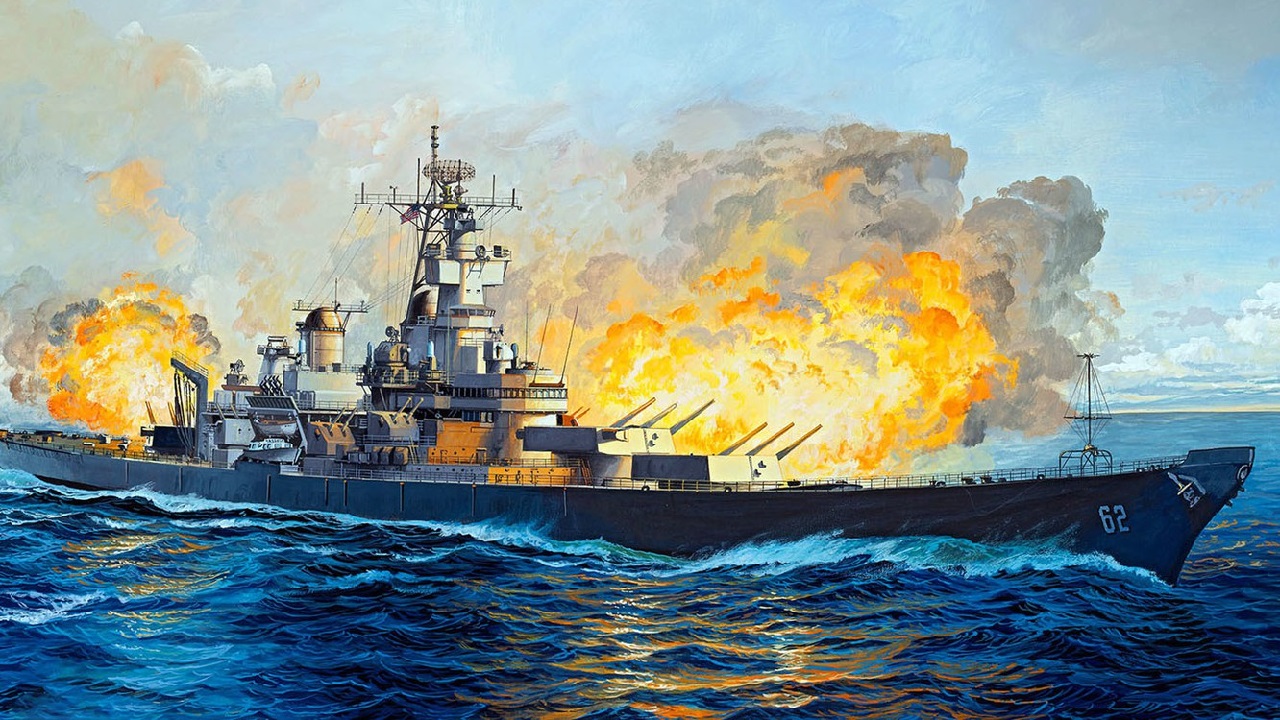
Summary and Key Points: USS New Jersey, commissioned May 23, 1943, fought in World War II, Korea, Vietnam and Lebanon across four commissions, earning 19 battle and campaign stars as the most decorated battleship in U.S. Navy history. At Truk in February 1944 she took part in the only surface engagement in which an Iowa-class battleship fired its main guns at enemy warships. Her 1968 Vietnam tour expended 5,688 sixteen-inch shells. She fired her final combat rounds off Lebanon in February 1984 and now serves as a museum ship in Camden.
Iowa-Class Battleship USS New Jersey Fought Across Four Conflicts and Half a Century
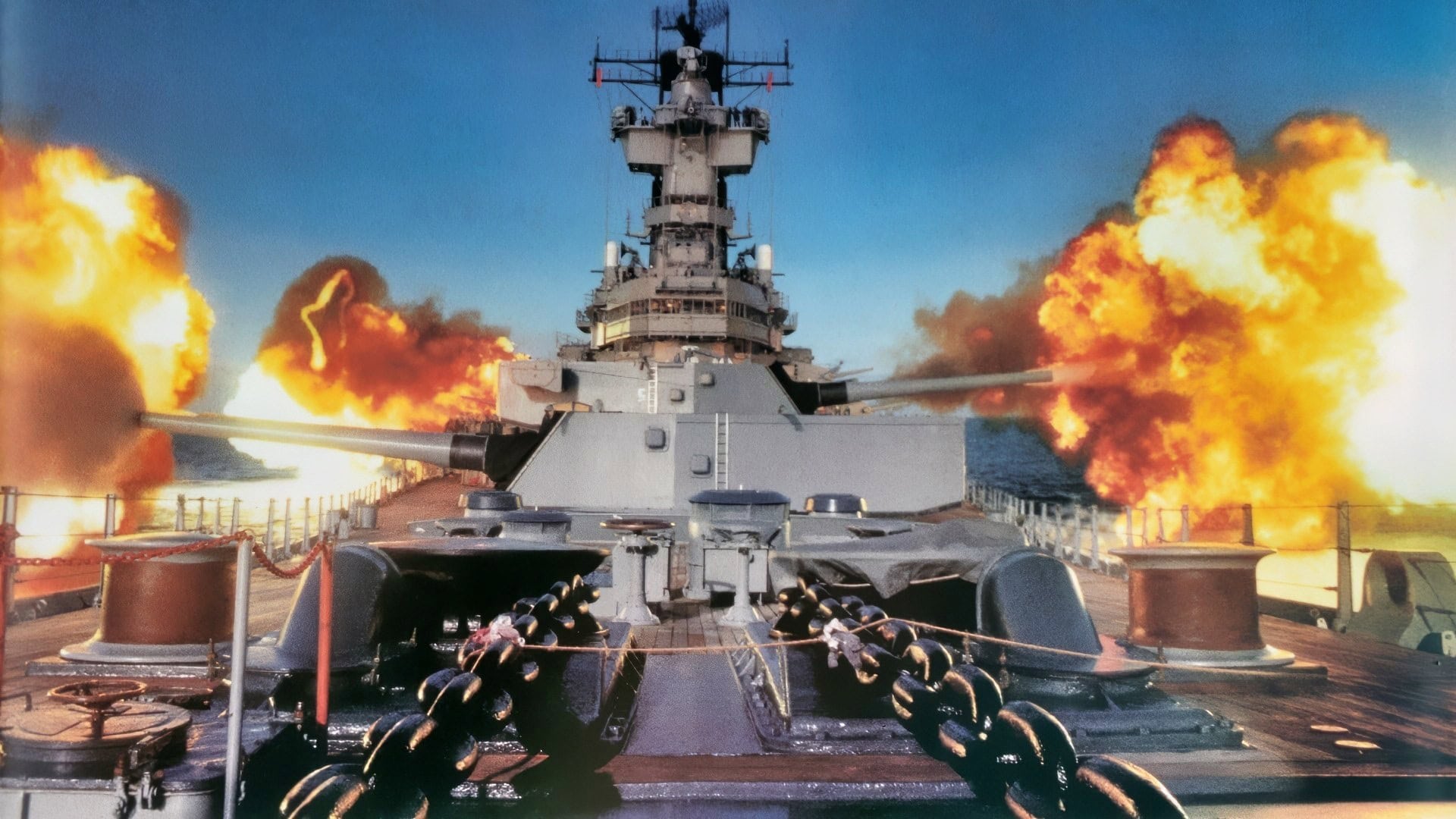
Copy negative of the US Navy (USN) Iowa Class (as built) Battleship USS NEW JERSEY (BB 62) firing a 21-gun broadside. Exact date shot unknown. Image Credit: Creative Commons.
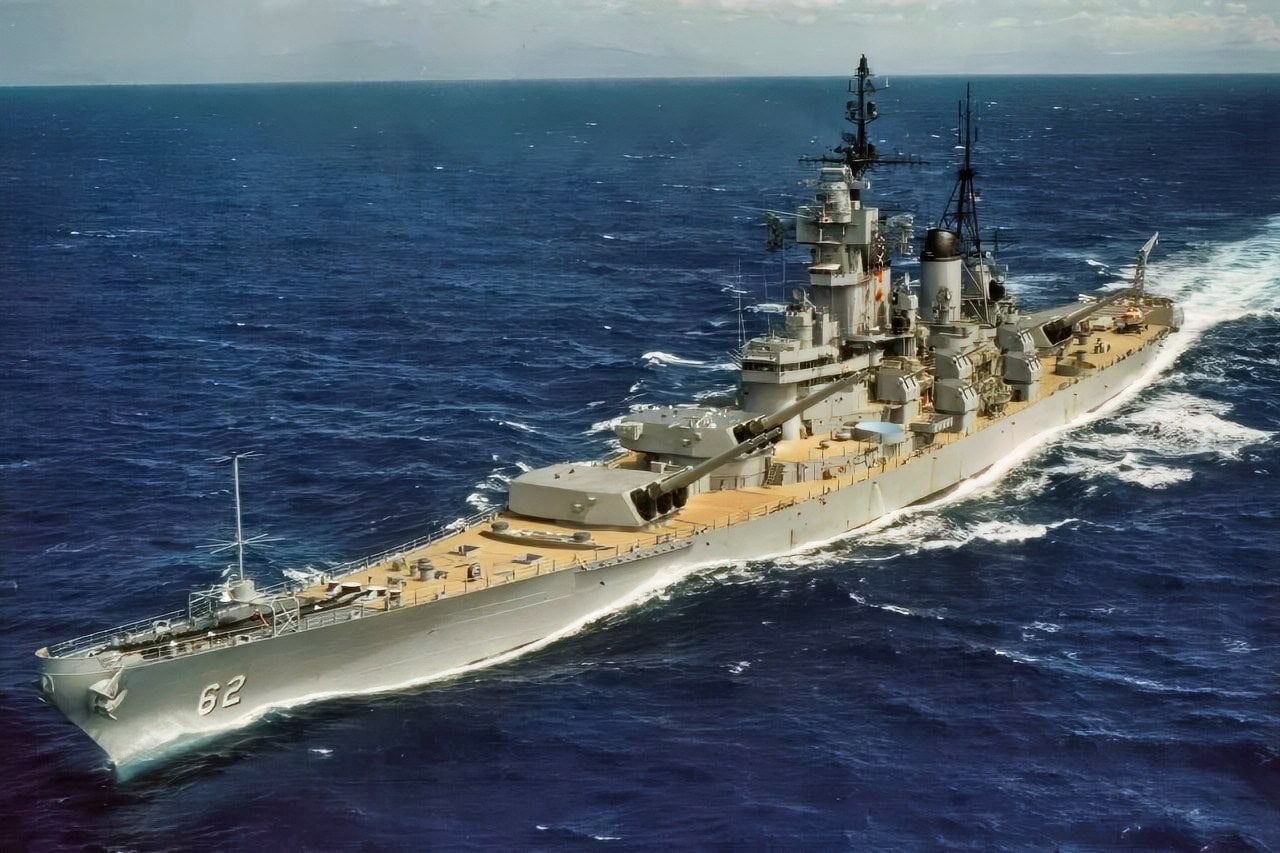
USS New Jersey Battleship. Image Credit: Creative Commons.
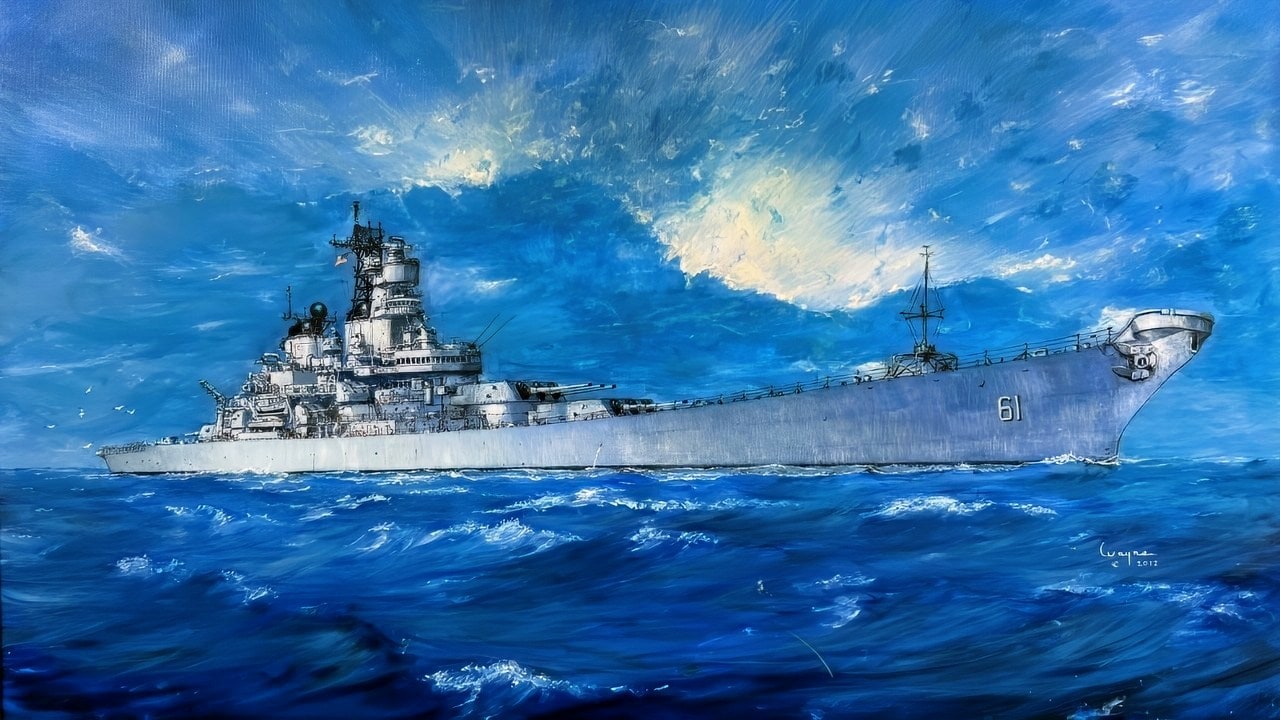
Image taken by Harry J. Kazianis aboard the USS Iowa on August 15, 2025. Image is of a painting of the USS Iowa of the Iowa-Class. USS New Jersey is also a Iowa-Class battleship.
USS New Jersey fired in combat across four conflicts separated by forty years. She entered World War II as a new fast battleship, shelled North Korean positions after a reserve recall, became the world’s only active battleship off Vietnam, and returned once more to fire 16-inch shells into Lebanon.
Commissioned on May 23, 1943, BB-62 was built to keep pace with fast aircraft carriers. Nine 16-inch guns supplied the heavy firepower, while 5-inch guns and a growing anti-aircraft battery protected the carrier force. She spent far more time screening flattops and striking land targets than hunting enemy battleships.
New Jersey eventually earned 19 battle and campaign stars. The ship’s official museum history identifies her as the most decorated battleship in U.S. Navy history and credits her with more active service than any other Iowa-class ship.
Her first Pacific combat began in January 1944 during the assault on the Marshall Islands. New Jersey guarded carriers striking Kwajalein and Eniwetok, then became Adm. Raymond Spruance’s flagship for Operation Hailstone against the Japanese base at Truk.
USS New Jersey Fought Japanese Ships at Truk
Truk produced the closest New Jersey came to the surface battle envisioned by her designers. On Feb. 17, 1944, she led Iowa, cruisers, and destroyers around the atoll to catch ships escaping American carrier attacks. Her 5-inch batteries helped destroy an armed trawler and the destroyer Maikaze. Her 16-inch guns straddled the fleeing destroyer Nowaki at extreme range, although the Japanese ship escaped. The Navy’s official ship history records the action as the class’s rare opportunity to use its main battery against ships at sea.
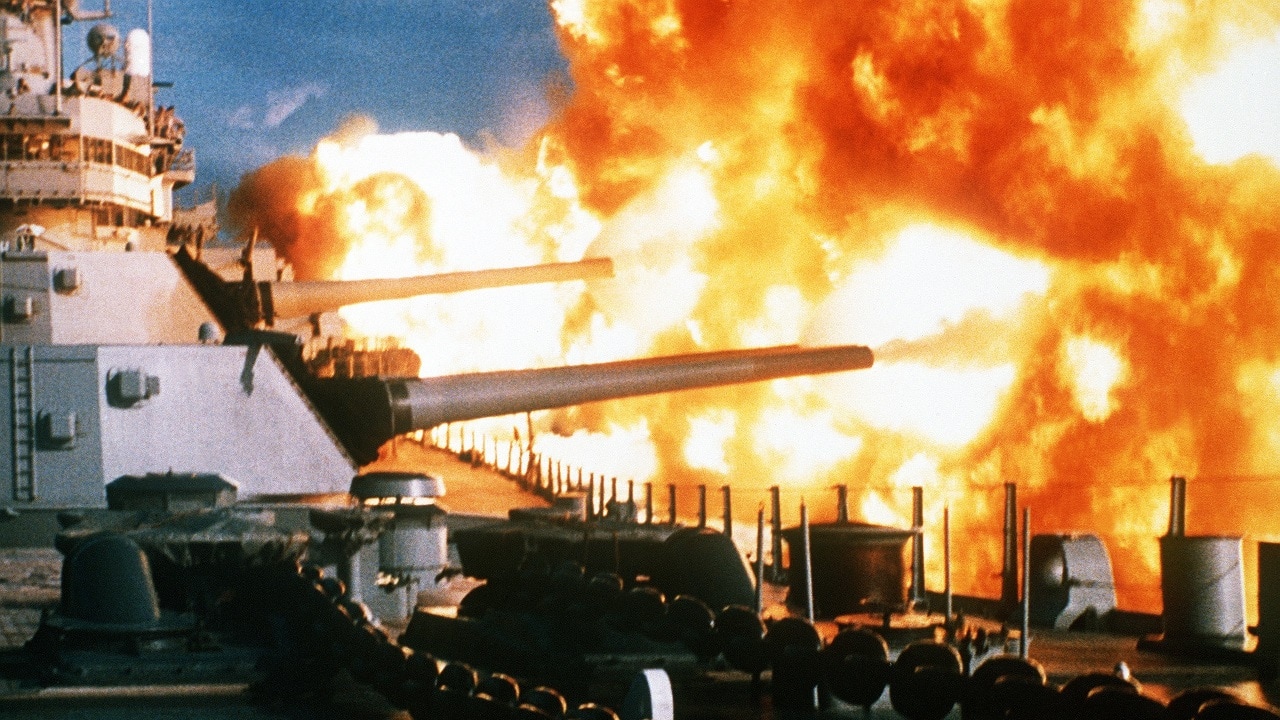
The Iowa-class battleship USS New Jersey fires at positions near Beirut on 9 January 1984 during the Lebanese Civil War.

USS New Jersey (BB 62) fires her 16” guns during a training exercise at San Clemente Island during fleet training exercises conducted off the coast of California. Photographed, July 15, 1968. Official U.S. Navy Photograph, now in the collections of the National Archives.
It was the only surface engagement in which an Iowa-class battleship fired its main guns at enemy warships. The class never fired at an enemy battleship. Carrier aircraft had already taken over the fleet’s offensive role, leaving New Jersey to protect the ships whose planes reached hundreds of miles beyond her guns. The change explains why the Iowa class found its greatest value outside a traditional battle line.
The carrier-screening mission placed her at the Battle of the Philippine Sea in June 1944. New Jersey stood ahead of the carriers with the fast-battleship screen and helped shoot down Japanese aircraft during the Marianas Turkey Shoot. The battle wrecked Japan’s carrier air arm and protected the landings on Saipan.
Four months later, New Jersey served as Adm. William Halsey’s flagship during the Battle of Leyte Gulf. The ship became the command center for several disputed decisions as Halsey raced north after Japanese carriers and left San Bernardino Strait unguarded. New Jersey never received the battleship duel her crew expected.
New Jersey later screened carrier strikes against Luzon, Formosa, Indochina, and Japan. She supported the invasions of Iwo Jima and Okinawa, bombarded Japanese-held islands, fought off kamikazes, and helped recover downed aviators. She finished World War II with nine battle stars.
USS New Jersey Took a Direct Hit in Korea
The Navy brought New Jersey back after North Korea invaded the South in 1950. Recommissioned in November, she reached the Korean coast in May 1951 and began firing against supply lines, troop positions, and transportation targets near Kansong and Wonsan. The Navy’s Korean War chronology records her arrival as the return of heavy battleship gunfire to the conflict.
On May 21, a North Korean shell struck Turret One. A near miss threw fragments across the ship and killed Seaman Robert Oesterwind, the only New Jersey sailor lost to enemy action during the ship’s four commissions. The battleship returned fire and destroyed the battery. Official records list the damage as superficial but confirm the combat loss aboard the ship.
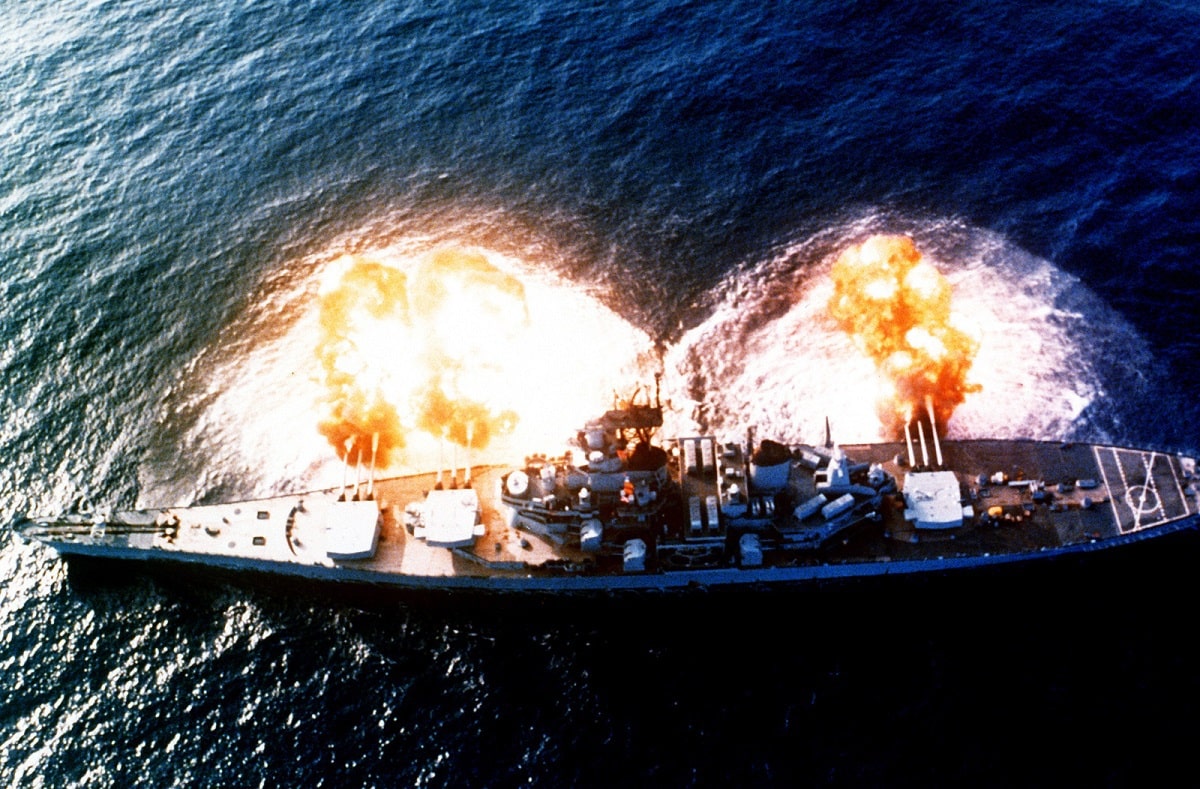
An overhead view of the battleship USS NEW JERSEY (BB-62) firing a full broadside to starboard during a main battery firing exercise.
New Jersey’s guns struck bridges, rail yards, tunnels, bunkers, artillery sites, ammunition dumps, and coastal defenses. The 16-inch battery reached targets far beyond most Army artillery. During her first Korean tour, she fired roughly three times as much 16-inch ammunition as she had during World War II.
A second deployment began in 1953 as armistice negotiations moved toward an end. New Jersey continued bombarding coastal targets and supporting United Nations forces until the fighting stopped on July 27. The final Korean War operational record shows enemy batteries repeatedly trying and failing to drive her away from Wonsan. Her two Korean tours earned four battle stars and wore out the rifling in her main-gun barrels, which the Navy replaced after the war.
USS New Jersey Became the Only Battleship in Vietnam
Vietnam brought New Jersey out of reserve again. The Navy selected her because she was in the best physical condition of the four Iowa-class ships and spent $21.5 million on a rapid reactivation. Her return demonstrated how quickly a preserved battleship still added heavy naval gunfire. She recommissioned on April 6, 1968.
New Jersey opened fire on Sept. 30 against positions near the Demilitarized Zone. Her shells hit artillery sites, bunkers, storage areas, roads, and infiltration routes in North and South Vietnam. The guns delivered heavy fire without risking a pilot over one of the world’s most dangerous air-defense networks.
During the deployment, New Jersey fired 5,688 16-inch shells and 14,891 5-inch rounds, according to the Naval History and Heritage Command’s Vietnam record. Her single tour sent almost as many 16-inch projectiles downrange as her World War II service and both Korean deployments combined. Marines and soldiers used the battleship for planned bombardments and rapid calls for fire.
The ship earned three Vietnam battle stars and a Navy Unit Commendation. The scale of her bombardment set a record unmatched by her previous deployments. The tactical performance did not protect the program from budget pressure. The Navy canceled a planned second deployment and decommissioned New Jersey again in December 1969.
USS New Jersey Fired Her Last Combat Rounds in Lebanon
President Ronald Reagan recommissioned New Jersey in December 1982 with Tomahawk and Harpoon missiles, modern radar, electronic warfare equipment, and Phalanx close-in guns. The upgraded battleship reached Beirut on Sept. 25, 1983, as American Marines serving in a multinational peacekeeping force came under growing attack.
New Jersey fired 11 16-inch shells on Dec. 14 after Syrian-controlled air defenses engaged American reconnaissance aircraft. The long range, limited spotting, and ammunition shortages reduced the mission’s effectiveness.
On Feb. 8, 1984, the battleship fired 288 16-inch rounds during nine hours against Syrian and Druze positions east of Beirut. The Navy’s history of the Lebanon operation describes it as the heaviest American naval bombardment since the Korean War. The firepower was immense, but it did not reverse the political and military collapse ashore.
The bombardment also reinforced the view among some Lebanese factions that the United States had moved from neutral peacekeeping toward support for one side. The Marine Corps’ history of the deployment places New Jersey’s gunfire within a deteriorating mission as the Marines prepared to leave Beirut.
New Jersey fired another 13 main-battery rounds on Feb. 26 after American aircraft drew fire. Those became her final combat shots. She left Lebanon in April, later entered the Persian Gulf during a tense 1989 deployment without firing a shot, and was decommissioned for the last time on Feb. 8, 1991.
The ship now rests as a museum in Camden, where visitors can descend into Turret Two and see the hoists and handling rooms built to move 16-inch ammunition.
About the Author: Harry J. Kazianis
Harry J. Kazianis (@Grecianformula) was the former Senior Director of National Security Affairs at the Center for the National Interest, a foreign policy think tank founded by Richard Nixon in Washington, D.C. Harry has more than a decade of experience in think tanks and national security publishing. His ideas have been published in The New York Times, The Washington Post, The Wall Street Journal, CNN and many other outlets worldwide. He has held positions at CSIS, the Heritage Foundation, the University of Nottingham and several other institutions related to national security research and studies. He is the former Executive Editor of The National Interest and The Diplomat. He holds a master’s degree focusing on international affairs from Harvard University.

