
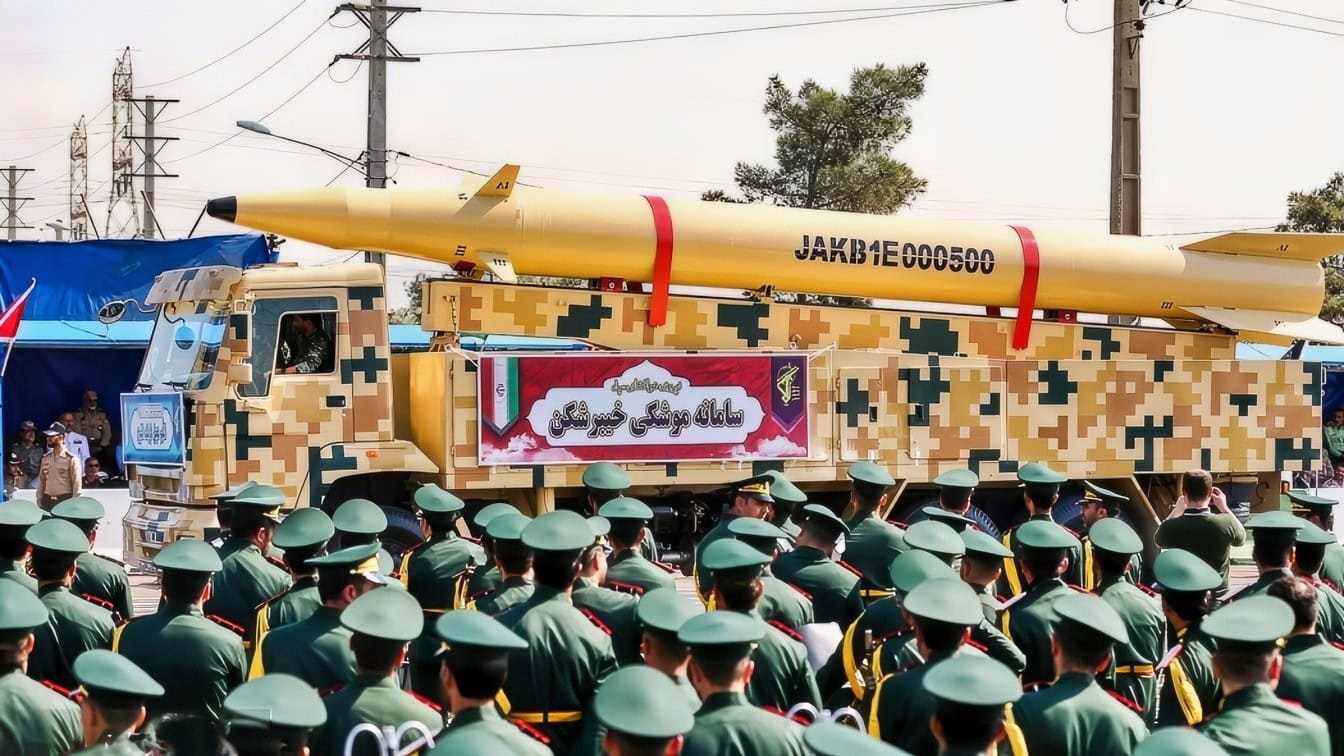
Iranian Kheibar Shekan “Fortress Buster” Ballistic Missile Used Against US Bases In The Middle East – The Kheibar Shekan is an Iranian solid-fuel, medium-range ballistic missile (MRBM) operated by the Islamic Revolutionary Guard Corps (IRGC) Aerospace Force.
Unveiled in 2022, its name translates to “Castle Breaker” or “Fortress Buster.”
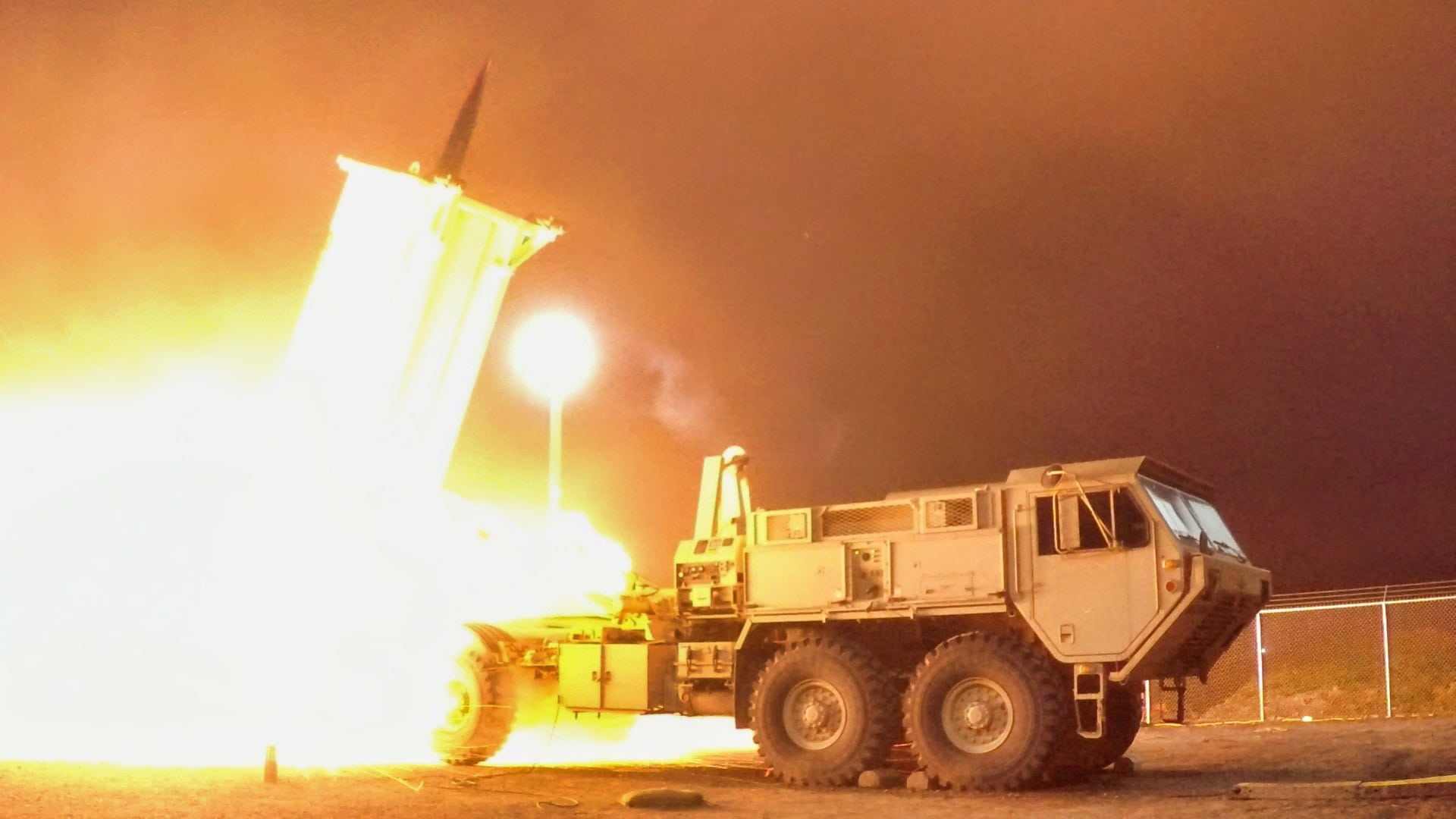
THAAD. Image Credit: Department of Defense.
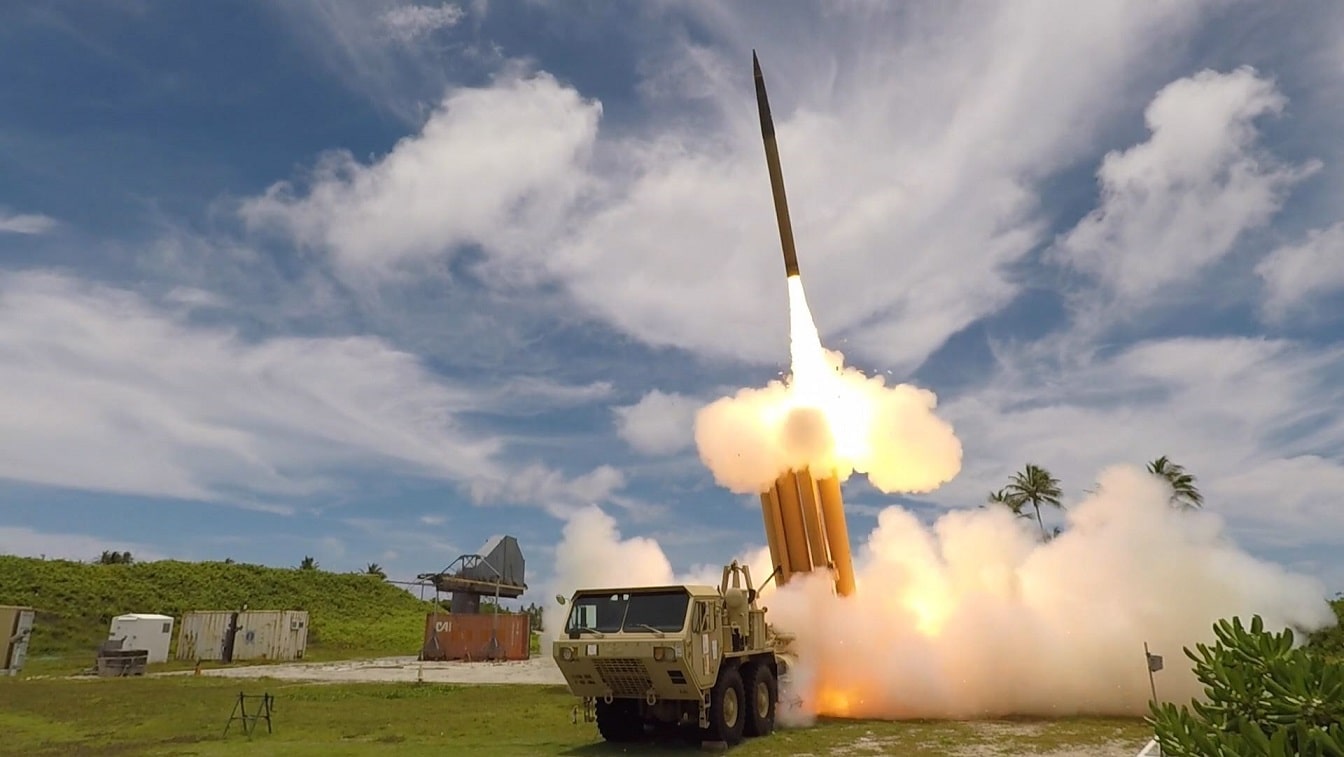
THAAD Missile Defense Battery Firing. Image Credit: Lockheed Martin.
The Iranians have utilized Kheibar Shekan ballistic missiles to target U.S. bases across the Middle East by reportedly altering flight paths, speeds, and mid-air maneuvers to breach American air defenses, according to unnamed U.S. officials quoted by The Wall Street Journal.
Ukrainian President Volodymyr Zelenskyy stated that Russia has used satellites to conduct reconnaissance on U.S. bases in the Gulf, sharing intelligence with Iran, aiding in their targeting.
“There is a clear correlation between Russia’s satellite imagery of these sites and Iranian strikes,” Zelenskyy said.
The Kheibar Shekan Ballistic Missile
The Iranians debuted the intermediate-range ballistic missile in 2022. It has an estimated range of about 900 miles (1,450 kilometers), putting the entire Middle East, Israel, parts of India, and NATO member Turkey within striking distance.
The missile is named after the Battle of Khaybar, in 628 AD, when the Islamic Prophet Muhammad’s forces conquered the fortified oasis of Khaybar, located about 150 km northwest of Medina and home to Arabian Jews, according to the EB.
The Iranians are increasingly relying on this particular missile, used in conjunction with drone strikes, often varying its trajectory, speed, and maneuvering to complicate interception efforts.
Some missiles can perform last-minute maneuvers using aerodynamic fins rather than movable nozzles in the final stage of flight, helping them avoid interceptors.
Unlike Iran’s Fattah-1 missile, which features a secondary solid-propellant motor equipped with a flex-nozzle (movable nozzle) for thrust vector control in the upper atmosphere, the Kheibar Shekan achieves its trajectory adjustments using external aerodynamic surfaces.
While the majority of the missiles have been shot down, some have gotten through the defenses of the US and partner nations. The Iranians have been studying the flight paths of the intercepted missiles and trying to better learn how to circumvent missile defenses.
The Kheibar Shekan Missiles Are “Cheap, Lethal, And Accurate”
The solid fuel allows the medium-range ballistic missile to be readied for launch in only about 15 minutes, significantly shortening the time that liquid-fueled missiles take to be ready.
The truck-mounted, road-mobile launcher system also significantly reduces setup and preparation time before firing. The missile launcher is mounted on a 10-wheel commercial chassis that can also be camouflaged as a commercial vehicle.
The missile is 10.5 meters (34.5 feet) long and weighs 4.5 tons. The missile has a diameter of 76 centimeters (about 30 inches). The warhead’s weight is 550 kgs or about 1,200 pounds of explosive.
The warhead’s impact velocity is reportedly estimated at Mach 2-3, although some Iranian officials claim it is much faster.
Wreckage from one missile shows that Tehran has integrated anti-jamming satellite navigation with a maneuverable warhead, potentially improving strike precision and resilience against electronic warfare.
The antenna, which closely resembles Chinese multi-constellation designs, could support signals from China’s BeiDou constellation alongside GPS, GLONASS or Galileo, giving the missile several navigation options.
US-Manufactured Missile Defenses Are Expensive
The solid-fuel ballistic missiles are believed to be significantly cheaper than the interceptors used by the U.S. and its partner nations, which can cost anywhere from several million to $15 million each.
US missile defense operations have relied heavily on THAAD and Patriot missiles, as well as AEGIS destroyers armed with SM-3 and SM-6 interceptors.
While the cost of the Iranian missile is unknown, but believed to be about $1 million due to domestic state-controlled manufacturing, local labor, and the use of modified commercial or dual-use electronics instead of costly military-grade microchips; the flyaway costs for US-manufactured air defense missiles are much higher.
The cost of a Patriot missile is about $4.5 million, while the THAAD interceptors cost $15 million per shot. The SM-3 interceptors used by the Navy range from $9.7 million to $27.9 million for the extended-range version. The SM-6 averages between $4.3 and $4.9 million per shot.
Military analysts believe that continuously expending high-end interceptor stockpiles against lower-cost incoming projectiles presents a long-term sustainability challenge for the US and its allies in the region.
Nicole Grajewski, an Iranian strategist at Sciences Po in Paris, said to the WSJ, “The Iranians kind of figured out during the war that the Kheibar Shekans are great because it’s pretty cheap to produce, it’s flexible with launch systems, and it’s pretty effective.”
Iran’s Manufacturing/Storage Of Solid-Fuel For Missiles Are Targets
After the Iranians fired 181 ballistic missiles at Israel in October 2024 after the assassination of Hezbollah leader Hassan Nasrallah and IRGC Commander Abbas Nilforoushan, the Israelis launched massive airstrikes against military targets inside Iran, including multiple facilities used to manufacture and store the solid propellant fuel for Kheibar Shekan missiles.
Iran manufactures solid rocket fuel and components for missiles like the Kheibar Shekan at key industrial complexes in Khojir and Parchin (just outside Tehran) and at Shahroud (about 350 kilometers northeast of the capital).
In the event of continued hostilities, these sites will once again be heavily targeted by US airstrikes.
Storage and final assembly occur largely within dispersed underground tunnel networks and hardened military bases operated by the Islamic Revolutionary Guard Corps (IRGC).
The Khojir Complex is located in the rugged terrain east of Tehran; this serves as a primary industrial hub for blending solid propellants and manufacturing rocket motors.
The Parchin Facility is a long-standing military-industrial site near Tehran used for defense research, chemical production, and missile component testing.
The IRGC’s Shahroud Facility is located further east in Semnan province. This site accommodates rocket motor development and testing for the IRGC aerospace sector.
Raw chemical precursors like sodium perchlorate—vital for creating composite solid rocket fuel—have been imported through ports such as Bandar Abbas to feed these production lines.
Not surprisingly, Iran imports sodium perchlorate primarily from suppliers in the People’s Republic of China (PRC).
According to intelligence reports and U.S. Department of the Treasury data, Chinese chemical companies and front networks have shipped thousands of tons of the material—a key precursor used to manufacture solid rocket fuel for ballistic missiles—to Iranian ports via sanctioned cargo vessels.
MORE – Iran Built a Frankenstein Tank
About the Author: Steve Balestrieri
Steve Balestrieri is a National Security Columnist. He served as a US Army Special Forces NCO and Warrant Officer. In addition to writing on defense, he covers the NFL for PatsFans.com and is a member of the Pro Football Writers of America (PFWA). His work was regularly featured in many military publications.