NATO is currently debating whether it is time to update its nuclear posture, given the threat posed by Russia.
Some speculate that NATO should increase the number of weapons and states participating in NATO’s nuclear mission. Finland’s parliament recently voted to allow nuclear weapons on its soil, and Poland has repeatedly expressed interest in hosting American nuclear weapons and joining NATO’s nuclear sharing arrangement.
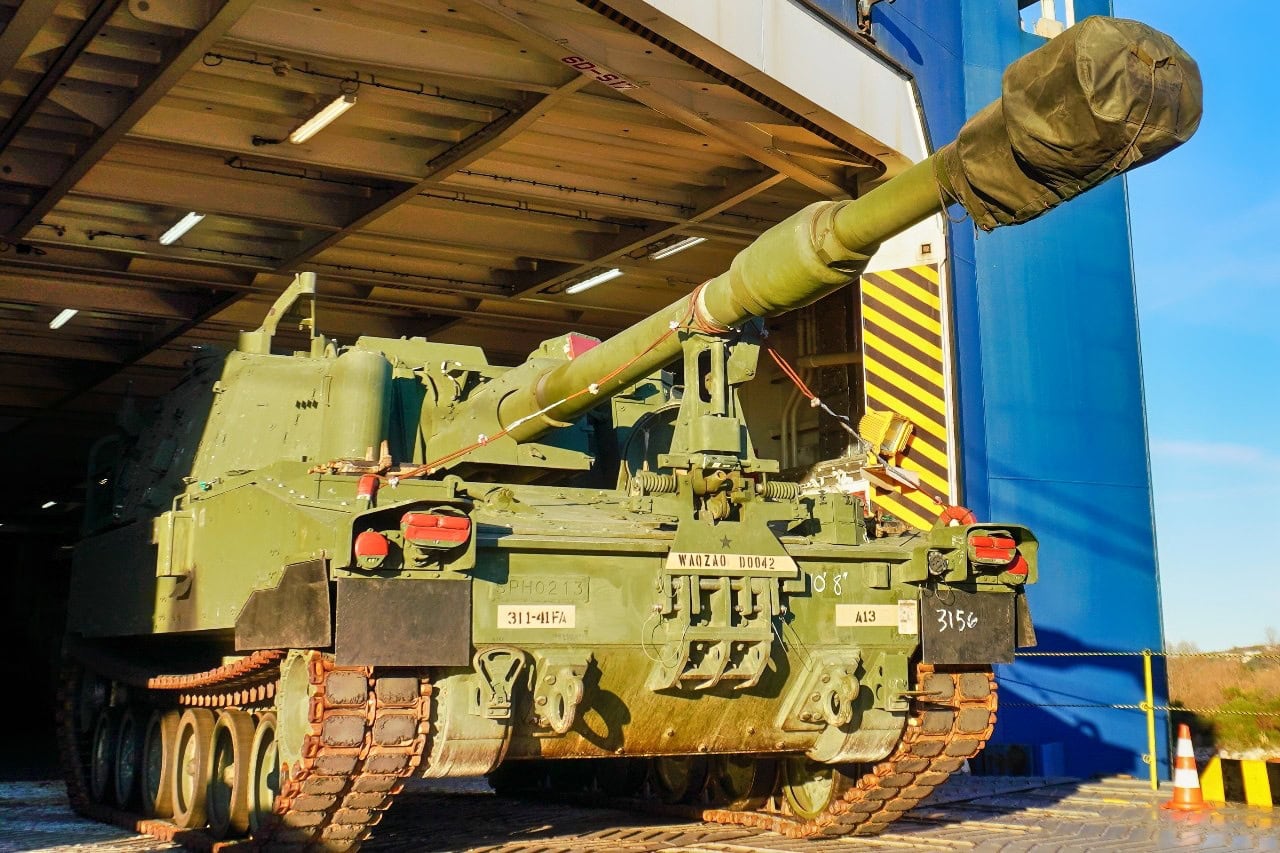
A U.S. M109 Paladin howitzer drives off the vessel Liberty Peace during offloading operations at the port of Koper, Slovenia on December 28, 2024. This Reception, Staging, and Onward Movement (RSOM) operation in the port of Koper is bringing in 1-3ID, the next Regionally Aligned Force (RAF), into the European Theater. These forces will be then transported by the 21st Theater Sustainment Command to their forward operating sites across NATO where they will conduct interoperability training with Allies and partners. The intent of these RAFs is to assure our allies and deter all adversaries.
Some, including the Heritage Foundation, have advocated that the United States deploy an additional hundred or so warheads to Europe to better deter Russian aggression.
For many critics, such proposals mark the beginning of a dangerous new arms race. But before assuming the worst, it is worth looking at what is actually being proposed.
First, the numbers themselves hardly justify the panic.
During the Cold War, the United States maintained more than 30,000 nuclear warheads, with thousands deployed in Western Europe.
It stationed almost 6,000 nuclear weapons in West Germany alone. Compared to those historical levels, the current discussion to increase the number of nuclear weapons in Europe from roughly 150 to roughly 250-300 weapons represents a limited adjustment rather than a revolutionary expansion.
Second, even if one accepts the premise that the world is entering a new era of nuclear competition, the United States is not the country responsible for it.
China is carrying out the most rapid nuclear expansion in its history.
Russia continues to modernize its strategic forces while maintaining the world’s largest stockpile of non-strategic nuclear weapons.
Indeed, Russia likely has at least a 10-to-1 advantage over NATO in non-strategic nuclear weapons. North Korea has steadily expanded its nuclear capabilities for nearly two decades.
These developments did not occur in response to a NATO decision to increase its warhead ceiling.
They occurred while the United States was operating with a significantly smaller arsenal than it possessed during the Cold War.
This distinction matters because many critics speak as though Western restraint alone determines whether an arms race occurs.
Too often, it seems that they forget that America’s adversaries possess agency of their own.
Beijing’s nuclear buildup is not contingent upon NATO policy. Moscow’s modernization efforts did not begin because the United States proposed modest increases to its arsenal.
North Korea did not develop nuclear weapons because Washington maintained too many warheads.
These states have pursued expansion independently to advance their strategic interests. Pretending otherwise confuses cause and effect.
Most importantly, the United States should not approach every discussion of military competition from a position of fear.
If deterrence requires additional capabilities to maintain credibility, policymakers should not reject them simply because adversaries may respond.
Throughout the Cold War, the United States successfully competed against a formidable Soviet Union while simultaneously maintaining the world’s strongest economy, most innovative technological sector, and most capable military alliance network.
America did not prevail because it avoided competition. It prevailed because it possessed the economic, industrial, and military strength necessary to sustain it.
None of this means policymakers should seek an arms race for its own sake. Nuclear competition carries costs and risks that deserve serious consideration. But neither should leaders allow fear of escalation to paralyze necessary decisions.
A proposal to modestly increase and expand NATO’s nuclear mission is neither unprecedented nor reckless. It is a prudent, measured response to a strategic environment shaped by the actions of Russia, China, and North Korea.
Peace endures when America’s adversaries never doubt the consequences of threatening it.
About the Authors
Robert Peters is a Senior Research Fellow for Strategic Deterrence in the Heritage Foundation’s Allison Center for National Security. Neely Grantham is a member of Heritage’s Young Leaders Program.