
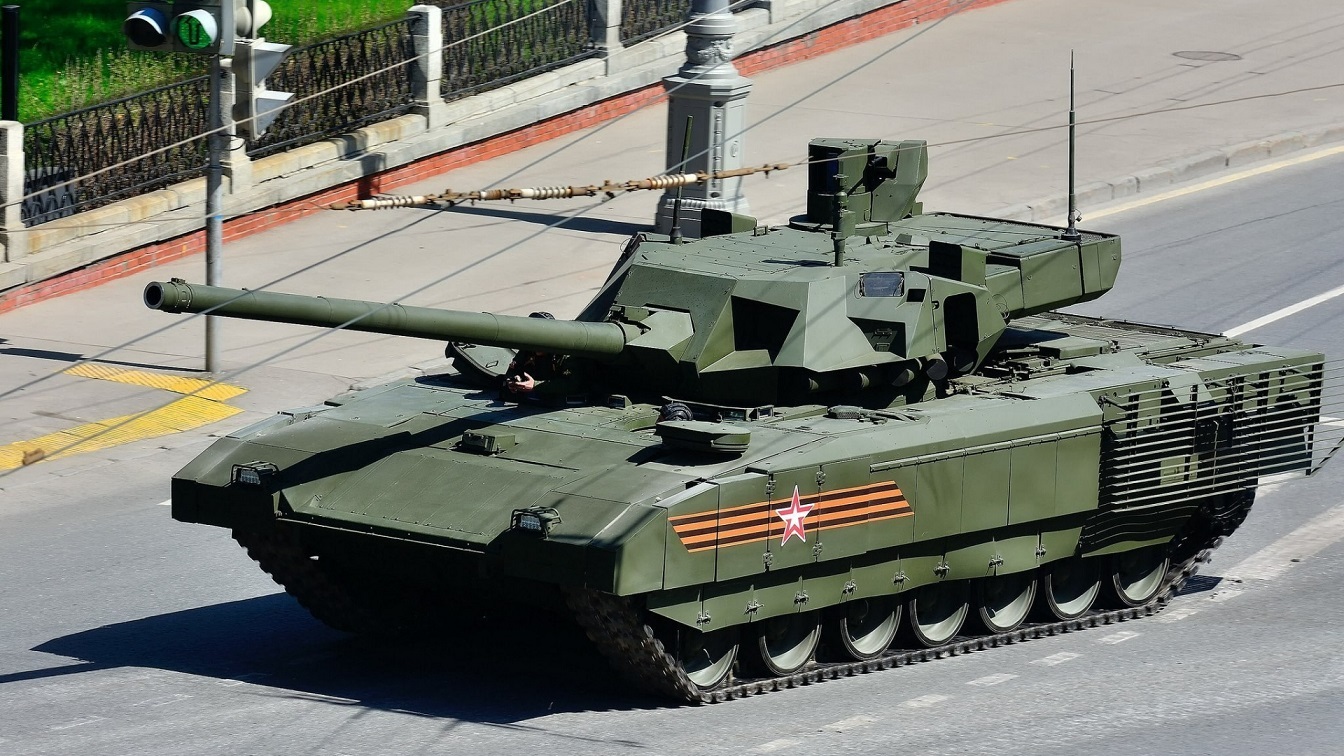
In 2015, Russia announced it would field 2,300 T-14 Armata tanks by 2020, an armored revolution meant to replace every tank the country owned. A decade later, Ukrainian military intelligence and Western analysts put the number at about twenty, a figure the tank’s own manufacturer has never contradicted with a real one. The gap between those two numbers, 2,300 promised and roughly 20 delivered, is the whole story of the most ambitious weapons program of Vladimir Putin’s rearmament, and one of its most complete failures.
The T-14 Armata Tank Failure
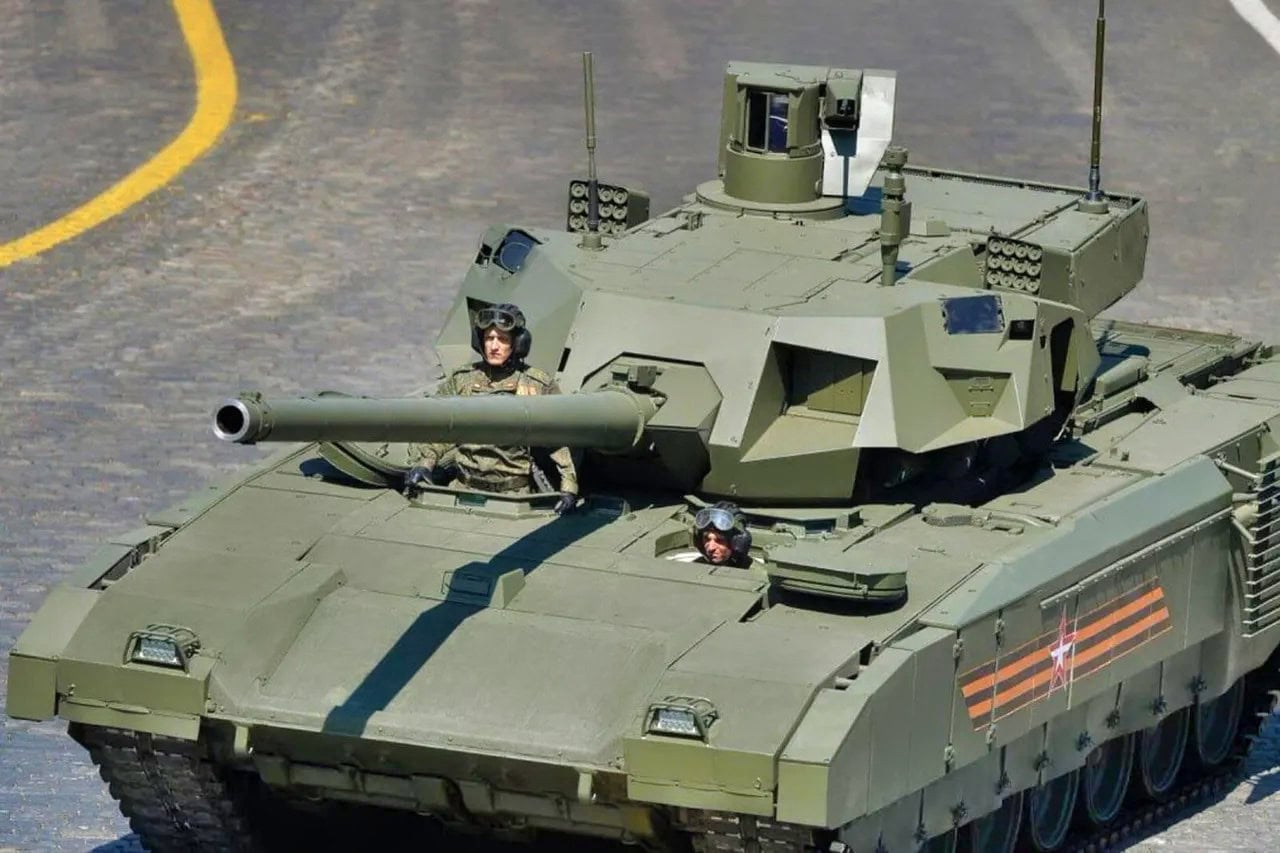
Russian T-14 Armata Tank. Image Credit: Social Media Screenshot.
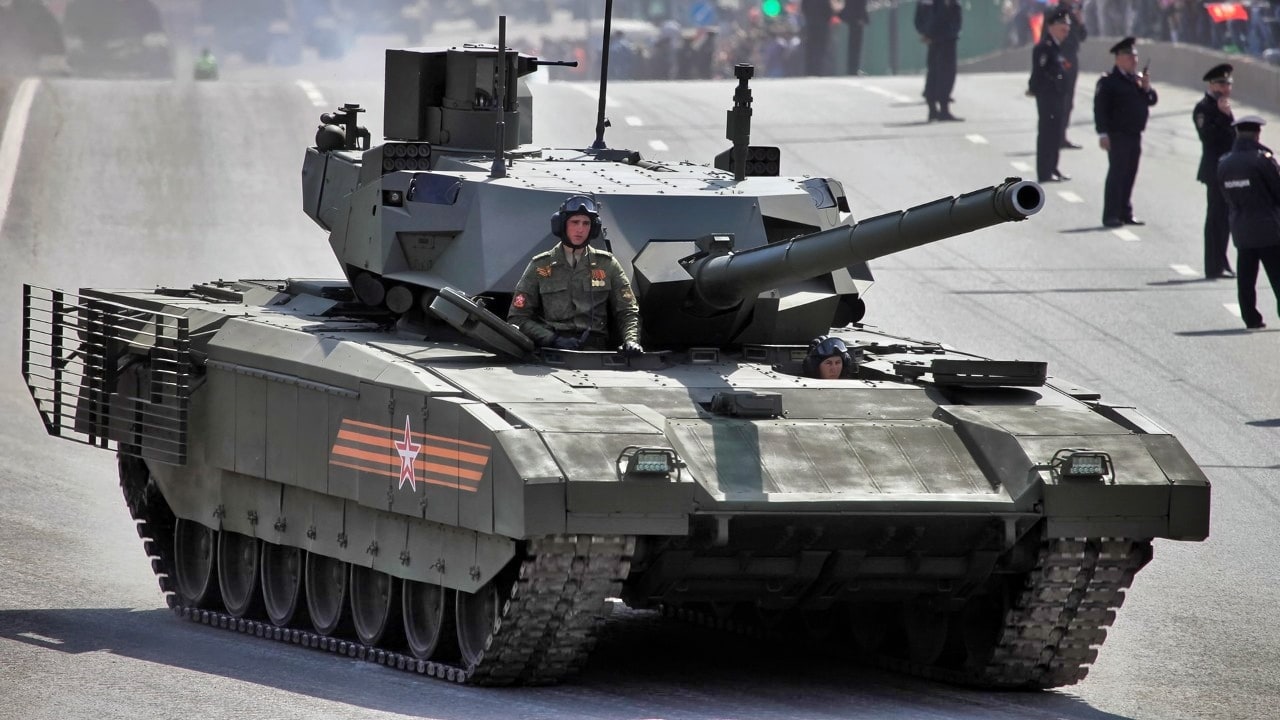
T-14 Armata Tank from Russia
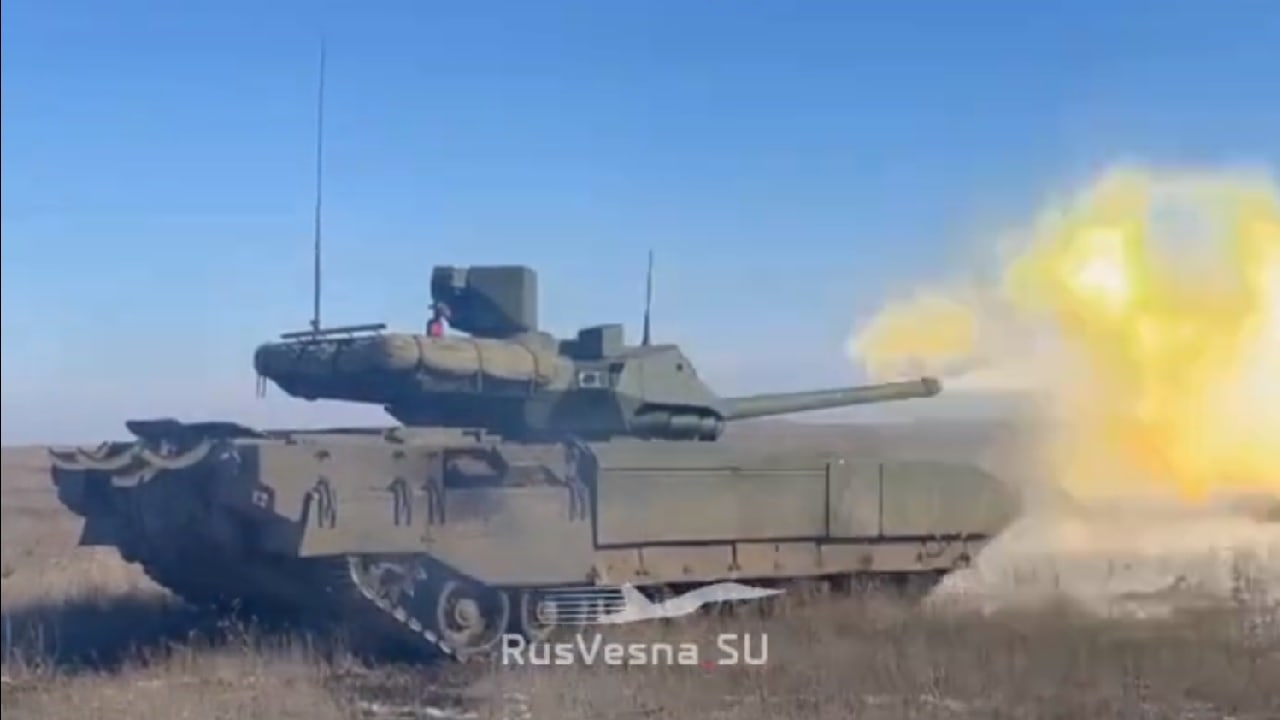
T-14 Armata Screenshot
The ambition was real, and I remember covering it years back, thinking this could be a really big deal. The T-14 was the first clean-sheet Russian tank design since the Soviet collapse, and it broke with a half-century of Soviet doctrine. Its 125-millimeter gun sits in an unmanned turret; the three-man crew rides low in an armored capsule in the hull, separated from the ammunition that has turned so many older Russian tanks into rolling bombs. An active protection system called Afghanit was designed to shoot down incoming missiles before they reached their target.
The tank was one member of the universal Armata family, a common chassis designed to spawn a heavy infantry fighting vehicle, a recovery vehicle, and more, thereby rationalizing the entire armored force onto a single platform. A leaked British Army assessment judged it the most revolutionary tank design in a generation, and the alarm it caused in NATO capitals was real enough that Germany and France accelerated work on a joint next-generation tank of their own.
The scale of the plan matched the design. The 2,300 tanks were to re-equip the Russian Ground Forces wholesale, retiring the T-72s, T-80s, and T-90s that traced their lineage to the 1970s. The tank debuted at the May 2015 Victory Day parade in Red Square, where it famously ground to a halt during the televised rehearsal and had to be towed—an omen nobody in Moscow acknowledged at the time.
But cost was the issue for sure. Yuriy Borisov, then the deputy minister overseeing procurement, admitted publicly that the funds allocated could not cover the program, with production costs running roughly 250 percent above projections.
By July 2018, Borisov, elevated to deputy prime minister, killed the mass buy outright, asking, “Why flood our military with Armatas” when upgraded T-72s were, in his telling, superior to Western tanks in price and quality, and boasting that a military budget a tenth of NATO’s demanded such efficiencies. Three years after it was announced, the 2,300-tank order was dead, replaced by a test batch of one hundred that itself kept shrinking.
The War It Was Built For, Fought Without It
Then came the war the T-14 existed to fight, and the tank sat it out. Russia’s 2022 invasion of Ukraine opened the largest armored war since 1945, and within weeks Ukrainian military intelligence reported that sanctions had stopped T-14 production, choking off the imported electronics and optics the advanced design depended on, in the year serial deliveries were supposed to begin.
In mid-2023, state media announced that a handful of Armatas had reached the front, where they reportedly fired from standoff range; within months, they were withdrawn, and no verified evidence of the combat use Moscow claimed ever surfaced.
While the future tank stayed home, the past came out of storage: Uralvagonzavod, the T-14’s builder and the largest tank plant on Earth, turned its lines over to refurbishing Soviet-era T-72s and building T-90Ms, and Russia began reactivating T-62s and even T-55s, tanks designed while Stalin’s successors ran the Kremlin, to replace staggering battlefield losses. The army fighting Russia’s biggest tank war in eighty years never received the tank built for exactly that war.
The Verdict From Moscow
The official epitaph came in March 2024 from the man who built the tank. Sergey Chemezov, chief executive of the state conglomerate Rostec and one of Putin’s closest allies, told the state news agency RIA Novosti that the Armata was superior to everything in the inventory and too expensive to use: “It’s easier for them to buy the same T-90s.”
He added, in a separate telling of the same interview, “Now we need money to create new tanks, new weapons, perhaps cheaper ones.” Pressed on numbers, Chemezov said serially produced T-14s had been delivered to the army and declined to say how many.
The arithmetic behind his shrug is brutal. Cost estimates for the T-14 have ranged from under four million dollars per vehicle in early projections to as much as nine million now, roughly double that of a T-90M, and the tank never had a true assembly line; the vehicles that exist were essentially built by hand.
A Russian official promised in 2021 that more than forty serial tanks would arrive after 2023. The count never visibly moved past the two dozen or so pre-production vehicles built for trials.
The T-14 Armata Is a Sad Tank Story
Add up what Russia bought with fifteen years of Armata spending. It funded a design bureau’s masterpiece it cannot manufacture, at a unit price its wartime economy cannot pay, dependent on foreign components its politics cut off.
It spent the program’s prestige twice, first on the promise and then on the retreat from it. The opportunity cost landed on the battlefield: every ruble and every Uralvagonzavod work hour that went into hand-building parade tanks was a ruble and an hour not spent on the T-90Ms the army uses, in a war where Russia’s answer to armor attrition has been to reach deeper into Cold War storage yards.
The T-14 proved one thing conclusively: Russia’s defense industry can still design a modern weapon. What it cannot do is build one at scale under sanctions, and a tank that cannot be built in numbers is not a weapon; it is an argument.
As of this year, the T-14 appears where it has always performed best, at arms expos and in promotional footage. It was absent from the Victory Day parade in Red Square in May 2025, the stage where it debuted ten years earlier.
Rostec has never published a production figure, and the 2,300 tanks Russia promised by 2020 remain, at about twenty built, more than 99 percent undelivered.
About the Author: Harry J. Kazianis
Harry J. Kazianis (@Grecianformula) was the former Senior Director of National Security Affairs at the Center for the National Interest (CFTNI), a foreign policy think tank founded by Richard Nixon based in Washington, DC. Harry has over a decade of experience in think tanks and national security publishing. His ideas have been published in the NY Times, The Washington Post, The Wall Street Journal, CNN, and many other outlets. He has held positions at CSIS, the Heritage Foundation, the University of Nottingham, and several other institutions related to national security research and studies. He is the former Executive Editor of the National Interest and the Diplomat. He holds a Master’s degree focusing on international affairs from Harvard University.

