
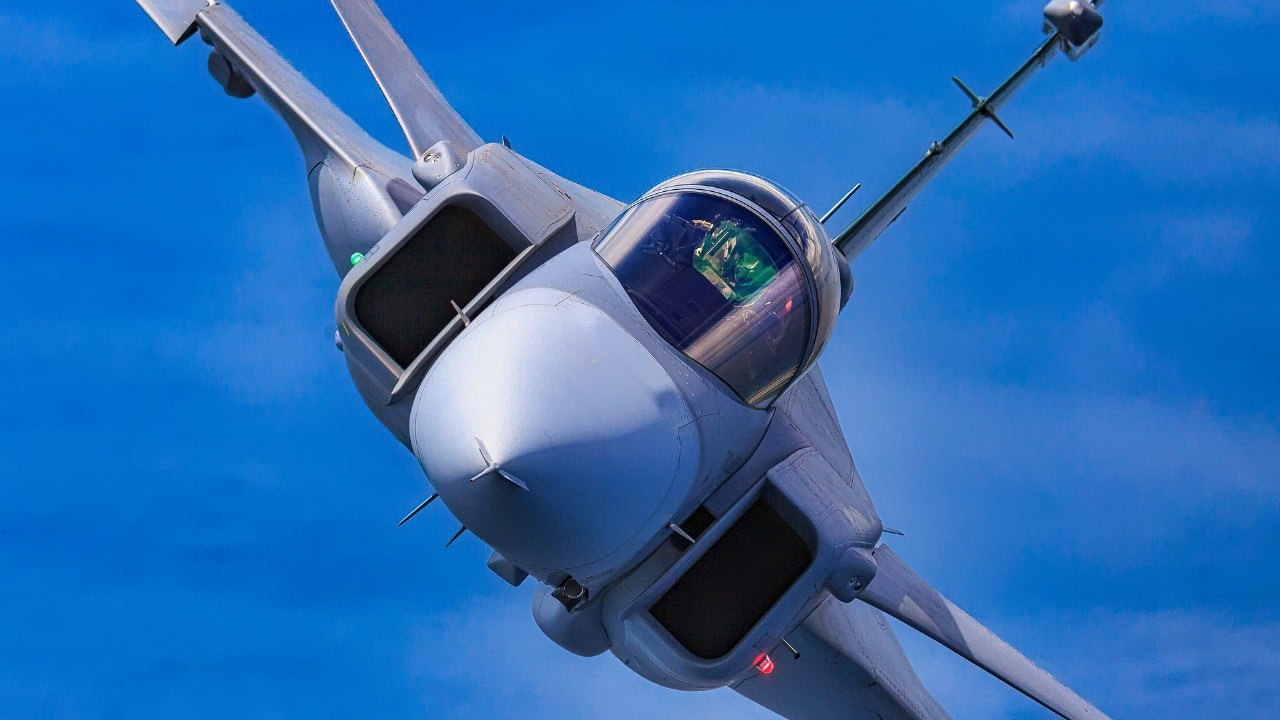
The JAS 39 Gripen Was Built to Fly After the Airfield Was Gone. That Is Why Air Forces Still Buy It – The F-22, the F-35, and China’s J-20 own the first look in a modern air war. They were designed to be hard to see. The Saab JAS 39 Gripen was designed for a different problem.
Sweden assumed that in a war with the Soviet Union, the main runways would be gone in the opening hours, and that the air force would have to generate sorties from road strips, dispersed hangars, and a small ground crew. That requirement produced a single-engine fighter that is still being sold in 2026, in a market that stealth jets are supposed to have closed.
The JAS 39 Fighter Story
JAS stands for jakt, attack, spaning — fighter, attack, reconnaissance. The program was launched in the early 1980s to replace the Viggen and, in the original requirement, the Draken as well. The first Gripen flew on December 9, 1988. A Gripen training center opened at F 7 Såtenäs on June 9, 1996; Batch Two deliveries to the Swedish Air Force began that December. The early A and B models were followed by the NATO-standard C and D, then by a redesigned E and two-seat F that share the name and almost none of the internals.
Saab’s current E-series product page lists 60 for Sweden, 36 for Brazil, 17 for Colombia, and four for Thailand — 117 before Ukraine’s June order. Hungary took the last of a C/D follow-on in June 2026. The Czech Republic and South Africa still fly the older jet. On May 28, 2026, Sweden’s prime minister and Ukraine’s president announced that Kyiv intends to buy an initial batch of up to 20 Gripen E/F aircraft and that Stockholm intends to donate up to 16 C/Ds. On June 30, Saab and FMV signed a firm order for 16 Gripen Es at 24.6 billion kronor, with deliveries in 2029–2030. Canada has not signed a fighter contract with Saab.
None of that makes the Gripen a fifth-generation aircraft. It has a radar cross-section, not a stealth shaping program. The case for it is narrower and, for many air forces, more honest.
The jet is light; it turns around fast; it can sit on a road; and the E-model’s main long-range shot is MBDA’s Meteor, a ramjet missile that outranges most of what fourth-generation rivals still carry.
A Small Air Force Wrote the Requirements
Sweden did not have the money or the geography for a U.S.-style fighter force. The aircraft had to perform three jobs from a single cockpit. It had to start and stop from short, rough strips. It had to be maintained by a handful of conscripts.
It had to keep a useful payload on one engine. Saab still advertises the C-series as capable of operating from an 800-by-16-meter stretch of ordinary highway, with an air-to-air turnaround in under ten minutes. That is the Cold War Bas 90 idea, written in metal.
The C and D models use a Volvo RM12, a licensed development of General Electric’s F404. The E switched to the larger F414G, the same family that powers the Super Hornet. Maximum takeoff weight rose from 14,000 kilograms to 16,500. Hardpoints went from eight to ten. The mechanically scanned PS-05/A radar gave way to Leonardo’s ES-05 Raven, an AESA set on a swashplate so the array can look well off-boresight without pointing the nose. A Skyward-G infrared search-and-track sensor sits in front of the canopy and looks for aircraft that are trying not to emit.
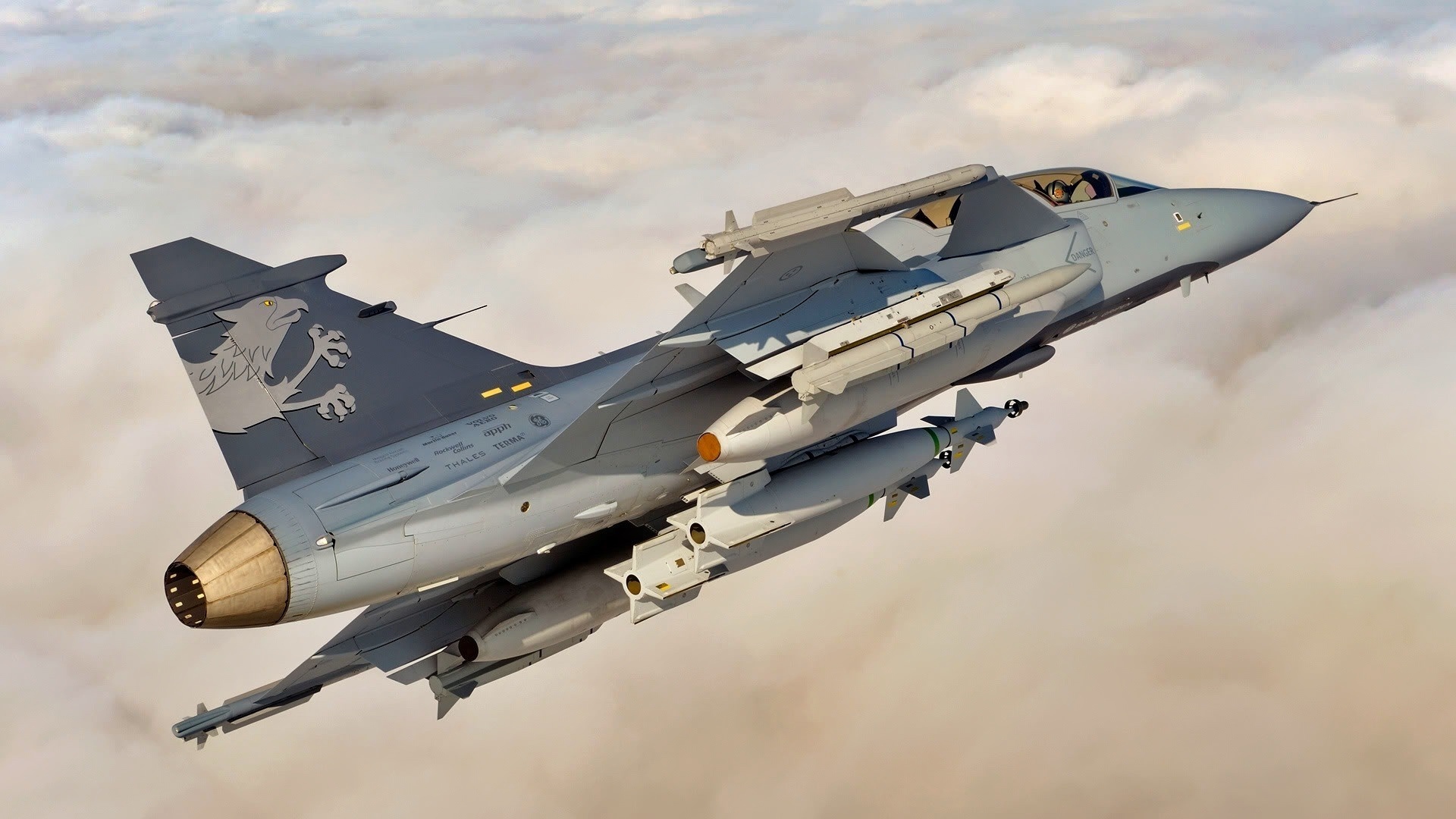
JAS 39. Image Credit: Creative Commons.
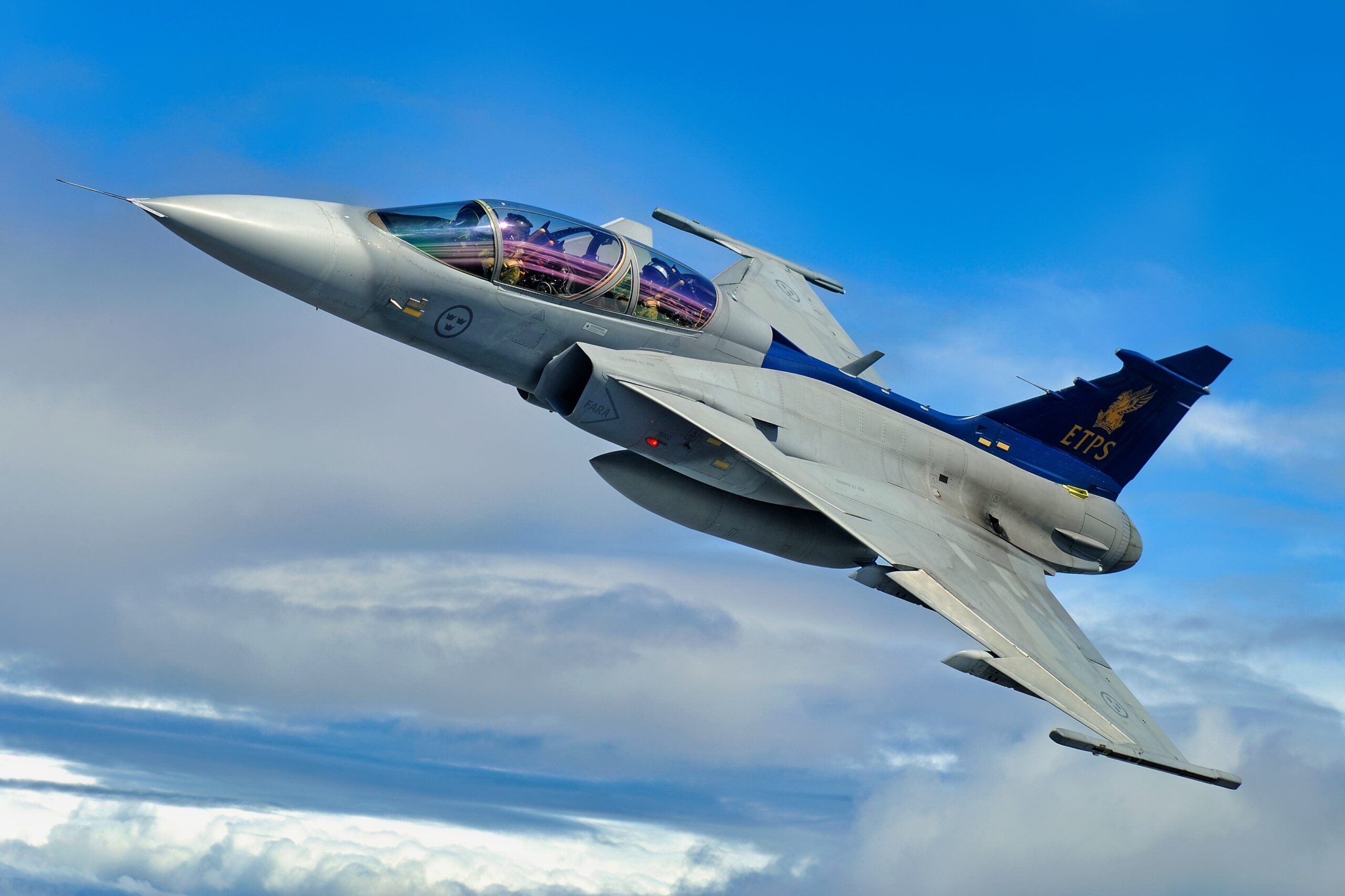
JAS 39 Gripen Fighter from Sweden. Image Credit: Creative Commons.
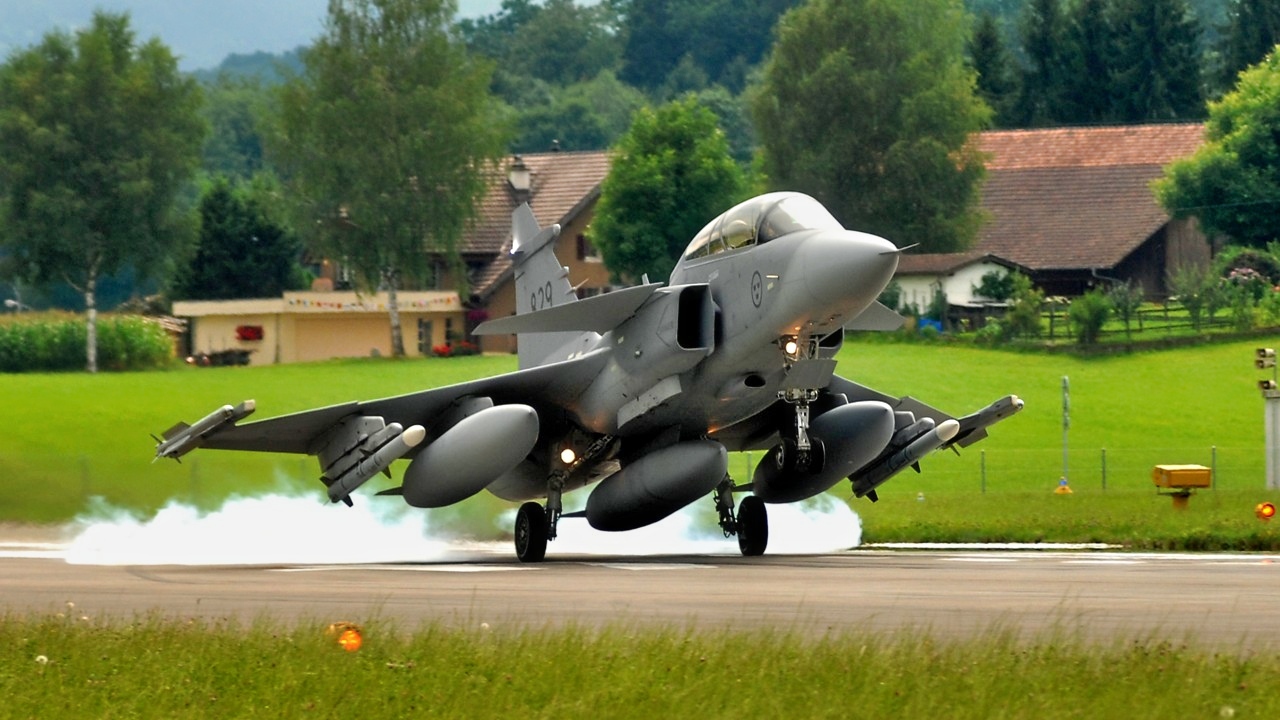
JAS 39 Gripen Fighter. Image Credit: Creative Commons.
Those are fourth-generation tools used well. They are not an F-35 sensor suite, and they are not a J-20’s frontal aspect. What they buy is a fighter that can be updated in software, hung with Western and Brazilian weapons, and parked somewhere a cruise missile did not expect. For air forces that will never field a hundred stealth jets, that is the sale.
What It Carries, and What Combat It Has Actually Seen
Saab’s brochure loadout for the E is “up to seven” Meteor beyond-visual-range missiles and two IRIS-T short-range missiles. The 27-millimeter Mauser BK-27 is the gun on the single-seaters; the two-seat D and F have no gun. The pylons also take anti-ship missiles, guided bombs, reconnaissance pods, and tanks. Older C/D jets have flown with AIM-120 AMRAAM. Sweden’s May package for Ukraine listed IRIS-T, AMRAAM, and Meteor together. The magazine is not an F-22’s internal bay. It is a conventional fighter load built around a missile that has changed the beyond-visual-range argument for every European jet that carries it.
Combat time is thin. Swedish Gripens flew reconnaissance over Libya in 2011. The government told the Riksdag the jets would not do ground strikes; open tallies put the Swedish contribution in the range of 570 missions and about 1,770 hours, most of it tactical recce. Czech and Hungarian jets have done NATO air policing. On March 11, 2024, a Swedish Gripen made its first visual identification as a NATO member on Baltic QRA.
Thailand is the kinetic case, and it needs to be dated. Reuters’ July 24, 2025 openers named F-16s on the first strike day. Trade reporting from July 26 onward — Forbes, Aviation Week, Armada — put two Gripens in later strike packages with two F-16s. The bomb type in those accounts is not consistent. Reuters’ December 2025 stories said “fighter jets” without a type. Treat the Gripen’s first combat as a trade-press finding, not a Reuters one.
Cost is why the type stays in competitions stealth jets are supposed to end. There is no single flyaway price. Colombia’s November 2025 deal for 17 E/F jets, weapons, training, and support is €3.1 billion. Thailand’s August 2025 order for four E/F aircraft is 5.3 billion kronor. Ukraine’s 16 Es are 24.6 billion kronor. Those are packages. Saab’s product pages say “low flight hour costs” and do not print a dollar figure. A 2012 IHS Jane’s comparison that put Gripen at the bottom of a Western hourly table is still recycled as if it were current. It is not a 2026 official number.
The E and F Are a New Jet With an Old Name
Calling the E a mid-life upgrade undersells the redesign. New engine, new radar, new electronic-warfare suite, more fuel, more stations, a new cockpit, and a two-seat F developed with Brazil. FMV handed the first E to the Swedish Air Force at F 7 Såtenäs on October 20, 2025. Saab and Embraer unveiled the first Brazilian-built E at Gavião Peixoto on March 25, 2026; eleven of the 36-jet 2014 contract had been handed over by then. Saab rolled out the first Gripen F in Linköping on June 2, 2026. That aircraft then entered flight test. It was not a delivery.
Thailand ordered three Es and one F. Colombia signed on November 14–15, 2025, for 15 Es and two Fs, deliveries 2026–2032. Bogotá is a contracted customer, not an operator. The F414 is American. Every E-series export still needs a U.S. engine license. Early 2025 reporting said Washington might sit on Colombia’s license; Saab denied a veto. The November contract is commercial evidence Saab judged the path viable. It is not a published State Department approval. The same leverage sits on any Canadian or Ukrainian E, because there is no Swedish engine on the wing. That is the independence problem the airframe cannot design out.
Who Flies It, and What Ottawa Has Not Decided
Current operators of the C/D or E are Sweden, Brazil, the Czech Republic, Hungary, South Africa, and Thailand. Hungary’s extra C/D buy closed when the last two jets arrived at Kecskemét on June 23, 2026, taking the fleet to 18. The Czechs have 14 on lease, with a plan to drop to 12 after 2027 and replace the type with F-35s later. South Africa bought 26; availability has been poor for years, and treating that number as an operational fleet is a mistake. Ukraine is not an operator. Peru has no contract. The United Kingdom has used Gripens at its test-pilot school. That is not a combat buy.
Canada is the sale that would change the industrial map. Ottawa announced 88 F-35As in January 2023. Sixteen are on a firm paid order. Prime Minister Mark Carney opened a review of the rest in March 2025. CBC reported in June 2026 that sources said Ottawa was exploring 72 Gripens assembled in Canada, even while still looking at a large F-35 buy. That is sourced reporting, not a signed offer. On May 27, 2026, the government named Saab the preferred supplier for an airborne early-warning aircraft. Saab said it had not signed a contract and had not received an order. The fighter decision is still open.
A split fleet is the compromise that keeps appearing in Canadian reporting: some F-35s for stealth missions and Gripens for daily Arctic and sovereignty patrols. It would be expensive in terms of training and spare parts. It would also put a non-American fighter on NORAD alert in modern memory. No contract has been signed. The original evaluation scored the F-35 well ahead. The review is not about that score. It is about industrial work and how much of a fighter fleet Canada wants to own without a U.S. software pipeline.
The Gripen’s market in 2026 is the set of countries that have looked at the F-35’s price, the J-20’s politics, and the F-22’s export ban, and decided they still need a fighter they can actually fly. Sweden built that airplane for itself first. The export list is the residue of that decision, not a conversion on stealth.
About the Author: Harry J. Kazianis
Harry J. Kazianis (@Grecianformula) was the former Senior Director of National Security Affairs at the Center for the National Interest (CFTNI), a foreign policy think tank founded by Richard Nixon based in Washington, DC. Harry has over a decade of experience in think tanks and national security publishing. His ideas have been published in the NY Times, The Washington Post, The Wall Street Journal, CNN, and many other outlets worldwide. He has held positions at CSIS, the Heritage Foundation, the University of Nottingham, and several other institutions related to national security research and studies. He is the former Executive Editor of the National Interest and the Diplomat. He holds a Master’s degree focusing on international affairs from Harvard University.

