
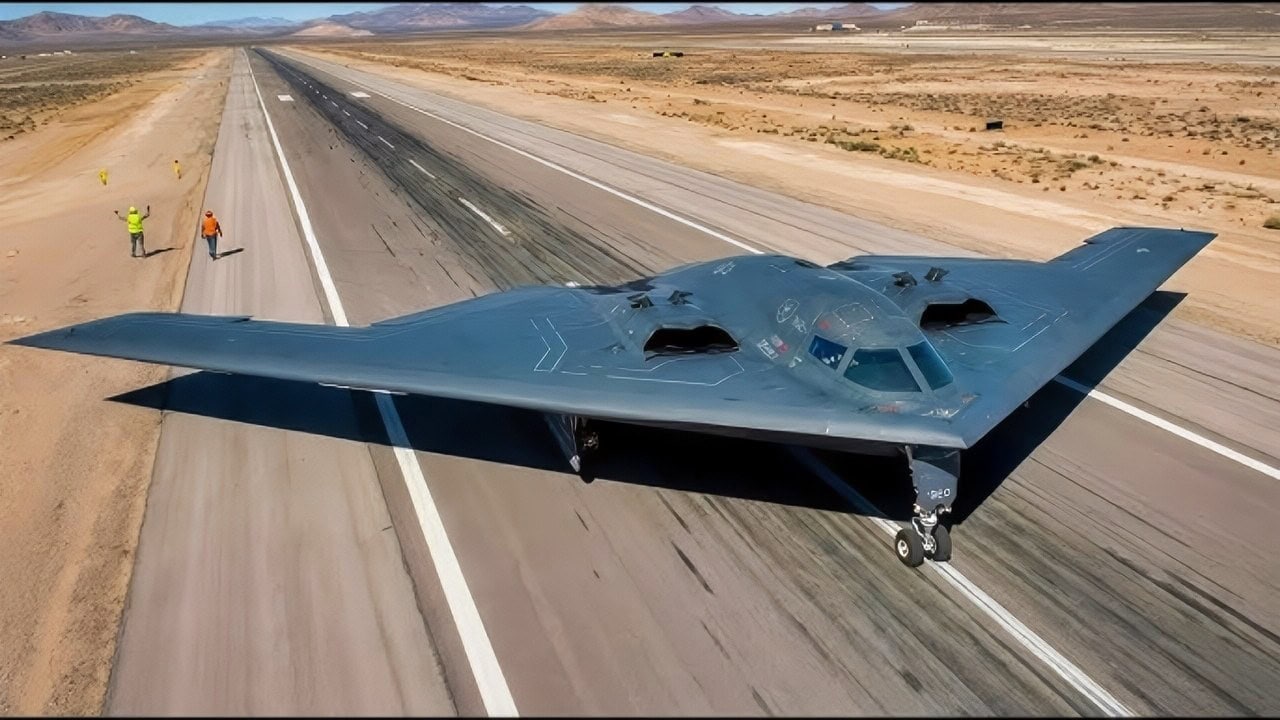
Six months ago, the U.S. Air Force and Navy rehearsed sinking ships together off the coast of California. On June 27, 2026, they stopped rehearsing. A B-2 Spirit from the 509th Bomb Wing put a live AGM-158C Long Range Anti-Ship Missile into the decommissioned amphibious transport USS Juneau north of the Mariana Islands, and the stealth bomber that spent three decades as America’s nuclear door-kicker became, in public, a ship killer.
What Changed Since February
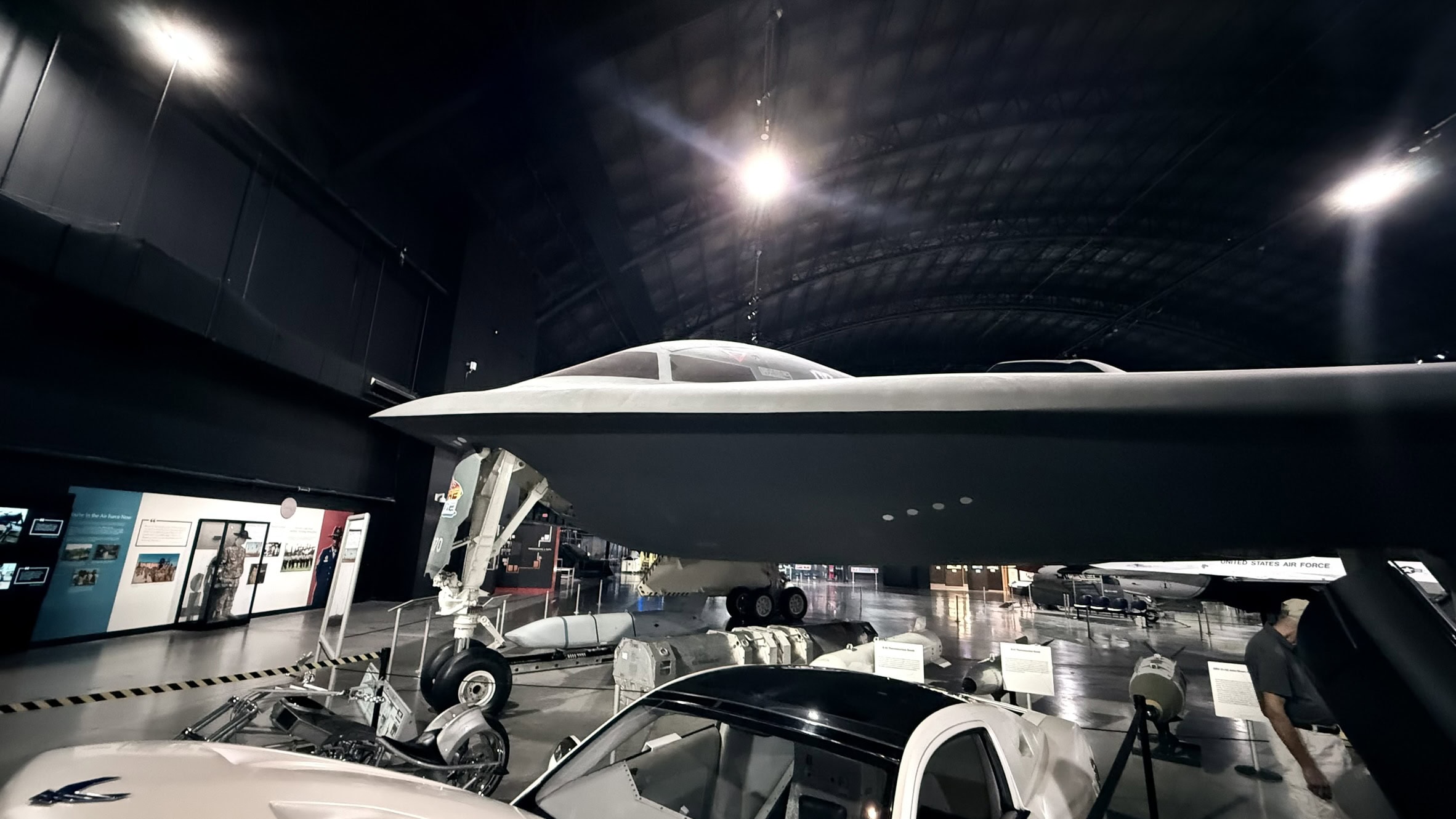
B-2 Spirit Stealth Bomber. 19FortyFive.com Photo from National Museum of the U.S. Air Force Visit in 2025.
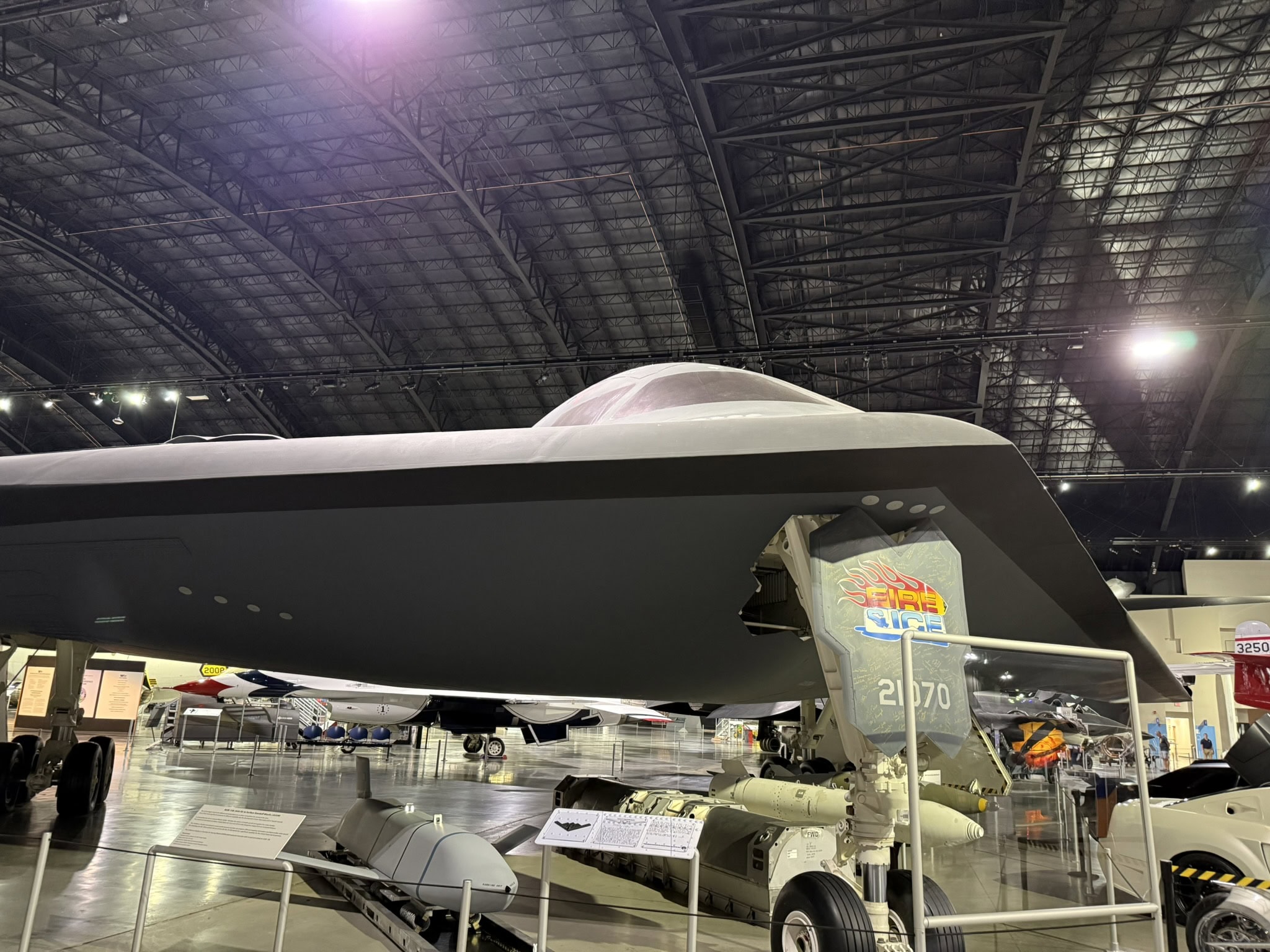
B-2 Spirit Stealth Bomber. 19FortyFive.com Photo from National Museum of the U.S. Air Force Visit in 2025.
The February 24 drill off California paired at least one B-2 flying from Whiteman Air Force Base in Missouri with fighters from Carrier Air Wing 11, the air component of the Theodore Roosevelt Carrier Strike Group, in what the Navy described as an integrated maritime strike exercise.
Two Super Hornets carried the AIM-174B Gunslinger, the air-launched SM-6 that had become the longest-ranged air-to-air missile in American service. The drill was, in retrospect, a dress rehearsal for two different wars: days later, the same bomb wing was flying strikes against Iran, and four months after that, the concept came back to the Pacific with live warheads.
Valiant Shield 2026 supplied them. Airmen of the 393rd Bomber Generation Squadron loaded a live LRASM onto a B-2 at Whiteman on June 22; five days later the bomber flew the shot over the Philippine Sea alongside an F-15E Strike Eagle from the 85th Test and Evaluation Squadron, and the Juneau, an Austin-class transport dock the Navy retired years ago, went down in a sinking exercise that networked air, surface, and subsurface shooters into one kill chain.
Pacific Air Forces disclosed it on June 29. “The B-2’s impressive performance underscores the US military’s commitment to adaptability and flexibility,” said General Kevin Schneider, the PACAF commander, in language aimed unmistakably at Beijing.
The Weapon Math
The significance is in the range. Until June, the B-2’s public anti-ship tool was QUICKSINK, a guidance kit bolted to ordinary 2,000-pound and 500-pound bombs that the Air Force Research Laboratory built to replicate a Mk 48 torpedo kill at a fraction of the price. It works, as the ex-USS Tarawa learned at RIMPAC 2024 and as a target in the Norwegian Sea learned in September 2025, when a B-2 ran the strike with four Norwegian F-35As and a P-8A Poseidon. But QUICKSINK is a bomb, and a bomb requires flying over the ship.
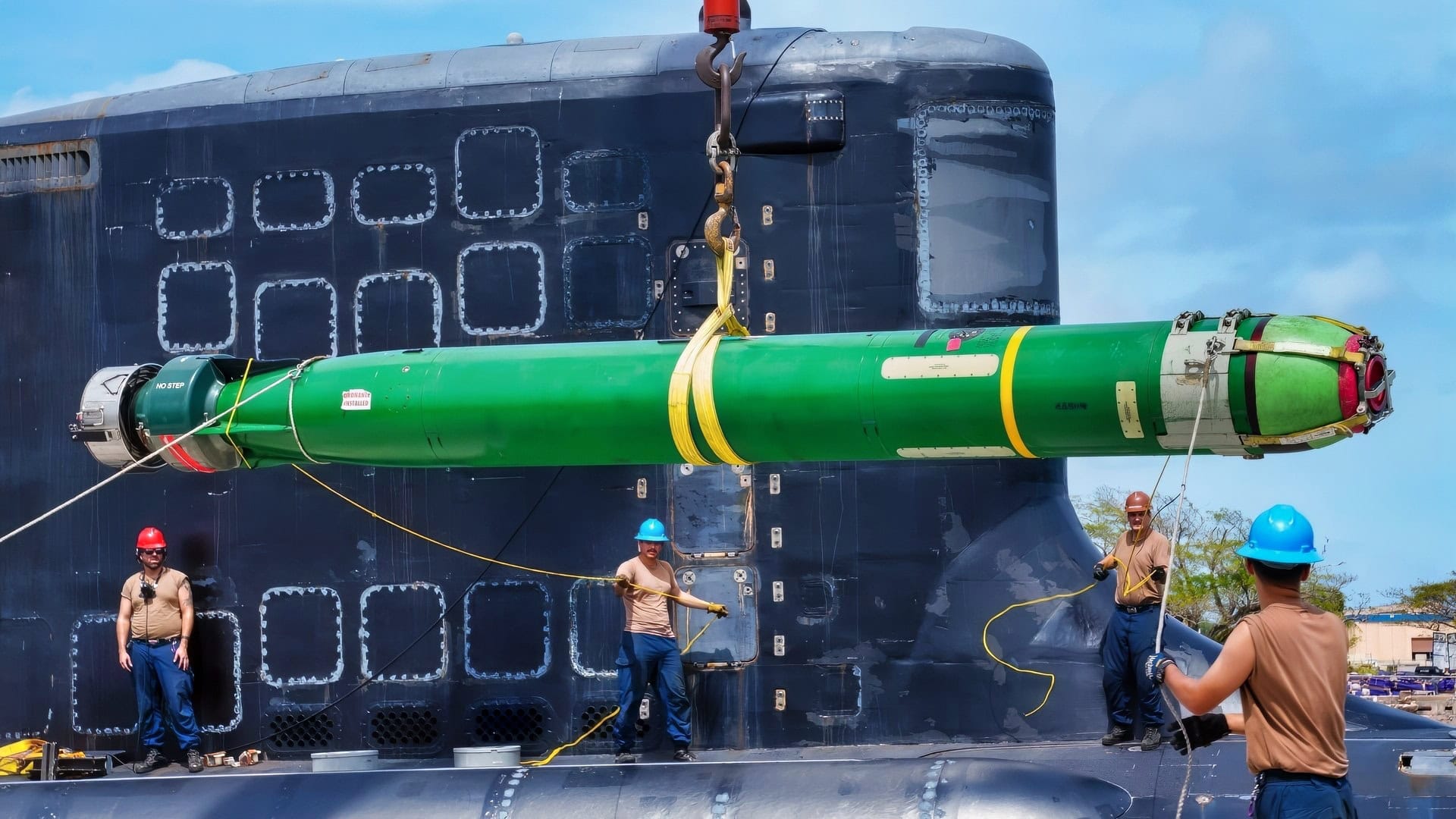
NAVAL BASE GUAM (Feb. 3, 2025) – Sailors assigned to the Virginia-class fast-attack submarine USS Minnesota (SSN 783) guide a Mark 48 ADCAP (Advanced Capability) torpedo during a weapons offload onboard Naval Base Guam, Feb. 3, 2025. Assigned to Commander, Submarine Squadron 15, based at Polaris Point, Naval Base Guam, Minnesota is one of five forward-deployed fast-attack submarines. Renowned for their unparalleled speed, endurance, stealth, and mobility, fast-attack submarines are the backbone of the Navy’s submarine force. Regarded as apex predators of the sea, Guam’s fast-attack submarines serve at the tip of the spear, helping to reaffirm the submarine force’s forward-deployed presence in support of a free and open Indo-Pacific. (U.S. Navy photo by Mass Communication Specialist 1st Class Nikita Custer)
LRASM does not: the stealthy Lockheed Martin cruise missile ranges beyond 200 nautical miles and hunts its own target when the datalinks go dark, allowing the bomber to shoot from outside a modern task group’s air-defense envelope. The Air Force ordered an increase in production of the weapon in March 2026. A B-2 can carry as many as sixteen JASSM-family missiles; the service has not said how many LRASMs fit, and that silence is itself a planning problem for anyone counting American shots.
The Navy’s Half of the Kill Web
Gunslinger has spread in parallel. Fielded first with Carrier Air Wing 2 at RIMPAC 2024 and then with the permanently forward-deployed Carrier Air Wing 5 at Iwakuni, it has since appeared on Super Hornets aboard the Abraham Lincoln during Northern Edge and, in February, on the Roosevelt’s jets off California. Public range estimates run past 200 miles, with some assessments exceeding 300.
The Missile Defense Agency has flagged the weapon as a candidate for shooting down hypersonic missiles, and the AIM-260 that will eventually complement it has now been photographed on an operational Navy fighter.
Put the pieces together and the shape of the Pacific plan is visible. The carrier air wing pushes the outer air battle hundreds of miles from the deck, killing the tankers and radar aircraft that make Chinese anti-ship missiles accurate.
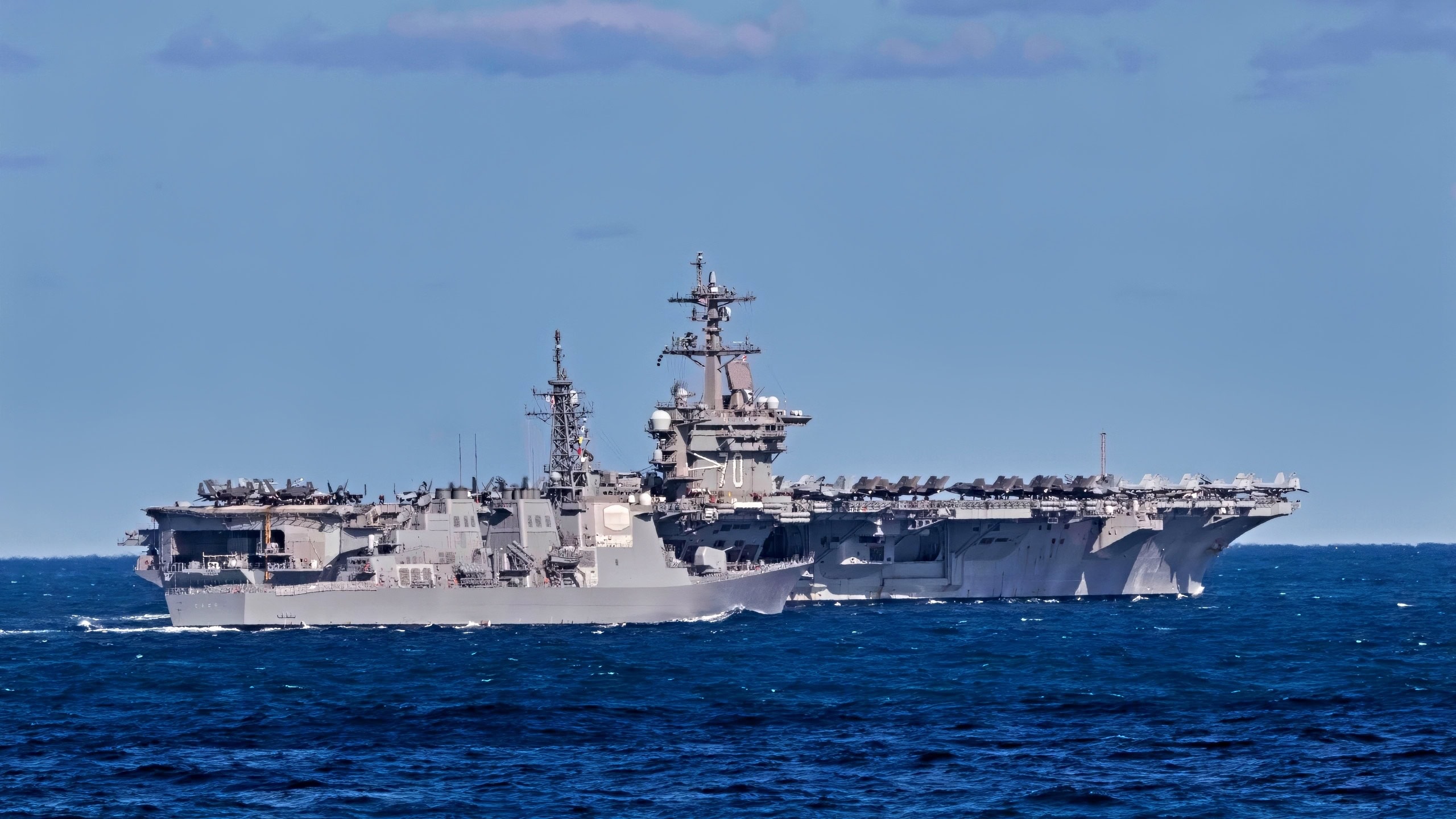
AT SEA (Jan. 16, 2024) The Nimitz class aircraft carrier USS Carl Vinson (CVN 70), back, and the Kongo-class helicopter destroyer JS Kongo (DDG-173) from the Japan Maritime Self Defense Force sail together during a trilateral exercise, Jan. 16. The exercise allowed maritime forces from Japan, Republic of Korea, and U.S. to train together to enhance coordination on maritime domain awareness and other shared security interests. Vinson, flagship of Carrier Strike Group ONE, is deployed to the U.S. 7th Fleet area of operations in support of a free and open Indo-Pacific. (U.S. Navy photo by Mass Communication Specialist 1st Class Charles J. Scudella III)
The bomber, cleared for LRASM since June, arrives from Missouri or Guam and strikes the ships themselves from beyond their reach. Neither platform has to be where the enemy expects it, which was the entire point of the February exercise this site reported when the pairing was still theoretical.
The tempo has not slowed. Two B-2s deployed from Whiteman to Joint Base Pearl Harbor-Hickam in July to fly with F-22s during RIMPAC 2026, the exercise’s thirtieth iteration, which drew roughly 30 nations, 40 surface ships, five submarines, and more than 30,000 personnel before it ended on July 31.
That is a serious rotation for a fleet of about twenty aircraft that is also covering the Middle East, and it is the last such rotation the B-2 will make alone: the B-21 Raider is in flight test, and every maritime tactic the Spirit proves in 2026 becomes the Raider’s inheritance.
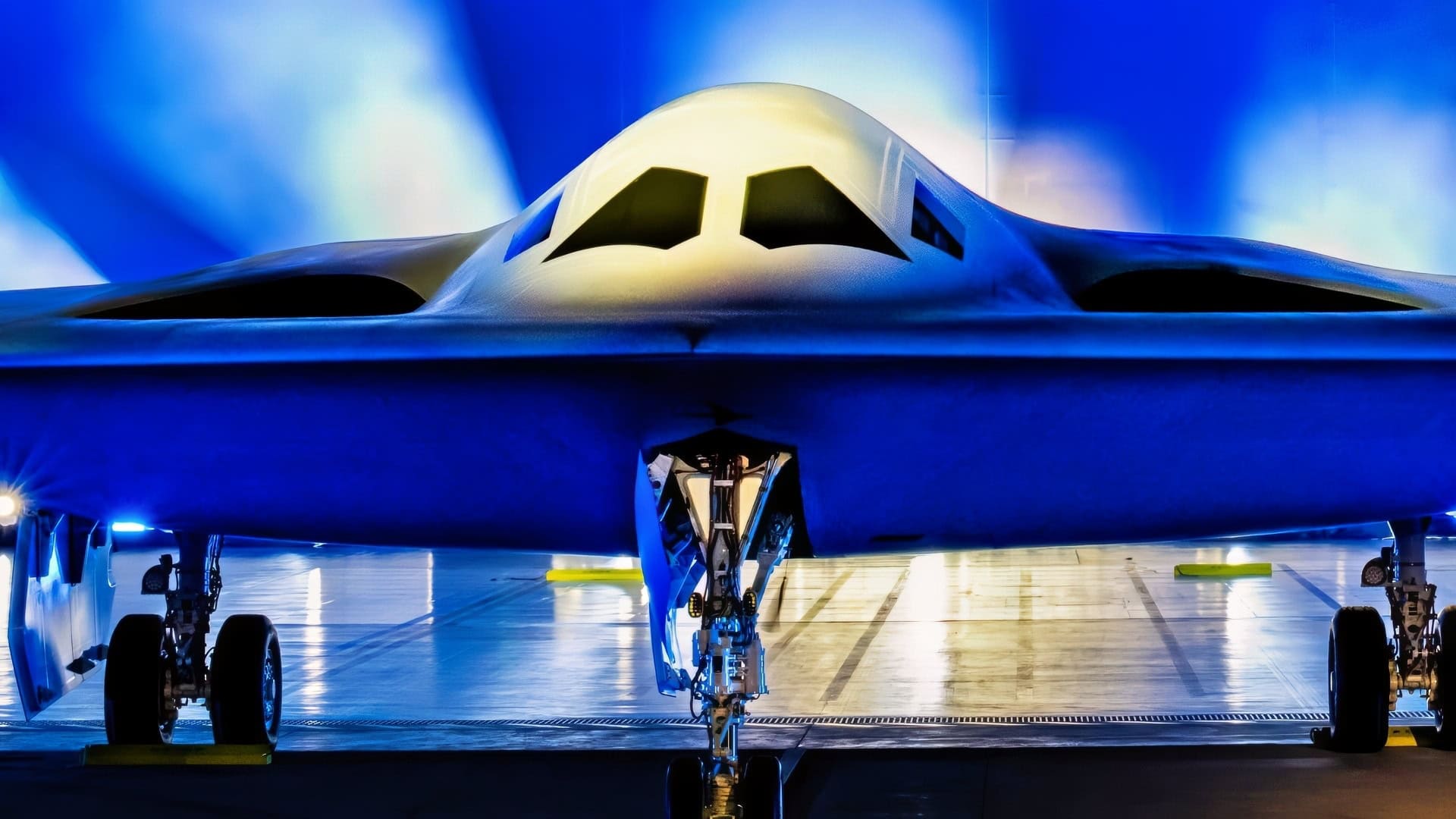
A B-21 Raider is unveiled at Northrop Grumman’s manufacturing facility on Air Force Plant 42 in Palmdale, California, Dec. 2, 2022. The B-21 will be a long-range, highly survivable, penetrating strike stealth bomber capable of delivering both conventional and nuclear munitions. (U.S. Air Force photo by Airman 1st Class Joshua M. Carroll)
The Juneau, meanwhile, is on the bottom north of the Marianas, sunk by a bomber that took off from the middle of Missouri.
About the Author: Harry J. Kazianis
Harry J. Kazianis (@Grecianformula) was the former Senior Director of National Security Affairs at the Center for the National Interest (CFTNI), a foreign policy think tank founded by Richard Nixon based in Washington, DC. Harry has over a decade of experience in think tanks and national security publishing. His ideas have been published in the NY Times, The Washington Post, The Wall Street Journal, CNN, and many other outlets. He has held positions at CSIS, the Heritage Foundation, the University of Nottingham, and several other institutions related to national security research and studies. He is the former Executive Editor of the National Interest and the Diplomat. He holds a Master’s degree focusing on international affairs from Harvard University.

