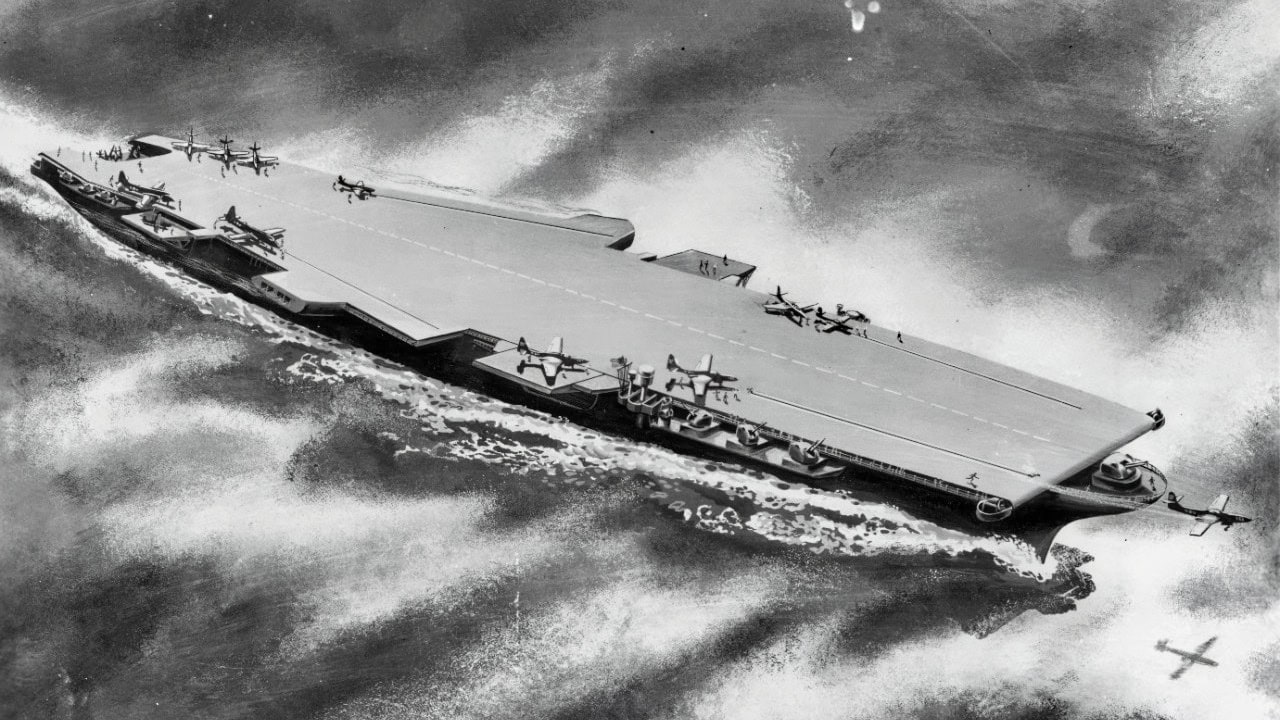
In 1949, as the Cold War was truly heating up, the United States Navy had conceived, and was within days of starting construction on, a massive aircraft carrier that could deploy nuclear-armed bombers from its deck.
The USS United States (CVA-58) was supposed to give the Navy its own strategic nuclear strike capability when the Cold War began.
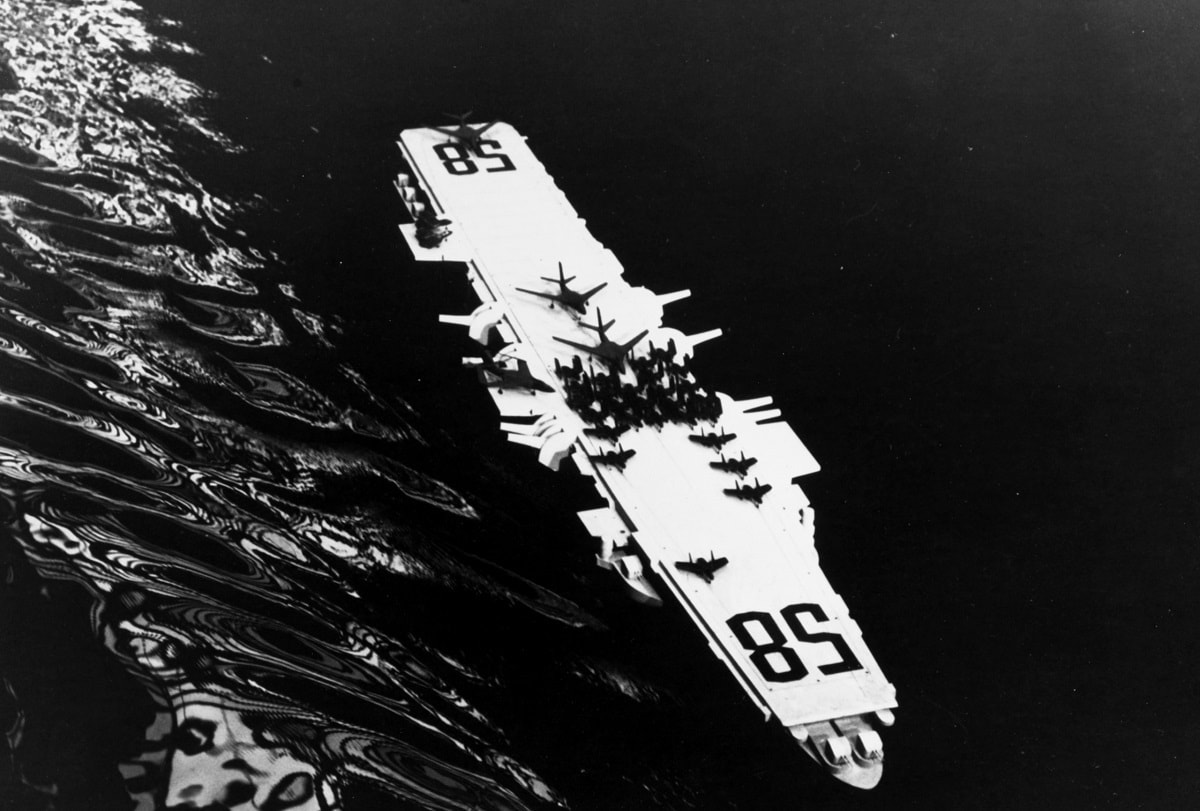
A preliminary design model of the proposed U.S. Navy aircraft carrier USS United States (CVA-58) undergoing seakeeping tests at the David Taylor Model Basin, Carderock, Maryland (USA), circa 1947. This is an early version of the CVA-58 design, without catapult sponsons. Note the folding smokestacks in the down position, as they would have been during flight operations. Aircraft models on the flight deck appear to represent the Vought F7U Cutlass fighter and a notional heavy attack bomber.
This was the beginning of the nuclear age, when certain intercontinental ballistic missile (ICBM) capabilities had not yet fully come into fruition, and nuclear bombers were one of the main modes of nuclear attack.
The Strategic Context
The USS United States came at a time when the Navy was contemplating how best to follow on from the maritime branch’s successful Midway-class carriers. Naval aviators desired larger carriers capable of carrying heavy bombers.
Nuclear weapons added another significant requirement: they were bulky, heavy bombs that needed larger planes (and, if the Navy got into the nuclear bomber business, they’d need larger aircraft carriers).
With these requirements in mind, US naval designers began studying proposed carrier designs capable of handling aircraft weighing up to 100,000 pounds.
The USS United States was a carrier unlike anything the Navy had developed before. The United States had a massive, unobstructed flight deck, with no island. Ironically, US President Donald J. Trump now wants to move the island into a configuration more like that of the Essex-class aircraft carrier.
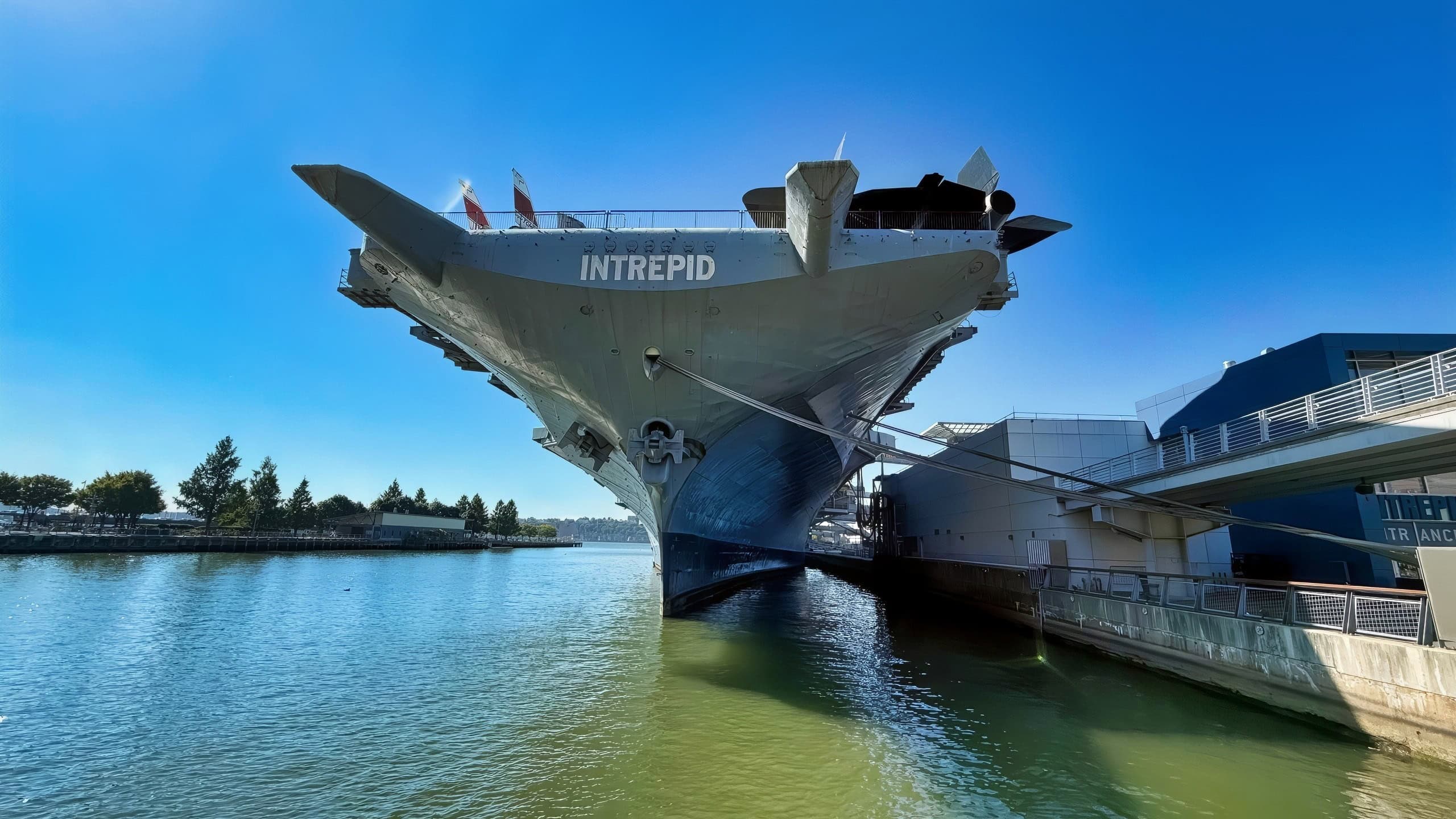
USS Intrepid Essex-Class Aircraft Carrier 19FortyFive.com Photo.
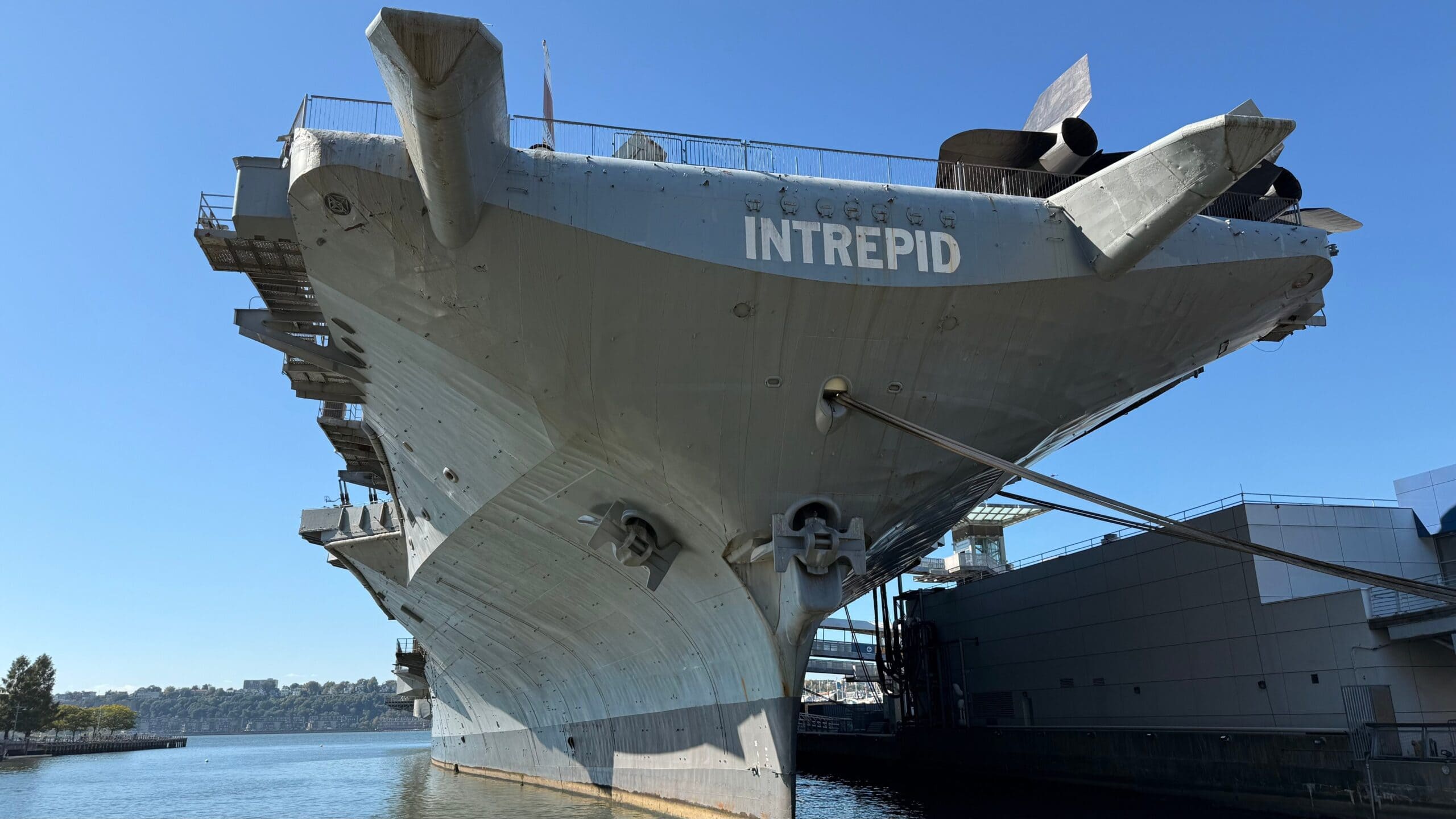
Exterior of Essex-Class USS Intrepid. Image Credit: 19FortyFive.com
The traditional island (the tower structure on the carrier’s flight deck) was removed because naval planners fretted over the idea that the island might interfere with flight deck operations involving the bombers.
Instead, the carrier would use alternative navigation, flight control, and exhaust management that would be unlike any carrier before or since.
One design specified a carrier 1,190 feet long, with an 82,000-ton displacement at full load. Ultimately, the design was scaled down. Yet, it remained a massive and unprecedented warship.
Defense Department documents claimed the United States was a 65,000-ton flush-deck carrier.
Because the proposed carrier’s primary purpose was supporting nuclear attack bombers, the US Naval Institute described its air wing as “unusual.” One iteration of the design had the carrier equipped with an air wing of 18 heavy, nuclear-capable bombers and 80 escort fighters.
Further complicating the carrier’s design was the Navy’s lack of an operational concept for its own heavy nuclear bomber.
Lockheed’s P2V Neptune was used as a stand-in during the ship’s development.
The Navy was building the AJ Savage, a long-range, large, carrier-capable attack warplane capable of carrying a nuclear load.
The War Between the US Navy and the US Air Force
These developments, however innovative and unique, put the Navy at loggerheads with the United States Air Force.
The National Security Act of 1947 established the Air Force as a separate branch of the United States Armed Forces—the subsequent Key West Agreement in 1948 divided missions among the various branches. Strategic air warfare was primarily an Air Force responsibility.
The Air Force centered its nuclear warfare strategy on aircraft like the Convair B-36 Peacemaker.
Air Force planners viewed the United States as an encroachment on their turf. Add in the classic budgetary concerns among the branches of the Armed Forces, and a fierce war between the Air Force and Navy erupted over the USS United States.
This occurred as President Harry S. Truman imposed reductions to the military budget after WWII. Indeed, the Navy’s budget had fallen dramatically in the years following WWII.
Under these conditions, then, funding for both the Navy’s proposed nuclear bomber-capable carrier fleet and the Air Force’s B-36 fleet would have been a difficult request to make of the political establishment.
Nevertheless, Congress authorized funding for the USS United States, and President Truman approved its construction in July 1948.
The Navy decided to focus on the one prototype before ordering more units.
Construction officially started at Newport News Shipbuilding in Virginia on April 18, 1949. That construction project lasted barely one week.
Revolt of the Admirals
A new Secretary of Defense, Louis A. Johnson, hated the program and demanded that the Joint Chiefs of Staff (JCS) reassess its utility.
Of course, the Navy wanted the carrier while the Air Force resented it. Secretary of Defense Johnson ultimately ordered the nuclear bomber-capable carrier terminated–just five days after the keel was laid.
Johnson did not even inform his naval advisers. They learned about it from a press release.
The fallout was immediate.
Senior naval officers criticized the decision—and their Air Force colleagues—publicly.
Then, the Navy Secretary resigned in protest. After that, intense congressional hearings followed, becoming known as the “Revolt of the Admirals.”
While the United States died in the womb, the idea of a supercarrier stayed with naval planners.
Just a few years after the United States fiasco, the Korean War demonstrated the need for carrier aviation.
Yet, that war showed that the Navy did not need to concern itself with nuclear-capable bombers. Instead, it needed a variety of warplanes to conduct multiple non-nuclear mission sets.
Influencing Future Supercarriers
As the United States died, the idea for the Forrestal-class supercarriers was born.
The supercarrier’s design philosophy ultimately influenced future aircraft carrier classes, such as the nuclear-powered Enterprise, Nimitz, and Gerald R. Ford classes.
Eventually, the Navy did achieve its nuclear weapons capabilities.
As miniaturization became more efficient, nuclear weapons became more compact, meaning that these weapons could be deployed from the smaller carrier-based planes.
So, the United States may not have been completed, and it might have caused a bureaucratic ruckus in the immediate aftermath of its termination.
But the Navy adopted many of the United States’ ideas and concepts, using them as the basis for the aircraft carrier force that still serves the Navy today.
About the Author: Brandon J. Weichert
Brandon J. Weichert is the Senior National Security Editor at 19FortyFive.com. He also manages The Weichert Brief on Substack. Weichert also hosts “National Security Talk” on Rumble. He is the author of four bestselling national security books, the most recent of which is A Disaster of Our Own Making: How the West Lost Ukraine (Encounter Books). Follow him via Twitter/X @WeTheBrandon.