
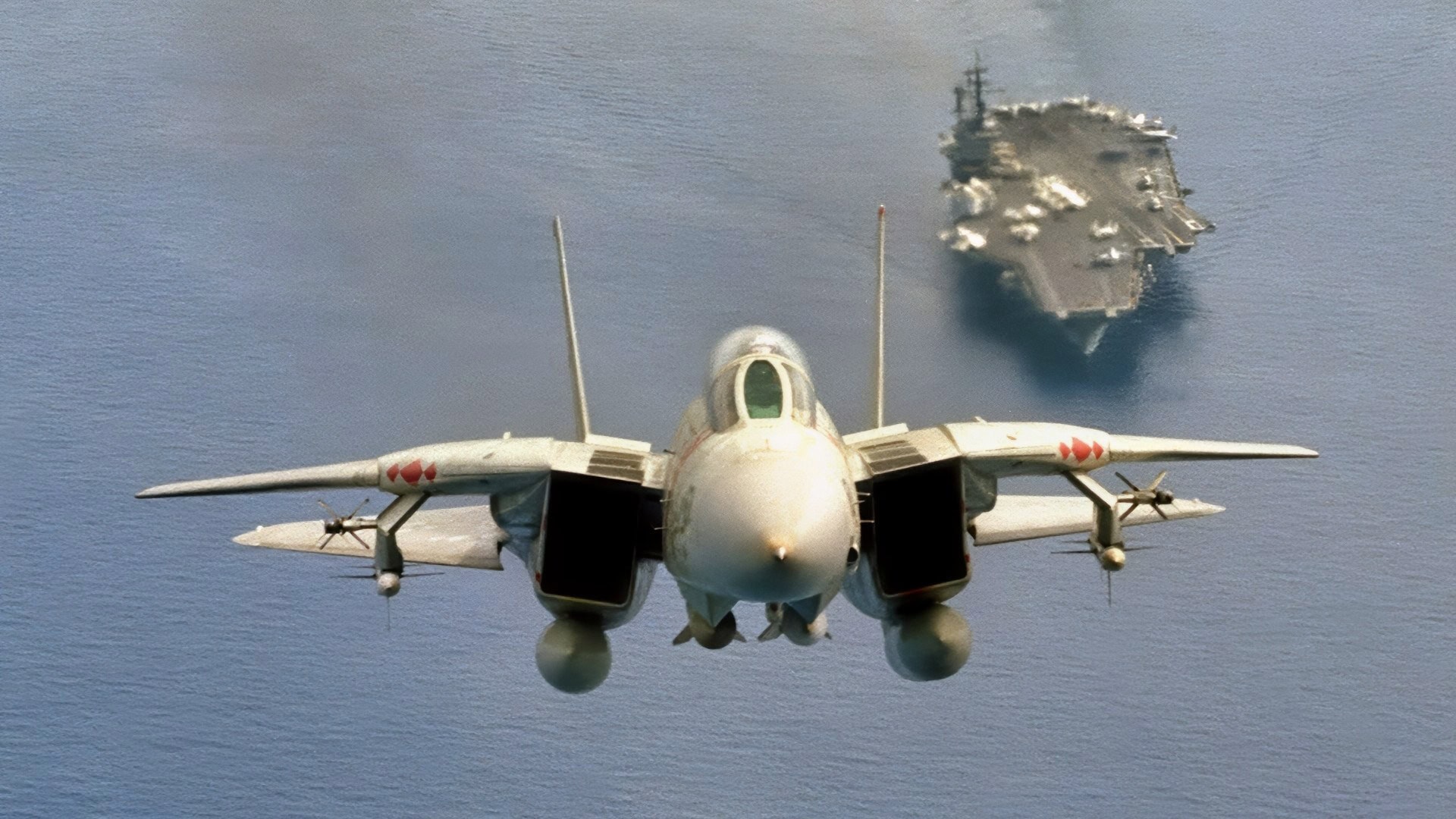
Thanks to the blockbuster success of the Top Gun film franchise—and to a lesser extent, the 1980 sci-fi film The Final Countdown—the Cold War-vintage Grumman F-14 Tomcat is arguably the most popular fighter plane of all time with American filmgoing audiences.
For the basis of comparison, although the General Dynamics cum Lockheed Martin F-16 Fighting Falcon also wins plenty of cool points, the Iron Eagle film series has been nowhere near as lucrative as Top Gun.
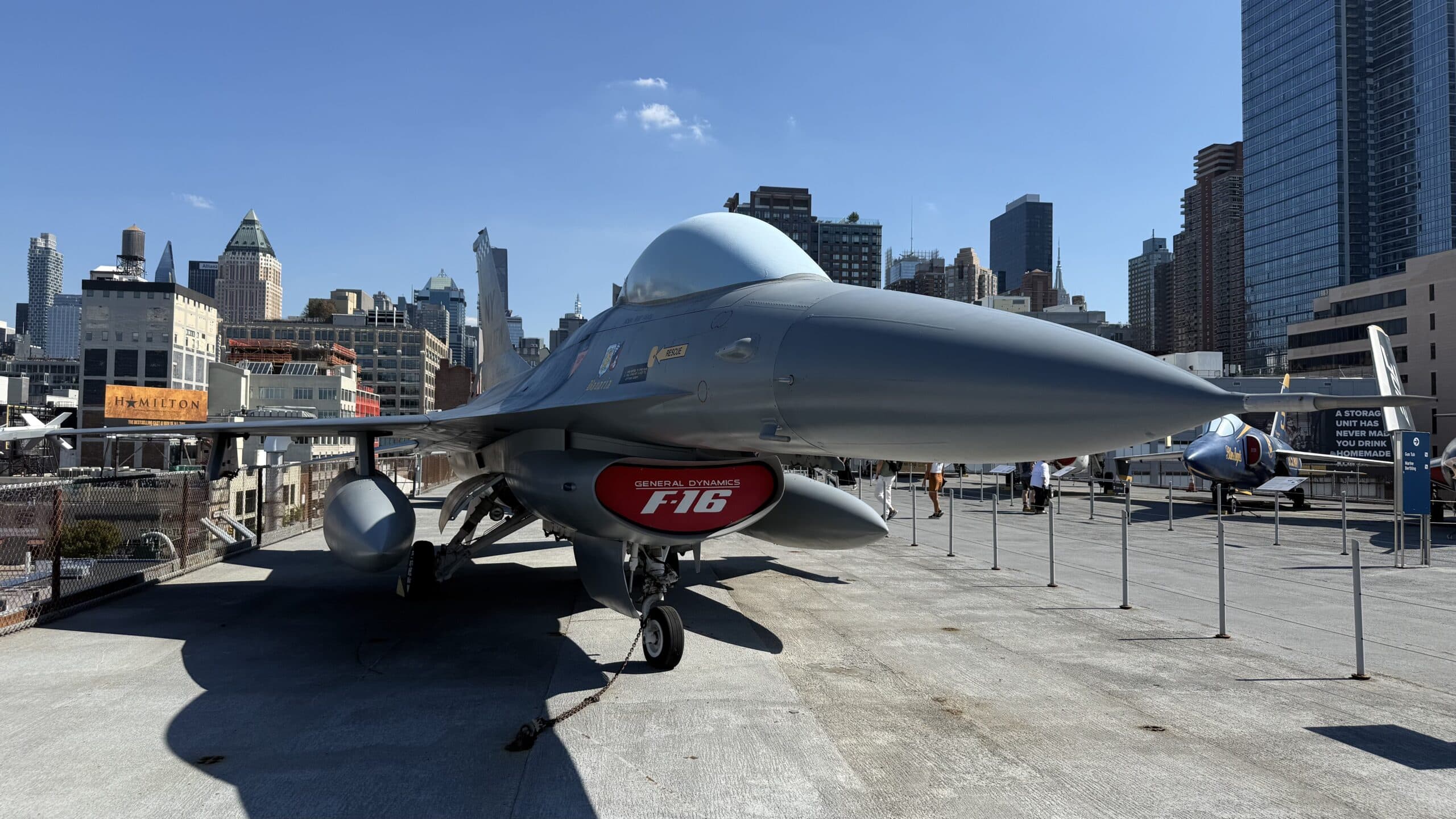
F-16 On Flight Deck of USS Intrepid. 19FortyFive.com Image.
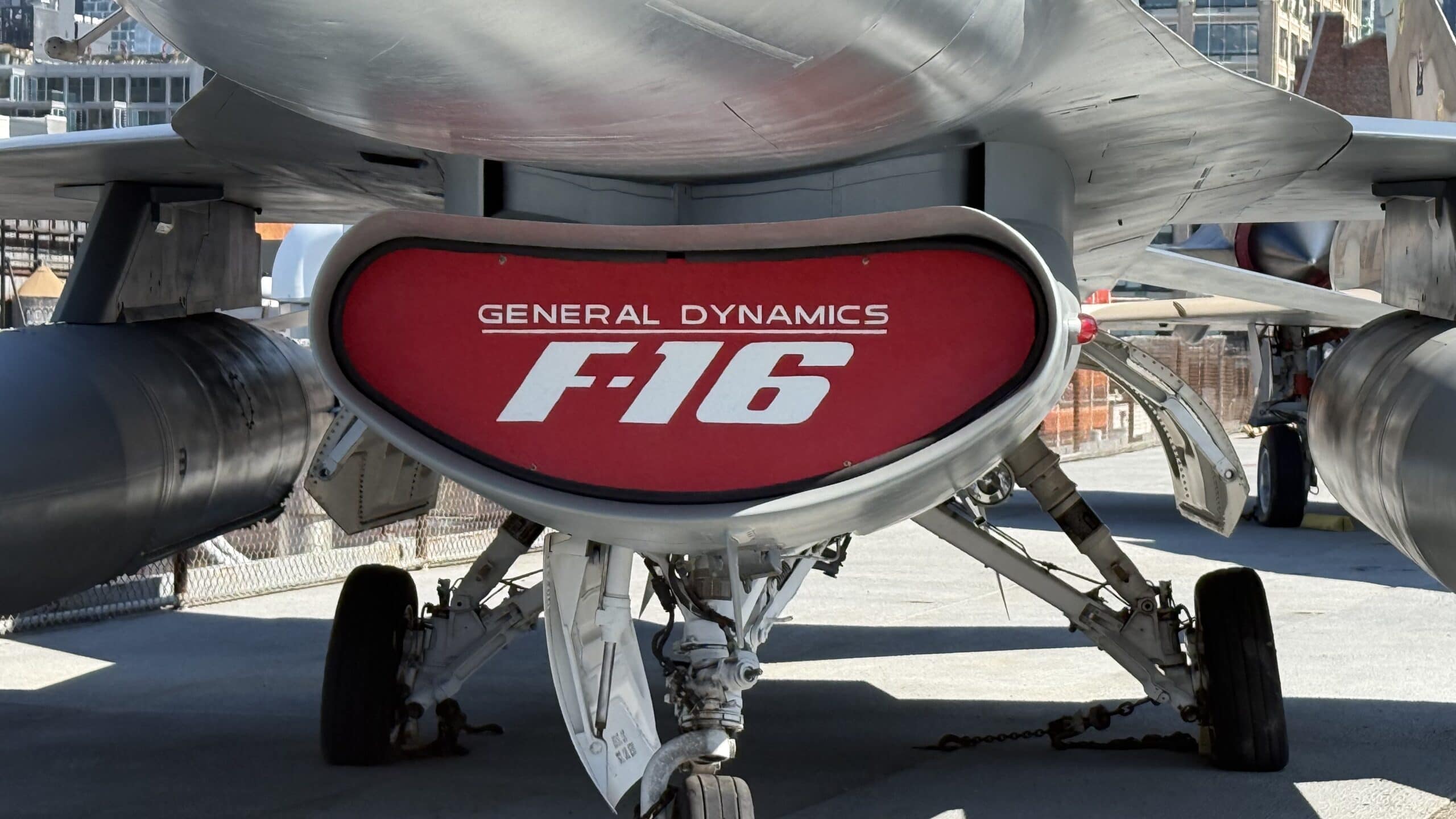
F-16 On Flight Deck of USS Intrepid. 19FortyFive.com Image.
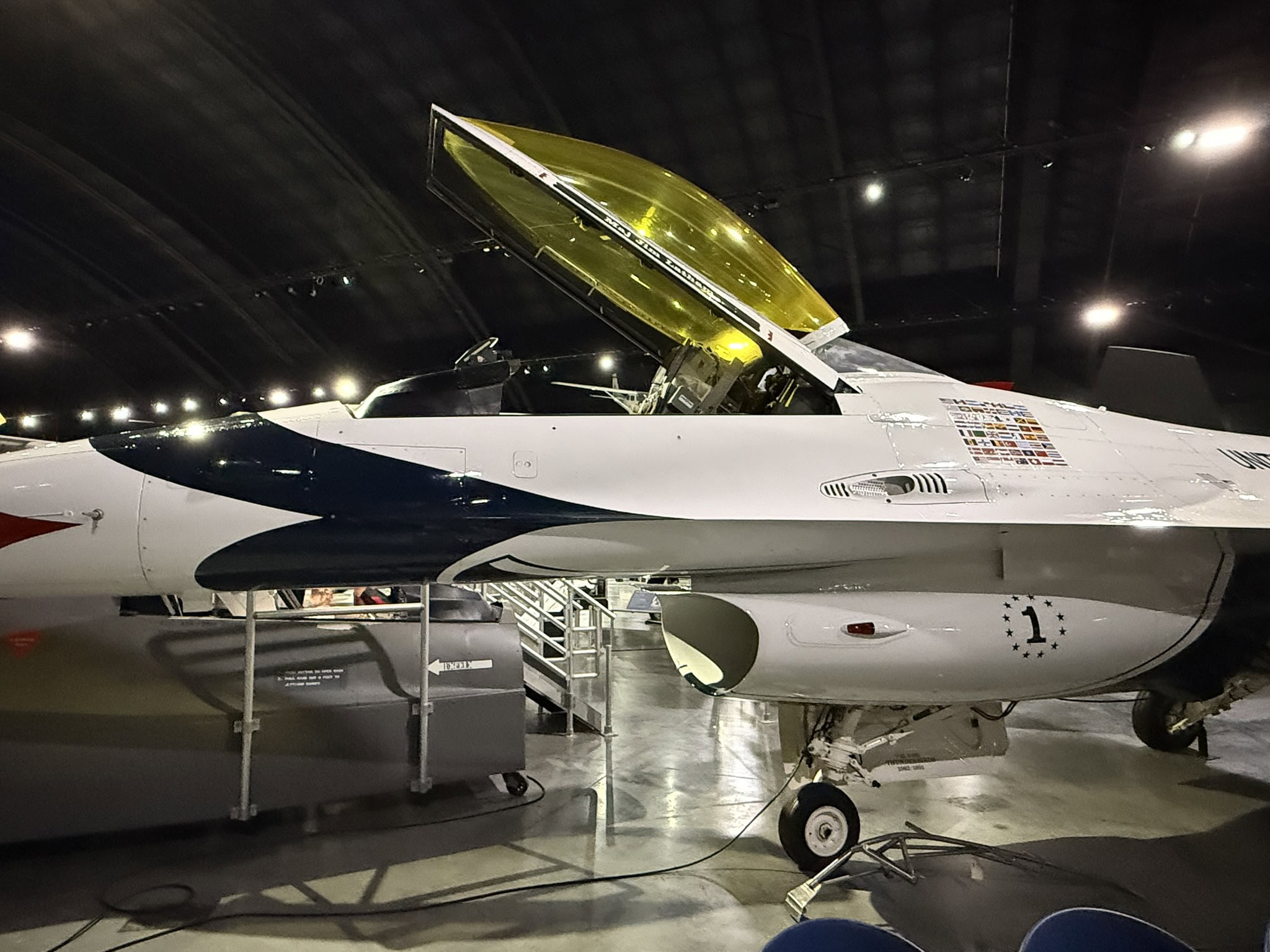
F-16 Fighter. 19FortyFive.com Image from the National Museum of the U.S. Air Force.
Given all the all-American rah-rah surrounding the American-made Tomcat, it comes as no small irony that the only remaining operational user of the F-14 is one of the worst enemies of the United States, namely Iran.
Accordingly, we now look at the history of Iran’s F-14s, starting with the question: How in blue blazes did this true-Navy-blue U.S. fighter jet end up in the hands of an enemy entity?
Initial History: How Iran Got Its Tomcats
A fair question, and the short answer is: hard to believe as it may seem now, Iran wasn’t always a foe.
Shah Mohammad Reza Pahlavi, who reigned from 1941 until his overthrow during the radical Islamic Iranian Revolution of 1979, was unashamedly pro-U.S. and pro-Israel.
This sharply contrasted with Ayatollah Ruhollah Khomeini and his now equally deceased successor, Supreme Leader Ali Khamenei.
Thus it came to pass that in January 1974, Iran became a foreign military sales (FMS) customer of the F-14, placing an initial order for 30 Tomcat specimens, with the quantity being bumped up to 80 just a few months later. The first of those arrived two years later, modified only by the removal of classified avionics components—which, with the benefit of 20/20 hindsight, turned out to be a fortuitous decision—but still fitted with the Pratt & Whitney TF30-414 engines, with a dozen more delivered in 1977…a mere two years before then-POTUS Jimmy Carter’s abandoned the Shah and thus facilitated the takeover by Khomeini.
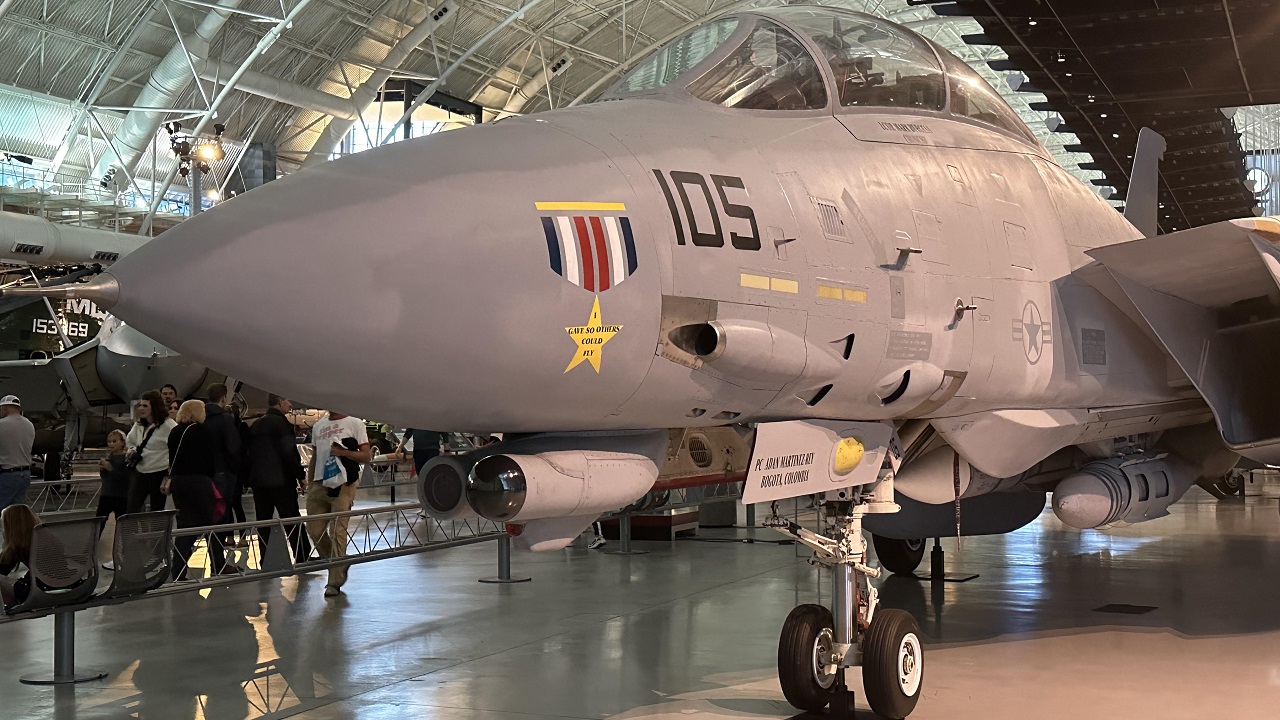
F-14 Tomcat. Image taken at National Air and Space Museum on October 1, 2022. Image by 19FortyFive.
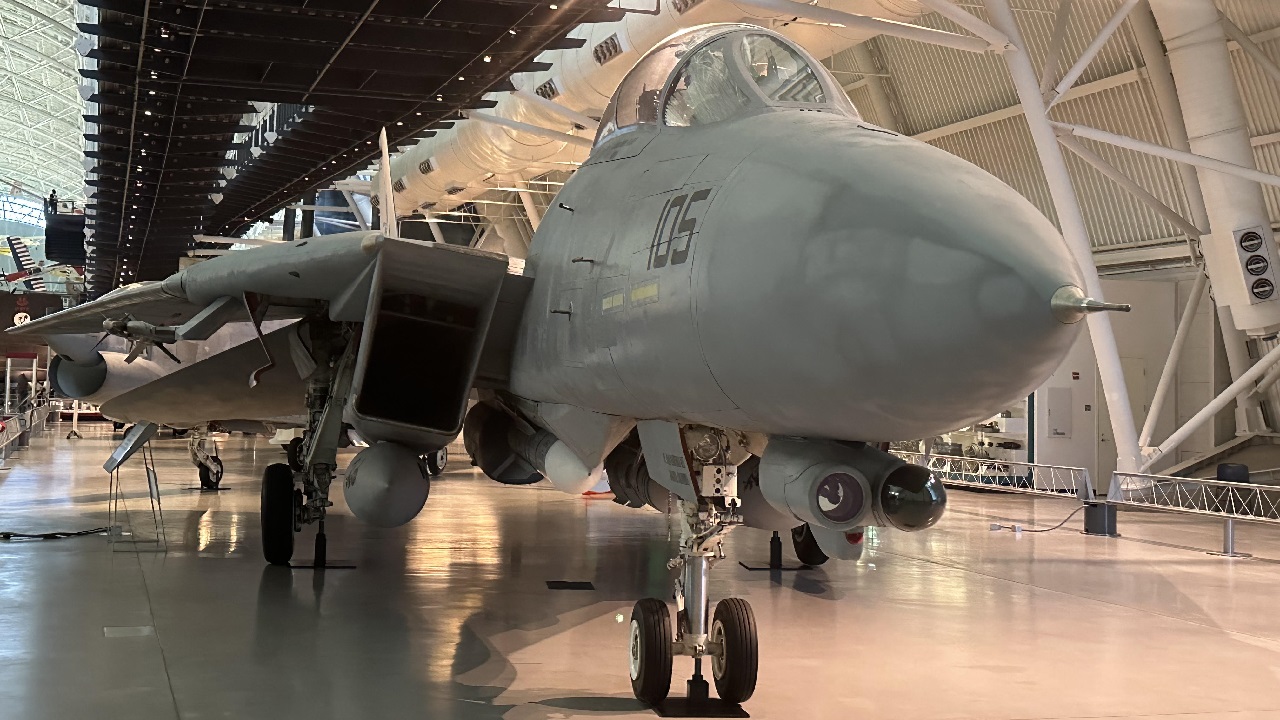
F-14 Tomcat. Image taken at National Air and Space Museum on October 1, 2022. Image by 19FortyFive.
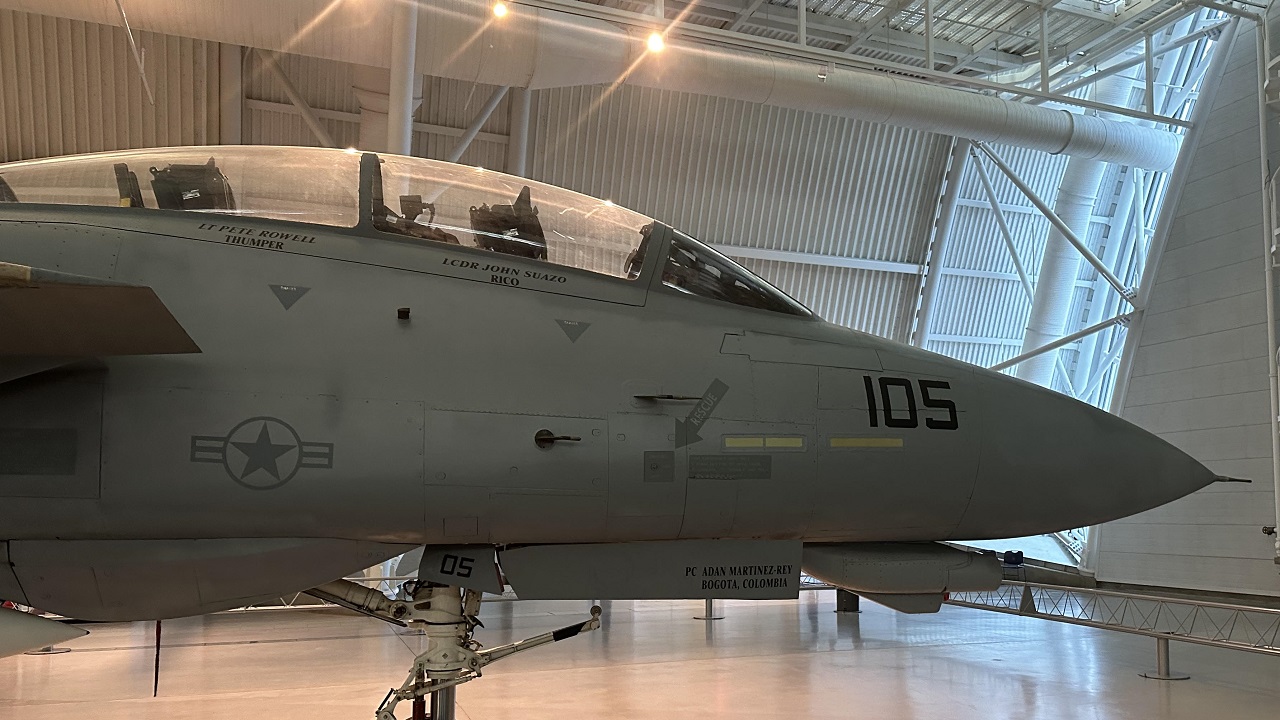
F-14 Tomcat. Image taken at National Air and Space Museum on October 1, 2022. Image by 19FortyFive.
In that procurement process, the Shah-led Iranian government also tried to purchase the Rockwell International AGM-53 Condor TV-guided missile. The Condor was canceled due to its exorbitant cost, so instead the Iranians settled for the F-14’s vaunted AIM-54 Phoenix missile.
Operational History: Iranian Phantoms in the Iran-Iraq War
Notwithstanding the plane’s origins with so-called “Great Satan” (Sheytân-e Bozorg), i.e., American, the Ayatollah’s fighter pilots of the Islamic Republic of Iran Air Force (IRIAF) were still pragmatic enough to put religious fervor aside for the sake of putting their conveniently grandfathered-in Tomcats to good use.
Accordingly, Khomeini’s IRIAF Tomcats saw heavy action in the 1980-1988 Iran–Iraq War and, despite the Western arms embargo on spare parts, were kept operational by overhaul and servicing from Iran’s aerospace industry.
Indeed, in one of military history’s great ironies, the majority of the F-14’s air-to-air combat victories were achieved not by U.S. Navy aviators, but rather Iranian fighter jockeys.
No American Tomcat drivers attained ace status—5 or more aerial victories, that is—but at least one IRIAF Force pilot did: Sarhang (Colonel) Mostafa Roustaie, who scored five kills against Iraqi Air Force (IqAF) opponents and described his beloved plane as “the last word in the fighter business.”
To add to that irony, ‘twas only the Iranian Tomcat drivers that were able to score air-to-air kills with the Phoenix missile; all Phoenixes fired by American F-14 crews in combat missed their marks.
By the time the eight-year conflict finally ended, IRIAF F-14 pilots had claimed 130 kills versus only 4 losses against the IqAF.
However, as noted by aviation expert Tom Cooper in Smithsonian Magazine, “It is impossible to tabulate, for example, how many air-to-air victories were scored by Iranian F-14s because air force records were repeatedly tampered with during and after the war for political, religious, or even personal reasons.”
As for those fortunate few Iraqi fighter pilots who managed to kill a Tomcat – rare birds, indeed – the somewhat scanty evidence indicates that two of them did so in a MiG-23 “Flogger,” whilst one kill apiece is credited to a MiG-21 “Fishbed and a Dassault Mirage F1.
Current Status
Before Operation Epic Fury/Roaring Lion kicked off, reliable sources reported that the IRIAF had a total of 41 F-4D/E/RF airframes, constituting 17.74 percent of their total 231-strong fighter fleet (which also included 63 F-4s, in case anybody was wondering), which in turn comprised 58 percent of the IRIAF’s total active inventory of 400 aircraft.
So, are any Iranian Tomcats still around, or have they been completely wiped out by now? Depends who you ask.
At least five of them were already destroyed in two separate Israeli airstrikes in 2025. Fast-forward to 8 March 2026, and the Israeli Air Force (IAF) asserted that they obliterated the remainder of the IRIAF F-14 fleet in a strike on the 8th Tactical Fighter Base in Isfahan in central Iran.
However, in an apparent effort to rebuke those IAF claims, on 10 June, Iranian state media released footage showing an F-14 returning from a mission.
The problem with that footage, as noted by our esteemed Editor-in-Chief, Mr. Harry Kazianis: “The provenance and dating of the footage are disputed, with some accounts suggesting the clip may be older material rather than a current sortie, and no independent source has confirmed that Iranian Tomcats flew combat operations during the 2026 conflict.”
And given the rather large radar signature of the Tomcat—being a 4th Generation fighter, it was never designed for stealth—an Iranian F-14 taking to the skies during the present conflict would’ve almost certainly been noticed by American and/or Israeli radar operators, whether ground-based radar and/or AWACS.
So, in the meantime, the life status of Iran’s aging Tomcats remains a bit of a question mark.
About the Author: Christian D. Orr
Christian D. Orr is a Senior Defense Editor. He is a former Air Force Security Forces officer, Federal law enforcement officer, and private military contractor (with assignments worked in Iraq, the United Arab Emirates, Kosovo, Japan, Germany, and the Pentagon). Chris holds a B.A. in International Relations from the University of Southern California (USC) and an M.A. in Intelligence Studies (with a concentration in Terrorism Studies) from American Military University (AMU). He is also the author of the book “Five Decades of a Fabulous Firearm: Celebrating the 50th Anniversary of the Beretta 92 Pistol Series,” the second edition of which was recently published.