
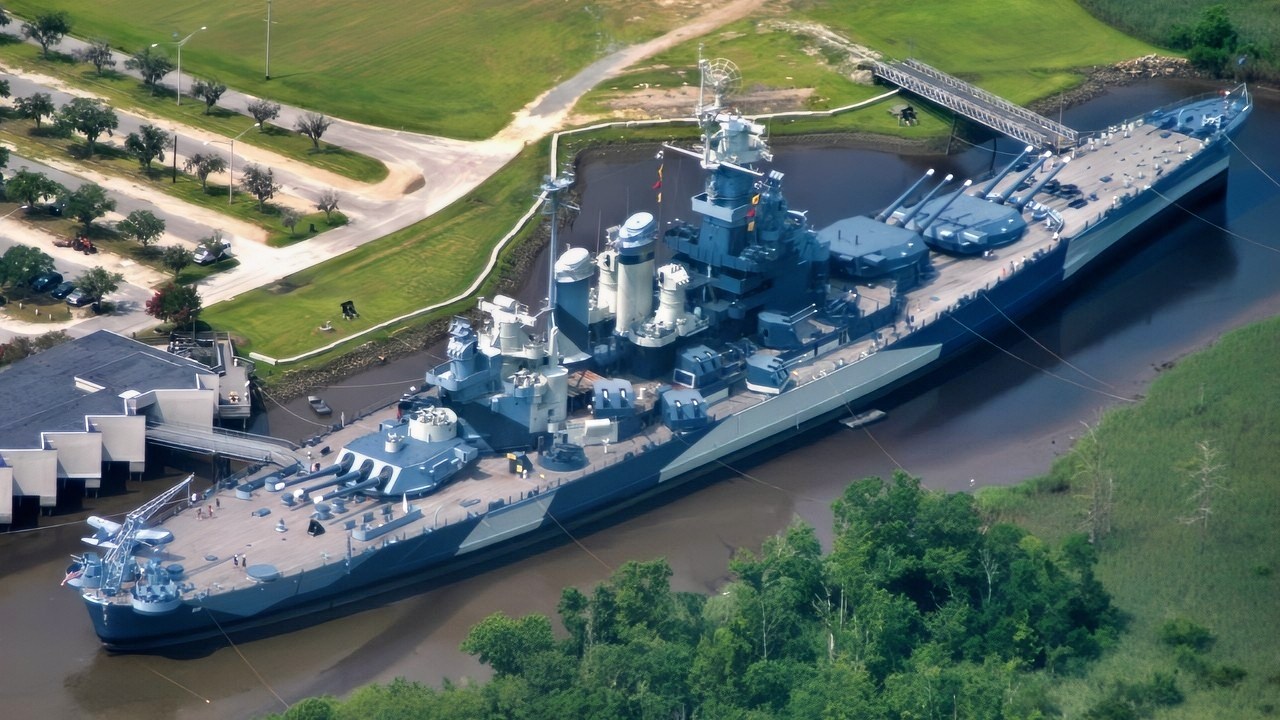
USS North Carolina by the Numbers: $76.9 Million, 44,800 Tons and Nine 16-Inch Guns – USS North Carolina cost a commonly recorded $76,885,750, displaced 44,800 tons fully loaded, and carried nine 16-inch guns. Four steam turbines produced 121,000 shaft horsepower, enough to move the 728-foot battleship at 28 knots. When BB-55 entered service on April 9, 1941, the National Park Service records that she was considered the most powerful warship afloat.
Designers had to stay near the 35,000-ton treaty ceiling, keep the beam below 110 feet for the Panama Canal and fit armor, long-range guns and carrier-escort speed into one hull. The original plan used twelve 14-inch guns. Japan’s refusal to accept the new limit let the United States switch to nine 16-inch weapons after construction began.
North Carolina used eight Babcock & Wilcox boilers feeding four General Electric geared turbines, one for each propeller shaft. The machinery was divided among four main spaces so that one hit was less likely to disable the entire plant. Her 121,000 shaft horsepower produced about 28 knots, or 32 miles per hour.
The main battery sat in three triple turrets. Ten twin mounts held twenty 5-inch/38 dual-purpose guns. Late in the war, the anti-aircraft battery included sixty 40mm Bofors barrels and between 36 and 53 20mm Oerlikons. Wartime complement reached 2,339 sailors.
And, strangely enough, while built to fight other battleships, history shows that never occured.
USS North Carolina Cost $76.9 Million and Weighed 44,800 Tons
North Carolina was laid down at the New York Navy Yard on Oct. 27, 1937, launched on June 13, 1940 and commissioned less than ten months later. She was the first new American battleship in 18 years, a fact behind the “Showboat” nickname.
The Navy examined dozens of designs before accepting the North Carolina-class compromise. The ship placed nine heavy guns, a 12-inch armored belt and 28-knot speed inside a treaty-limited hull. The follow-on South Dakota class used the same guns in a shorter ship with revised protection.
121,000 Horsepower Sent the Battleship to 28 Knots
North Carolina’s engineering plant was enormous by ordinary standards and modest beside the Iowas. Her turbines produced 121,000 shaft horsepower, while an Iowa-class ship produced roughly 212,000. That difference separated North Carolina’s 28 knots from the Iowas’ 33.
Twenty-eight knots was enough to operate with fast carrier task forces. North Carolina carried more than 7,000 tons of fuel oil and protected carriers with radar-directed antiaircraft fire. The rise of the carrier explains why the newest American battleships guarded flight decks more often than they hunted enemy capital ships.
Nine 16-Inch Guns Produced a 12-Ton Broadside
Each 16-inch/45 Mark 6 gun fired a 2,700-pound armor-piercing shell about 21 miles. A full broadside placed 24,300 pounds of steel and explosive into the air, more than 12 tons. High-capacity shells weighed 1,900 pounds and reached about 23 miles. The published firing rate was one round every 30 seconds per gun.
At that rate, the battery was capable of sending 18 armor-piercing shells weighing 48,600 pounds downrange in one minute. Three officers and 177 enlisted sailors served each six-level turret. The Mark 6 was shorter than the later Iowa-class Mark 7, but both used the 2,700-pound super-heavy shell concept behind America’s most advanced battleship artillery.
The twenty 5-inch guns engaged aircraft, ships and shore targets. The 40mm and 20mm weapons formed the close defensive ring. Protection included a 12-inch belt, turret armor up to 16 inches and armored decks over vital machinery and magazines.
USS North Carolina Survived a Torpedo and Earned 15 Battle Stars
North Carolina arrived at Pearl Harbor on July 11, 1942, then entered combat around Guadalcanal. During the Battle of the Eastern Solomons, her antiaircraft fire became so dense that USS Enterprise asked whether the battleship was burning. The action established the fast battleship’s wartime role as a shield for carriers.
On Sept. 15, 1942, a torpedo from Japanese submarine I-19 struck the port side, tore a large hole in the hull, and killed five sailors. The same spread hit USS Wasp and USS O’Brien. North Carolina controlled the flooding, remained under way, and returned after repairs.
She later screened carriers and bombarded targets from the Gilberts through the Marianas, the Philippines, Iwo Jima, Okinawa and the Japanese home islands. North Carolina never fired at an enemy battleship. Even the later Iowa class never received that gun duel.
At Iwo Jima, North Carolina expended all 855 high-capacity 16-inch shells carried for the bombardment before replenishing at sea. The record anticipated the later use of USS New Jersey’s guns in Korea, Vietnam and Lebanon. North Carolina finished World War II with 15 battle stars, more than any other American battleship in the conflict.
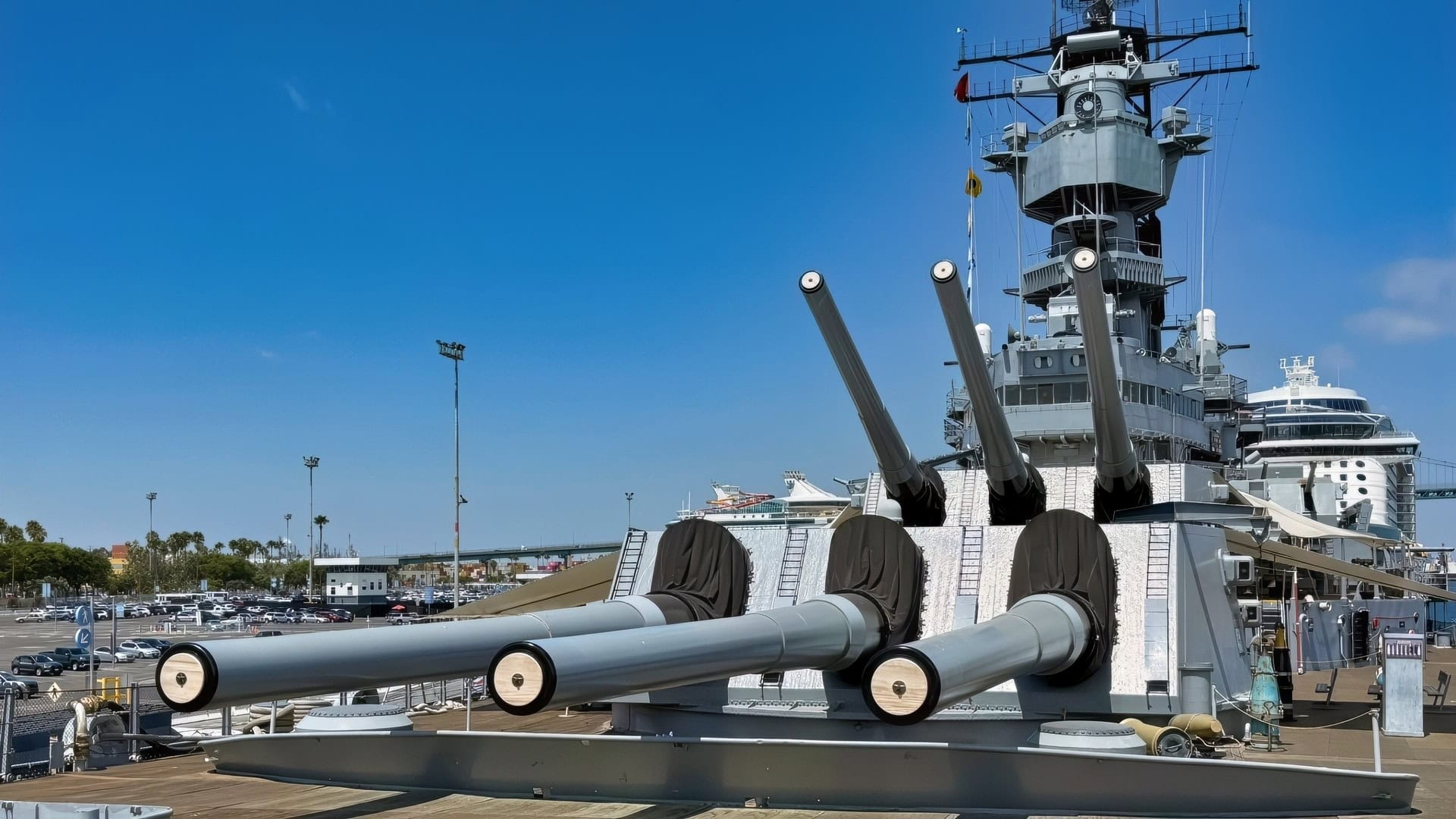
USS Iowa Battleship Guns 19FortyFive.com Image
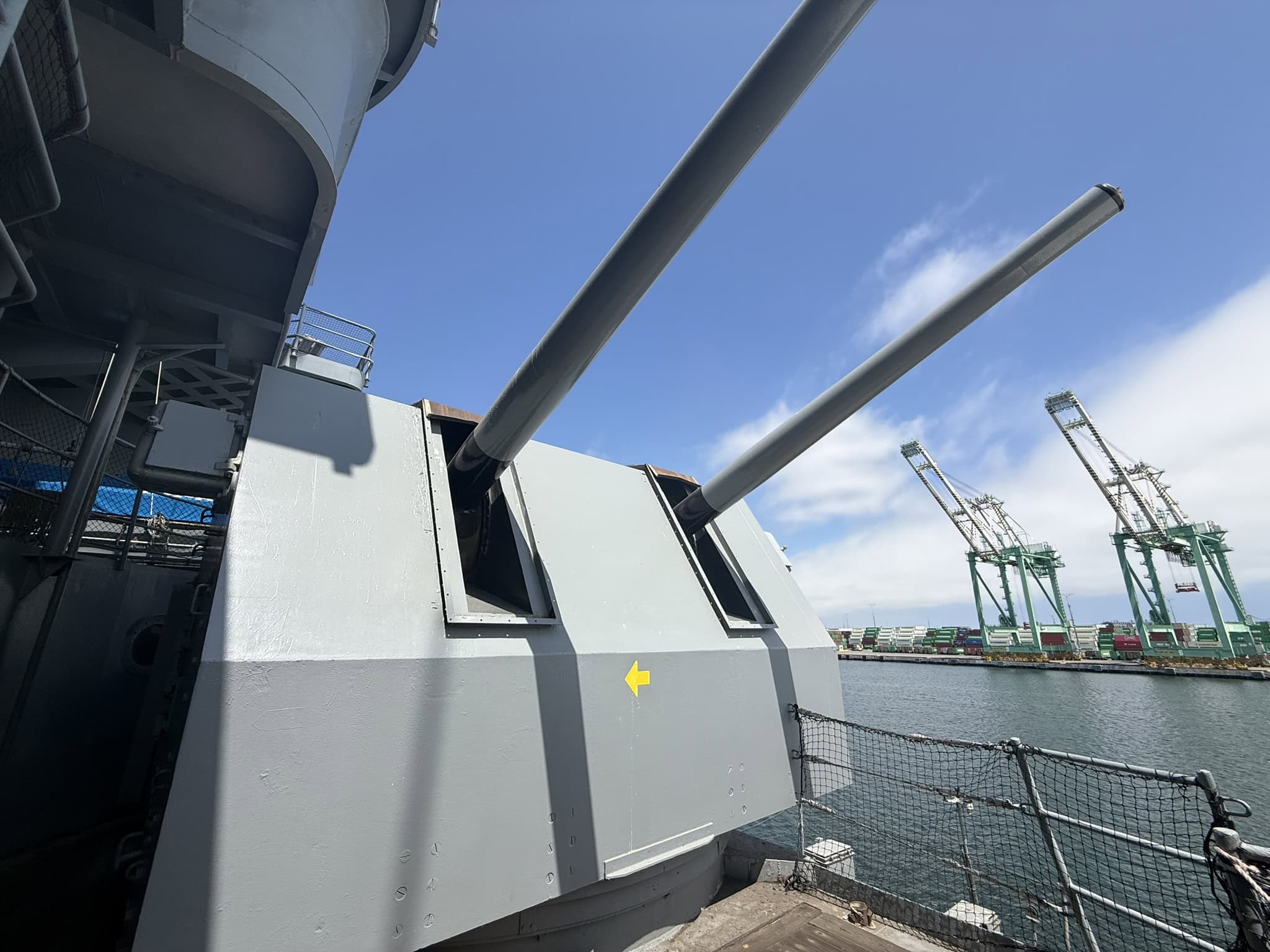
USS Iowa. 19FortyFive.com Original Image Taken in July of 2025.
USS North Carolina Became a Museum Instead of Scrap
The Navy decommissioned the USS North Carolina on June 27, 1947, after a brief period carrying midshipmen. She remained in reserve at Bayonne, New Jersey, until the Navy struck her from the register in 1960. Most battleships of her generation faced scrapping, and the canceled Montana class had already shown where naval priorities were moving.
North Carolina residents organized a statewide campaign to save BB-55. Schoolchildren contributed coins, local organizers funded a berth and the state acquired the ship for $250,000. Tugs brought her to Wilmington on Oct. 2, 1961. The memorial opened the following April.
A nearly four-year hull project completed in 2021 cost $11 million and replaced deteriorated steel without moving the ship to dry dock. The memorial remains self-supporting through admissions, donations, and other revenue.
Visitors now move through nine levels, climb inside the 16-inch turrets, and descend into an engine room. The four shafts no longer turn, but the boilers, armor, and loading machinery remain inside the same hull that crossed the Pacific with more than 2,000 sailors aboard.
About the Author: Harry J. Kazianis
Harry J. Kazianis (@Grecianformula) was the former Senior Director of National Security Affairs at the Center for the National Interest, a foreign policy think tank founded by Richard Nixon in Washington, D.C. Harry has more than a decade of experience in think tanks and national security publishing. His ideas have been published in The New York Times, The Washington Post, The Wall Street Journal, CNN and many other outlets worldwide. He has held positions at CSIS, the Heritage Foundation, the University of Nottingham and several other institutions related to national security research and studies. He is the former Executive Editor of The National Interest and The Diplomat. He holds a master’s degree focusing on international affairs from Harvard University.

