
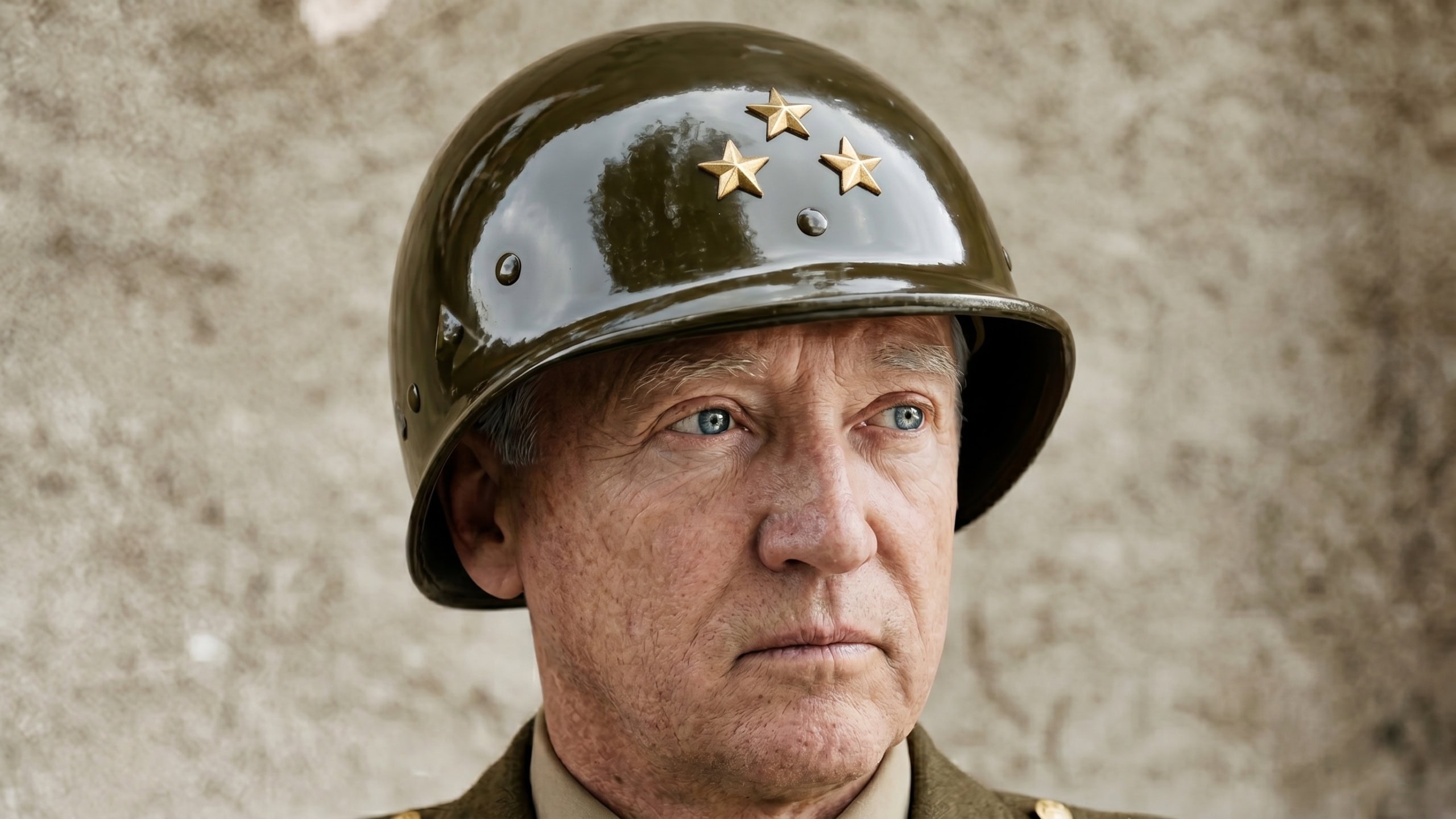
Summary and Key Points: In March 1943, after the Germans broke through II Corps at Sidi Bou Zid and drove it back through Kasserine Pass, Eisenhower needed someone to take over the corps. Two generals turned the job down. Patton, doing administrative work in Casablanca, took it, and eight days later his men had won at El Guettar — where, as one of them put it afterward, the great training benefit was learning that the opponent was not ten feet tall.
George Patton Is a Real US Army Legend
Military quote of the day: “Battle is the most magnificent competition in which a human being can indulge. It brings out all that is best, and it removes all that is base.” – Gen. George S. Patton
Gen. George Patton’s leadership in World War II, especially in the Battle of the Bulge and other major battles in Europe, is somewhat legendary.
But before that, the great general notched several notable military victories in North Africa, which truly helped establish his reputation.
According to a Warfare History Network account, Patton’s World War II service began in November 1942, when he commanded the Western Task Force in Morocco and defeated the Vichy French in just three days.
After that, though, the Germans made advances in Algeria and Tunisia, as General Jurgen von Arnim, in early 1943, “smashed into the American II Corps under Major General Lloyd Fredendall at Sidi Bou Zid.” The Americans were pushed back to Kasserine Pass, while also suffering heavy casualties.
That’s when General Eisenhower called in Patton, who had been handling “administrative duties” in Casablanca, to take over the American II Corps.
According to the Warfare History Network, two other generals, Ernest Harmon and Mark Clark, had turned down the appointment before Patton accepted it.
The mission, Eisenhower told Patton, was to “tie up as many German units as possible until British General Bernard Law Montgomery’s Eighth Army pushed through Rommel’s Mareth Line, and to capture the port town of Gafsa.”
Patton vs. Rommel?
Patton had hoped to take on German Field Marshal Erwin Rommel, but just as Patton took on his new assignment, Rommel headed back to Europe amid health problems, disagreements with Adolf Hitler, and the Germans’ Italian allies.
The Germans were led there by General Hans-Jürgen von Arnim.
However, Patton did not realize this at first.
“I suppose it is an honor to be given all the tough nuts to crack,” Patton reportedly told his wife at the time. “I hope my teeth hold out.”
Patton came up with a battle plan.
“Patton planned to send Major General Terry Allen’s 1st Infantry Division south from Feriana to attack and hold Gafsa, some 45 miles away,” the Warfare History Network account said.
“Once completed, Major General Orlando Ward’s 1st Armored Division, supported by elements of Major General Manton Eddy’s 9th Infantry Division, would head out of Kasserine Pass and attack southeast past Gafsa, driving some 25 miles east to Maknassy.
Defending the passes to Patton’s rear would be other elements of the 9th, as well as Major General Charles Ryder’s 34th Infantry Division.”
However, soon after, Patton realized that only one of those divisions, Allen’s 1st Infantry, was ready. Patton, the account said, “fancied a whimsical idea to control the moving parts of the offensive: he wished he were triplets so he could command the two attacking divisions and the corps himself.” But alas, there was only one General Patton.
“Gentlemen, tomorrow we attack. If we are not victorious, let no one come back alive,” Patton said the day before the planned attack, on March 16, 1943.
Per Defense Media Network, Patton saw the ensuing battle as the equivalent of Second Bull Run in the Civil War. What followed was an eight-day offensive, which left Patton’s men victorious at the Battle of El Guettar.
“Probably, the greatest training benefit of the Battle of El Guettar was learning that the opponent was not ten feet tall,” one participant eventually said of that battle, per Defense Media Network.
Shortly after that, Patton was sent back to Morocco, and it was on to Europe in 1944.
The Quote
Patton’s quote, “Battle is the most magnificent competition in which a human being can indulge. It brings out all that is best, and it removes all that is base,” comes from his famous speech to the Third Army in June 1944, shortly before D-Day.
Patton went on, in the speech, to remind his men that most of them are not going to die, because just about two percent of them would be likely to lose their lives in a major battle. And while every man, Patton told his men, is scared when they go into battle, “the real hero is the man who fights even though he’s scared.”
About the Author: Stephen Silver
Stephen Silver is an award-winning journalist, essayist, and film critic, and contributor to the Philadelphia Inquirer, the Jewish Telegraphic Agency, Broad Street Review, and Splice Today. The co-founder of the Philadelphia Film Critics Circle, Stephen lives in suburban Philadelphia with his wife and two sons. For over a decade, Stephen has authored thousands of articles that focus on politics, national security, technology, and the economy. Follow him on X (formerly Twitter) at @StephenSilver, and subscribe to his Substack newsletter.