
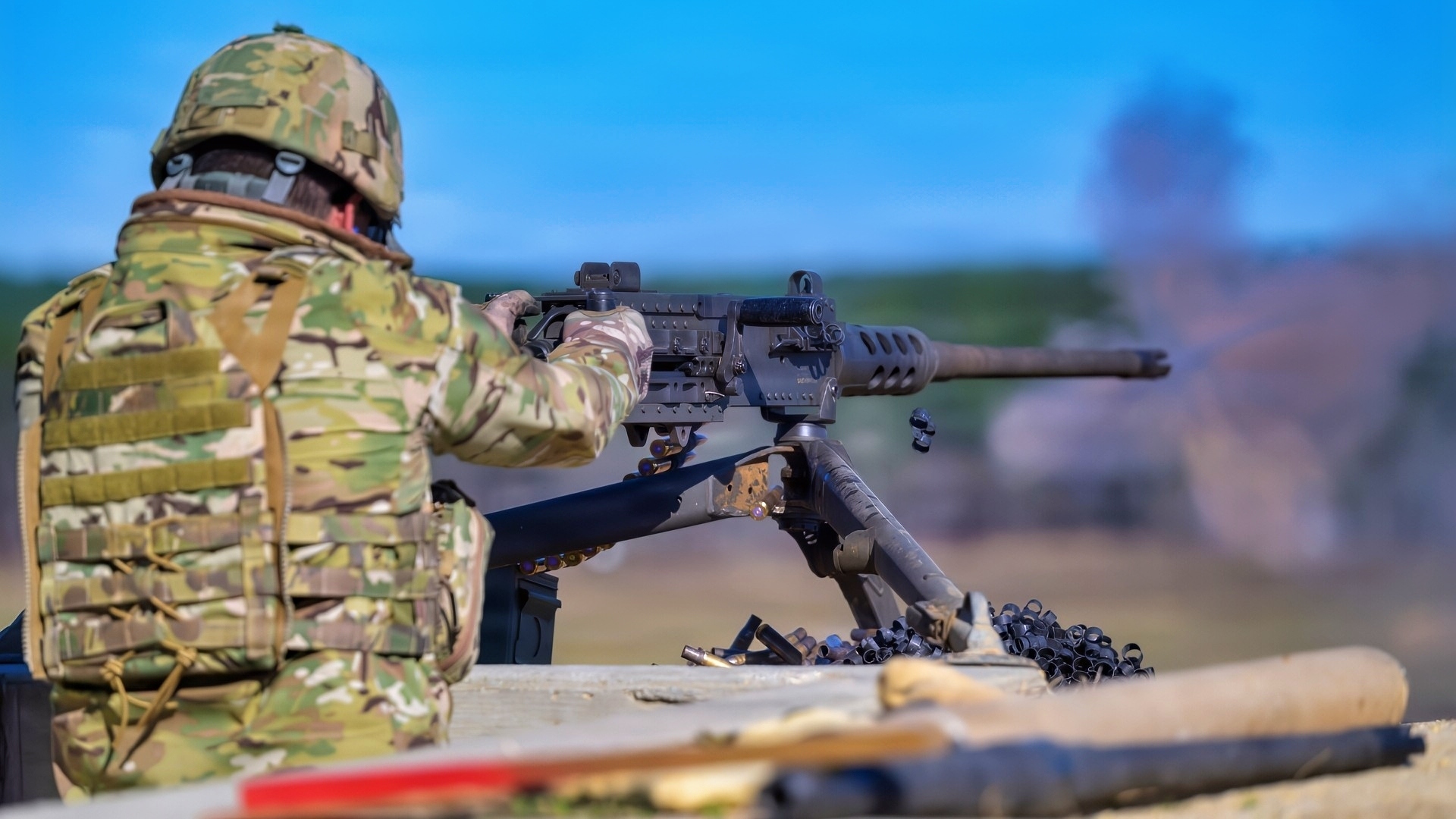
Ma Deuce: The M2 Browning .50 Caliber That Refuses to Retire – Some weapons are built for a war. The M2 Browning was built for a century. John Moses Browning‘s .50 caliber heavy machine gun has been in American service since before most of our grandparents were born. Troops call it “Ma Deuce,” and they say it with something close to affection. It has ridden on Jeeps, half-tracks, tanks, Humvees, MRAPs, patrol boats, and bombers. It has fired on the beaches of Normandy, the frozen hills of Korea, the jungles of Vietnam, and the mountains of Afghanistan. However, the most remarkable thing about the M2 is not where it has been.
It’s that it’s still here, largely unchanged, while nearly every weapon that served alongside it has long since gone to the museum.
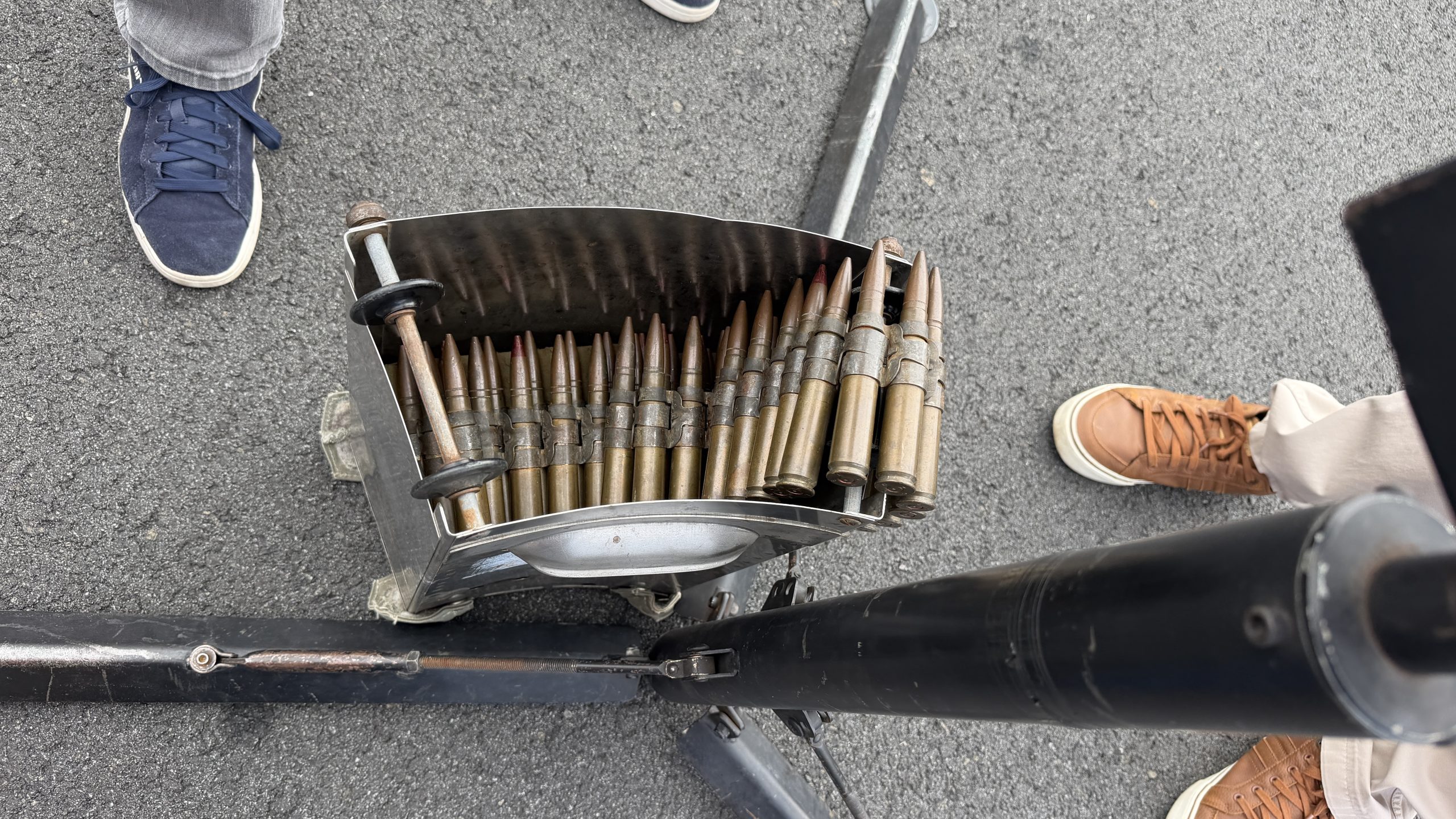
M2 Browning. Image taken by 19FortyFive.com staff at Leesburg, VA airshow.
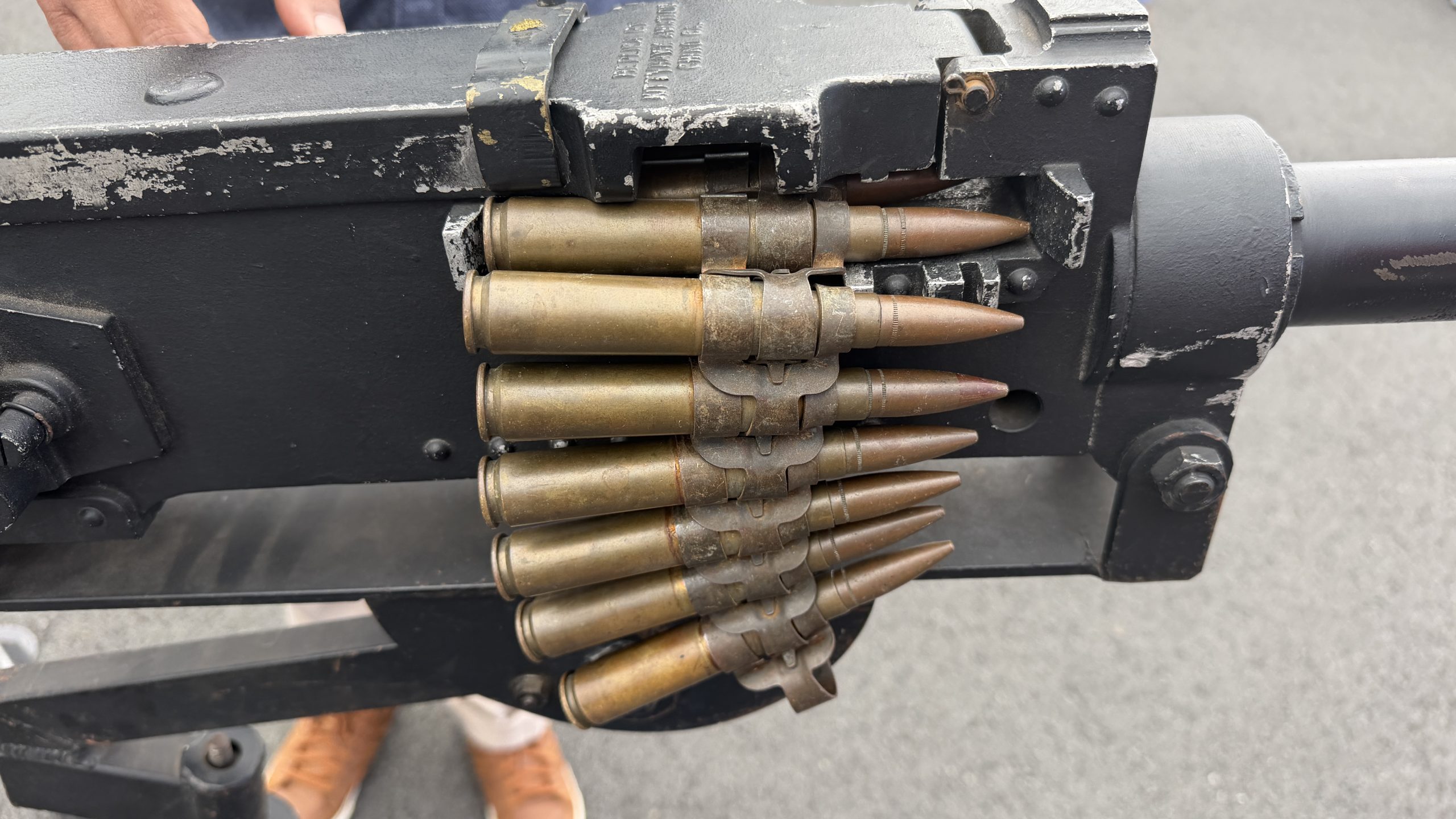
M2 Browning. Image taken by 19FortyFive.com staff at Leesburg, VA airshow.
The gun is older than the Army’s mechanized infantry. That’s not a figure of speech.
The Browning M2 .50 Caliber Machine Gun, Heavy Barrel, is an automatic, recoil-operated, air-cooled machine gun with adjustable headspace and timing. A disintegrating metallic link belt feeds ammunition into the breach. It can be crew-carried for short distances or mounted on vehicles, tanks, aircraft, etc., as an anti-aircraft or anti-personnel weapon.
M2 Browning: Born Of The Trenches
The M2 traces its lineage to World War I. By 1917, the .30 caliber guns of the day were losing the argument against armor. Tanks were appearing on the Western Front, and aircraft were becoming more capable.
Browning began with a personal weapon to be issued to infantrymen at the squad level. His Browning Automatic Rifle, known as the “BAR,” would serve through the Korean War and into the 1960s.
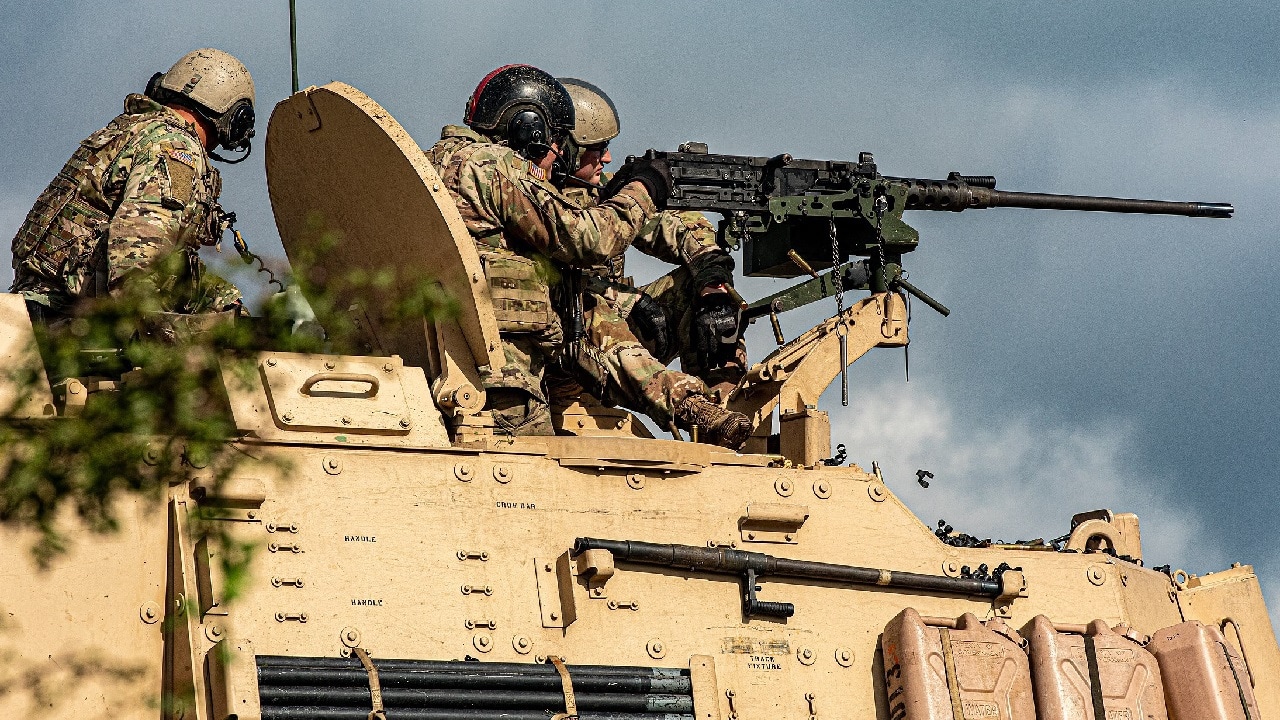
Soldiers with 1st Battalion, 5th Field Artillery Regiment, 1st Infantry Division fire a .50 caliber machine gun mounted on top of an M109 Paladin in Toruń, Poland, Aug. 26, 2021. The 1-5 is currently deployed to Poland in support of Atlantic Resolve. There are four types of U.S. Army Atlantic Resolve rotations – armored, aviation, sustainment task force and division headquarters. (U.S. Army photo by Spc. Michael Baumberger/RELEASED)
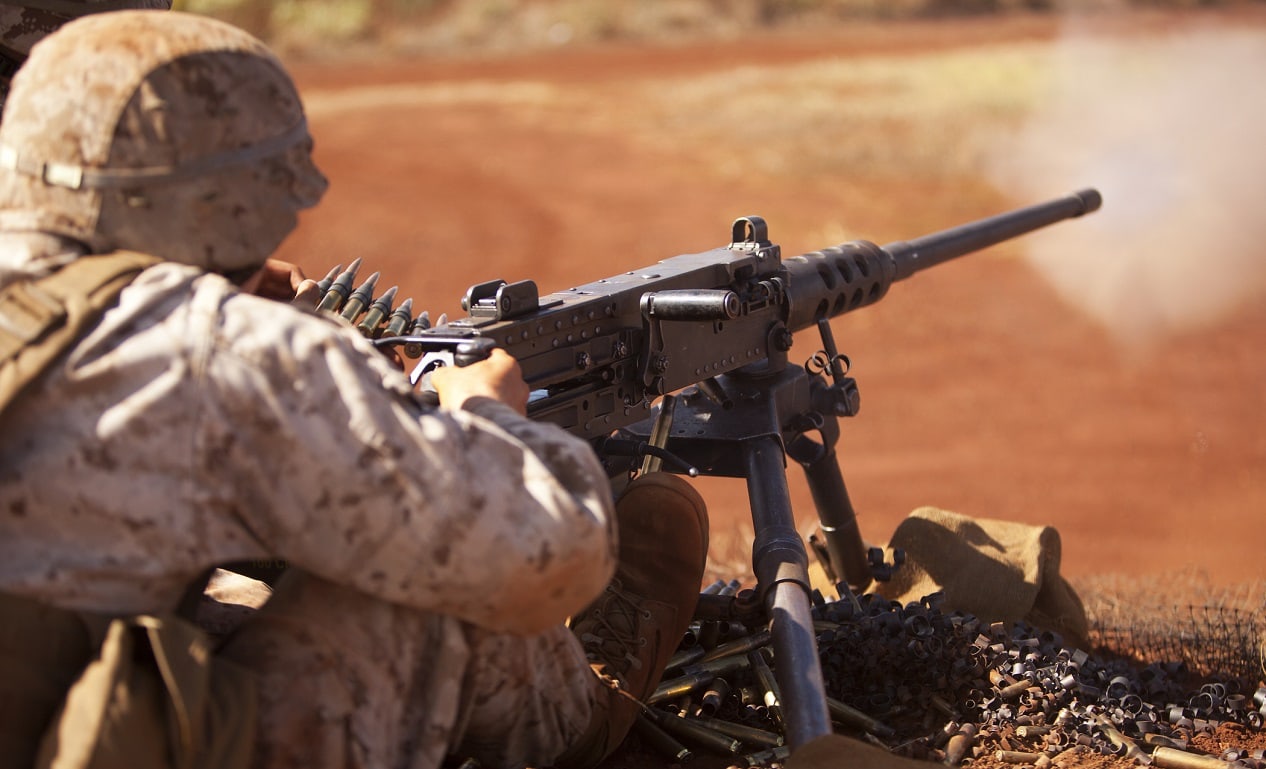
Pfc. Daniel Stillwell, a machine gunner with Charlie Company, 1st Battalion, 3rd Marine Regiment, shoots the .50 caliber M2 Browning machine gun during crew-served weapons training at Schofield Barracks, Oct. 8 to Oct. 10.
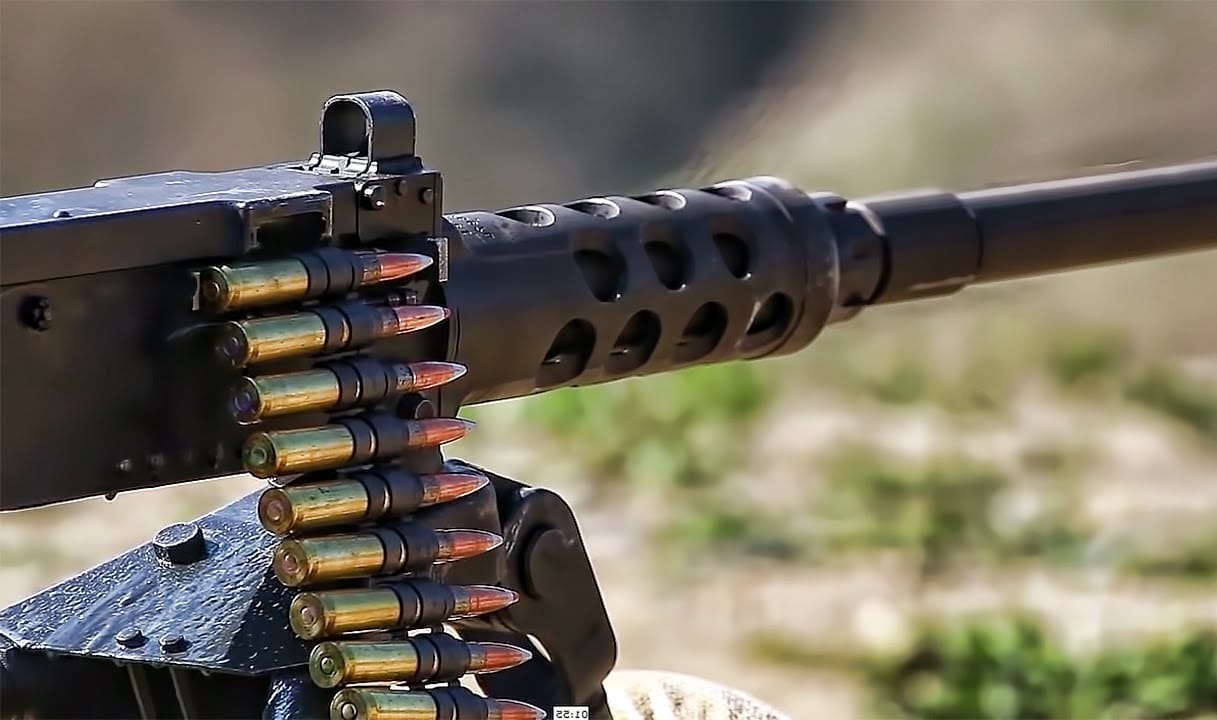
Browning M2 .50 Caliber Machine Gun
He improved his 1895 machine gun, which he retooled to fire a 7.62mm/.30-caliber cartridge, and it would become the M1917A1 machine gun.
However, General John “Black Jack” Pershing personally requested a heavier machine gun capable of engaging infantry and prepared positions, vehicles, aircraft, and even tanks, and he turned to Army Ordnance and John M. Browning to build it.
Browning did what Browning always did. He took a design that already worked, his water-cooled Model 1917, and scaled it up to a half-inch bore. He personally test-fired the prototypes in Colt’s cow pasture in Hartford late in 1918.
The war ended before the gun could get to France. However, the Army adopted it anyway as the M1921, and the .50 BMG cartridge that came with it, pushing a roughly 700-grain bullet at about 2,700 feet per second, became one of the most enduring rounds ever fielded.
Browning died in 1926. The gun that would carry his name for the next hundred years was finished by others. Engineers at Colt and Springfield Armory reworked the design so that a single receiver could be configured into seven different variants, water-cooled or air-cooled, left-hand feed or right-hand feed, for ground, vehicle, ship, or aircraft use.
The Army type-classified it as the M2 in 1933. The air-cooled heavy barrel version, the M2HB, is the one most of us know.
M2 .50 Caliber Specs:
Services: USN, US Army, USMC, USAF
Weight: 84 lbs
Length: 65 in
Barrel length: 45 in
Caliber: .50 BMG
Action: Short recoil-operated
Max Rate of Fire: 850 rpm
Muzzle velocity: 2,900 ft/s
Max Range: 6,800 m
Ma Deuce Has Fought In Every War Since
World War II made the M2 famous. It was everywhere. A B-17G Flying Fortress carried up to 13 M2 machine guns in 9 positions, from the chin turret to the tail. Fighters like the P-47 and P-51 went to war with banks of them in the wings. On the ground, the M2HB rode on Shermans, half-tracks, and deuce-and-a-halfs, and it chewed up German aircraft, trucks, and light armor alike.
Korea and Vietnam followed, and the M2 was there for both. In 1967, Marine sniper Carlos Hathcock mounted an Unertl 8X scope on an M2, set it on a sandbagged M3 tripod, and fired it in single-shot mode at a Viet Cong soldier pushing a bicycle loaded with weapons. The target was 2,500 yards away.
Hathcock’s first round took out the bicycle. The second took out the man. That stood as the longest sniper kill on record until a Canadian sniper broke it in Afghanistan in 2002.
With a machine gun. For those keeping score at home.
From the Gulf War to Iraq and Afghanistan, the M2 sat on top of Humvees, MRAPs, and Strykers, and in my opinion no weapon in the convoy did more to change an enemy’s mind about an ambush.
The Only Drawback Is The Headspace And Timing
So why does a design from the Wilson administration still ride on top of American combat vehicles? Because it works, and it keeps working. Ask anyone who has ever shot it, and they’ll tell you it’s an awesome weapon with tremendous firepower.
The M2 is heavy, roughly 84 pounds for the gun alone, before you add the tripod and ammunition. However, that weight is part of why it’s so controllable and so durable. It fires a cartridge that can reach beyond 2,000 meters and defeat light armor, at roughly 500 to 600 rounds per minute, slow enough to keep a gunner on target.
Consider the M2 with serial number 324. When it arrived at Anniston Army Depot for conversion, it had never been overhauled in more than 90 years, and the inspectors found it gauged better than most of the newer guns.
The one real knock on Ma Deuce was headspace and timing. Anyone who has been through a heavy weapons class knows the drill. Get it wrong, and the gun can malfunction or blow up in your face.
The Army finally fixed that with the M2A1, which began fielding in 2011. It added fixed headspace and timing, a quick-change barrel, and a flash hider that cuts muzzle flash by 95 percent at night.
Barrel changes dropped from three to five minutes to about 30 seconds. The program manager called the headspace fix the resolution of “the number one safety issue” for soldiers on the gun. I’d call it about 80 years overdue.
Nobody Has Built A Better One
The Pentagon has tried to retire the M2 more than once. The most serious attempt was the XM806, a lightweight .50 developed by General Dynamics. It weighed about 40 pounds, less than half of Ma Deuce.
However, it also fired at about half the rate, and the troops who tested it weren’t impressed. The Army canceled the XM806 in 2012. Soldiers who had been in contact wanted the M2’s volume of fire, and they said so.
Say what you want about the weight and the age. That’s beside the point. With something like three million built and a fleet of more than 54,000 guns in Army inventory alone being brought up to the M2A1 standard, the M2 isn’t going anywhere soon.
It will almost certainly be the first American weapon to serve for a full century, reaching 100 years in 2033.
John Browning built it for a war that ended before the gun got there. It has been fighting ever since.
About the Author: Steve Balestrieri
Steve Balestrieri is a National Security Columnist. He served as a US Army Special Forces NCO and Warrant Officer. In addition to writing on defense, he covers the NFL for PatsFans.com and is a member of the Pro Football Writers of America (PFWA). His work was regularly featured in many military publications.