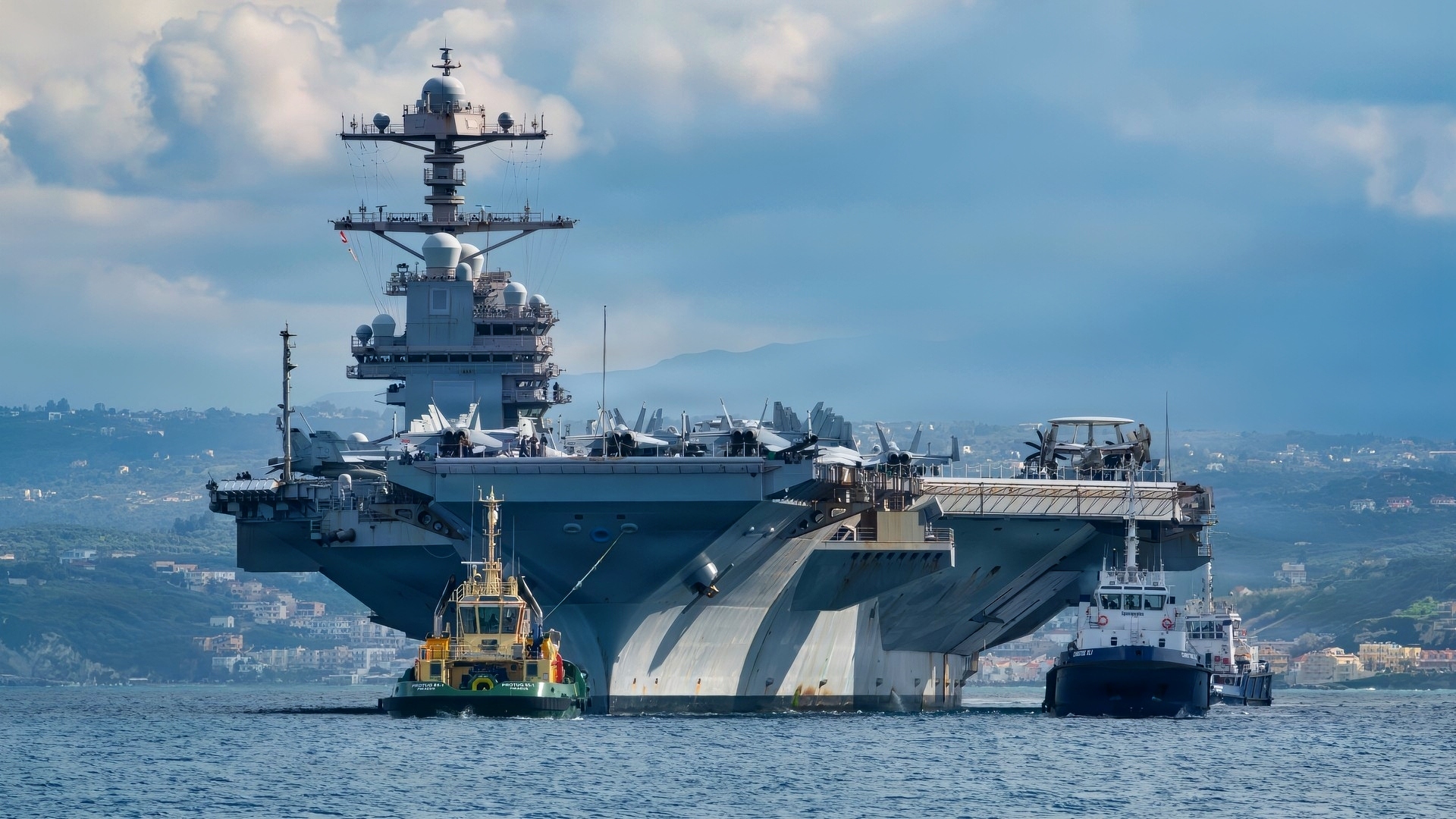
Summary and Key Points: The USS Gerald R. Ford has put its troubled development behind it. The Navy’s newest carrier returned in May 2026 from a 326-day deployment covering more than 57,700 nautical miles, and Carrier Air Wing 8 logged more than 12,200 launches. The class is still expensive and still controversial.
What Makes the USS Gerald R. Ford Aircraft Carrier Such a Target of Criticism
Aircraft carriers are not exactly cheap projects, but the $13.3 billion figure attached to the U.S. Navy’s newest one, USS Gerald R. Ford, is hard to ignore.
That is the final procurement cost, according to the Congressional Budget Office, for CVN-78, not counting roughly $6 billion in research and development costs, which apply to the whole class of carriers. But it may be time to correct another oft-repeated claim.
Ford did not take more than a decade simply to “get into the water.” The carrier’s construction began in 2008; its keel was laid in November 2009, and it was christened in November 2013.
It took more than a decade to turn the first-of-its-kind aircraft carrier into an operational warship: it reached initial operational capability in December 2021 and conducted its first deployment in October 2022.
The reason is apparent when you look at the ship itself. Ford was the Navy’s first new aircraft carrier design in more than four decades and introduced 23 new technologies.
Rear Admiral Brian Antonio described the carrier upon delivery as the Navy’s “newest, most capable, most advanced warship.”
The Ford-class replaced the steam catapults of its predecessors with the Electromagnetic Aircraft Launch System (EMALS), and introduced Advanced Arresting Gear (AAG) for recovering aircraft.
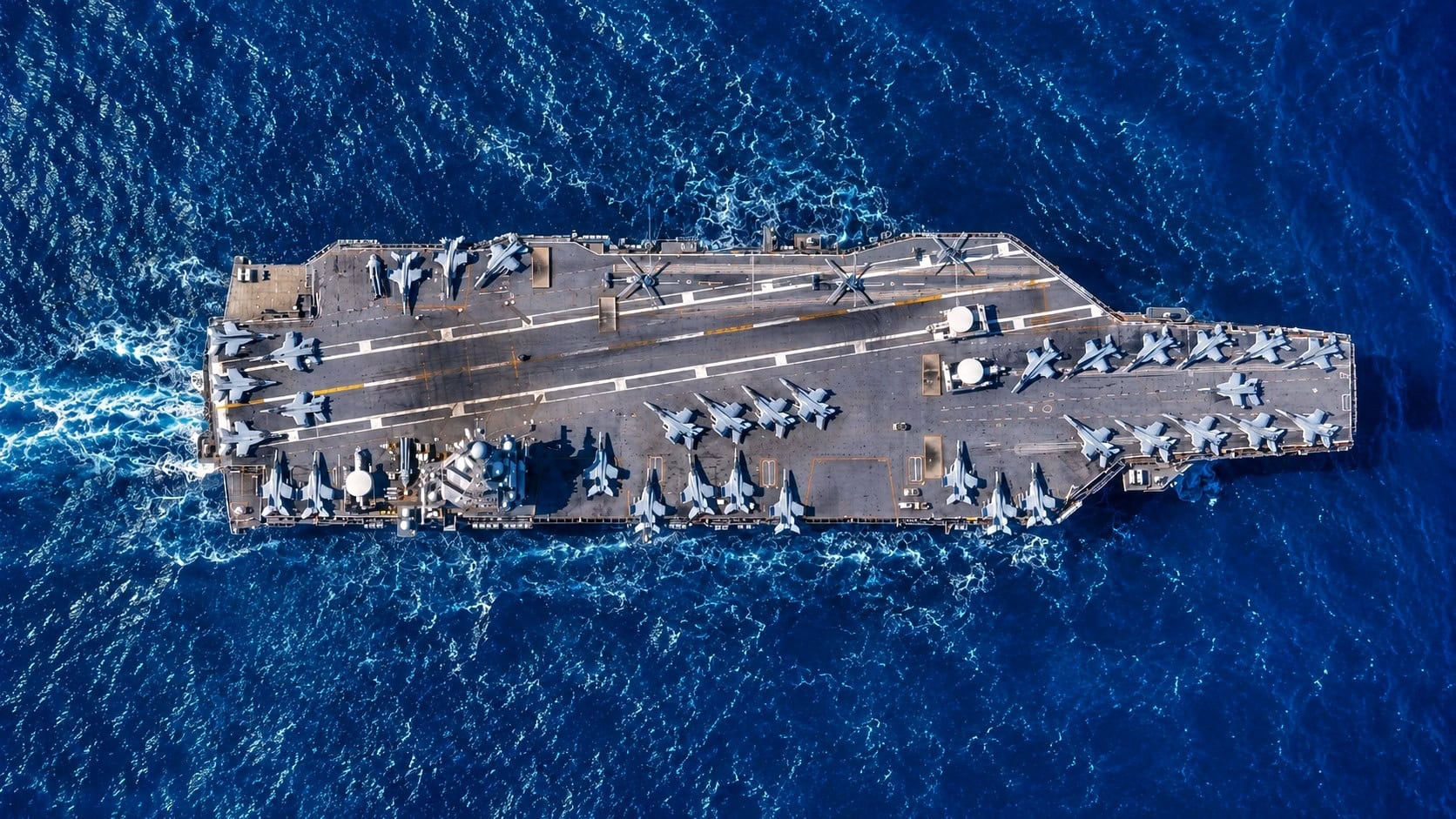
USS Gerald R. Ford. Image Credit: Banana Nano.
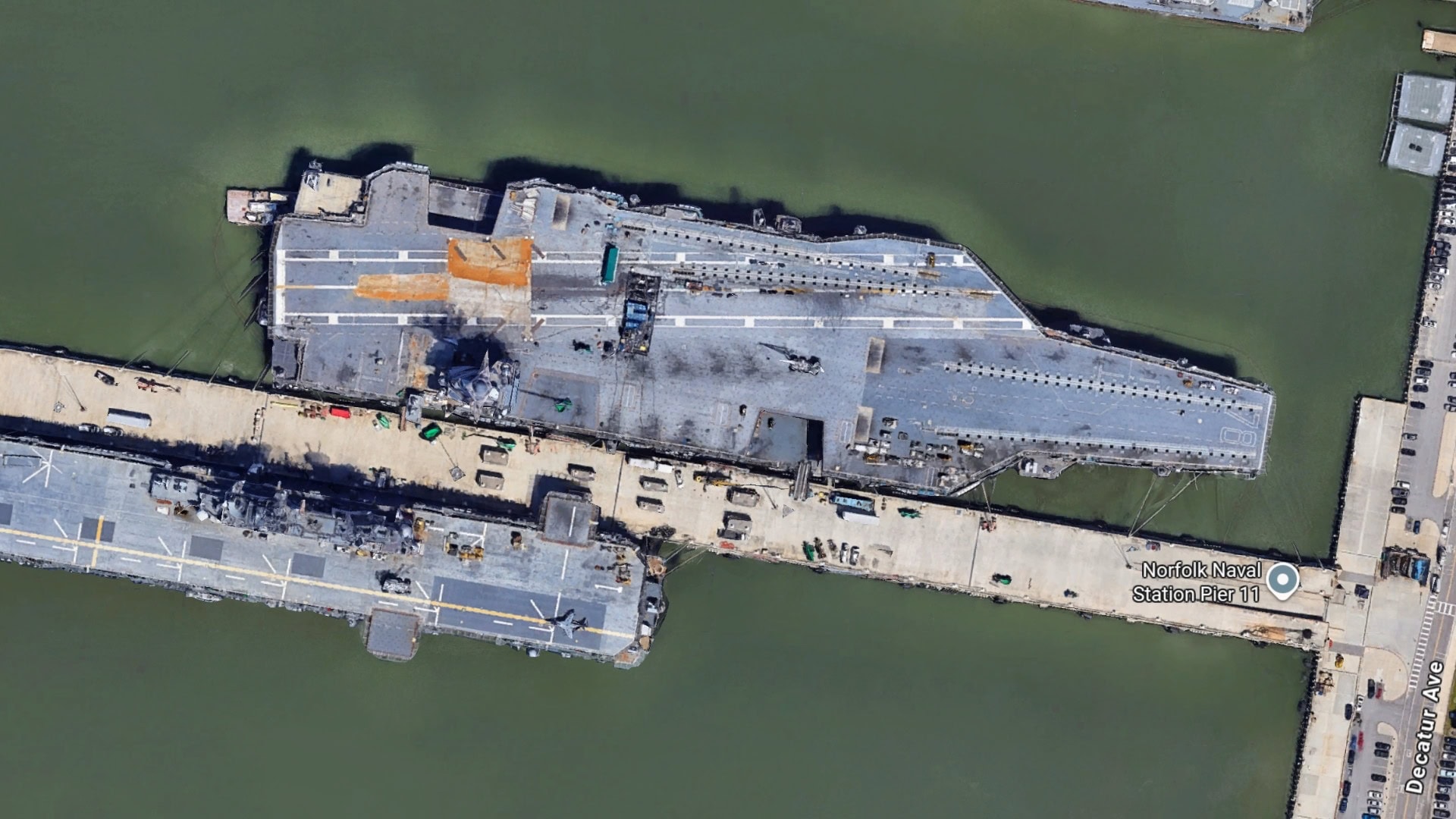
USS Gerald R. Ford Google Maps Photo Screenshot.
NAVAIR claims these systems require “less maintenance, and less manpower,” than their Nimitz-class counterparts.
When Ford made its 10,000th launch and recovery in 2022, Captain Kenneth Sterbenz called it a “significant milestone” for EMALS, AAG and naval aviation.
The carrier also replaced traditional weapons elevators with the electromagnetic Advanced Weapons Elevators. Lieutenant Commander Chabonnie Alexander said the system would allow sailors to “load more aircraft faster,” and boost overall sortie generation. T
These elevators were designed to carry up to 24,000 lbs. at 150 feet/minute, compared with 10,500 lbs. at up to 100 feet/minute on Nimitz-class carriers.
Then there is the electricity. Newport News Shipbuilding laid more than 14 million feet of electrical and fiber-optic cable in the carrier, says executive Rolf Bartschi. He described the carrier’s “increased electrical capacity” as making this ship “unique.” The Newport News-based company HII said the carrier provided more than 250 percent more electrical capacity than previous carriers, allowing for future systems.
That technology is supposed to save money over time.
Navy officials have said Ford-class carriers can operate with roughly 20 percent fewer crew and are projected to cost about $4 billion less in life-cycle operations and support per ship than the Nimitz class.
Captain Ron Rutan called Ford “a test bed for the warfighting technology essential for air dominance in the 21st century.”
The issue was that the Navy tried to mature several major technologies while building the ship.
GAO warned in 2015 that Ford had begun with an “unrealistic business case,” and the subsequent cost increases, delays, and capability problems, summed up as “getting less for more,” were the result. EMALS, arresting gear, and the elevators all had development problems.
The 11th and final weapons elevator was not turned over to the crew until December 22, 2021, more than four years after the carrier was commissioned.
The ship has since moved past that troubled development period.
In May 2026, Ford returned from a 326-day deployment, after sailing over 57,700 nautical miles. Its embarked Carrier Air Wing 8 recorded more than 12,200 flight launches.
After one of its previous Mediterranean deployments, commanding officer Captain Rick Burgess said Ford was “everything our nation hoped it would be, and more,” and the carrier entered the Norfolk Naval Shipyard in July for scheduled maintenance and modernization.
The class is still expensive. GAO reported in July 2026 that “costs for the CVN 78 program continue to rise” as the second carrier, future USS John F. Kennedy, was pushed back to spring 2027.
Kennedy completed acceptance trials in August and was 98% complete. Program manager Capt. Mark Johnson said its crew had demonstrated it was “ready to put this ship to work for the Navy.”
In August, President Donald Trump ordered the Pentagon to develop a plan to replace EMALS and the advanced weapons elevators on CVN-81 with steam and hydraulic systems, citing Navy setbacks due to “overly complex designs.”
About the Author: Georgia Gilholy
Georgia Gilholy is a journalist based in the United Kingdom who has been published in Newsweek, The Times of Israel, and the Spectator. Gilholy writes about international politics, culture, and education.