
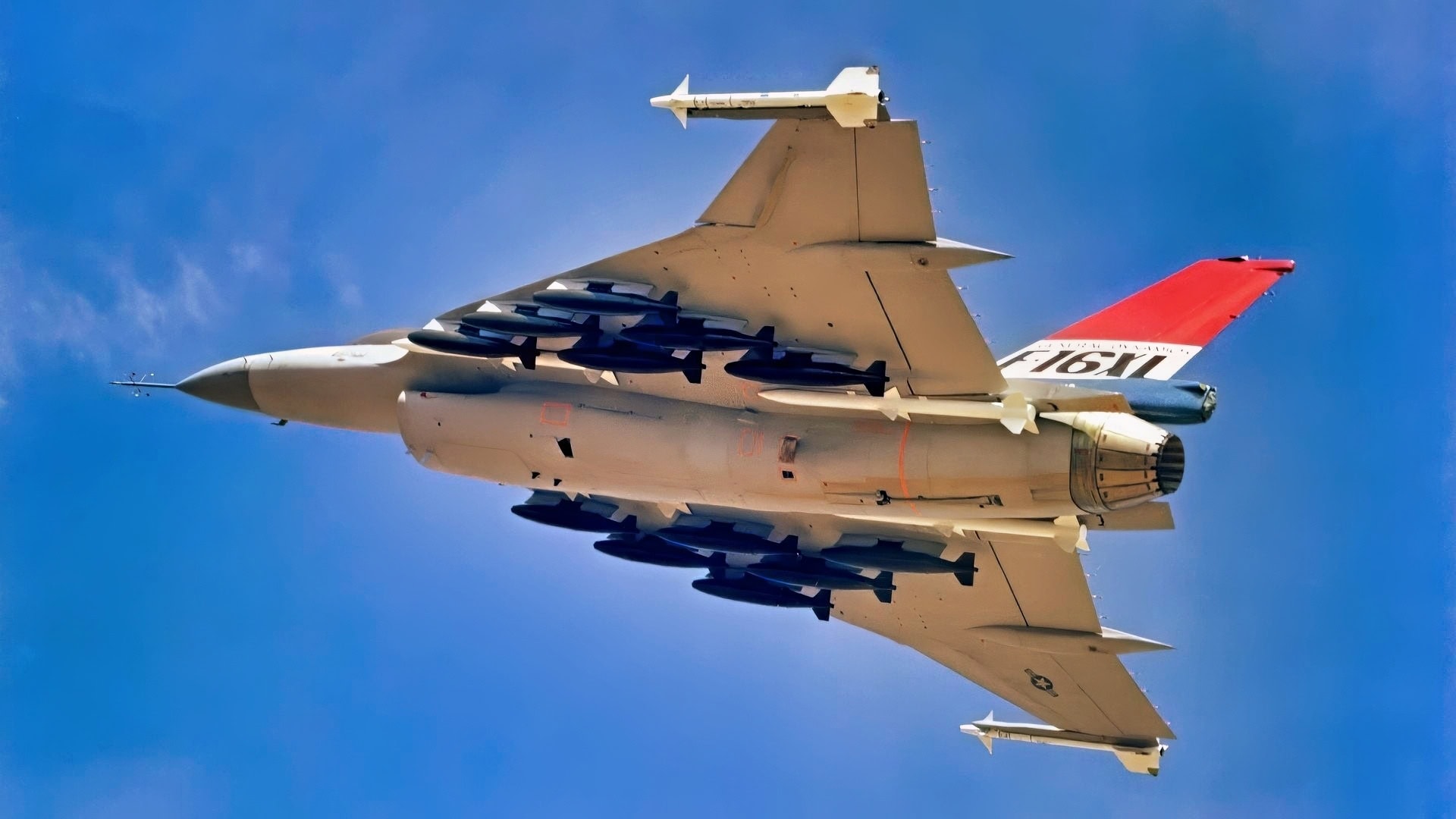
It has now been more than four decades since the F-16XL lost one of the most important U.S. fighter competitions of the Cold War — but the aircraft isn’t forgotten. On September 16, the combat flight game War Thunder added the F-16XL as the headline aircraft in a brand-new event.
It is the closest most people will ever be able to come to flying the unusual fighter themselves — not because it is something only military pilots can do, but because only two of them were ever built.
And neither of those two aircraft ever entered operational service. The type also made its final flight in 1999.
The addition of the F-16XL to the War Thunder video game introduces it to a new audience and highlights its remarkable history.
What Was the F-16XL?
The F-16XL was a significantly redesigned and modified version of the General Dynamics F-16 Fighting Falcon, a single-engine fourth-generation multirole fighter designed in the 1970s.
The F-16XL’s most notable feature was its large “cranked-arrow” delta wing, which replaced the original F-16’s cropped-delta wing.
The wing swept sharply backward near the fuselage before changing to a shallower angle toward the tips, giving it a distinctive “cranked” appearance.
The shape was intentional, combining the lift and high-speed efficiency of a delta wing with improved handling.
General Dynamics studied the new configuration beginning in 1977 under a project known as the Supersonic Cruise and Maneuver Prototype, or “SCAMP.” The effort was led by Harry Hillaker, who was one of the principal designers of the original F-16.
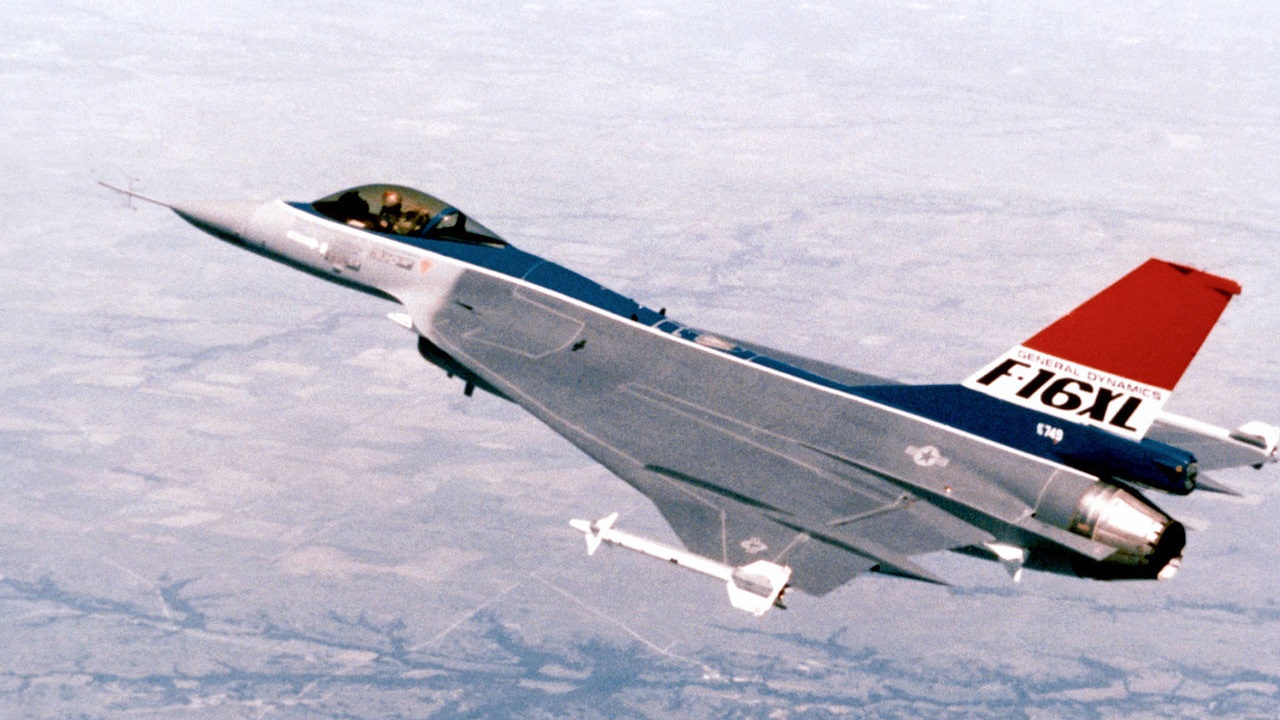
F-16XL. Image Credit: Creative Commons.
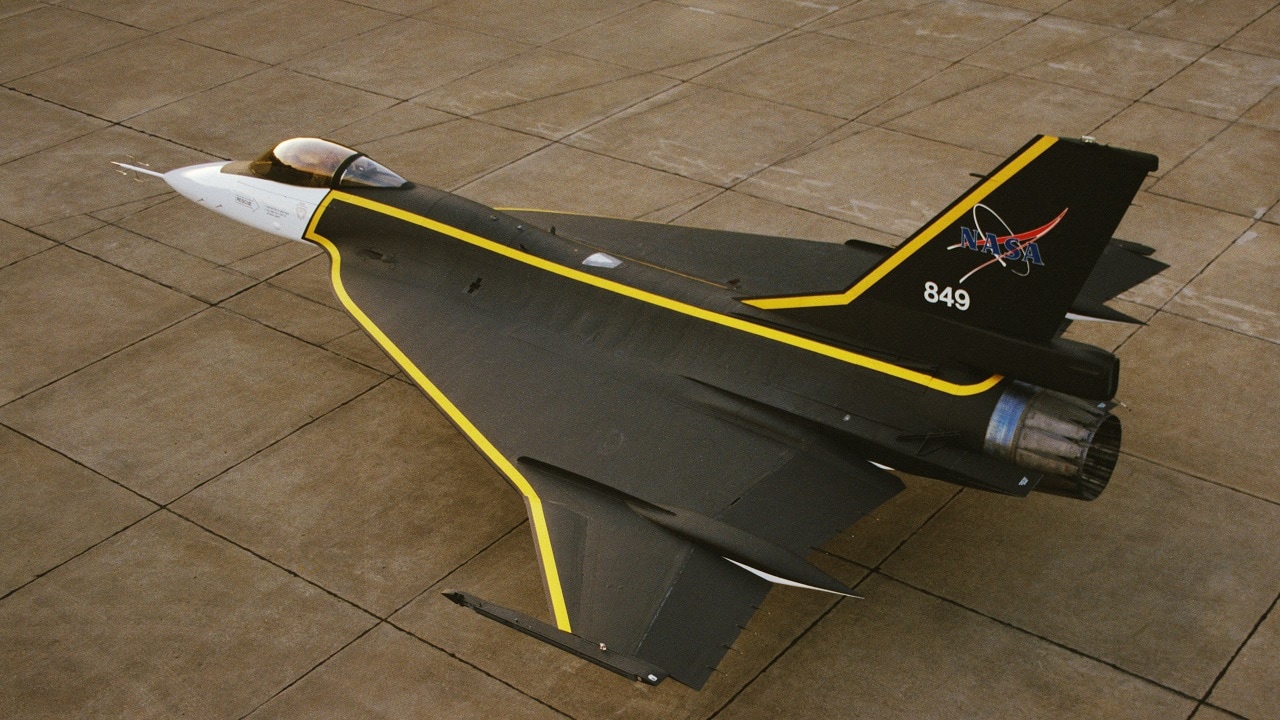
On October 5, 1993, Langley’s F-16XL High Lift jet was rolled out with a dynamic yellow and black paint job for Aero-Dynamic Flow Studies in High Speed Research.
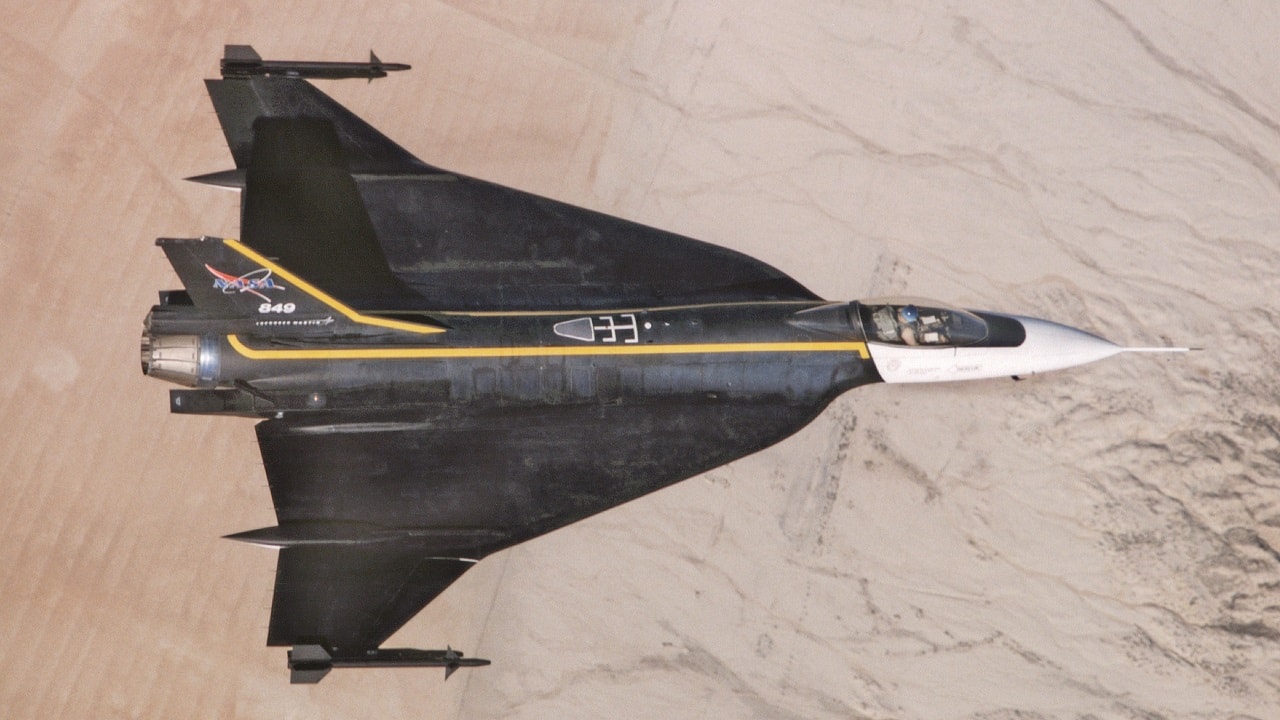
F-16XL. Image Credit: Creative Commons.
Instead of building an entirely new aircraft, General Dynamics converted two F-16 airframes from the early full-scale development phase.
The fuselage was lengthened by 56 inches and fitted with a wing more than twice the area of the original.
A single-seat prototype first flew on July 3, 1982.
A two-seat aircraft then flew on October 29.
Why It Was Built
The F-16XL’s larger wing was designed to accommodate additional fuel tanks and also provide additional space for carrying weapons.
The modified F-16 could reportedly carry up to 82% more internal fuel than the standard model and, as a result, offer around 40% greater range.
And it featured extra attachment points.
That means it could carry a heavy weapons load without relying entirely on underwing racks that generated extra drag.
Depending on the configuration, the aircraft offered up to 27 potential weapon mounting positions.
According to General Dynamics, the XL could carry twice as much ordnance as a conventional F-16.
The large wing also provided more lift, and the cranked-arrow shape meant better handling at lower speeds and improved performance at high speed.
It meant that the F-16XL was effectively a long-range strike aircraft built around a single-engine F-16 — and not on the much larger F-15.
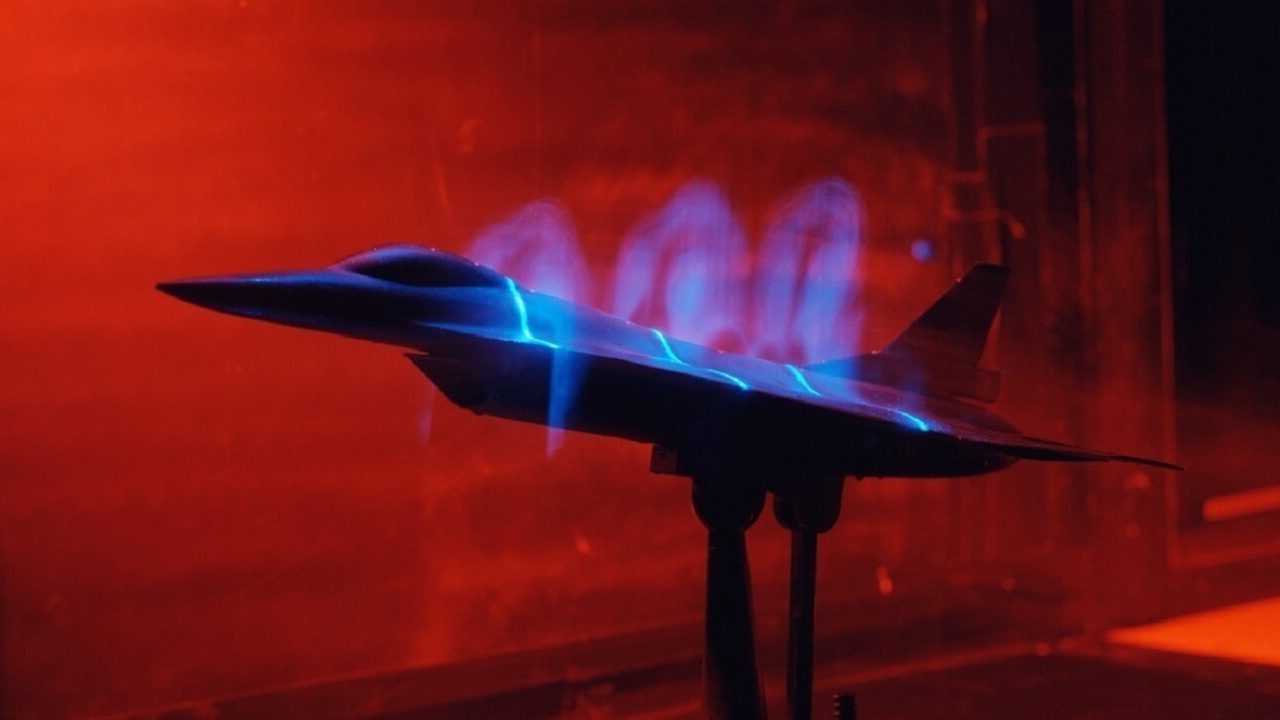
F-16XL fighter. Image Credit: Creative Commons.
The Air Force Said No
The F-16XL entered the Air Force’s Enhanced Tactical Fighter competition, which sought a long-range strike aircraft to replace the F-111 Aardvark.
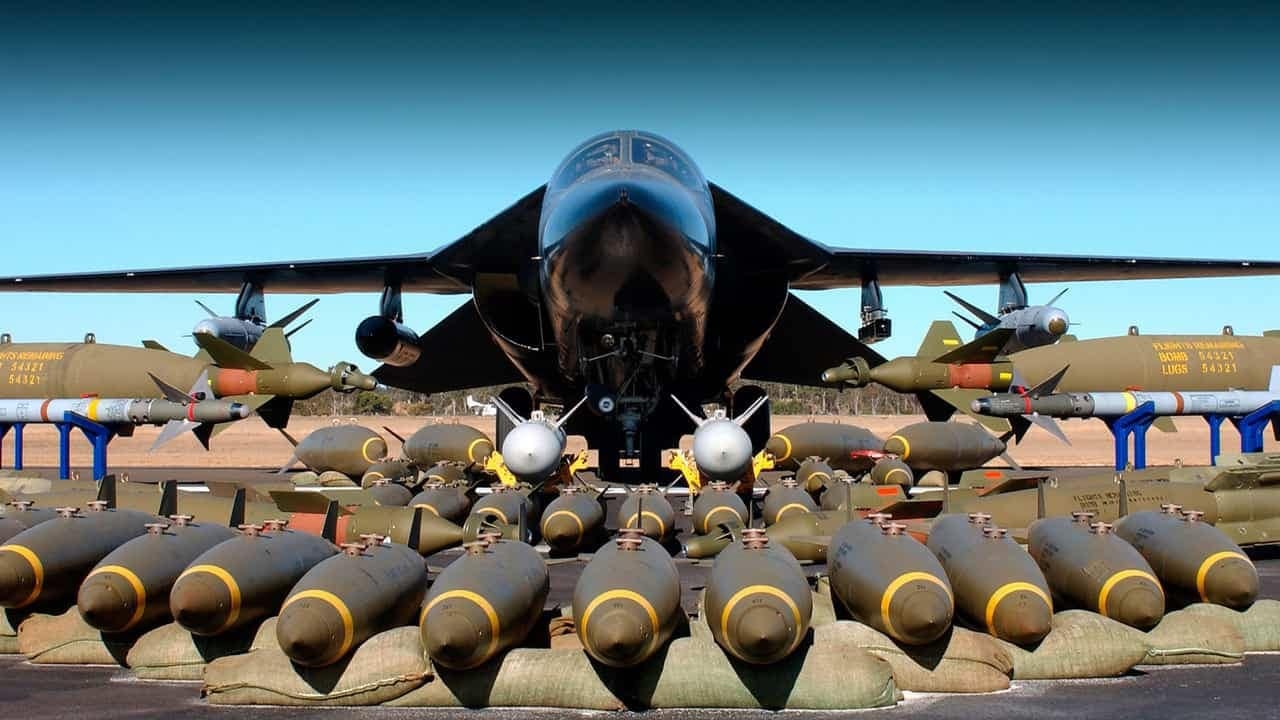
F-111 weapons loadout. Image Credit: Creative Commons.
It went up against a modified twin-engine F-15 Eagle.
Ultimately, in February 1984, the Air Force chose the F-15 design instead, which eventually entered service as the F-15E Strike Eagle.
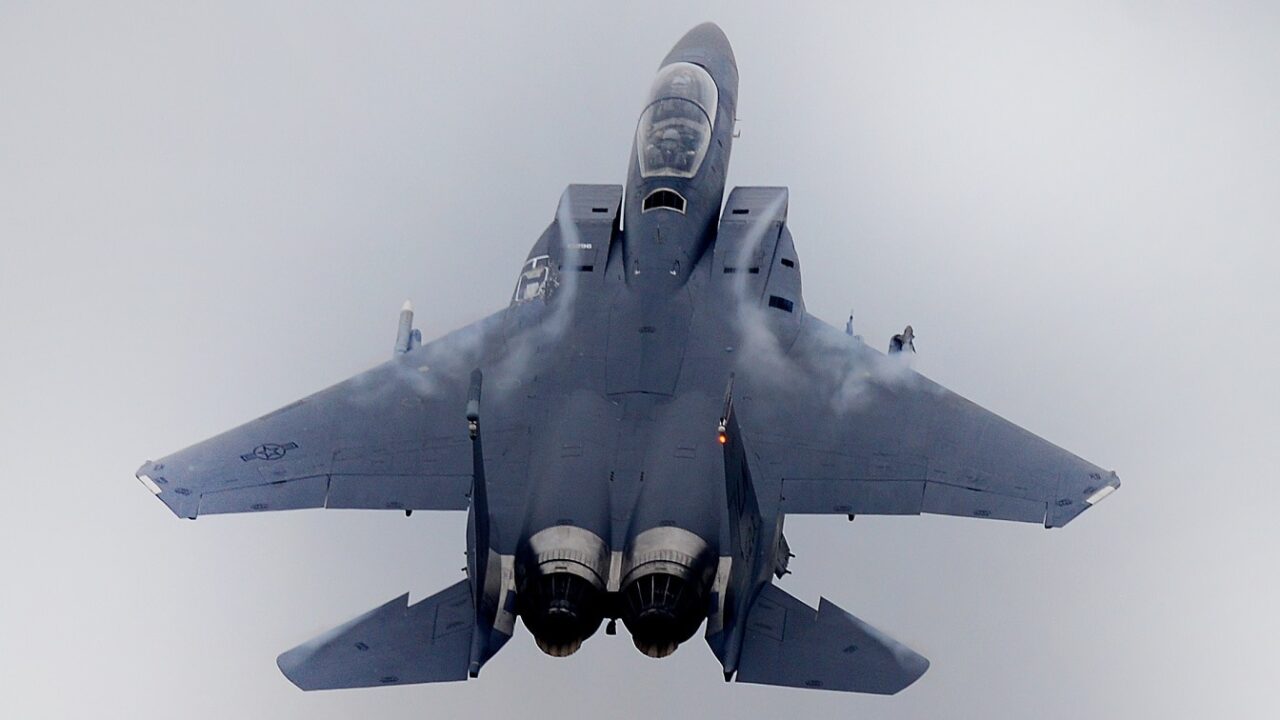
An F-15E Strike Eagle assigned to the 494th Fighter Squadron takes off for a training sortie at Royal Air Force Lakenheath, England, Oct. 26, 2018. The 494th trains regularly to ensure RAF Lakenheath brings unique air combat capabilities to the fight. (U.S. Air Force photo/ Tech. Sgt. Matthew Plew)
The F-15E was chosen because it offered two-engine redundancy, making it suitable for missions over hostile territory.
It also offered more room for future upgrades and was predicted to have lower development costs.
The F-16XL was by no means wholly inferior, however.
It demonstrated impressive range and payload capacity, but producing it would have required more extensive changes to the F-16 design and manufacturing process, making it costlier and riskier.
The two prototypes were placed in storage at Edwards Air Force Base in California, but that wouldn’t be the end of their life entirely.
NASA Revived the F-16XL
In 1988, NASA found a use for the two prototypes.
The space agency acquired both aircraft and used them to investigate ways to make supersonic flight more efficient, with researchers experimenting with maintaining smooth, or laminar, airflow across the XL’s wing.
One of the prototypes was fitted with a specially modified wing surface that contained millions of microscopic holes.
The aircraft was also used in sonic boom and aerodynamic research before the program ended in 1999. In 2009, both of the prototypes were formally retired.
Ultimately, the F-16XL never played a role in modern combat planning, but the problems it addressed remain relevant today.
Modern air forces need fighters that are capable of carrying more weapons over greater distances.
What’s more, NASA continues to research faster and more efficient supersonic aircraft.
So while the XL never reached operational service, it helped shape the technologies now incorporated into current and next-generation fighter aircraft.
Gamers can fly the F-16XL in War Thunder using PlayStation, Xbox, macOS, Linux, and Microsoft Windows.
About the Author: Jack Buckby
Jack Buckby is a British researcher and analyst specializing in defense and national security, based in New York. His work focuses on military capability, procurement, and strategic competition, and he produces and edits analysis for policy and defense audiences. He brings extensive editorial experience, with a career output spanning over 1,000 articles at 19FortyFive and National Security Journal, and has previously authored books and papers on extremism and deradicalization.