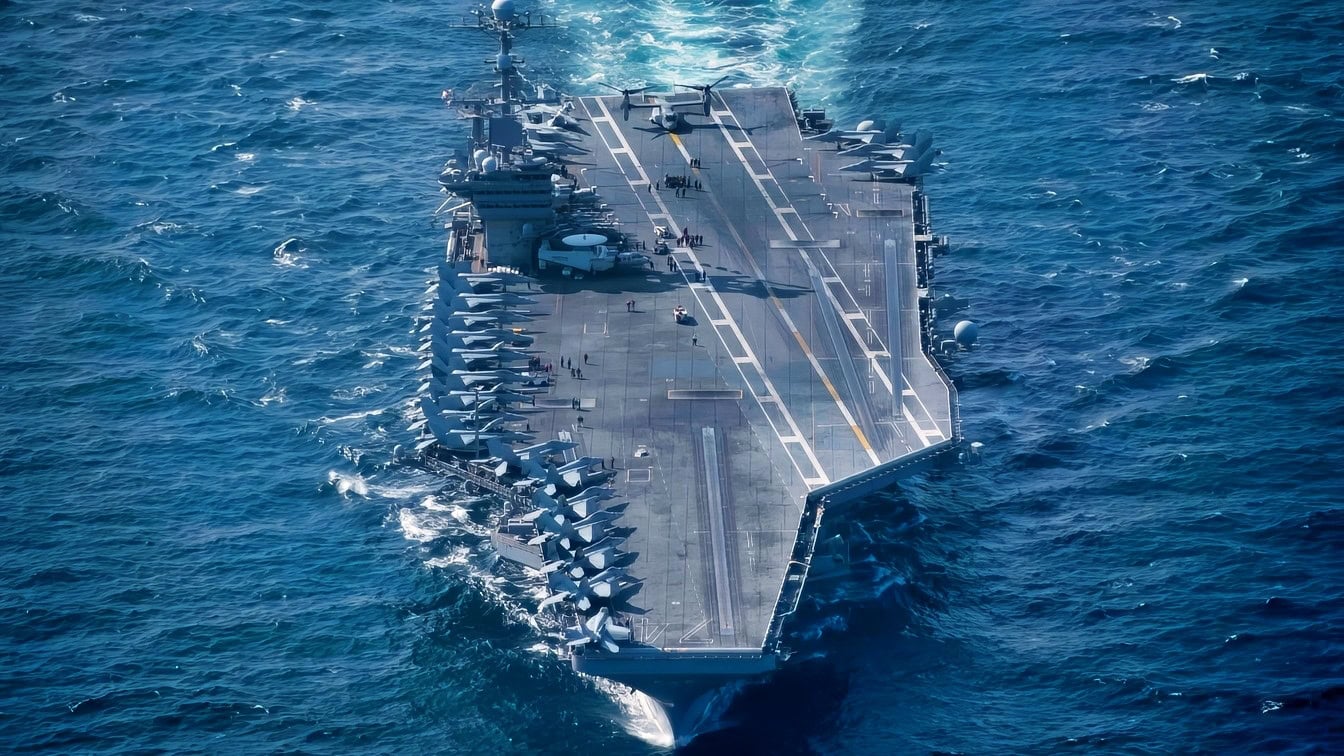
Summary and Key Points: Can the United States still fight its way into the First Island Chain? Brandon J. Weichert argues it can’t. China has spent years building one of the world’s most extensive anti-access and area-denial networks, from DF-26 anti-ship ballistic missiles meant to keep US aircraft carriers out of range to J-20 and J-35 stealth fighters that could threaten the tankers and aircraft carrier jets depend on.
The US Navy’s Great China Problem
From a military perspective, China has already secured the First Island Chain. Yes, Beijing must constantly fret about what Japan might or might not do. But the real threat to China’s dominance in the First Island Chain, the United States, has been properly negated at the conventional level.
The A2/AD Threat: Thousands of Missiles and Drones vs. the US Navy
That’s because China has established one of the most comprehensive and advanced anti-access/area-denial (A2/AD) networks in the world, which today covers the First Island Chain and even parts of the Second Island Chain.
Using its impressive mass-production capacity, the Chinese military has built a seemingly endless array of advanced, relatively cheap missiles, hypersonic weapons, and drone swarms that can stymie any US military advance into the First Island Chain (and complicate US forces’ ability to defend themselves in the region).
On top of China’s vast A2/AD arsenal, the Chinese military has rapidly expanded its numbers, notably its navy and air force, to ensure it can counter any intervening US military elements in a potential contingency over Taiwan or elsewhere in the First Island Chain.
The primary power-projection platform the United States Navy would employ, for example, would be nuclear-powered aircraft carriers.
China has developed advanced anti-ship ballistic missiles (ASBMs), such as the DF-26, to ensure that the expensive US carrier force (of which there are only 11, but really only around four are combat-ready) cannot get within range of the First Island Chain.
By forcing US carriers to stay over the horizon for safety, the carrier-based planes will struggle to reach their targets without constant midair refueling.
Those midair refuelers — enablers, in US Air Force speak— are not to be fretted over. After all, the Chinese have a massive fleet of Chengdu J-20 “Mighty Dragon” and Shenyang J-35 fifth-generation stealth warplanes that appear to be designed specifically to hunt down and destroy US systems such as midair refuelers.
Whereas the US military is clearly primed to fight–and win–a late twentieth-century war, China is already waging an effective mid-twenty-first-century conflict.
And they’ve been preparing the battlefield for that eventuality with great aplomb.
At the same time, the Americans have oscillated between quagmires in the Middle East and whatever you want to call the US involvement in the Ukraine War.
Scale Matters Most
There’s also the added complication of the new systems that China is producing at scale. Recent satellite photos indicate that China is building a drone-carrying mothership that will exclusively deploy large numbers of unmanned extra-large undersea vehicles.
Meanwhile, the Chinese are advancing the design of their Jiutian flying drone mothership, which will deploy swarms of smaller, lethal drones.
That’s to say nothing of the massive scale at which the Chinese are building their aircraft carrier and submarine forces, all of which will operate within the First Island Chain under the protective umbrella of the aforementioned A2/AD network.
Any US war with China would inherently be an expeditionary operation for the Americans, while the Chinese would be on the defensive.
We are living in an age in which the defenders have the prime mover advantage.
It’s Jomini’s World at War
Indeed, we should view Jomini’s theories with greater focus today, as we live in an age where fighting over interior lines, logistics nodes, and operational axes of advance matters more than the geometric layout of the front and the broader theories of the more popular Carl von Clausewitz.
Applying Jomini to a potential US-China clash over the First Island Chain, the operational execution of such a conflict will be quite Jominian.
And they favor China, which has shorter lines of communication and a tighter area of operations than the expeditionary Americans.
The Chinese forces can project mass much faster than the Americans can, and the Indo-Pacific has very particular spatial mechanics that favor chokepoint control and long-range missile attacks — meaning China has the upper hand already.
As time goes on, they will continue to strengthen that hand.
Barring some unforeseen “black swan” event, like the total collapse of China (a highly unlikely scenario, contrary to what the so-called “experts” in DC maintain), the Chinese military has already achieved overmatch in the First Island Chain.
They will build off that overmatch whereas the Americans are frittering about the world, depleting themselves everywhere, and breaking the back of their armed forces.
Lack of Proper Force Protection
What’s more, as the Center for Strategic & International Studies (CSIS) has assessed, the defense of American bases throughout the Indo-Pacific–especially Guam–is poor.
The world has already seen the abysmal defenses and force protection offered to US forces forward-deployed against Iran throughout the Middle East.
The same conditions exist on American bases forward-deployed throughout the Indo-Pacific.
And the Indo-Pacific has fewer strategic American bases, meaning they are easier to target and much easier to destroy by current–and likely future–Chinese weapons.
The bottom line is that the United States has lost the First Island Chain.
Washington must reassess its military posture in the region and establish a new defensive perimeter much closer to its base of operations in the Western Hemisphere; otherwise, the US military will be defeated by a peer rival for the first time in its history.
About the author: Brandon J. Weichert
Brandon J. Weichert is the Senior National Security Editor at 19FortyFive.com. He also manages The Weichert Brief on Substack. Weichert also hosts “National Security Talk” on Rumble. He is the author of four bestselling national security books, most recently A Disaster of Our Own Making: How the West Lost Ukraine (Encounter Books). Follow him via Twitter/X @WeTheBrandon.