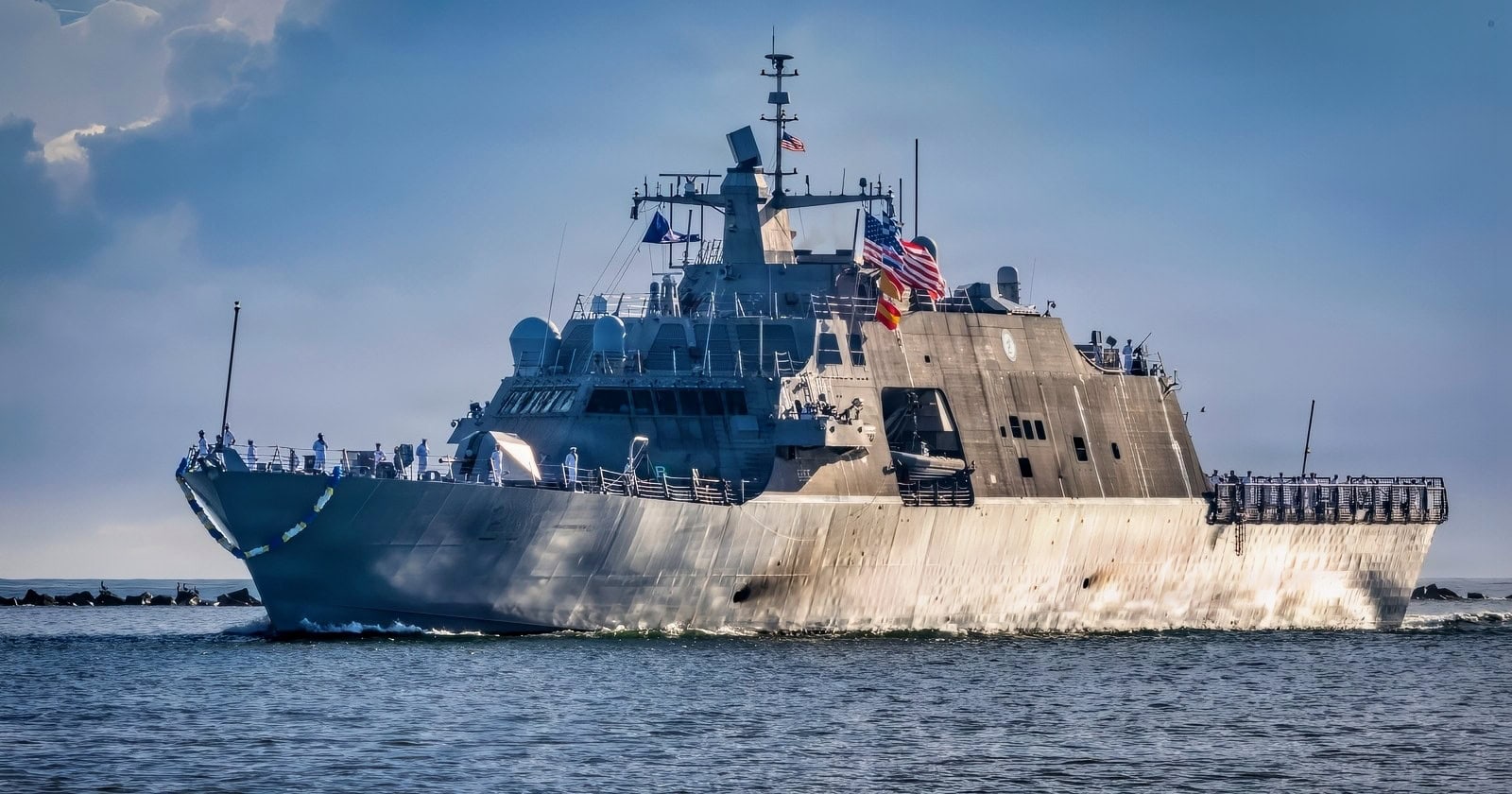
The U.S. Navy’s Littoral Combat Ship was not a success because of mission creep, cost overruns, and serious reliability issues. One of the core issues with the LCS ships was present at the genesis of the class’s design. The LCS ships were lightly armed and less robustly protected than other U.S. Navy warships — and the Navy needed ships for a more challenging maritime environment.
In tandem, the LCS ships did not fill a specific war-fighting niche and lacked serious prospects for survival in high-end combat against a peer navy.
What the Littoral Combat Ships were Meant to do
The Littoral Combat Ships were conceived in the post-Cold War, post-9/11 environment as fast, relatively inexpensive — and, most importantly, modular — ships for littoral waters.
To that end, they were to be highly flexible ships capable of anti-submarine warfare, surface combat against modest threats, maritime demining, interdiction, and patrol.
They were not intended to replace more capable ships like cruisers or destroyers.
Instead, the LCS ships were meant to free up those larger warships from the kinds of more modest maritime tasks the LCS ships could perform.
In the relatively shallow, cluttered waters near shore, the LCS ships were useful on paper. At the time, the logic was solid.
The U.S. Navy was focused on coastal patrol, international anti-piracy missions, and disaster relief, not on war at sea against a peer adversary.
The Obsolescence of the Littoral Combat Ships
The Littoral Combat Ship’s allure lay in its high degree of modularity.
Mission packages could be swapped out with relative ease, tailored to the task at hand.
But in practice, the ship’s modular operational concept ultimately failed to deliver the plug-and-fight performance it promised.
Teething issues were extensive, and the ship’s multi-mission systems failed to deliver.
As a result, the ships were neither true multi-mission ships nor specialist ships, but somewhere vaguely in the middle.
Alongside their lack of utility, the strategic environment in which the Littoral Combat Ships entered changed significantly.
A lightly armed ship intended to operate near shore became increasingly difficult to justify in an era saturated with long-range anti-ship missiles, maritime mines, high-end submarines, and a dense sensor network.
The U.S. Navy later added capabilities, including the Naval Strike Missile on some ships in the broader class, but that was a retrofit.
Cost, Quality, and Survivability
Perhaps one of the biggest reasons for the program’s failure was the cost of the ships relative to the combat capability they provided.
They were far more expensive than initially projected, and design and construction issues drove up the price tag. But the ships also had serious design issues.
Propulsion breakdowns, corrosion, and seawater contamination inside the ship, along with unreliability, eroded confidence in the class.
Broader criticism went beyond cost, including critiques of operating costs versus their utility to the U.S. Navy.
The ships’ survivability was also an extreme weakness.
By the time the ships completed testing, they had earned a reputation for being unable to confidently fight through and survive in a contested environment.
But rather than solving the survivability issue, the U.S. Navy adjusted its expectations for the ships.
Keeping the Class Alive
Despite the Littoral Combat Ship’s disappointment, the U.S. Navy has opted to squeeze as much as it can from them.
Rather than trying to integrate a true multi-mission capability, the U.S. Navy instead narrowed their role, turning some into demining ships, others into anti-ship platforms, and others into testbeds for unmanned systems and other emerging technologies.
But ultimately, these were stopgap measures until newer, higher-end warships entered service. And despite their premium price tag, the U.S. Navy is, albeit slowly, retiring the ships.
The Littoral Combat Ships in 2 Words: Retirement Time
The LCS retirement plan has been gradual. Several early hulls have already been decommissioned, and ships whose repair and retrofit costs are no longer justifiable are being retired.
For 2026, the U.S. Navy planned to decommission the USS Fort Worth, even though newer-built LCS remain in service.
Cost was not the only reason the Littoral Combat Ships failed, but it was a contributing factor.
The deeper issue was the strategic environment in which the LCS were built to excel: a concept of naval warfare that had changed before the class matured.
The shift away from lightly armed coastal craft toward more survivable warships meant that, ultimately, the LCS could at best be sustained at high cost and effort—but would be unlikely to contribute meaningful combat capability to a U.S. Navy retooling to best a peer adversary.
About the Author: Caleb Larson
Caleb Larson is an American multiformat journalist based in Berlin, Germany. His work covers the intersection of conflict and society, focusing on American foreign policy and European security. He has reported from Germany, Russia, and the United States. Most recently, he covered the war in Ukraine, reporting extensively on the war’s shifting battle lines from Donbas and writing on the war’s civilian and humanitarian toll. Previously, he worked as a Defense Reporter for POLITICO Europe. You can follow his latest work on X.