
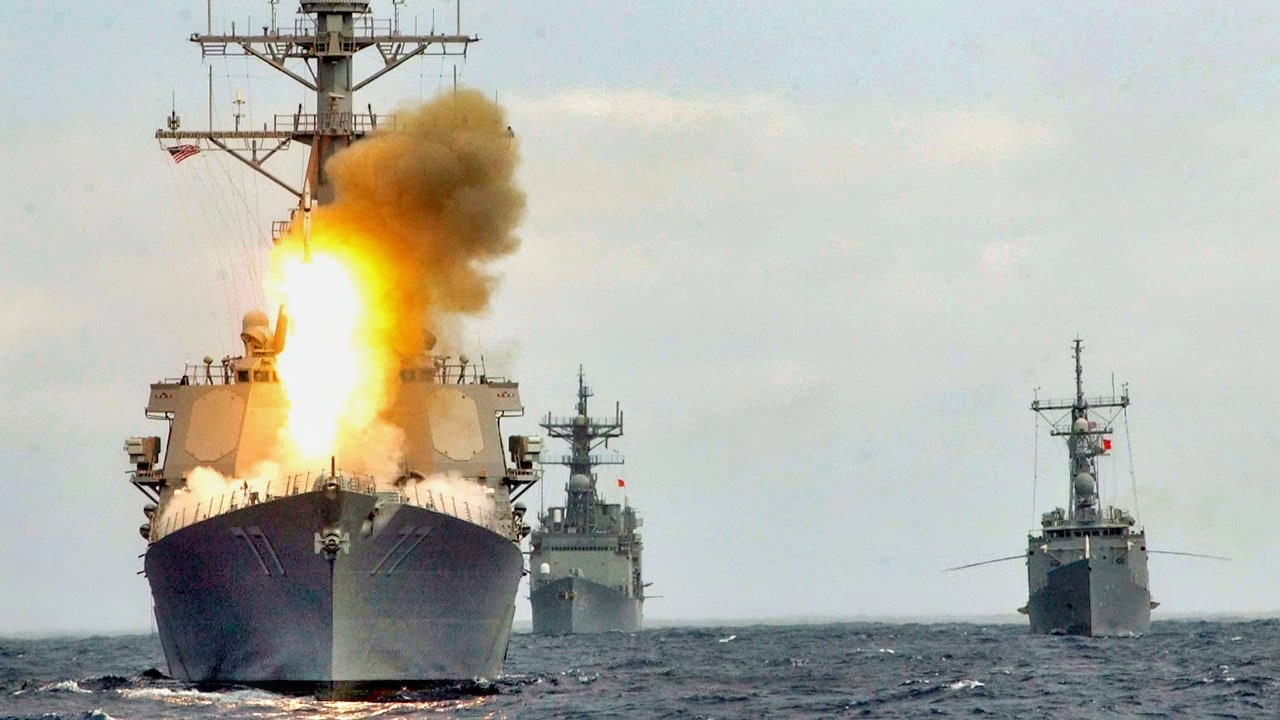
Summary and Key Points: The US Navy’s 31 Spruance-class destroyers entered service in the 1970s to hunt Soviet submarines around nuclear carriers. At 9,250 tons and 563 feet, they matched World War II cruisers, and their four GE LM2500 gas turbines became the surface fleet’s standard engine. Fitted with 61-cell launchers, they fired 112 of 288 Tomahawks in Desert Storm, with USS Fife alone firing 60. The last retired in 2005; only USS Paul F. Foster remains afloat.
What Made the Spruance-Class Special
The U.S. Navy has had some incredible warships in its history, and destroyers have played an integral role in navies worldwide over the past century.
Known for their speed, versatility, and maneuverability, destroyers have always hit well above their weight class.
Affectionately known as “tin cans,” destroyers typically protect aircraft carriers as part of the Navy’s carrier strike groups.
The Spruance-class destroyer is often considered the Navy’s best destroyer class for its revolutionary design, superior anti-submarine warfare (ASW) capabilities, and innovative gas-turbine propulsion.
These characteristics combined to provide a versatile, large platform (often known as “Spru-cans”) that served as the backbone of the Navy fleet for three decades.
The destroyers were named in honor of World War II Navy Admiral Raymond Spruance.
Meet The Spruance-class Destroyers:
The Spruance-class destroyers were developed to defend nuclear-aircraft carrier task forces against the latest generations of attack submarines. Their size reflected a need for seakeeping ability in all weather conditions.
The Spruance-class was more than twice as large as a World War II destroyer—in fact, it was as large as a World War II cruiser. (The Ticonderoga-class cruisers introduced later adopted Spruance’s same basic hull design.)
Their outward appearance didn’t inspire much early confidence—especially in Congress, where many members thought the ships didn’t look imposing enough compared to the heavily armed Soviet designs of the 1970s. Of course, no one ever accused Congress of being overly smart.
Length: 563′ 4″ overall; 529′ waterline.
Beam: 55′.
Draft: 22′ hull; 32′ navigation.
Displacement: 9,250 long tons full load.
Crew Complement: 24 officers; 330 enlisted. (Helicopter detachment: 9 officers; 30 enlisted.)
Powerplant: 4 x LM 2500 General Electric gas turbines; 2 shafts; 80,000 shp.
Speed: 32.5 knots.
Range: 6,000 nautical miles at 20 knots.
Spruance-Class Armaments:
The Navy’s earlier destroyers bore the “DD” designation, meaning they carried guns as their main armament.
When the Spruance class became active, the Navy retained the DD designation, even though the ships carried the RIM-7 Sea Sparrow ship-borne short-range anti-aircraft system designed to defend against anti-ship missiles.
In the 1980s and 1990s, 24 of the ships had their forward Mk 16 anti-submarine rocket launchers replaced with a 61-cell vertical launch missile system, which could launch Tomahawk and Harpoon missiles.
The ships used twin triple-barrel Mark 32 torpedo tubes firing Mark 46 or Mark 50 torpedoes and Phalanx close-in weapon systems.
The ships carried one Mk-45 5”/54 caliber gun.
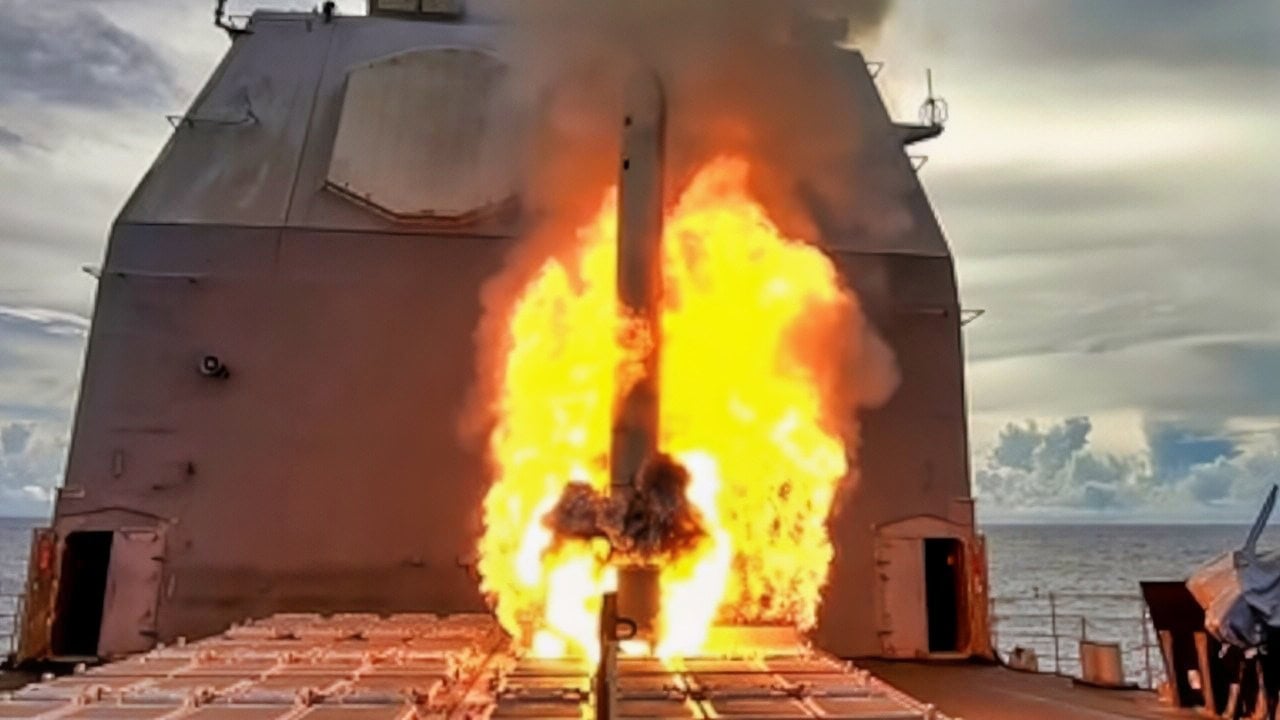
Tomahawk Missile Firing U.S. Navy Photo
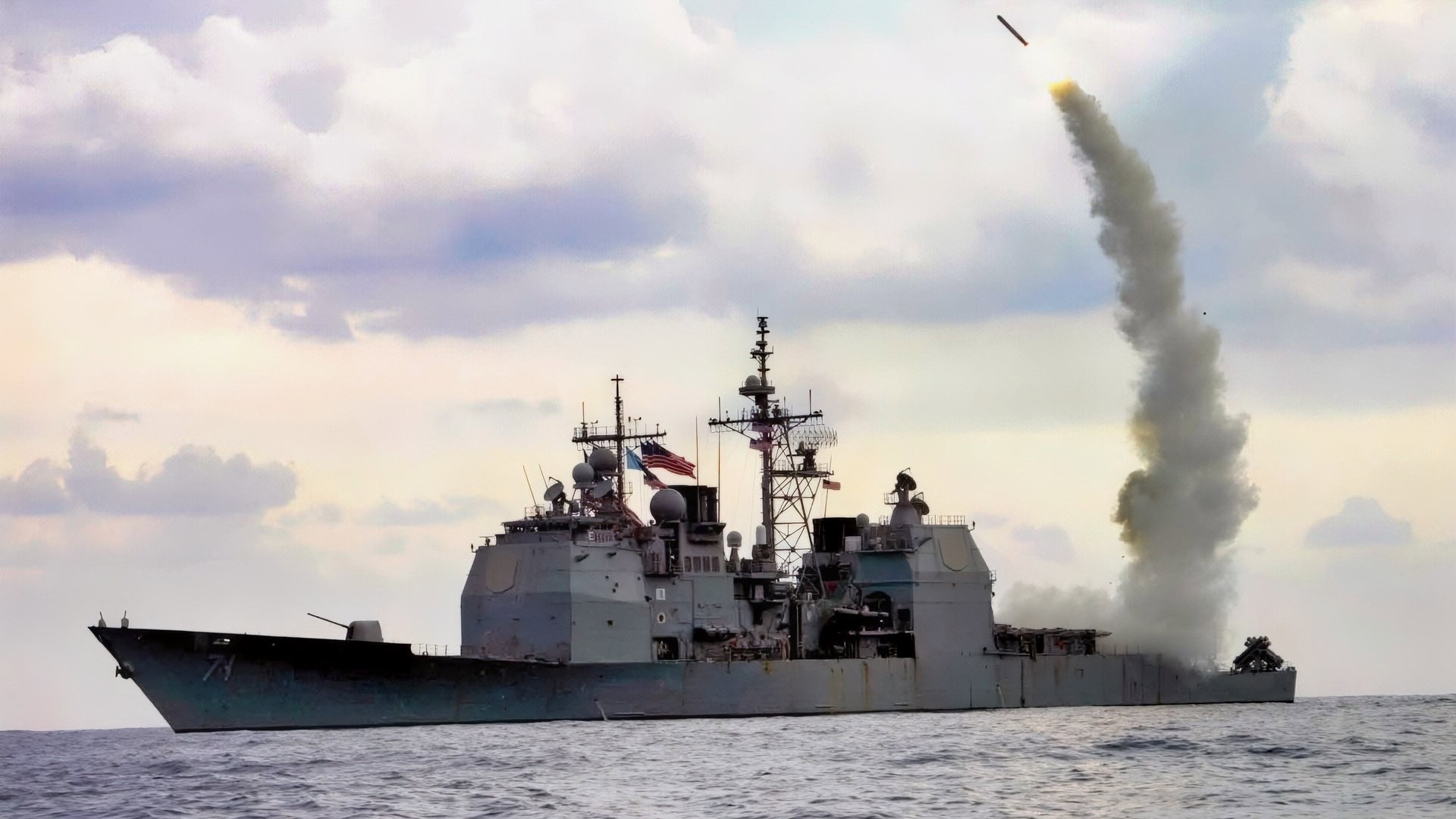
ABOARD USS CAPE ST. GEORGE (CG 71) AT SEA — A Tomahawk cruise missile launches from USS Cape St. George, operating in the eastern Mediterranean Sea in support of Operation Iraqi Freedom. (Photo by IS1 Kenneth Moll, USS Cape St. George) (Released by Sixth Fleet Public Affairs)
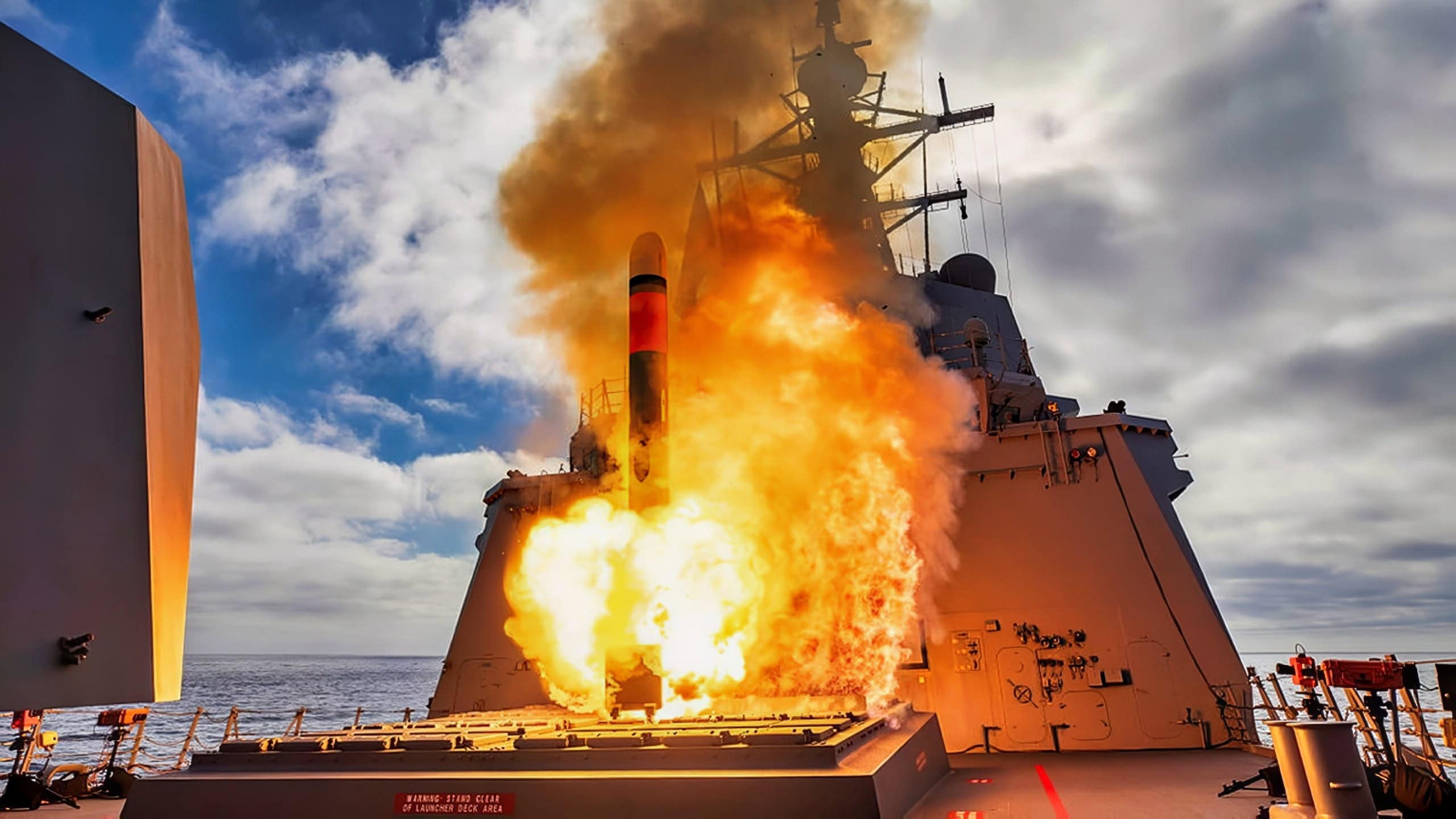
Tomahawk Missile Firing. Image Credit: Government of Australia.
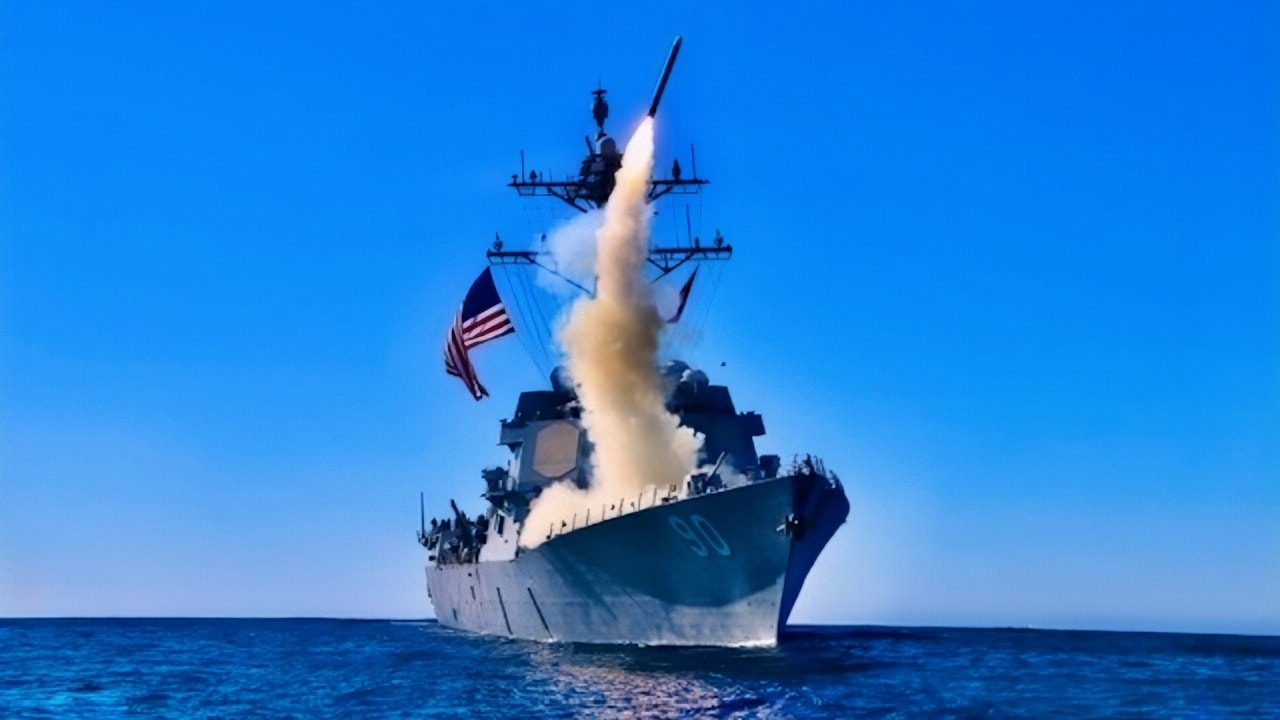
(Dec. 01, 2020) – The guided-missile destroyer USS Chafee (DDG 90) launches a Block V Tomahawk, the weapon’s newest variant, during a missile exercise. This event marked the first time a Block V Tomahawk missile was operationally tested, marking the Navy’s transition to a more advanced capability for the fleet. Block V includes an upgrade that will enhance navigation performance and provide robust and reliable communications. Chafee is currently assigned to Carrier Strike Group ONE and is homeported in Pearl Harbor. (U.S. Navy photo by Ens. Sean Ianno/Released)
The highly successful class became prized for its versatility. Its effectiveness in ASW was known, but it could be refitted for various roles.
The Spruance-class destroyers were the first major U.S. combatants to use four General Electric LM2500 gas turbines.
The powerplant delivers speeds of more than 30 knots and 80,000 horsepower, and it is still used on most current U.S. surface ships.
Brief History Of the Spruance-Class Destroyers:
The lead ship of the class, the USS Spruance (DD-963), in April 1981 rescued 17 crewmembers of the Greek freighter Hellenic Carrier after a collision with U.S. barge carrier Lash Atlantica.
The destroyer was deployed numerous times and was ordered in the late 1980s to assist in the safe passage of U.S. tankers in the Strait of Hormuz area during the Iran-Iraq War. Gathering intelligence and monitoring Soviet ships, she also tracked Iranian vessels while identifying merchant and naval shipping.
In January 1991, during Operation Desert Storm, the Spruance—along with the USS Virginia (CGN-38) and USS Pittsburgh (SSN-720)—launched Tomahawk missiles at targets in northern Iraq. She later joined the multi-national Maritime Interception Force.
During Desert Storm, the Spruances launched 112 of the 288 Tomahawks employed. The destroyer Fife (DD-991) launched 60 Tomahawks, more than any other platform.
In 1994, the Spruance participated in operations to evacuate Haitians during Operation Uphold Democracy. The destroyer then took part in numerous counter-narcotics patrols in the Caribbean, as well as deployments to Northern Europe and the Mediterranean.
Following the terrorist attacks on September 11, 2001, she carried out patrols as part of Operation Noble Eagle off the U.S. coast, and in the Mediterranean and Arabian Gulf as part of Operation Enduring Freedom.
Spru-Cans Were Excellent Submarine Hunters:
Designed specifically for Cold War-era ASW, the Spruances used advanced sonar systems such as the SQS-53 and could operate up to two helicopters, allowing them to track enemy vessels beyond the horizon.
Thirty-one Spruance-class destroyers were developed for the primary mission of ASW, which is a crucial task for carrier strike forces. While the Spruance-class destroyers had excellent strike and anti-submarine mission capabilities, they were limited in self-defense against air threats.
However, the installation of the Tomahawk missile system added another primary mission, as the destroyers excelled in strike warfare. The Spruances’ missions were expanded greatly when their vertical launch systems were added, as seen by their performance with the Tomahawk missile.
All of the Spruances were decommissioned, with the USS Cushing being the last in September 2005. They were replaced by the Kidd-class and Arleigh Burke-class destroyers. Only the USS Paul F. Foster (DD-964) remains afloat, serving as a test ship for experimental Navy weapons and sensors.
The USS Spruance was decommissioned in March 2005 and was sunk as a target during a SINKEX exercise off the Virginia Capes in December 2006.
About the Author: Steve Balestrieri
Steve Balestrieri is a National Security Columnist. He served as a US Army Special Forces NCO and Warrant Officer. In addition to writing on defense, he covers the NFL for PatsFans.com and is a member of the Pro Football Writers of America (PFWA). His work was regularly featured in many military publications.