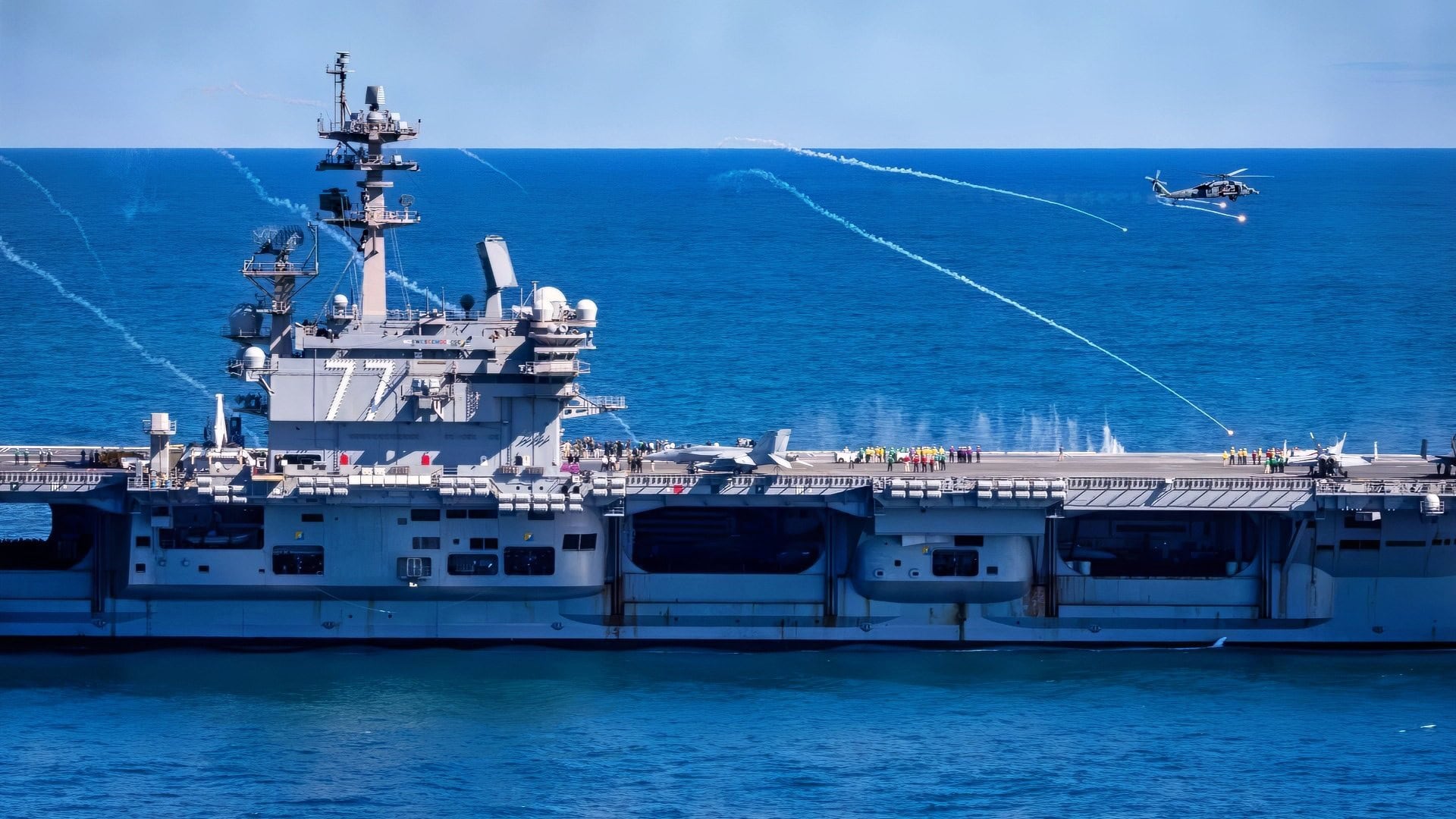
Summary and Key Points – A Supercarrier Crisis? : Anti-ship missiles like China’s DF-26 drive the argument that carriers are too big and too exposed, especially at long range.
-But survivability is evolving through a mix of distance, sensing, and layered defense.
-The MQ-25 Stingray extends supercarrier air wing reach by refueling strike fighters far from the deck, letting carriers operate from safer standoff ranges.
-At the same time, networked defenses—especially NIFC-CA using E-2 Hawkeyes and F-35s as sensor-relay nodes—can cue ship-launched interceptors such as the SM-6.
-Add advanced EW, upgraded radars, and emerging lasers, and the carrier fight becomes a contest of detection, disruption, and interception—not just missile range.
The Supercarrier Isn’t Dead Yet: MQ-25 Stingray Changes the Range Math
Given the growing mass of anti-ship missiles able to track and destroy targets from several thousands of miles offshore, it is persistently asked whether U.S. Navy carriers are too slow, too large, too insufficiently defended, and simply too vulnerable to exist.
Chinese “carrier-killer” missiles such as the DF-26 have demonstrated the ability to take down carrier-like targets at ranges of 2,000 miles.
Can Carriers Survive?
Some assets that aid aircraft carrier survivability are evolving quickly, such as new layered carrier defenses and the unmanned MQ-25 Stingray carrier-launched refueler drone.
Without having to risk a large, non-stealthy manned tanker aircraft, the Stingray refuels carrier-based aircraft in-flight to vastly increase their dwell time over targets and enable them to reach targets from much greater distances. This means carriers can operate from safer ranges, challenging the reach of modern enemy missiles.
The MQ-25 Stingray offers a potential answer to China’s anti-access/area-denial (A2/AD) strategy.
Advanced Carrier Defenses
Further, amid the hype about China’s A2/AD systems, the U.S. Navy believes it has achieved some breakthroughs in ship-defense systems. Senior service leaders regularly talk about rapid advances in ship-integrated Electronic Warfare (EW), laser weapons, and enhanced radar.
Destroyers and cruisers in a carrier strike group now offer new dimensions of protection to carriers through technologies such as the Aegis 10 Combat System, which combines ballistic and cruise missile radar into a single system able to cue fires and launch defensive interceptors.
For example, after software upgrades, the Standard Missile (SM)-6, can track and destroy moving targets by adjusting course in flight. Navy destroyers are increasingly being armed with scalable lasers able to operate as both optical sensors and weapons to incinerate or simply disable an enemy aircraft, drone, or incoming missile.
EW weapons’ ability to jam enemy communications or weapons has evolved—further, EW technologies are increasingly capable of deconflicting a cluttered spectrum to “frequency hop” to counter enemy jamming. These systems can identify hostile electronic signals versus friendly ones, or launch a series of difficult-to-detect electronic beams
. There are also upgraded close-in ship defenses increasingly able to track and intercept threats much more quickly, often using AI-enabled advanced algorithms to identify and destroy threats.
Supercarriers “Sense” Threats
The Navy for years has explored a range of ways to stop, destroy, or disable carrier-threatening weapons. Much remains to be learned about the reach, guidance technology, and accuracy of China’s carrier-killer missiles, and their ability to hit moving targets.
But the U.S. Navy continues to insist it will operate anywhere it is needed.
Layered ship defenses have improved that allow ships to engage threats from beyond the horizon. Long-range sensors relay threat data from beyond the horizon to ship commanders, putting them in position to decide which countermeasure or defensive weapon to use.
Carriers “Intercept” Missiles
A now-deployed technology called Naval Integrated Fire Control—Counter Air (NIFC-CA) uses Hawkeye surveillance planes and F-35s as aerial relay nodes to detect threats.
NIFC-CA uses an airborne gateway as a sensor to send threat data down to the ship while the attacking missile is at much safer ranges.
The aerial sensor then cues ship-based fire control to launch an SM-6 interceptor at the incoming enemy missile.
NIFC-CA was first deployed more than six years ago on destroyers and has likely been upgraded since then.
Layered ship defenses are also increasingly engineered with laser weapons and advanced EW able to track and jam the electronic guidance systems built into the Chinese carrier-killer missiles.
MQ-25 Stingray and the Supercarriers
Range-enhancing technologies were developed as a specific counter to China’s missiles A2/AD systems. The Navy’s MQ-25 Stingray carrier-launched refueler drone can basically double a fighter jet’s attack reach by refueling the aircraft hundreds of miles away from the carrier deck.
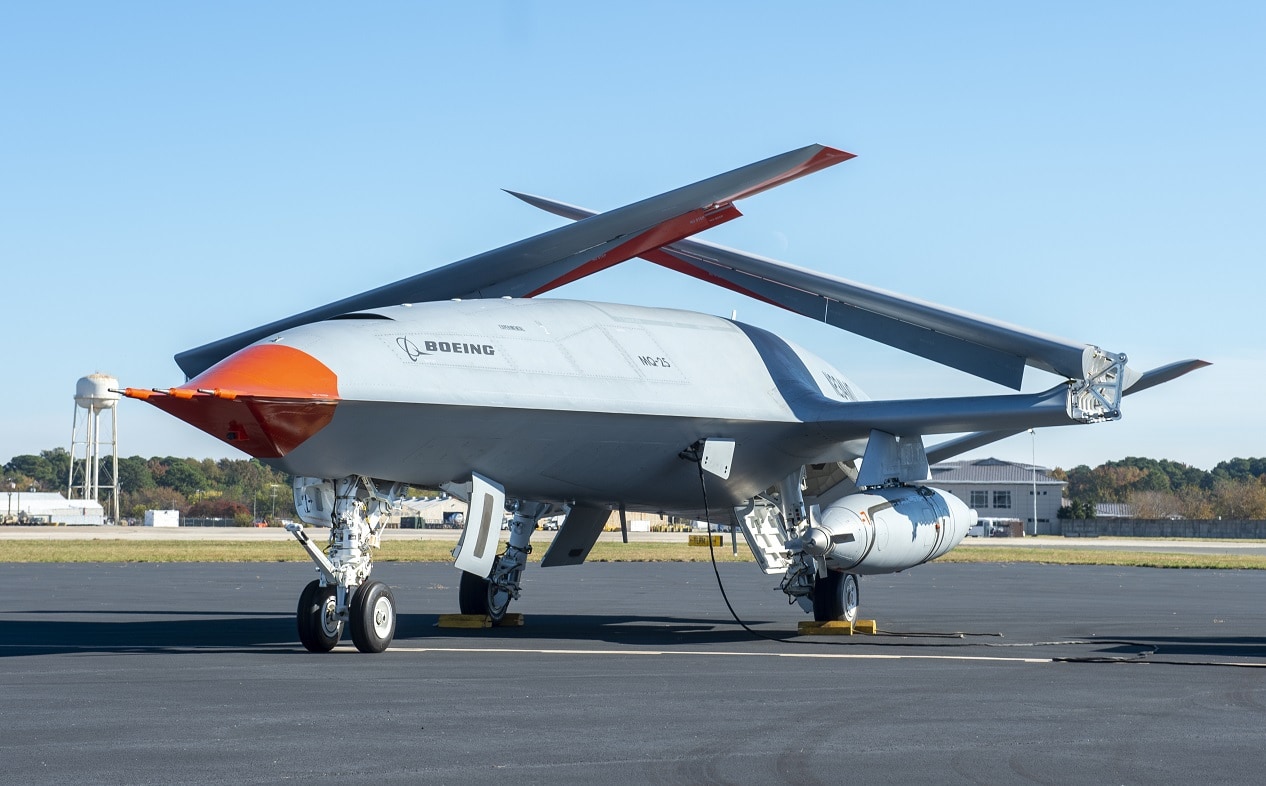
The U.S. Navy and Boeing conducted ground testing of the MQ-25 Stingray at Chambers Field onboard Naval Station Norfolk, Virginia. The MQ-25 Stingray is an unmanned aerial refueling aircraft. (U.S. Navy photo by Mass Communication Specialist 2nd Class Sam Jenkins)
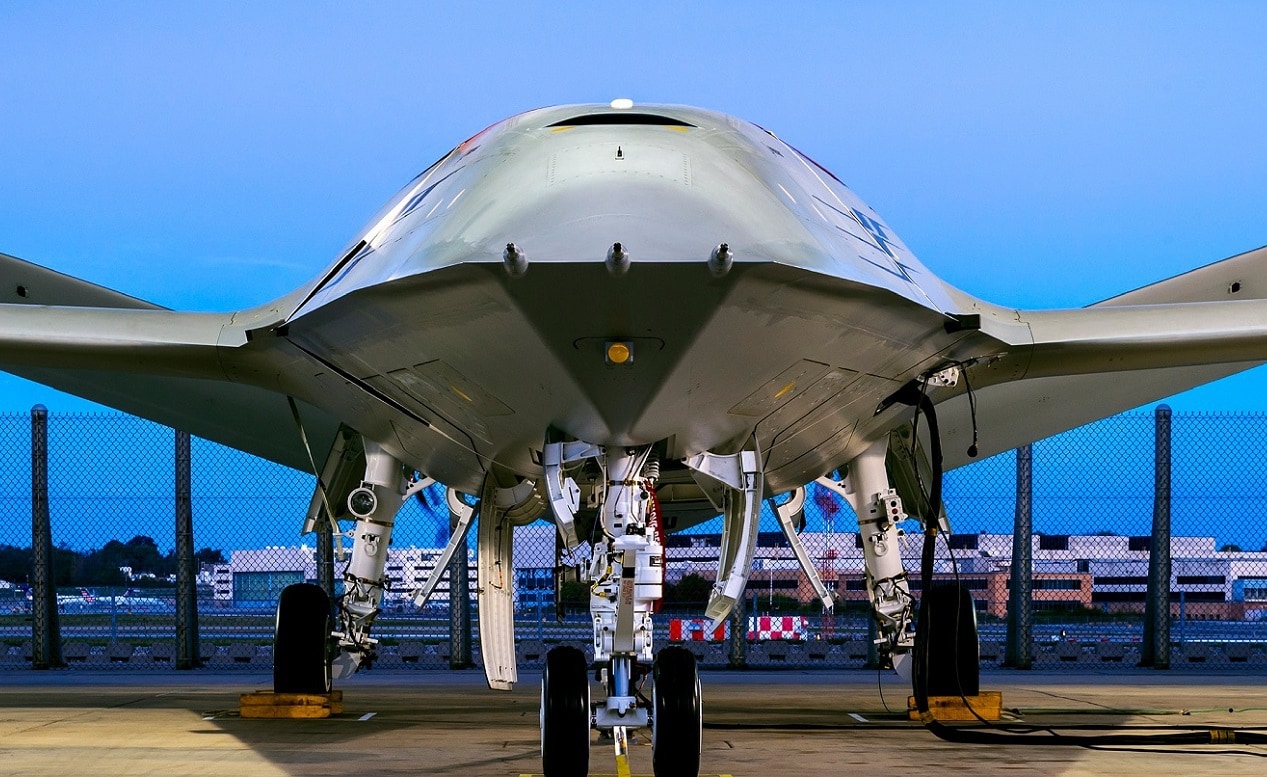
MQ-25. Image Credit – Creative Commons.

MQ-25. Image: Creative Commons.
Unlike a large, vulnerable tanker, the MQ-25 is small, tough to detect, and unmanned. Carriers with the MQ-25 on deck could project power from twice the distance offshore, enabling sustained attack reach in an A2/AD environment.
About the Author: Kris Osborn
Kris Osborn is the President of Warrior Maven – Center for Military Modernization. Osborn previously served at the Pentagon as a highly qualified expert in the Office of the Assistant Secretary of the Army—Acquisition, Logistics & Technology. Osborn has also worked as an anchor and on-air military specialist at national TV networks. He has appeared as a guest military expert on Fox News, MSNBC, The Military Channel, and The HistoryChannel. He also has a Master’s Degree in Comparative Literature from Columbia