
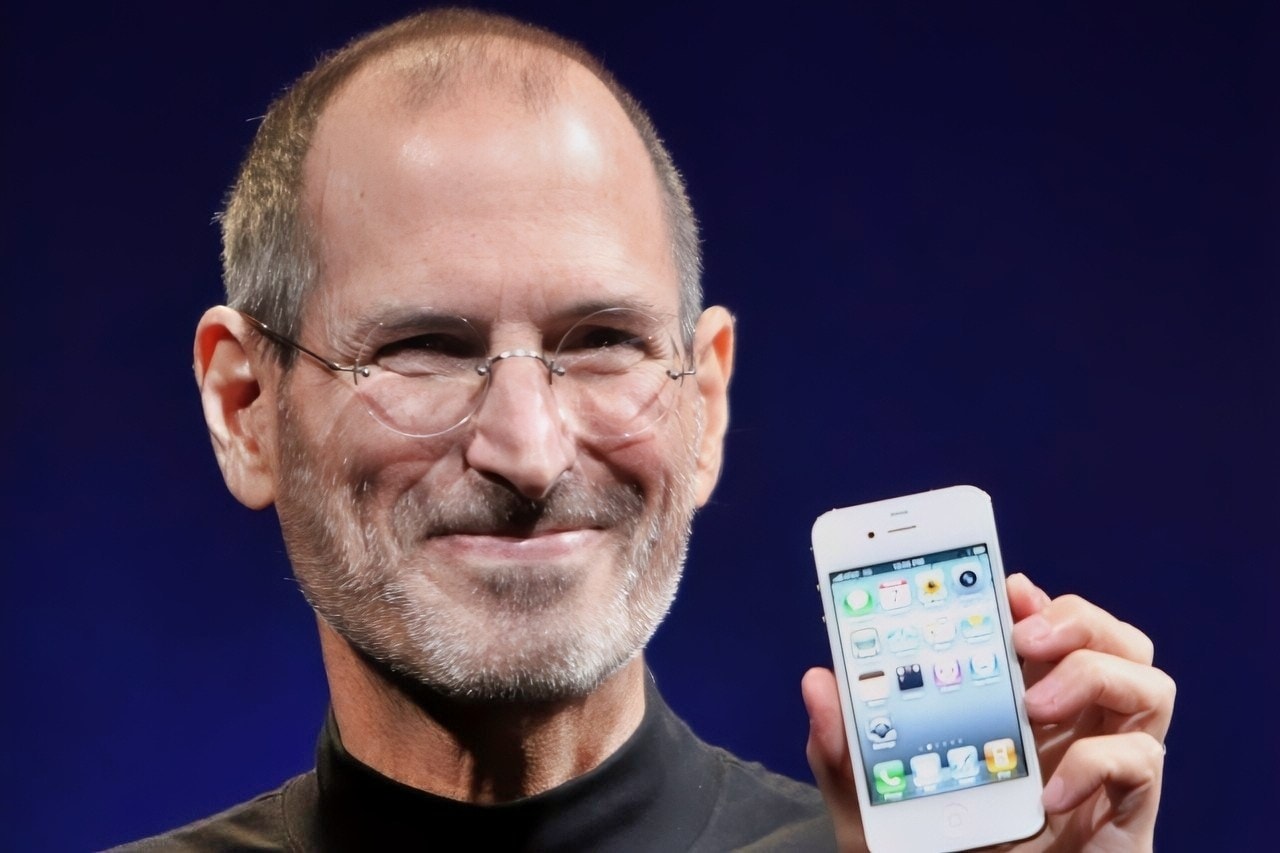
Summary and Key Points: A 1995 PBS interview with Steve Jobs captures a pragmatic view of wealth: money matters because it lets you fund ideas that won’t pay off quickly.
-Jobs described becoming rich early but insisted cash wasn’t his main motivation, emphasizing products, people, and what technology enables.

Image Credit: Apple.
Apple iPhone. Image: Creative Commons.
iPhone 12 Pro Max. Image: Apple.

Apple Laptop. Image Credit: Iliescu Victor.
-The interview came during his NeXT years, after he left Apple in 1985 and before Apple acquired NeXT in 1996–1997, bringing him back to lead a turnaround.
-He streamlined Apple’s product focus, reshaped internal structure, and even reached a surprising détente with Microsoft. The rebound set the stage for defining products that followed.
Steve Jobs’ Best Advice on Money and Long-Term Thinking
Quote of the Day: “I think money is a wonderful thing because it enables you to do things. It enables you to invest in ideas that don’t have a short-term payback and things like that.” – Steve Jobs
Business advice pages often include historical quotes by Steve Jobs, the founder of Apple, who developed some of the world’s most beloved products, and was also at the center of one of the greatest comeback stories in business history.
One of those is the quote above, which comes from an interview Jobs gave to PBS’s Robert Cringely, a pseudonym used by journalist Mark Stephens, in 1995, for the documentary Triumph of the Nerds. Jobs was interviewed, along with Paul Allen, Steve Ballmer, Bill Gates, and Steve Wozniak, and many others associated with the tech and nerd culture of the era.
In 2012, after Jobs’ death, the full interview with Jobs from that documentary was released under the title Steve Jobs: The Lost Interview. The full interview had been “lost,” in the sense that the recordings had been lost in shipping, although a copy was later discovered.
Jobs gave the interview when he was 40 years old and was with his post-Apple company, NeXT.
The Quote
Jobs, in the interview, was asked what it was like to get rich.
“It’s very interesting. I was worth about over $1 million when I was 23, and over $10 million when I was 24, and over $100 million when I was 25. And it wasn’t that important because I never did it for the money,” Jobs told his interviewer.
“I think money is a wonderful thing because it enables you to do things. It enables you to invest in ideas that don’t have a short-term payback and things like that. But especially at that point in my life, it was not the most important thing. The most important thing was the company, the people, the products we were making, what we were gonna enable people to do with these products, so I didn’t think about it a great deal. I never sold any stock. Just really believed that the company would do very well over the long term.”
NeXT After Apple
However, Apple didn’t always do well over the long term. Jobs left the company in 1985, after the Macintosh began to struggle against the offerings of rival IBM, and Jobs lost a power struggle with the company’s CEO, John Sculley. And Apple continued to struggle after Jobs’ departure.
Jobs founded NeXT in 1985, shortly after departing Apple. The first NeXT computer product was released five years later, in 1990, and its high cost slowed sales. By 1993, the company had pivoted to software.
In 1995, when Jobs sat down with the PBS interviewer, that’s what he discussed.
“The innovation in the industry is in software. And there hasn’t ever been a real revolution in how we created software,” Jobs said in the PBS interview about the plans at the time for his company.
“Certainly not in the last 20 years. Matter of fact, it’s gotten worse. While the Macintosh was a revolution for the end user to make it easier to use, it was the opposite for the developer. The developer paid the price. And software got much more complicated to write as it became easier to use for the end user. So, software is infiltrating everything we do these days.”
Back to Apple
What happened next is well-known: In late 1996, Apple agreed to acquire NeXT, in a deal that was finalized in early 1997. That summer, Jobs became acting CEO of the company, after he never had that title during his initial run with the company. The NeXT software went on to form the basis of Mac OS X.
“When Jobs came back as interim CEO in 1997, he was faced with the task of making Apple profitable again. What he did is nothing short of amazing: the company went from losing $1.04 billion to turning a $309 million profit a year later. Jobs saved the company and set the course for decades of innovation,” an Inc account of Apple’s turnaround said.
In doing so, Jobs returned to focusing on Apple’s core products, cancelling several product lines developed while he was away. Company management was streamlined as well.
“Jobs realized Apple had strayed too far from its core mission of offering personal computers. He streamlined the product line and focused on producing just four total products, two desktop computers and two portable devices, with one set marketed for professionals and the other for consumers,” the Inc account said. “During a recession, companies should similarly focus on their core competencies and the products or services that are most essential to their customers.”
Jobs also made the surprising decision to make peace with Microsoft and Bill Gates. Apple’s longtime rival agreed to provide Apple with a needed cash infusion, while also developing software for the Macintosh ecosystem.
He also changed the company’s structure.
“When Jobs came in, there were multiple business lines at Apple, each with its own P&L statement and strategy,” the Inc account said. “By having every business unit report to one P&L statement, Jobs eliminated the need for managers to compete with one another for resources and profitability.”
The changes worked, and Apple also introduced successful products early in Jobs’ return. The iMac arrived in the summer of 1998, followed by the iPod in 2001, the iPhone in 2007, and the iPad in 2010, all of which were category-defining products that notched massive sales.
Jobs remained CEO of Apple until August 2011, when he resigned two months before his death. When he died, Jobs’ estimated net worth was $10.2 billion, although it’s believed that more of that money came from his Disney stock, as a result of that company’s purchase of the Jobs-co-founded Pixar Animation Studios, than from his time leading Apple.
About the Author: Stephen Silver
Stephen Silver is an award-winning journalist, essayist, and film critic, and contributor to the Philadelphia Inquirer, the Jewish Telegraphic Agency, Broad Street Review, and Splice Today. The co-founder of the Philadelphia Film Critics Circle, Stephen lives in suburban Philadelphia with his wife and two sons. For over a decade, Stephen has authored thousands of articles that focus on politics, national security, technology, and the economy. Follow him on X (formerly Twitter) at @StephenSilver, and subscribe to his Substack newsletter.