
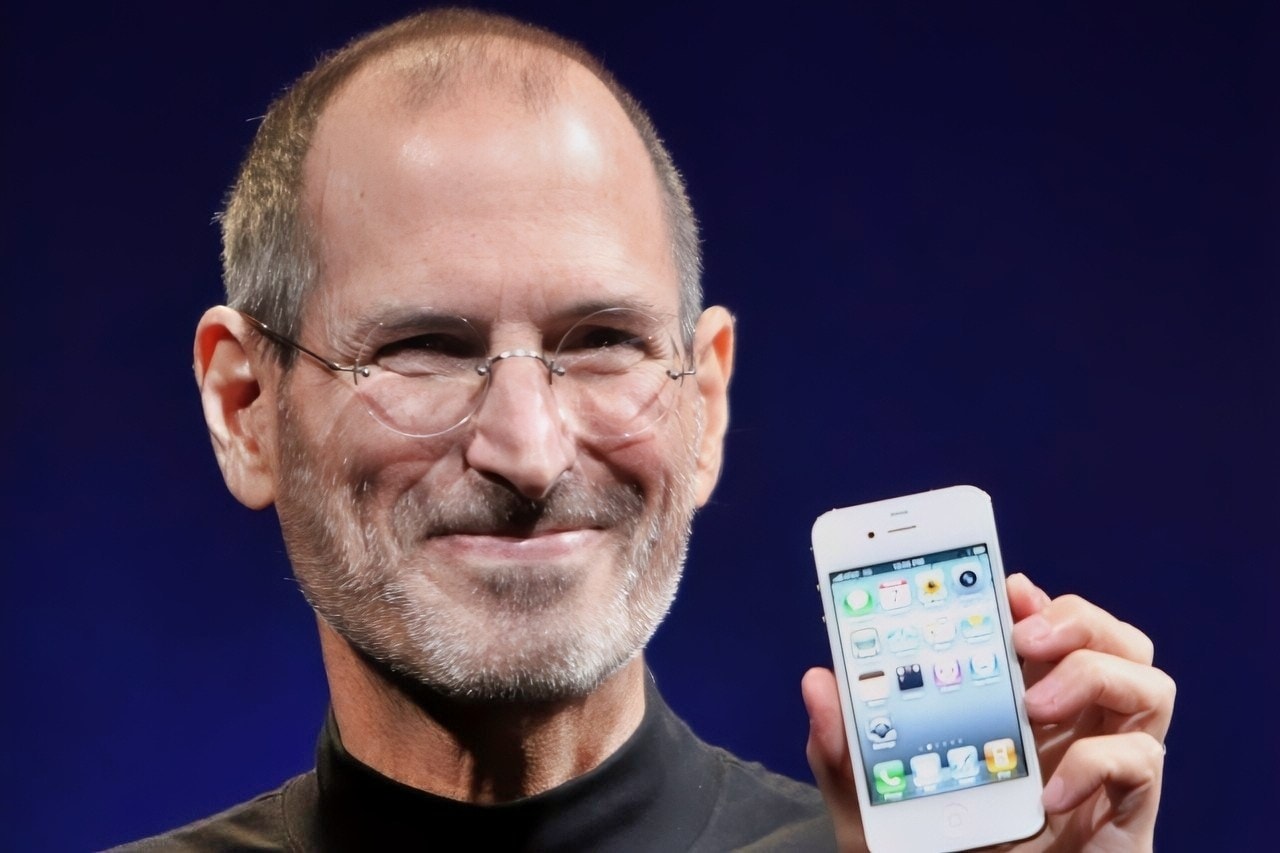
Synopsis: Steve Jobs was not a general or a politician, but his career arc reads like a leadership case study: early curiosity, rapid rise, a humiliating fall, and a historic comeback.
-Adopted at birth and raised in Silicon Valley’s shadow, Jobs dropped out of college, co-founded Apple with Steve Wozniak, and rode the Apple II and IPO wave to immense success.
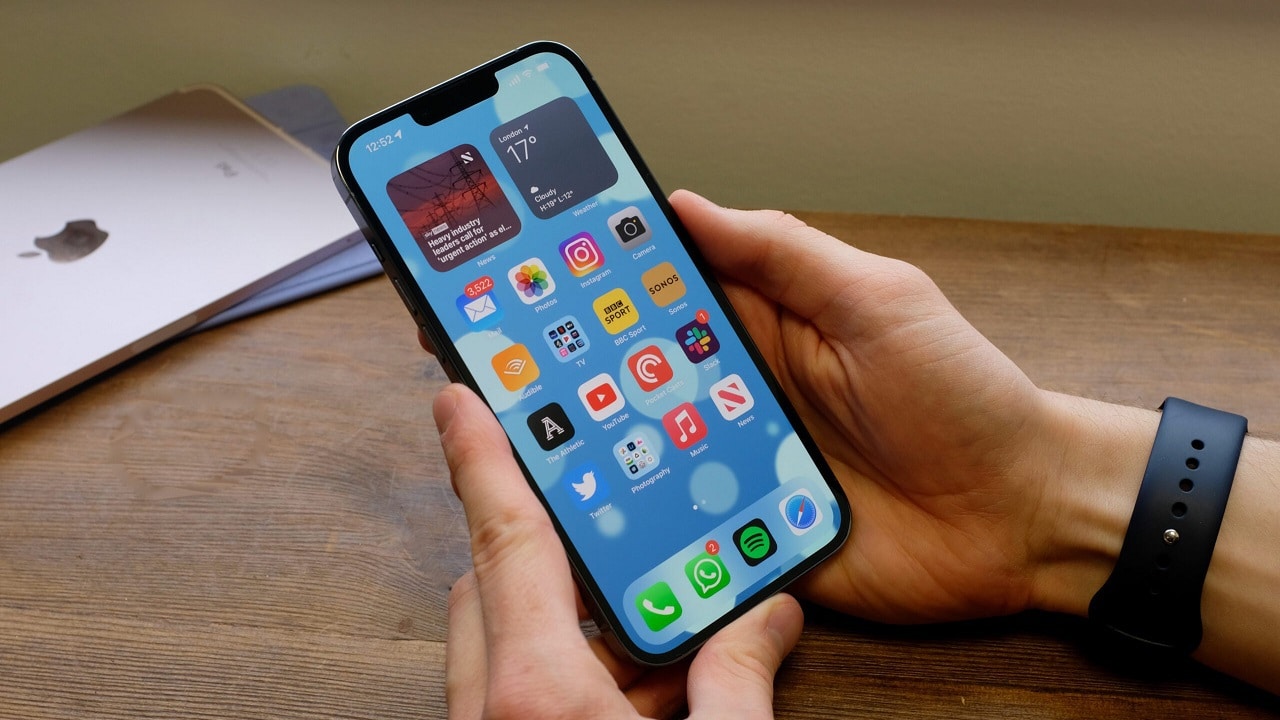
iPhone 13. Image Credit: Creative Commons.

Image: Creative Commons.
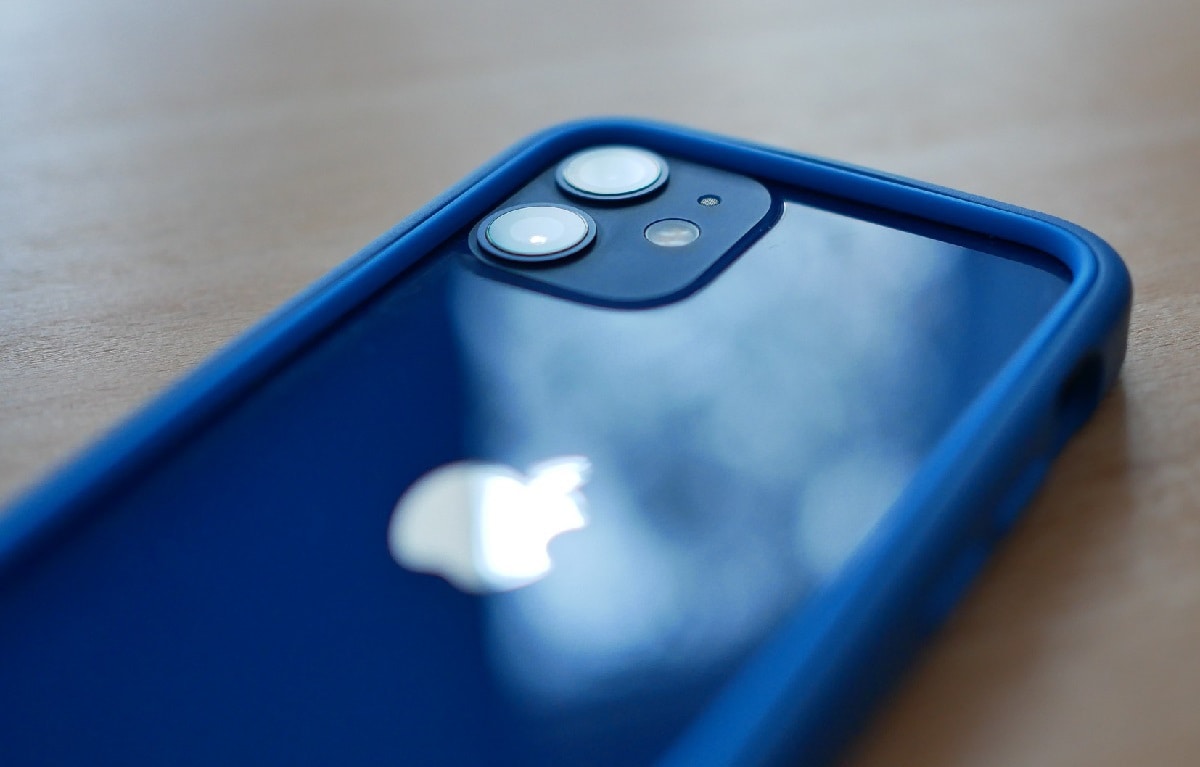
Apple iPhone. Image: Creative Commons.
-Then he was pushed aside, launched NeXT, and helped build Pixar into a powerhouse.
-When Apple faltered, Jobs returned, rebuilt the company, and reshaped modern communication—tools that also transformed how military families connect and how forces share information.
Steve Jobs Had A Message For Military Leaders: Don’t Lose Faith
“Sometimes life hits you in the head with a brick. Don’t lose faith…”—That quote belongs to the late great Steve Jobs, co-founder of Apple, Inc.
Mind you, as a Senior Defense Editor for 19FortyFive, this writer typically writes about military leaders and/or political leaders and/or gunmakers.
Steve Jobs was none of those things, yet to say he had a profound impact on American society—including the military—would be a huge understatement.
And that above-quoted nugget is certainly applicable to military leadership and followership alike.
So then, without further ado…
Early Life
Steven Paul Jobs was born on February 24, 1955 in San Francisco, California to unwed biological parents, Joanne Schieble and Abdulfattah “John” Jandali (a scion of wealthy Syrian parents), who put him up for adoption.
That adoption offer was taken up by Paul and Clara Jobs, a lower-middle-class couple (Paul was a U.S. Coast Guard veteran and repossession agent, whilst Clare was a bookkeeper), who moved to the suburban city of Mountain View (in Santa Clara County, coincidentally enough) a couple of years later.

iPhone 12 Pro Max. Image: Apple.
Santa Clara County became known as Silicon Valley in the early 1950s after the spawning of multitudes of semiconductor companies in the area.
This proved to be quite (to say the least) impactful upon young Steve Jobs in his formative years.
And as the All About Steve Jobs webpage adds, “At age 13, he met one the most important persons in his life: 18-year-old Stephen Wozniak, an electronics whiz-kid —and an incorrigible prankster, much like Steve himself.”
Dropping Out of College and Founding Apple
Fast-forward to 1972: Steve Jobs graduates from Homestead High School and enrolls at Reed College in Portland, Oregon.
Well, that turned out to be much ado about relatively little, as Steve dropped out of Reed after one measly semester; to cite his bio page again, “he was more interested in eastern philosophy, fruitarian diets, and LSD than in the classes he took. He moved to a hippie commune in Oregon where his main activity was cultivating apples.”
Hmm, a bit of foreshadowing in the last two words of that quoted passage, perhaps?
After dropping out of college, Steve rekindled his friendship with Steve Wozniak (AKA “Woz”), who by this time was an active member of a group of early computer hobbyists called the Homebrew Computer Club.

Apple Laptop. Image Credit: Iliescu Victor.
Drawing upon the knowledge gained as a member of Homebrew, “Woz” built his own computer board simply because he wanted a personal computer for himself.
Seeing an opportunity, Jobs “quickly understood that his friend’s brilliant invention could be sold to software hobbyists, who wanted to write software without the hassle of assembling a computer kit. Jobs convinced Wozniak to start a company for that purpose: Apple Computer was born on April 1, 1976.” This was no mere April Fool’s joke, and just as 1976 marked the 200th anniversary of America’s Declaration of Independence, the foundation of Apple would set the two Steves on the path to financial independence:
-In January 1977, Jobs sweet-talked business angel Mike Markkula to invest in Apple to the tune of $250,000 (roughly equivalent to $1 million in today’s dollars), and three months later, the Apple II computer was officially introduced at the West Coast Computer Faire
-In December 1980, Apple went public via IPO, boosting Steve Jobs’s net worth to over $200 million at the age of 25
Leaving Apple
Alas, by 1985, there was trouble in paradise.
Long story short, that May Steve Jobs was stripped of operational duties by the board of directors (though he still held the nominal title of chairman of the board), and he resigned from Apple and sold all but one of his Apple shares in disgust.
Jobs spent the initial part of those “wilderness years” (so to speak) by forming a company called NeXT.
However, his then-new company’s flagship product, the NeXT Cube, didn’t catch on because it was overpriced.
Even the financial backing of Texan billionaire and quixotic former presidential candidate Ross Perot couldn’t keep NeXT afloat. “Steve Jobs had failed, and he was devastated. He started focusing less on work, and more on his wife Laurene (who he married in 1991) and his newborn son, Reed.”
Fortunately, Steve still had millions of dollars left in his bank account. He used a chunk of that money to: (1) hire small group of computer scientists who needed a new employer when George Lucas sold the computer graphics division of his Lucasfilm empire; and (2) incorporate a new company called Pixar, which had been founded by Ed Catmull and Alvy Ray Smith back in the late 1970s.
Suffice it to say that Pixar proved much more successful than NeXT.
What Goes Around, Comes Around
By 1997 Apple was foundering, and the board of directors approached Jobs, hat in hand; on September 16, 1997, Steve accepted to become Apple’s interim CEO, and for good measure, he brought with him his executive team from NeXT and installed them in key positions.
Long story short, the plan worked. Apple was saved by its founder.
Sadly, Jobs died at his home in Palo Alto, California, on October 5, 2011, due to complications from a relapse of his previously treated islet-cell pancreatic neuroendocrine tumor.
Lasting Impact on the Military
As noted in an article published in Military.Com the day after his passing, titled “Steve Jobs’ Influence on the Military”: “[Jobs] may not be the first person you associate with the military — he even issued the famous quote “it’s more fun to be a pirate than join the navy” — his inventions have indeed helped transform the military.”
This was corroborated four days later by Elaine Sanchez in an article for DVIDS: “Thanks to this technology, kids can video call their dad in Afghanistan to share a recent achievement, a proud mom can text pictures to a military loved one overseas, and a soldier dad can watch the birth of his child from thousands of miles away.”
About the Author: Christian D. Orr, Defense Expert
Christian D. Orr is a Senior Defense Editor. He is a former Air Force Security Forces officer, Federal law enforcement officer, and private military contractor (with assignments worked in Iraq, the United Arab Emirates, Kosovo, Japan, Germany, and the Pentagon). Chris holds a B.A. in International Relations from the University of Southern California (USC) and an M.A. in Intelligence Studies (concentration in Terrorism Studies) from American Military University (AMU). He is also the author of the newly published book “Five Decades of a Fabulous Firearm: Celebrating the 50th Anniversary of the Beretta 92 Pistol Series.”