
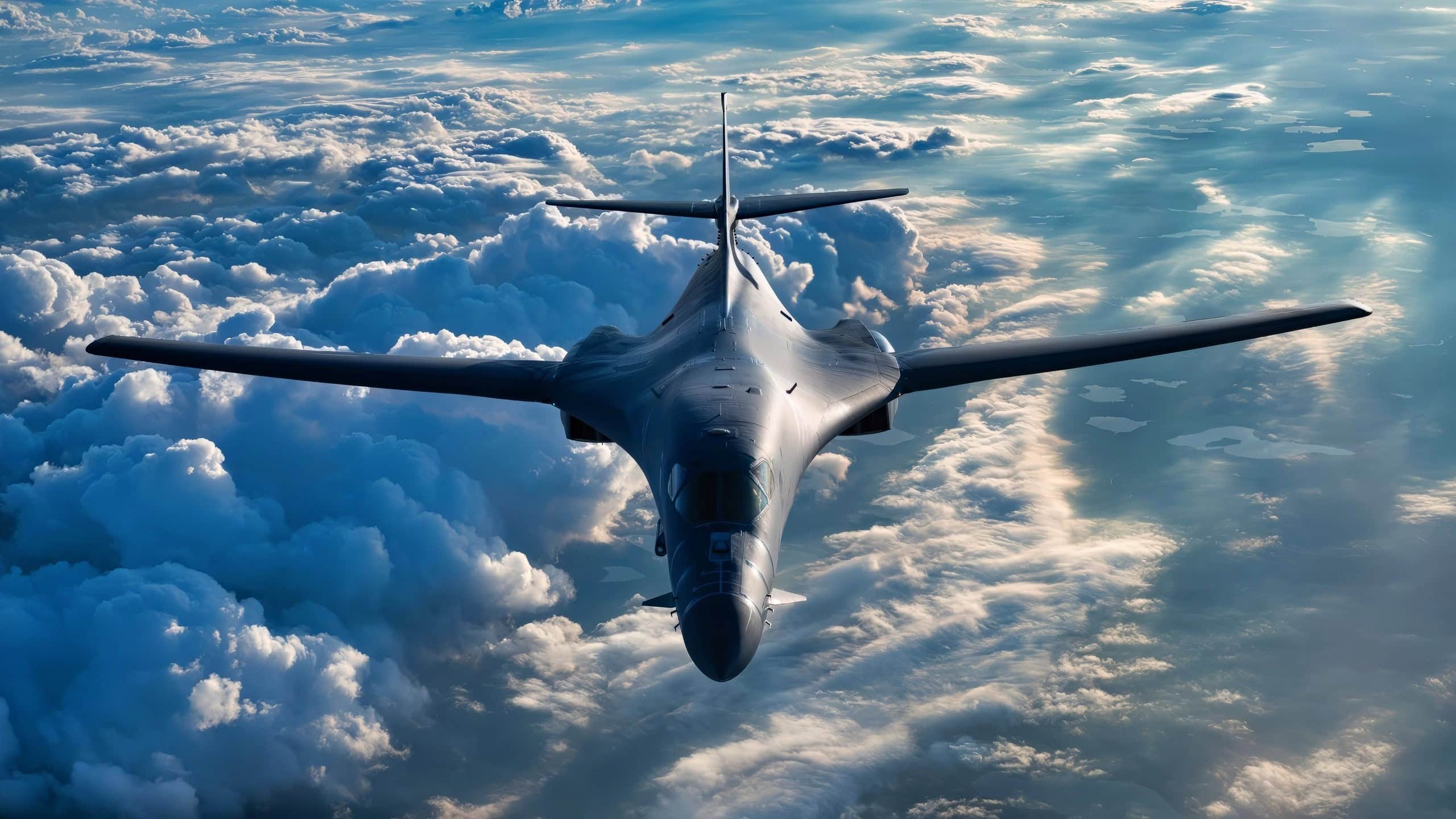
Summary and Key Points: Dr. Andrew Latham, an international relations expert, evaluates the unprecedented coordination of the U.S. Bomber Triad during Operation Epic Fury in Iran.
-As of March 2026, the B-2 Spirit has successfully neutralized high-value Iranian air-defense nodes, allowing the B-1B Lancer and B-52 Stratofortress to conduct sustained, high-volume strikes on drone production sites and naval infrastructure.
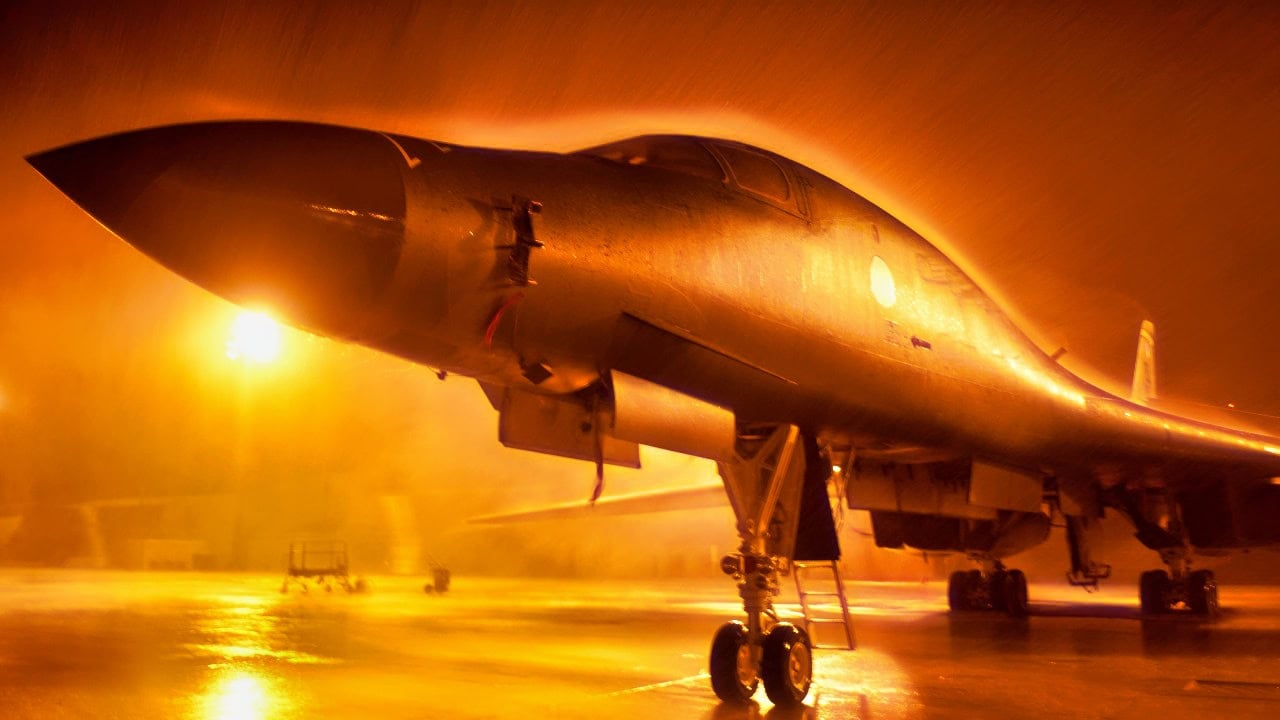
Lights in the aircraft parking area cast an eerie glow around a B-1 bomber standing at the ready during a summer rainstorm at Ellsworth Air Force Base, S.D., July 24, 2012. Ellsworth is home to 28 B-1 bombers and two of the Air Force’s three B-1 combat squadrons.

A 28th Bomb Wing B-1 Lancer sits on a ramp waiting to taxi in the early morning at Ellsworth Air Force Base, South Dakota, August 30, 2006.The B-1 Lancer will be taking off to conduct its first Joint Air-to-Surface Standoff Missile (JASSM) operational fire from a B-1 Lancer. (US Air Force Photo By: Airman Angela Ruiz) (Released)
-This report analyzes how the “continuous strike system” leverages stealth, speed, and standoff range to degrade the IRGC’s military power.
-Latham concludes that while the Triad can reduce infrastructure to rubble, Iran’s mobile launchers and hardened facilities remain a persistent challenge.
The Triad Unleashed: Why the B-2, B-1B, and B-52 Are Operating Together Over Iran for the First Time
The United States almost never sends all three of its strategic bombers into the same fight. Each aircraft normally appears in a different context to solve a specific operational problem.
Yet recent operations over Iran have put the B-2, the B-1B, and the B-52 into the same campaign. When that happens, the United States is bringing together the full architecture of its long-range strike force.
The combination carries enormous destructive potential. The question floating around Washington and in military circles is straightforward enough: If these aircraft are able to operate largely unchecked against Iranian targets, how much damage could they actually inflict?
The U.S. Bomber Force Over Iran
The three bombers were built for different tasks. Their design logic only becomes clear when they operate as part of the same system.
The B-2 Spirit is the aircraft that opens the door. Its shape and radar signature allow it to move through defended airspace that would be dangerous for conventional aircraft. In the early hours of a campaign, that capability matters enormously. The aircraft can reach command facilities, hardened infrastructure, or nuclear sites that planners regard as the most sensitive targets. Precision weapons aimed at air-defense nodes, radar systems, and command centers begin to loosen the architecture that protects the country beneath.
The B-1B Lancer performs a different function once those defenses start to fray. It carries one of the largest conventional payloads of any aircraft in the U.S. arsenal. Whereas stealth aircraft specialize in penetrating difficult airspace, the B-1 specializes in delivering volume. It moves fast, carries large loads of precision weapons, and can revisit the same battlespace repeatedly. The result is a rhythm of sustained bombardment rather than a handful of dramatic strikes.
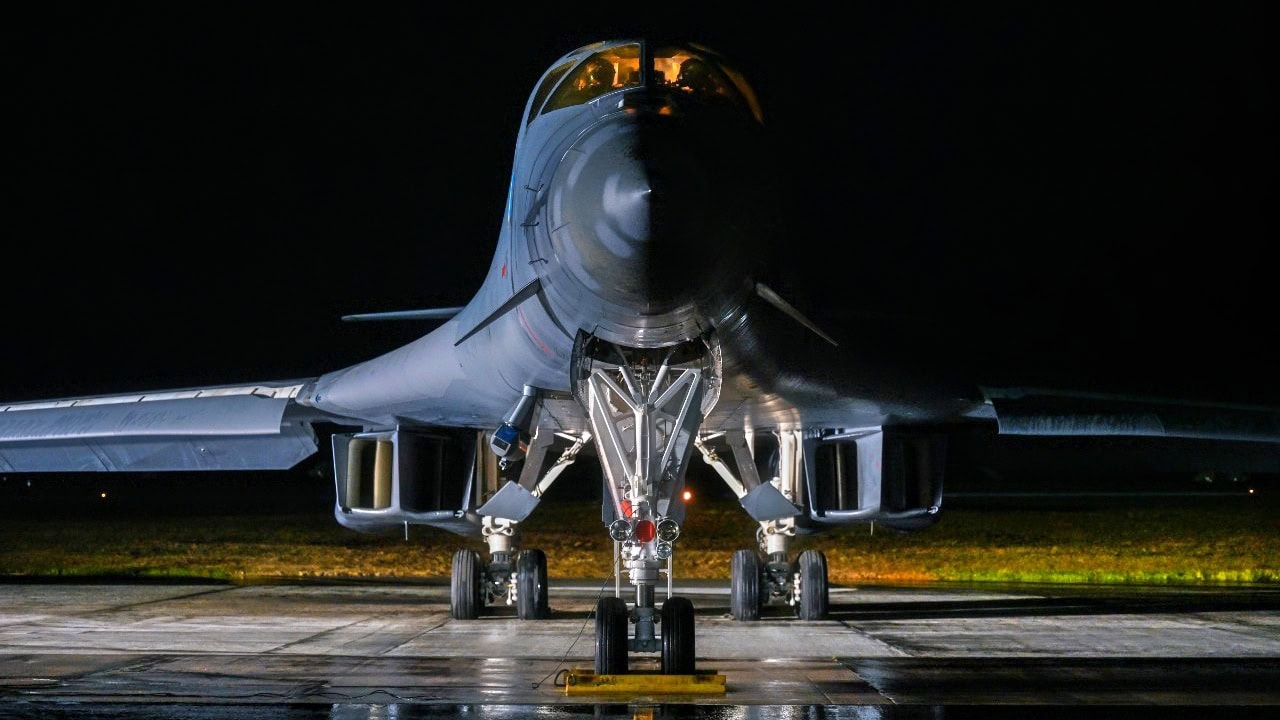
A U.S. Air Force B-1B Lancer assigned to the 34th Expeditionary Bomb Squadron, prepares to taxi onto the runway at Andersen Air Force Base, Guam, prior to a mission in support of Bomber Task Force 25-1, Feb. 27, 2025. Bomber missions demonstrate the credibility of U.S. Air Forces to address a complex and uncertain security environment. (U.S. Air Force photo by Airman 1st Class Alec Carlberg)
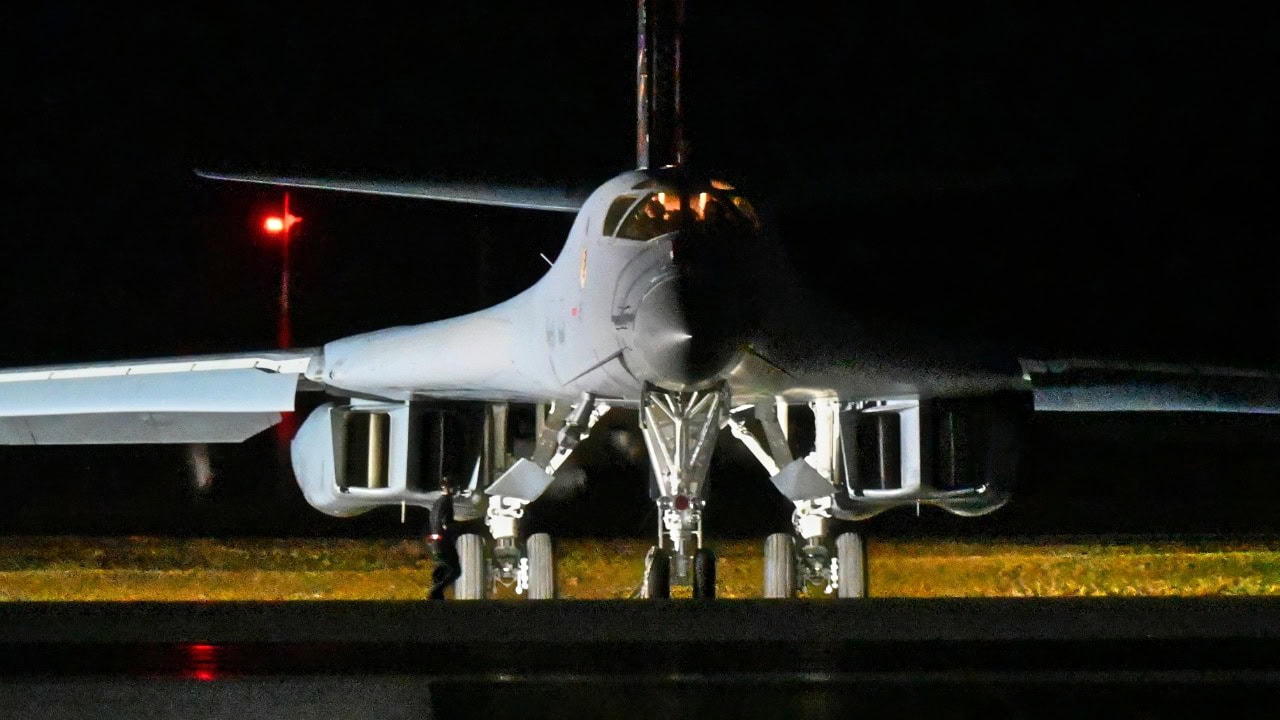
A U.S. Air Force B-1B Lancer assigned to the 34th Expeditionary Bomb Squadron, Ellsworth Air Force Base, S.D., runs final checks before takeoff of a training mission in support of Bomber Task Force 25-1 at Andersen Air Force Base, Guam, Feb. 24, 2025. The BTF missions are designed to showcase the Pacific Air Force’s ability to deter, deny, and dominate any influence or aggression from adversaries or competitors. (U.S. Air Force photo by Tech. Sgt Robert M. Trujillo)
The B-52 fights at a different range. It can fire long-range cruise missiles from far outside heavily defended airspace. Those munitions fly hundreds of miles to find their targets. Age has never been the bomber’s problem. The airframe has evolved into an incredibly versatile missile truck, capable of raining down volleys of stand-off attacks without approaching Iran’s defenses.
Together these aircraft create a continuous strike system—it is more than a simple collection of bombers. Stealth aircraft penetrate and disrupt defenses. Heavy bombers deliver sustained conventional strikes. Missile carriers extend the reach of the campaign.
What U.S. Bombers Can Destroy
With Iranian air defenses largely suppressed, these bombers’ damage to military infrastructure can accumulate quickly.
Ballistic-missile facilities were some of the earliest targets hit. Iran spent the last two decades developing its missile forces—constructing production facilities, storage bunkers and launch pads. That infrastructure is now being leveled by continued bombardment.
Air-defense networks have already come under sustained pressure. Radar installations, command nodes, and missile batteries are vulnerable to repeated precision strikes. As those networks unravel, the operating environment for bombers becomes progressively easier.
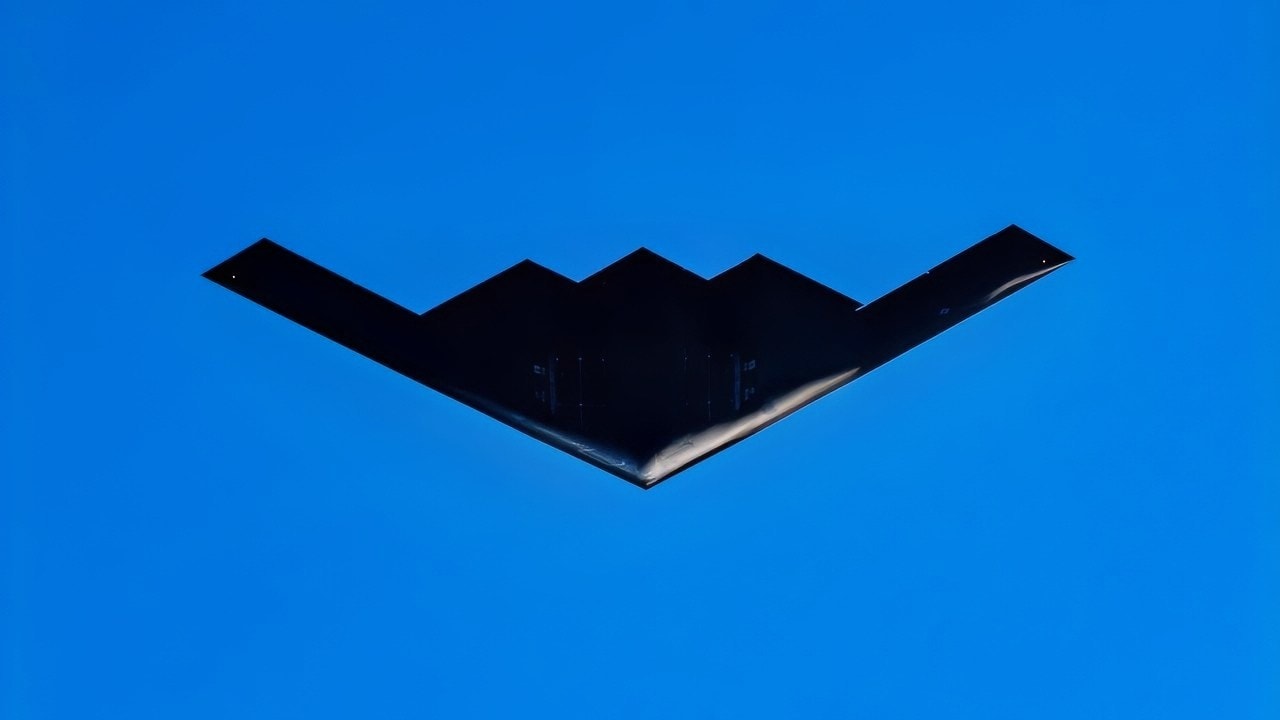
The B-2 Spirit flies over the Rose Parade at Pasadena Ca., Jan. 1, 2024. The Rose Parade is a parade of flower covered floats, marching band, and equestrian units that is produced by the Tournament of Roses. (U.S. Air Force photo by Airman 1st Class Bryce Moore)
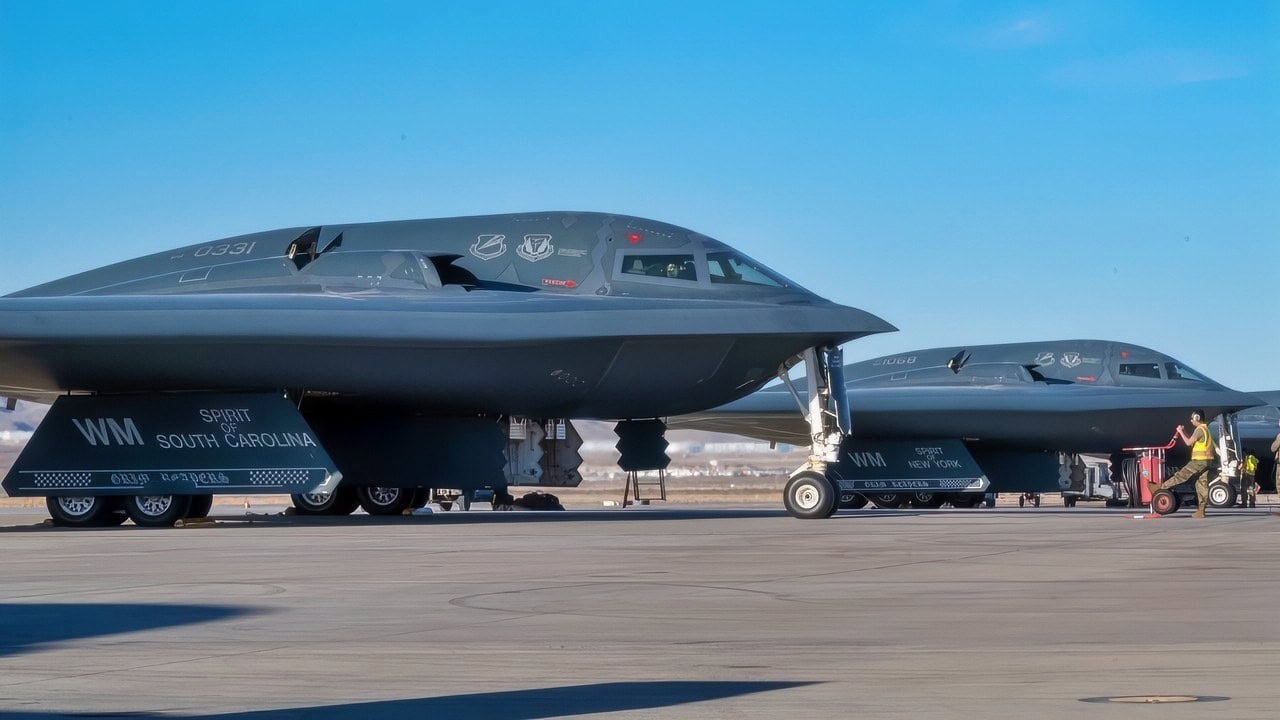
Three B-2 Spirit stealth bombers prepare for departure during Exercise Bamboo Eagle at Nellis Air Force Base, Nevada, Feb. 10, 2025. Bamboo Eagle incorporates multiple mission scenarios, preparing aircrews for complex operational challenges. (U.S. Air Force photo by Senior Airman Bryson Sherard.)
Naval infrastructure in the Persian Gulf is also exposed. Bases supporting fast attack craft, missile boats, and logistics vessels can be hit repeatedly. Facilities used by the Revolutionary Guard Navy to stage operations in the Strait of Hormuz are not difficult targets once the surrounding airspace is contested.
The Iranian defense industry is also under attack. Drone production sites, ammunition depots, and weapons factories are now coming under sustained bombardment as the campaign turns toward the infrastructure that sustains Iran’s military power.
The cumulative effect of these strikes does not come from a single night of bombing. It emerges through repetition. During sortie after sortie, weapons fall on the same infrastructure, and logistics networks fray under sustained pressure.
Why Iran Is Harder to Bomb Than It Looks
Iran has spent years preparing for precisely that scenario.
Some of the most sensitive facilities were built with air attack in mind. Enrichment infrastructure lies under layers of rock and reinforced concrete. Missile forces rely in part on mobile launchers that disperse across the landscape rather than sitting inside permanent bases. Military networks have been designed with redundancy so that the loss of one facility does not cripple the system.
Bombers can destroy a great deal of infrastructure, but the problem does not end with infrastructure.
A missile program can survive the destruction of buildings if the knowledge behind it remains intact. Mobile launchers can vanish into the terrain for long stretches of time. Leadership structures adapt once the first wave of attacks passes.
The Limits of Airpower
Air campaigns impose real costs on governments. They disrupt planning, destroy equipment, and degrade military capability. Those effects can accumulate into serious strategic pressure. Yet the political consequences are never automatic. Governments sometimes absorb the damage while framing the conflict as proof that their struggle is existential.
Iran’s leadership has long expected confrontation with the United States. Military planning and political messaging inside the country reflect that expectation.

B-2 Spirit Stealth Bomber 19FortyFive Photo. Taken by Harry J. Kazianis back in July 2025.
The presence of the B-2, B-1B, and B-52 over Iran represents one of the most formidable conventional strike forces ever assembled. Few countries could endure sustained bombardment from that arsenal without suffering enormous damage. Missile bases could be wrecked. Military facilities could be reduced to rubble. Command structures would be forced to operate under relentless pressure.
Bombers are exceptionally good at breaking things. What follows after the breaking depends on forces that lie well beyond the reach of any aircraft.
About the Author: Dr. Andrew Latham
Andrew Latham is a non-resident fellow at Defense Priorities and a professor of international relations and political theory at Macalester College in Saint Paul, MN. You can follow him on X: @aakatham. Dr. Latham writes a daily column for 19FortyFive.