Summary and Key Points: Defense expert Kris Osborn evaluates the complexities of a full-scale U.S. invasion of Iran.
-Despite a massive $895 billion defense budget and a 13,000-to-550 aircraft advantage, the U.S. faces significant geographic obstacles, including the Zagros and Alborz Mountains.
-This report analyzes the transition from conventional strikes to the high-risk occupation of a nation four times the size of Iraq.
-Osborn explores the Islamic Revolutionary Guard Corps’ (IRGC) focus on asymmetric warfare, concluding that the logistical burden of supplying hundreds of thousands of troops amidst missile attacks makes a “forever war” a distinct possibility.
Why a U.S. Ground Invasion of Iran in 2026 is a Logistical “Red Line”
A potential invasion of Iran by the United States Army would be one of the most complex military operations in modern history.
While the United States possesses the world’s most powerful military, defeating Iran in a full-scale war would depend on multiple factors: technological advantages, geography, political goals, and the difficulty of occupying a large and hostile country.
An analysis of these factors suggests that the United States could likely defeat Iran’s conventional military forces.
Still, a full invasion and long-term control of the country would be far more difficult.
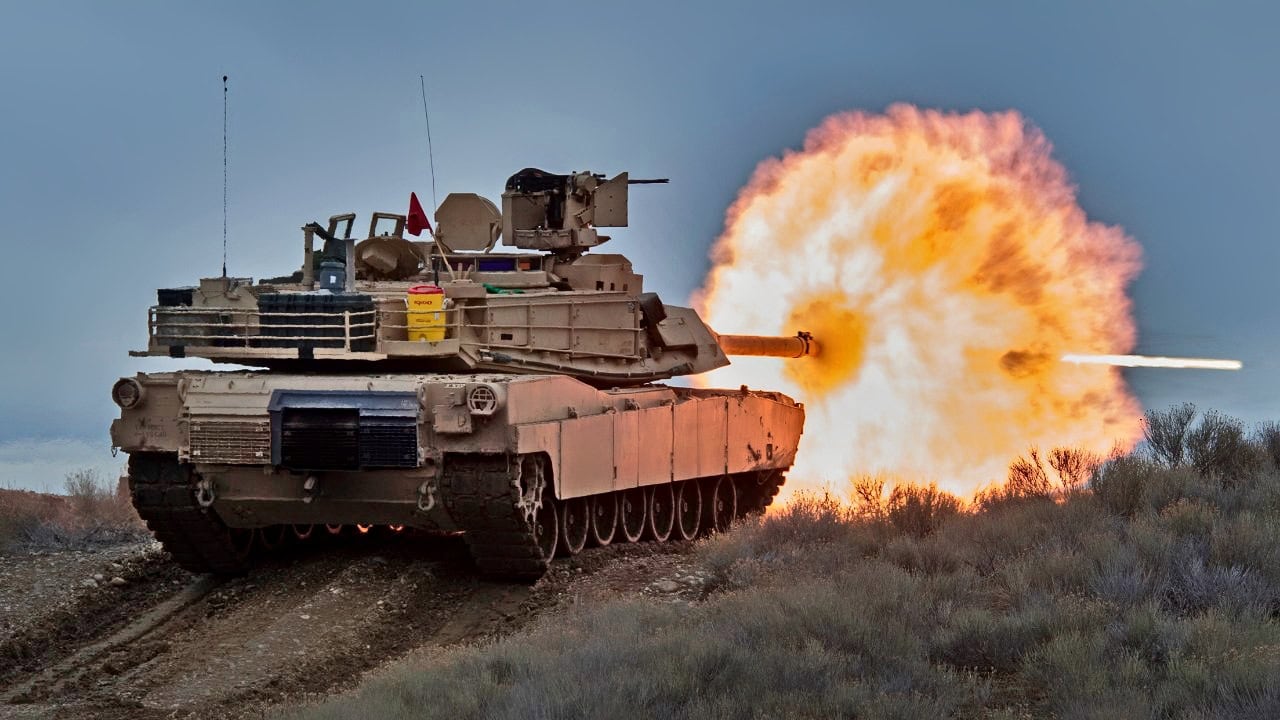
M1A2 Abrams Tanks from A Company, 2-116th Cavalry Brigade Combat Team (CBCT), Idaho Army National Guard run through field exercises on Orchard Combat Training Center (OCTC).
One of the United States’ strongest advantages is its overwhelming military superiority in technology, airpower, and budget.
The U.S. defense budget is roughly $895 billion annually, compared with about $15 billion for Iran.
This massive funding gap allows the United States to maintain advanced aircraft, naval fleets, satellites, and precision weapons.
In terms of airpower alone, the United States possesses more than 13,000 aircraft, while Iran has roughly 550, many of which are older designs from the Cold War era.
Air Superiority over Iran
This imbalance is likely why the U.S. already has air superiority over Iran.
With stealth aircraft, long-range bombers, and cruise missiles launched from ships and submarines, American forces could strike air bases, missile launch sites, radar stations, and command centers across Iran. Modern U.S. military doctrine relies heavily on destroying an enemy’s communications and logistics early in a conflict, reducing its ability to coordinate defenses. If successful, this campaign could severely weaken Iran’s conventional military within the early stages of a war.
Naval power would also favor the United States, as evidenced by Iran’s Navy already being largely destroyed. The U.S. Navy operates aircraft carriers, nuclear submarines, and guided-missile destroyers capable of launching large numbers of precision strikes.
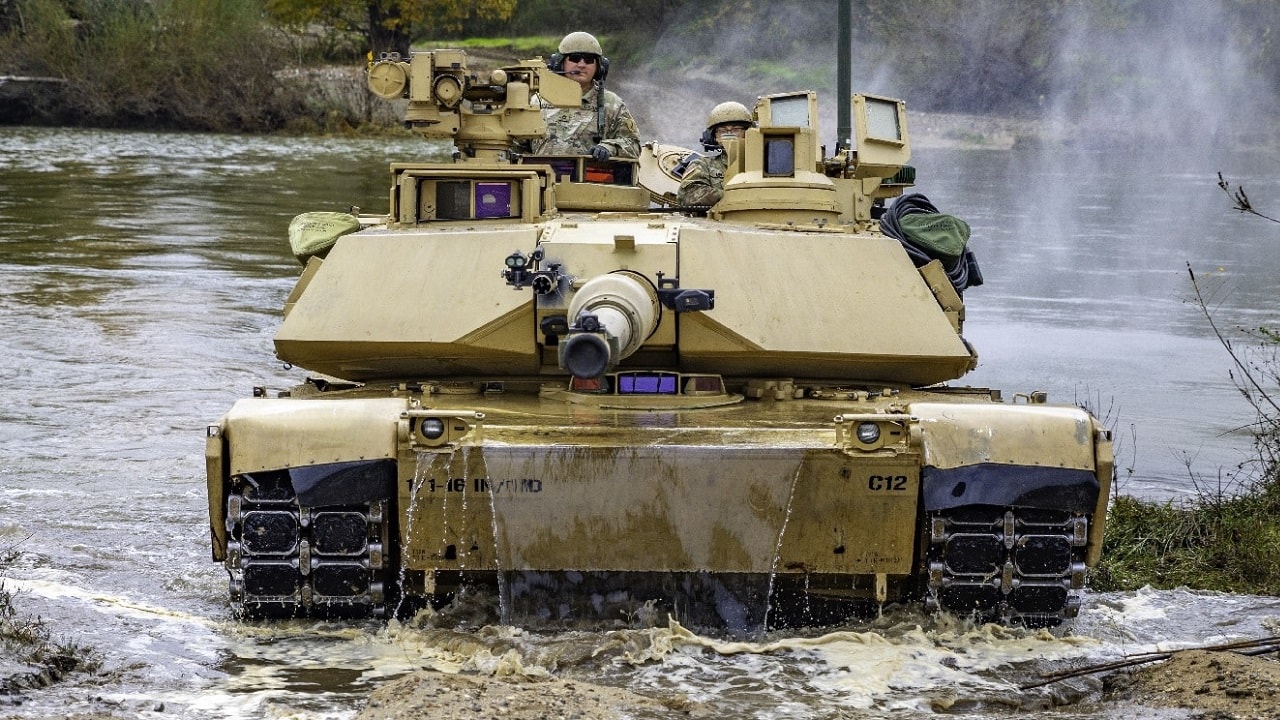
M1 Abrams Tank. Image Credit: Creative Commons.
Iran, by contrast, lacks aircraft carriers and focuses mainly on coastal defense and smaller naval vessels. This would give the United States a significant advantage in controlling the Persian Gulf and surrounding waters.
Despite these advantages, defeating Iran would not be as straightforward as past U.S. conflicts. One major challenge is Iran’s geography. Iran is a very large country—roughly four times the size of Iraq—with rugged mountains, deserts, and densely populated cities.
These features provide natural defensive barriers and make large-scale military operations more difficult. Mountain ranges such as the Zagros and Alborz could slow the advance of invading forces and provide defensive positions for Iranian troops.
Asymmetric Warfare & Terrorism
Another factor is Iran’s military strategy, which emphasizes asymmetric warfare. Because Iran cannot match the United States in conventional military power, it has invested heavily in ballistic missiles, drones, and irregular forces. Iran reportedly possesses thousands of missiles capable of targeting U.S. bases and allies across the Middle East. These weapons could strike military installations, ports, and airfields supporting an invasion.

M2 Bradley. Image Credit: Creative Commons.
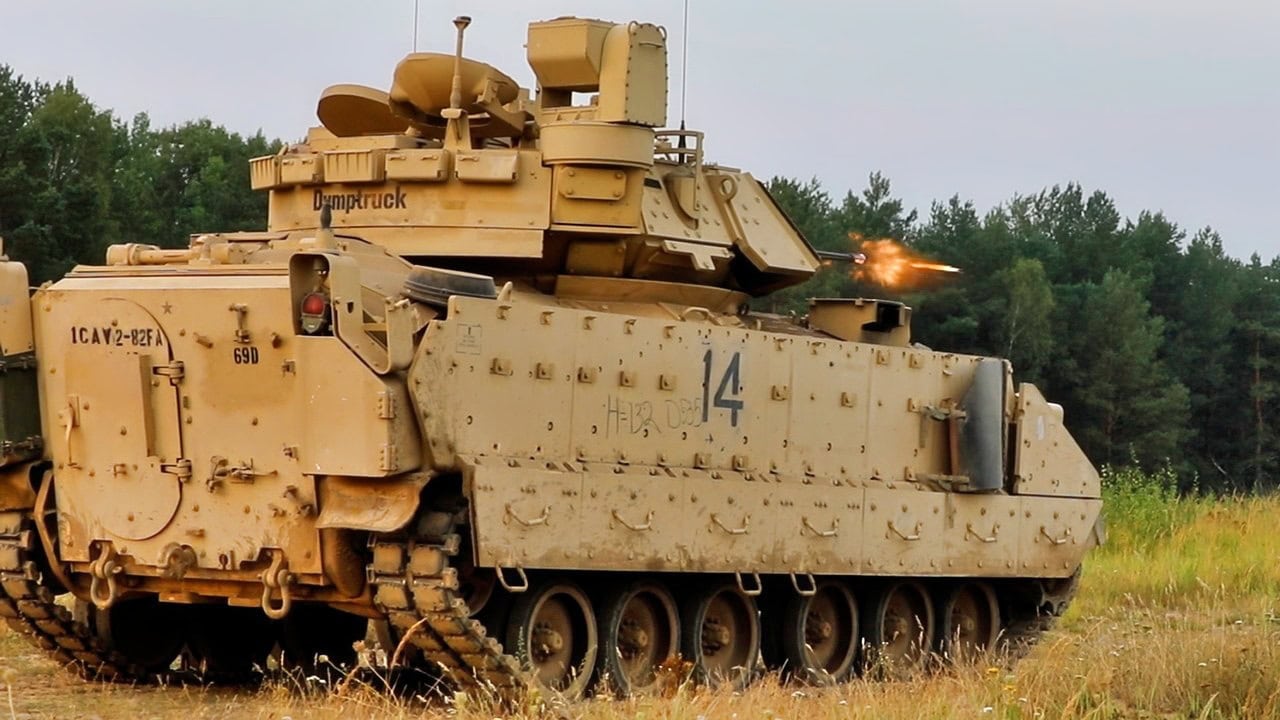
Troopers with 3rd Armored Brigade Combat Team, 1st Cavalry Division firing the 25mm canon on a Bradley fighting vehicle in order to zero the vehicles weapons systems at a range in Poland. Ranges such as these familiarize troopers with the vehicles systems in order to ensure combat readiness.
Iran also has large paramilitary organizations, including the Islamic Revolutionary Guard Corps, which could mobilize large numbers of fighters.
These forces are trained for guerrilla warfare and could operate in cities and mountainous terrain. Even if the United States defeated Iran’s conventional army, these irregular forces could continue fighting for years.
Occuping Iran Would Be a Tough Challenge
A third major challenge would be the scale of an occupation.
Iran has a population of more than 80 million people, significantly larger than the population of Iraq during the 2003 invasion.
Occupying such a large country would require hundreds of thousands of troops and enormous logistical support. Supplying those forces—fuel, food, ammunition, and medical care—would require secure supply routes through neighboring countries or ports.
Maintaining those supply lines while facing missile attacks and insurgent ambushes would be extremely difficult.
About the Author: Kris Osborn, President of Warrior Maven
Kris Osborn is the President of Warrior Maven – Center for Military Modernization. Osborn previously served at the Pentagon as a highly qualified expert in the Office of the Assistant Secretary of the Army—Acquisition, Logistics & Technology. Osborn has also worked as an anchor and on-air military specialist at national TV networks. He has appeared as a guest military expert on Fox News, MSNBC, The Military Channel, and The History Channel. He also has a Master’s Degree in Comparative Literature from Columbia University.