
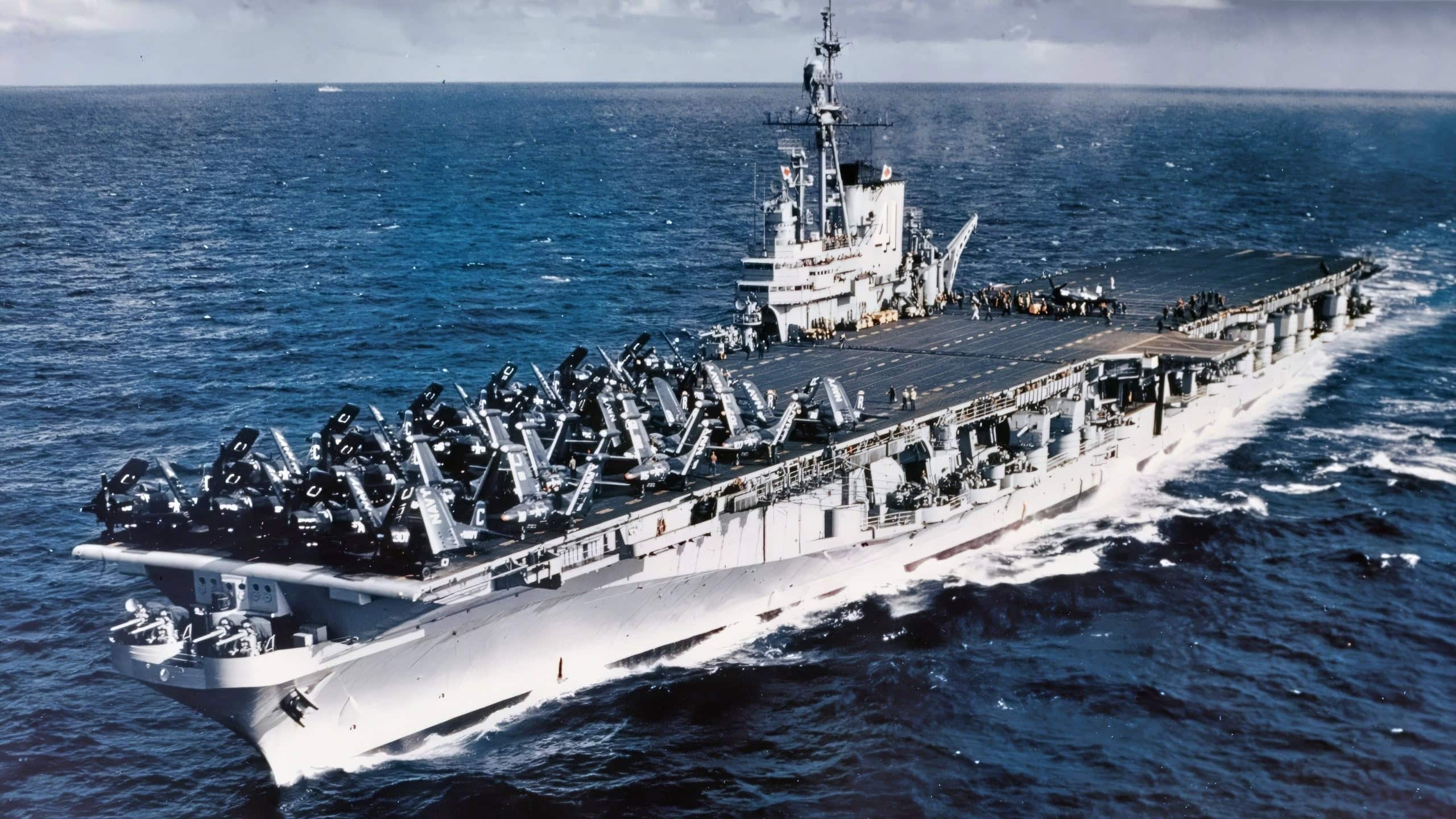
Summary and Key Points: Defense columnist Isaac Seitz chronicles the Midway-class (CVB-41), the essential “bridge” between WWII Essex-class ships and modern supercarriers.
-Comprised of the USS Midway, USS Franklin D. Roosevelt, and USS Coral Sea, these vessels introduced the armored steel flight deck to the U.S. Navy, trading wooden planks for superior survivability against kamikaze threats.
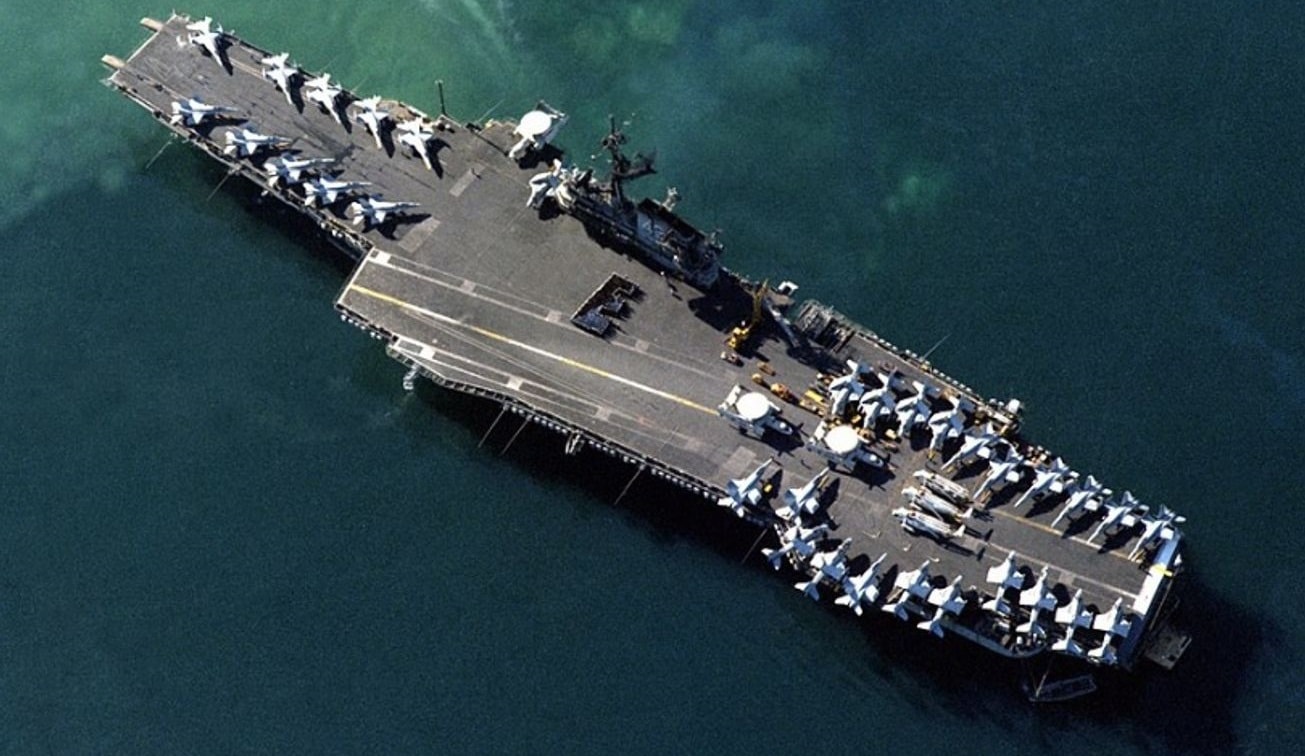
Image of Midway-class aircraft carrier. Image Credit: Creative Commons.
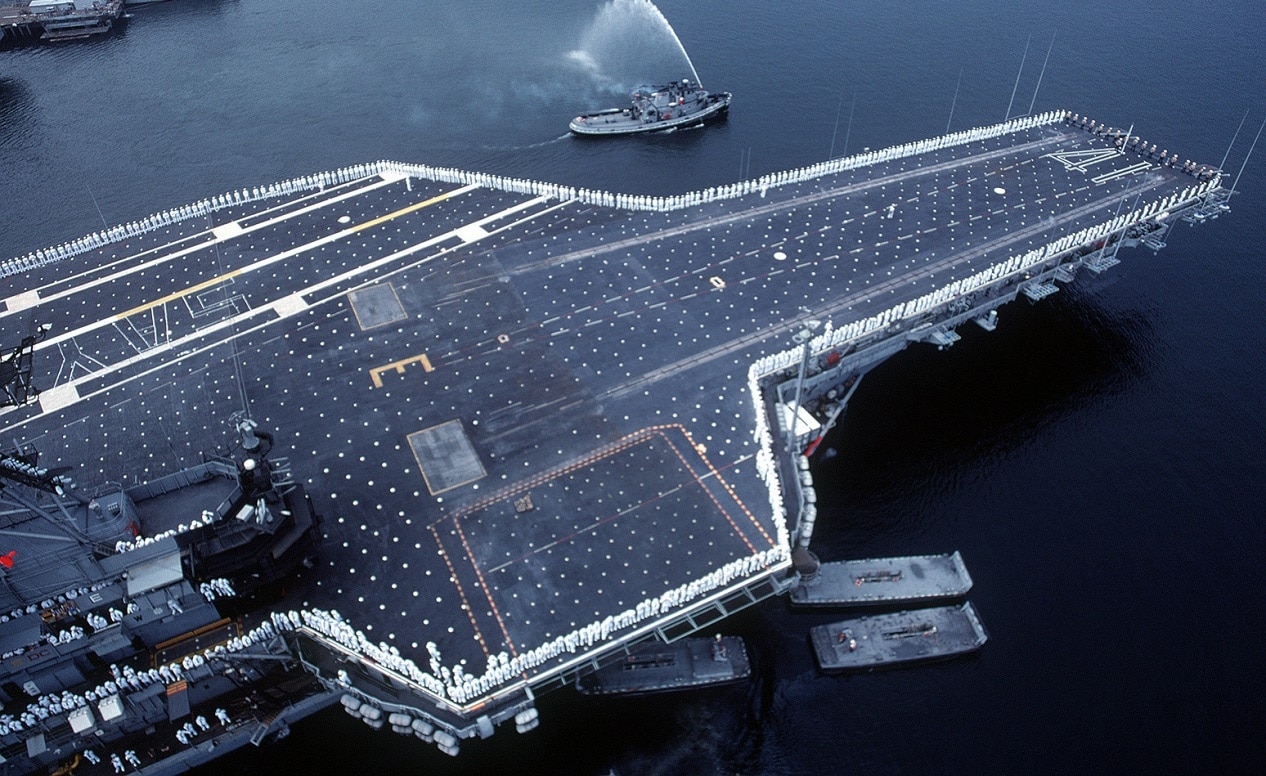
The aircraft carrier USS MIDWAY (CV-41) moves away from the pier as it departs from Yokosuka for the last time. The MIDWAY, which has been based in Japan since 1973, will be replaced by the aircraft carrier USS INDEPENDENCE (CV-62) as the Navy’s forward-based aircraft carrier.
-Though they missed combat in WWII, these 45,000-ton behemoths evolved throughout the Cold War, integrating angled flight decks and steam catapults.
-The USS Midway notably served 47 years, launching sorties from Vietnam to Operation Desert Storm before its 1992 decommissioning.
The Steel Revolution: How the Midway-Class Aircraft Carriers Redefined Naval Survivability
During the Second World War, the U.S. Navy was constantly seeking to improve the quality of its aircraft carriers. CVB-41 was the result of such experiments (the ships did not even have an official designation when first commissioned).
Roughly the size of an Essex-class carrier, the Midway-class carriers experimented with a reinforced flight inspired by the design of some of the UK’s carrier designs.
Despite being produced in small numbers, the carriers served as a good transition between the WWII-era carriers and the supercarriers that followed.
Design and Development
The Midway-class was born out of lessons learned during the Second World War. Battles such as Coral Sea, Midway, and the carrier engagements around Guadalcanal revealed both the strengths and vulnerabilities of existing American carriers.
The Yorktown-class had performed admirably, yet the loss of the USS Yorktown during the Midway battle made it very clear that there was still much to improve upon in terms of carrier design. At the same time, the Essex-class carriers were already under construction, but designers believed that an even more resilient and powerful carrier could be produced if constraints on size and tonnage were relaxed.
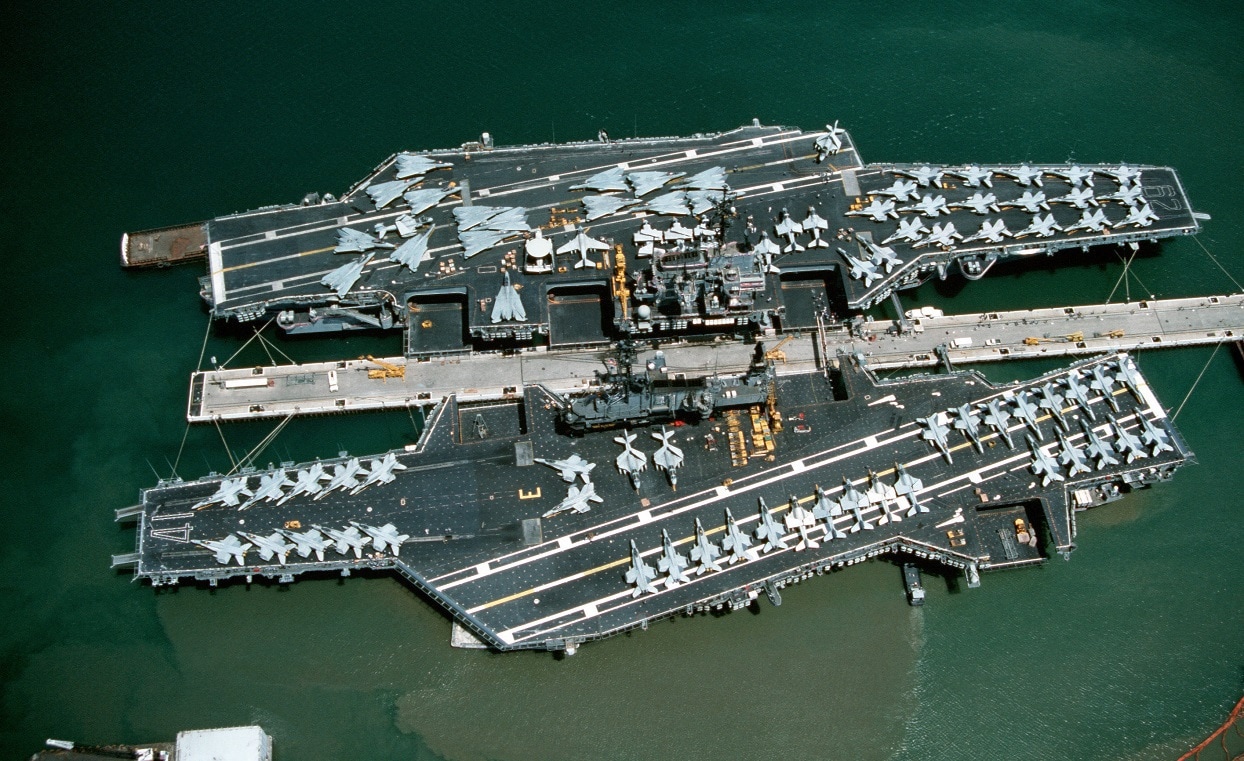
An aerial view of various aircraft lining the flight decks of the aircraft carrier USS INDEPENDENCE (CV-62), right, and USS MIDWAY (CV-41) moored beside each other in the background. The MIDWAY is en route from Naval Station, Yokosuka, Japan, to Naval Air Station, North Island, California, where it will be decommissioned in the spring of 1992. The INDEPENDENCE will travel to Yokosuka to take over as the Navy’s forward-based aircraft carrier.
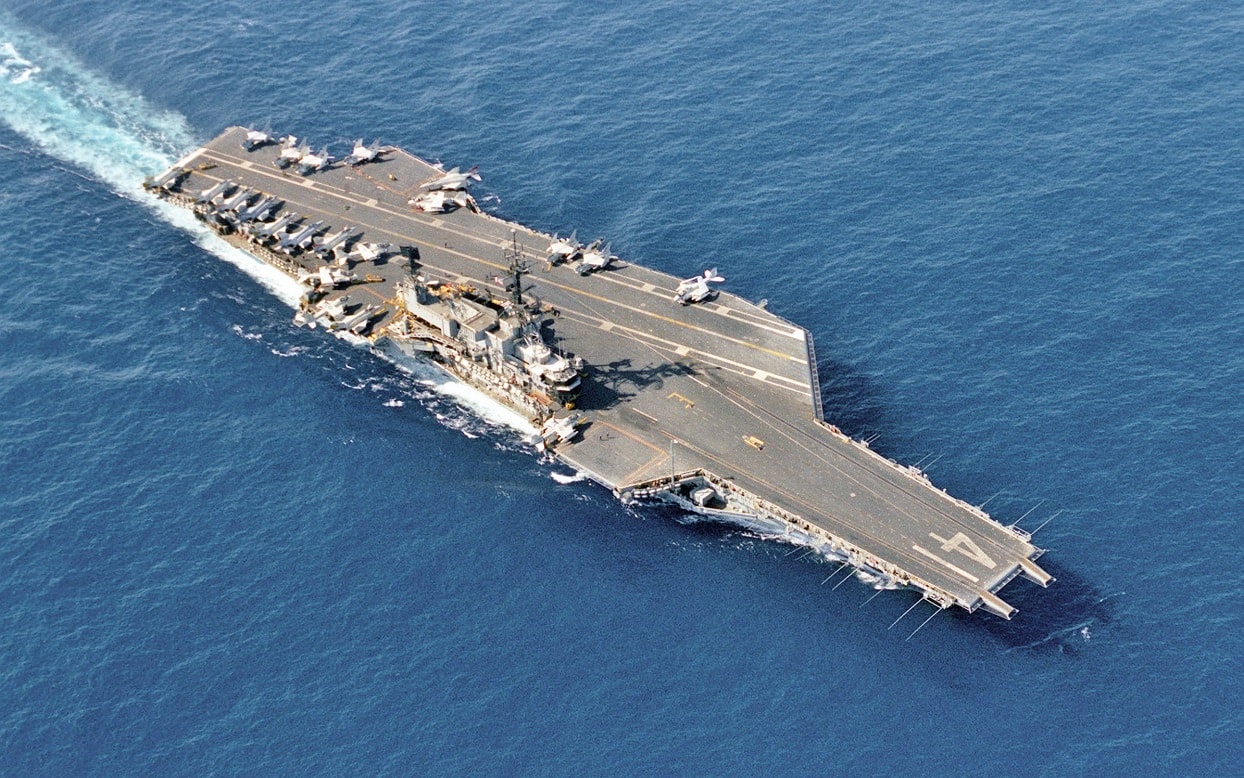
An elevated starboard bow view of the aircraft carrier USS MIDWAY (CV 41) underway off the coast of Okinawa, Japan.
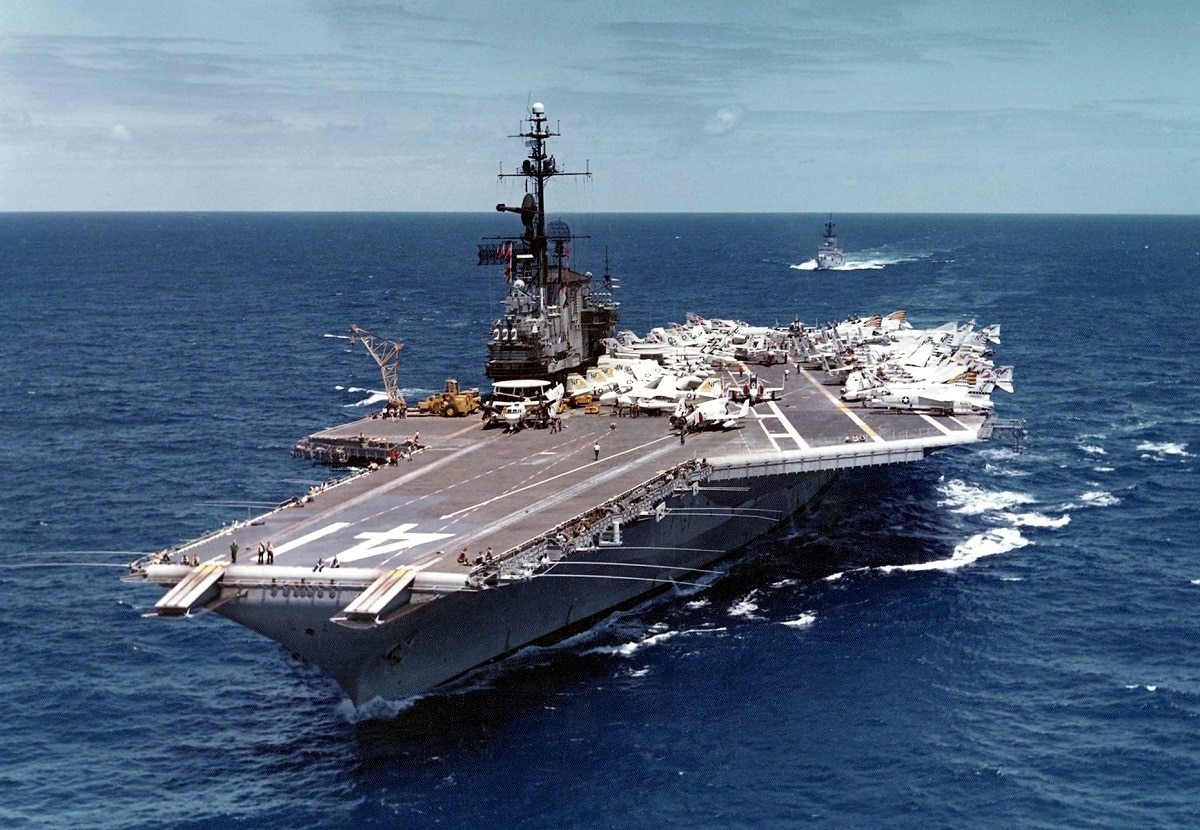
Midway-Class Aircraft Carriers. Image: Creative Commons.
Thus, the Midway-class emerged, consisting of only three ships: USS Midway (CV-41), USS Franklin D. Roosevelt (CV-42), and USS Coral Sea (CV-43).
Ordered during the war and laid down shortly thereafter, they were ultimately completed too late to participate in wartime operations. Instead, they were commissioned between 1945 and 1947, entering a world that was rapidly transitioning from global conflict to geopolitical tension between the United States and the Soviet Union.
Specs and Capabilities
When they joined the fleet, the Midway carriers were the largest warships afloat. With a fully loaded displacement exceeding 45,000 tons, they dwarfed their predecessors and even rivaled some battleships in scale.
This tremendous size granted them several innovative features that distinguished them from earlier carriers.
The most significant departure from American tradition was the adoption of an armored steel flight deck. While British carriers had long used armored decks to protect against bomb hits, the U.S. had prioritized wooden decks to maximize aircraft capacity and ease of wartime repair.
The Midway class reversed that practice, offering superior resistance to bomb and kamikaze damage. Though the war ended before this design could be tested in combat, it represented a major evolution in the Navy’s thinking.
Their vast internal volume allowed for enormous air groups. At various points in their early careers, Midway-class carriers could embark up to 130 aircraft, a staggering number by any standard. Their propulsion plants, consisting of twelve boilers feeding four geared turbines, enabled them to steam at over 30 knots, essential for launching and recovering aircraft, especially during heavy loading conditions.
The ships’ internal architecture featured exceptional armor protection, with nearly a third of their weight devoted to armor for magazines, fuel storage, hangar spaces, and critical machinery. This level of protection reflected hard lessons from wartime losses.
The Midway-class During the Cold War
Although their designers could not have predicted the advent of widespread jet aviation, the Midway carriers proved exceptionally well-suited for postwar modifications. Their broad decks and generous displacement enabled retrofitting angled flight decks, steam catapults, new radar systems, and modern arresting gear. In many ways, the Midway class served as a bridge between the propeller-driven era of World War II and the jet-powered, missile-equipped naval aviation environment of the Cold War.
Of the three ships, USS Midway is undoubtedly the most famous. Commissioned on September 10, 1945, just days after Japan’s surrender, she immediately began a long and eventful career. In the late 1940s, Midway conducted some of the earliest operational tests of jet aircraft aboard U.S. carriers and provided the Navy with valuable data.
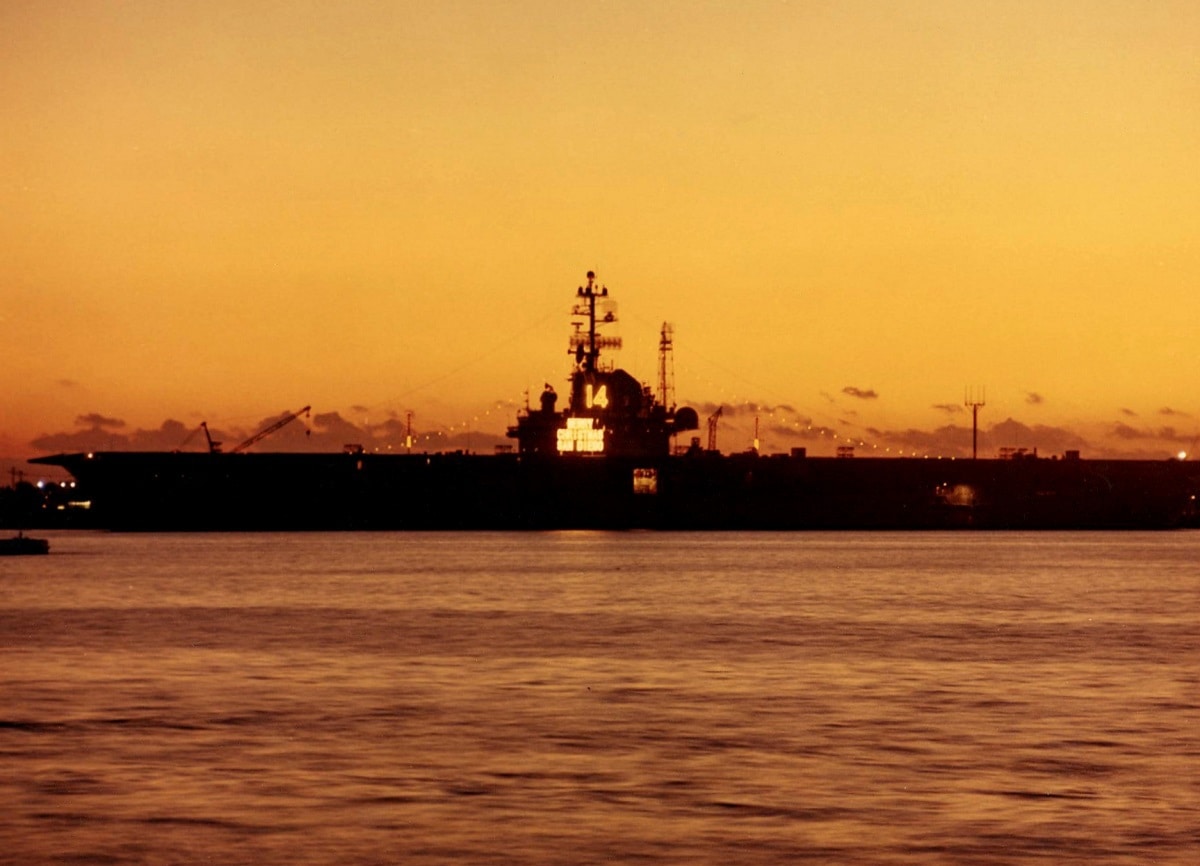
Image: Creative Commons.
During the Cold War, she spent long periods deployed to the Mediterranean and Western Pacific, serving as a tangible symbol of American military presence.
Her career reached a major turning point during the Vietnam War, where her air wings conducted combat sorties throughout the conflict, including during the Linebacker campaigns. She also played a pivotal role in Operation Frequent Wind, the final evacuation of Saigon in 1975, helping to rescue thousands of refugees.
Upgrades and Modernizations
Even after three decades of service, Midway and her sister ships continued to evolve. She underwent a massive modernization that elevated her flight deck, altered her bow shape for better seakeeping, and greatly improved her aviation facilities.
These changes allowed her to operate more advanced aircraft, including the F/A-18 Hornet. Remarkably, she was still fully operational in 1991 during Operation Desert Storm, launching air missions despite being one of the oldest ships in the fleet. After an extraordinary 47 years of continuous service, she was decommissioned in 1992 and now
In 1990, only the USS Midway and the USS Coral Sea were still active. The USS Franklin D. Roosevelt had been decommissioned earlier in 1977, having not received the rapid upgrades that the other ships had.
With the Cold War dialing down, there was no longer a need to maintain its large carrier force. As one of the oldest carriers, the Midway-class was naturally the first to be decommissioned. Coral Sea was decommissioned in 1990 and slowly scrapped. Midway, however, remained in service until 1992 and took part in Operation Desert Storm before being officially decommissioned, marking the end of an era.
About the Author: Isaac Seitz
Isaac Seitz, a Defense Columnist, graduated from Patrick Henry College’s Strategic Intelligence and National Security program. He has also studied Russian at Middlebury Language Schools and has worked as an intelligence Analyst in the private sector.