
Summary and Key Points: National security contributor Stephen Silver evaluates the USS Nimitz (CVN-68) as it transits to its new homeport in Norfolk, Virginia, for decommissioning.
-Following a March 7, 2026, departure from Naval Base Kitsap, the carrier is participating in the Southern Seas 2026 deployment, visiting partner states across South America.
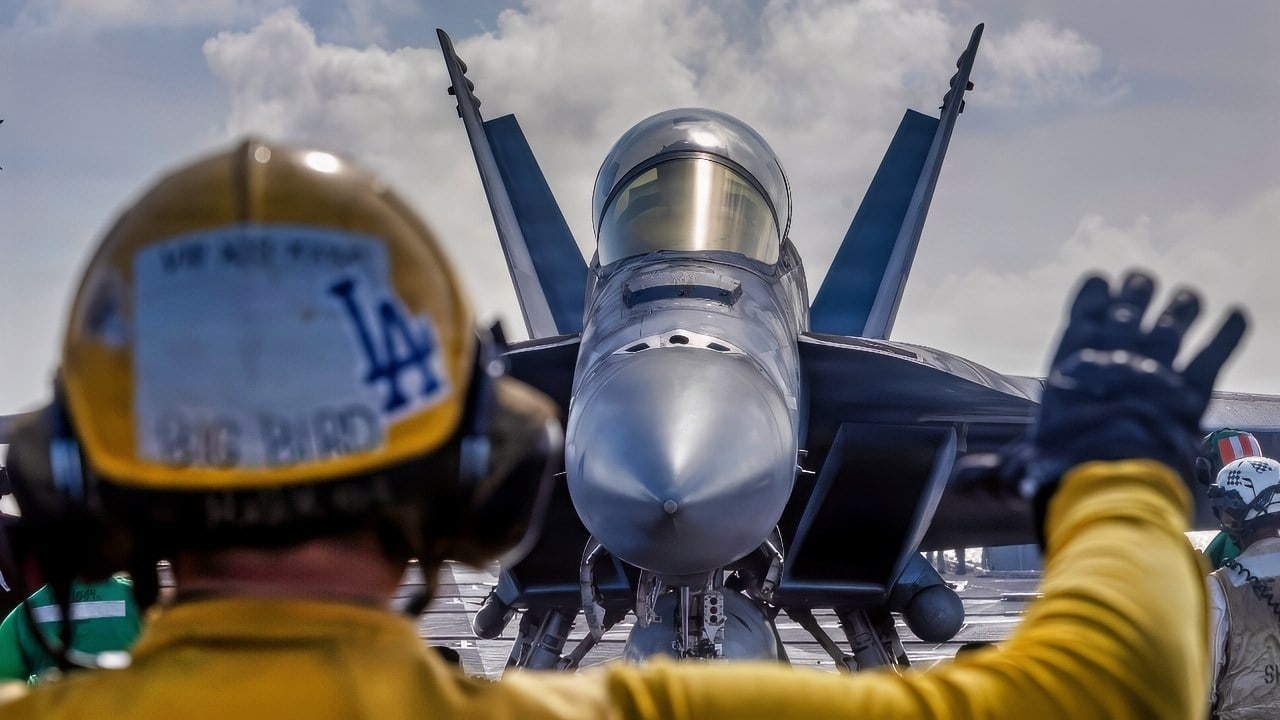
U.S. Navy Aviation Boatswain’s Mate (Handling) 2nd Class Michael Cordova directs an F/A-18E Super Hornet, attached to Strike Fighter Squadron (VFA) 14, on the flight deck of Nimitz-class aircraft carrier USS Abraham Lincoln (CVN 72) on Jan. 10, 2026. The Abraham Lincoln Carrier Strike Group is underway conducting routine operations in the U.S. 7th Fleet area of operations. Units assigned to 7th Fleet conduct regular Indo-Pacific patrols to deter aggression, strengthen alliances and partnerships, and advance peace through strength. (U.S. Navy photo by Mass Communication Specialist Seaman Daniel Kimmelman)
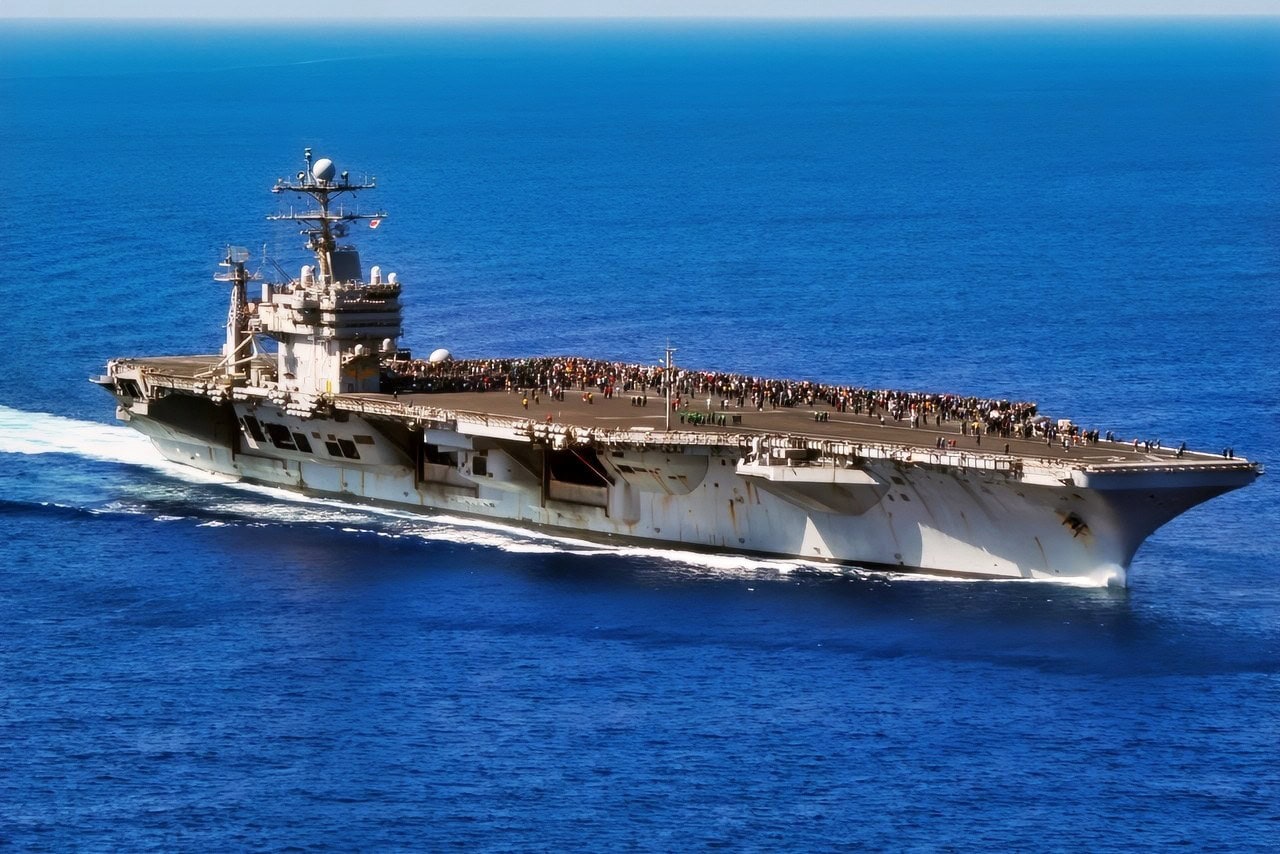
ATLANTIC OCEAN (Aug. 6, 2012) F/A-18 Hornets and Super Hornets from Carrier Air Wing (CVW) 2 fly in formation as MH-60S Seahawk helicopters assigned to the Golden Falcons of Helicopter Sea Combat Squadron (HSC) 12 fire flares during an air power demonstration above the Nimitz-class aircraft carrier USS Abraham Lincoln (CVN 72). Lincoln is returning to the United States after the completion of an eight-month change-of-homeport deployment during which she operated in the U.S. 5th, 6th and 7th Fleet areas of responsibility. (U.S. Navy photo by Mass Communication Specialist Seaman Zachary A. Anderson/Released)

USS Nimitz in November 2025. Image Credit: Creative Commons.
-This report analyzes the $33.4 million Huntington Ingalls (HII) contract modification for advanced planning and the complex defueling of its two Westinghouse A4W reactors.
-Silver explores the carrier’s 50-year history, from Operation Evening Light to its final 82,000-nautical-mile Pacific deployment.
The Final Cruise: Why the USS Nimitz is Circumnavigating South America on its Way to Retirement
While many U.S. Navy aircraft carriers have headed to the Middle East in recent weeks, one venerable carrier is bound for Latin America on its final voyage. According to DVIDS, the USS Nimitz (CVN-68) departed Naval Base Kitsap in Washington state on March 7.
It is the final departure from Washington after more than 50 years of service, as the Nimitz switches its home port to Naval Station Norfolk, Virginia. The Nimitz has been known for a half-century as “the Pacific Northwest’s Carrier.”
“This ship and her crew could not be more thankful to the people of Washington State for their decades of hospitality, friendship, and trust,” Captain Joseph Furco,commanding officer of the Nimitz, said, DVIDS reported. “It is in no small part due to the support of our local community that Nimitz Sailors have been able to successfully train, fight, and win, exemplifying the ship’s motto: Teamwork, a Tradition.”
The carrier returned to base in Bremerton in December, after nine months underway.
“As flagship of the Nimitz Carrier Strike Group during this period, the Nimitz and her crew completed more than 8,500 sorties and 17,000 flight hours, carried out 50 replenishments-at-sea aboard the carrier and sailed over 82,000 nautical miles combined,” DVIDS said. “An integral part of the U.S. Pacific Fleet, U.S. 3rd Fleet operates naval forces in the Indo-Pacific and provides the realistic and relevant training to ensure the readiness necessary to execute the U.S. Navy’s timeless role across the full spectrum of military operations. U.S. 3rd Fleet works together with our allies and partners to advance a shared vision of a free, open, and secure Indo-Pacific in which all nations are secure in their sovereignty and free from coercion.”
Where It’s Going
Stars and Stripes shared some details about the Nimitz’ journey.
“Nimitz is deploying to the U.S. Southern Command area of responsibility this spring as part of U.S. Naval Forces Southern Command/U.S. 4th Fleet’s Southern Seas 2026 deployment,” Lieutenant Commander Peter Pagano told Stars and Stripes in an email.
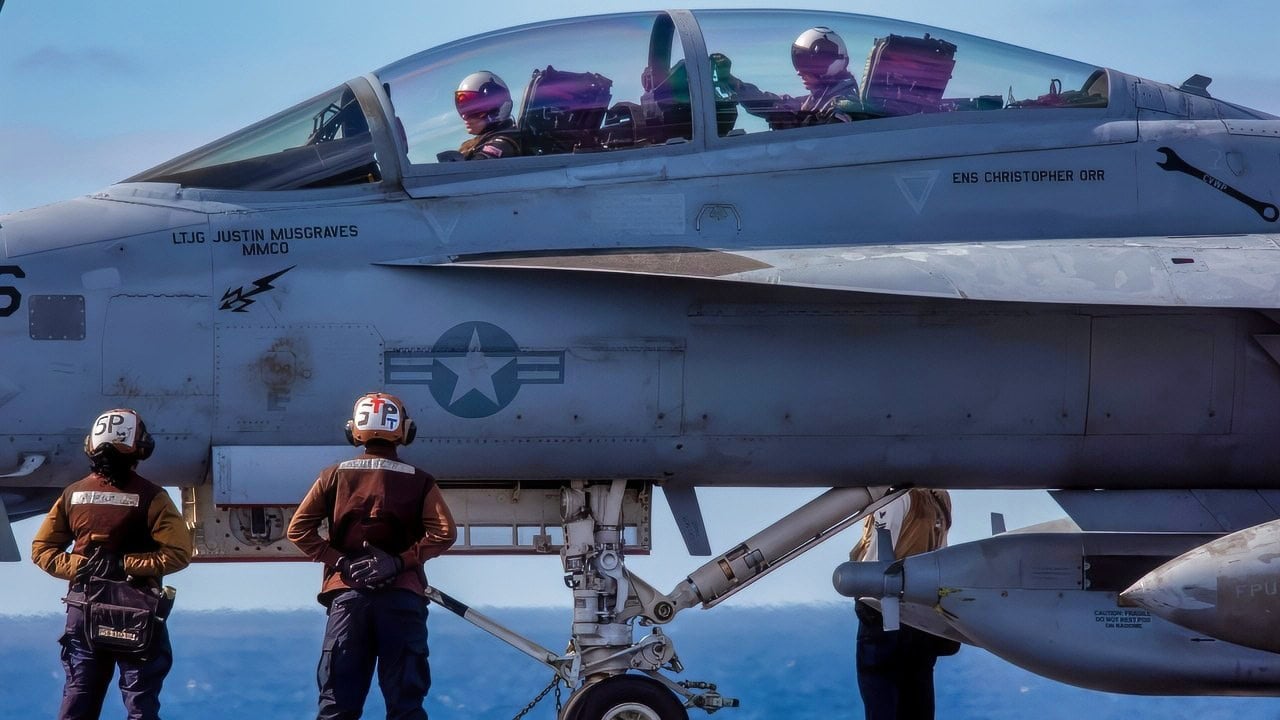
U.S. Navy Sailors prepare to taxi an EA-18G Growler, attached to Electronic Attack Squadron (VAQ) 133, on the flight deck of Nimitz-class aircraft carrier USS Abraham Lincoln (CVN 72) on Nov. 24, 2025. USS Abraham Lincoln (CVN 72), flagship of the Abraham Lincoln Carrier Strike Group, is underway conducting routine operations in the U.S. 3rd Fleet area of operations, demonstrating the U.S. Navy’s long-term commitment to a free and open Indo-Pacific. (U.S. Navy photo by Mass Communication Specialist Seaman Daniel Kimmelman)
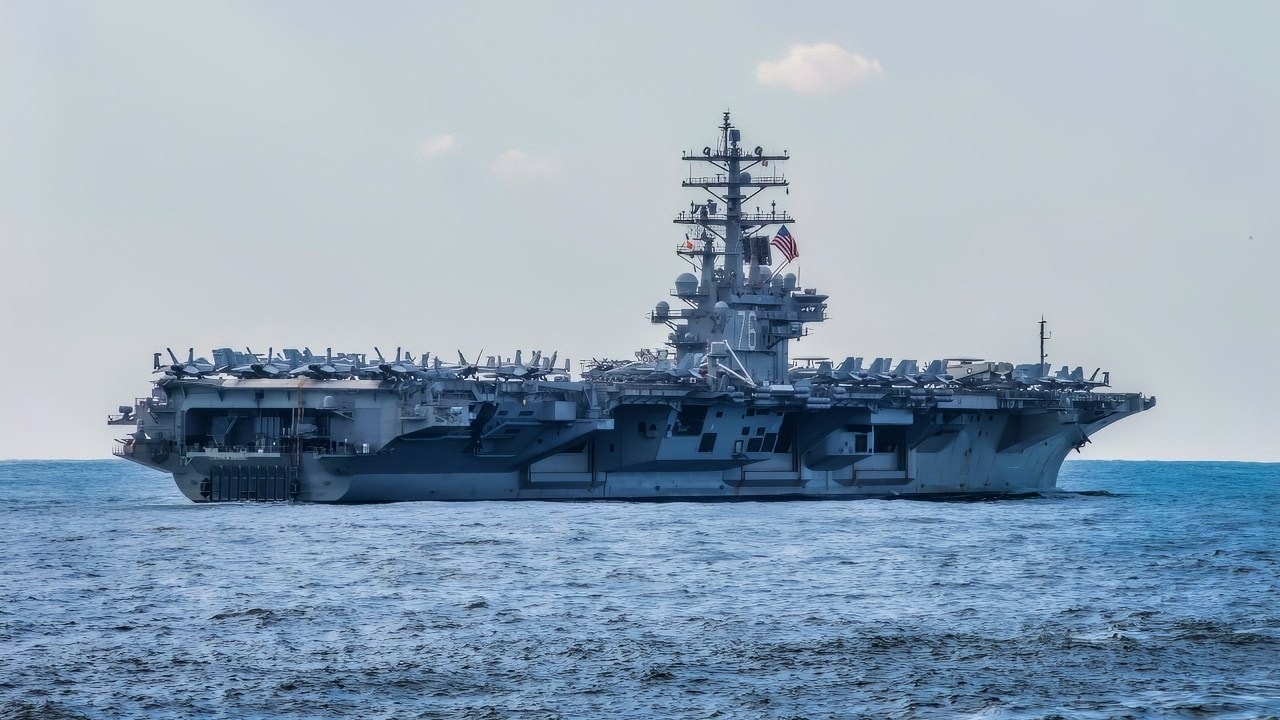
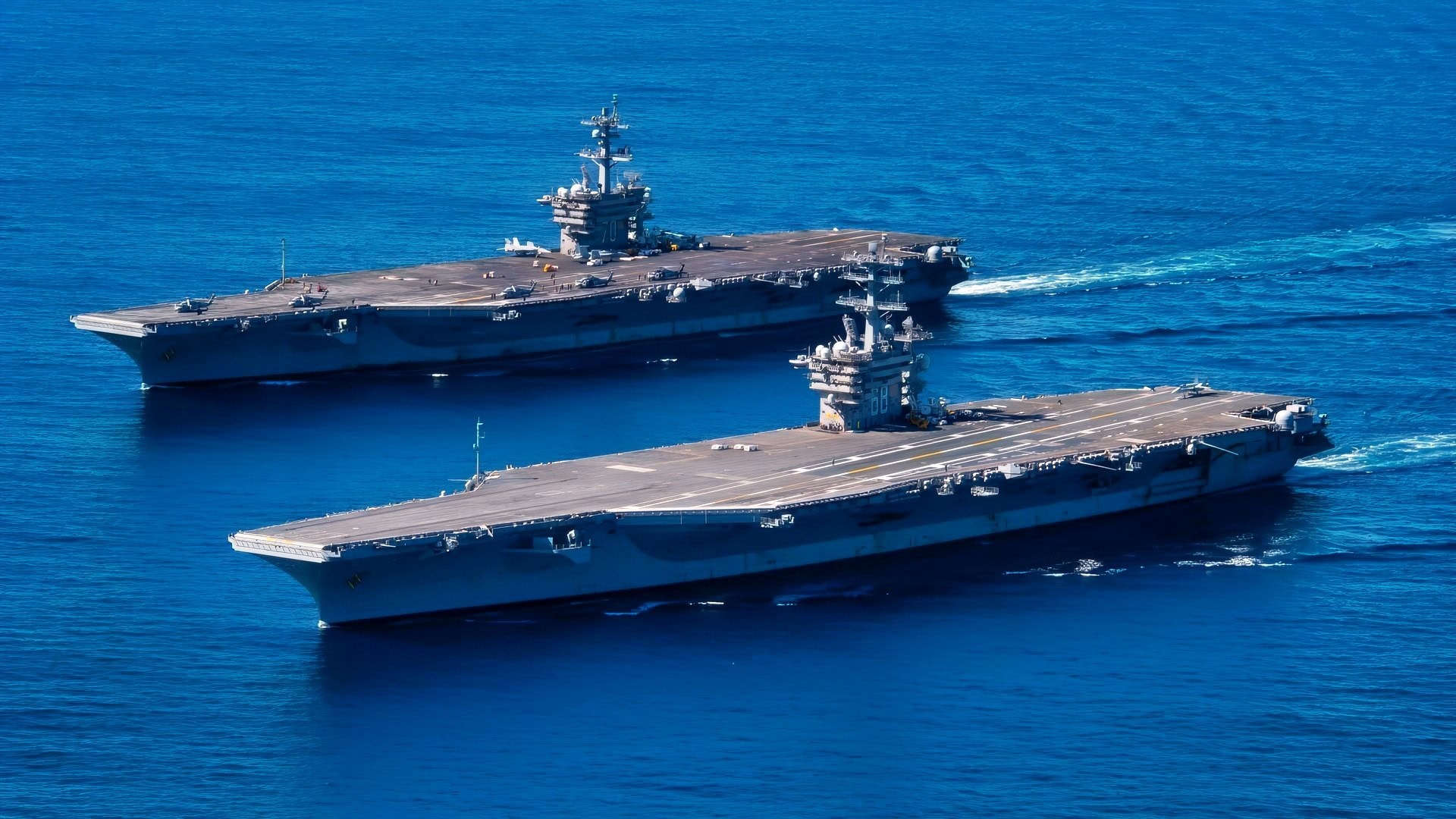
WESTERN PACIFIC (Nov. 12, 2017) The aircraft carrier USS Theodore Roosevelt (CVN 71) transits the Western Pacific during a three-carrier strike force photo exercise. The USS Ronald Reagan (CVN 76), USS Theodore Roosevelt (CVN 71) and USS Nimitz (CVN 68) Strike Groups are underway and conducting operations in international waters as part of a three-carrier strike force exercise. The U.S. Navy has patrolled the Indo-Asia Pacific region routinely for more than 70 years promoting regional security, stability and prosperity. (U.S. Navy photo by Mass Communication Specialist 3rd Class Kelsey J. Hockenberger/Released)
Details of the deployment are still under development, the Stars and Stripes report said. The Nimitz is too large to go through the Panama Canal, so it must go around South America entirely.
“Detailed planning is currently underway for Nimitz to visit several partner states on the ship’s circumnavigation of the continent of South America, en route to its new homeport,” Pagano added. “Additional details on the upcoming Southern Seas 2026 deployment, such as participating and embarked units, will be released before it begins.”
History and Future of the USS Nimitz Aircraft Carrier
The Nimitz was commissioned on May 3, 1975, and it was named for Fleet Admiral Chester W. Nimitz, who was Commander in Chief, Pacific Fleet during World War II. That makes it the Navy’s oldest carrier, and also the oldest in the world.
Per the Navy website, the Nimitz first deployed days after the nation’s bicentennial, on July 7, 1976. One of its first missions involved tensions in Iran.
“Sept. 10, 1979, she was dispatched to the Indian Ocean as tensions heightened after Iran took 52 U.S. hostages,” the Navy history says. “Four months later, Operation Evening Light was launched from Nimitz in an attempt to rescue the hostages. The rescue was aborted in the Iranian desert when the number of operational helicopters fell below the minimum needed to complete the rescue.”
Other notable deployments included the Persian Gulf during Operation Desert Storm, an around-the-world cruise in 1997, and a change in ports to San Diego in 2001, shortly after the 9/11 attacks. The Nimitz went on to be deployed in the subsequent wars.
“After leaving the Gulf, the strike group participated in Malabar 2005, an exercise between the U.S. and Indian navies. In 2007 and 2008, Nimitz CSG deployed in support of the U.S. commitment to peace and stability in the region,” the Navy site says. “Nimitz departed to the Persian Gulf for a scheduled eight-month Western Pacific deployment on July 31, 2009, in support of Operation Enduring Freedom.”
The Nimitz changed ports once again, to Everett, Washington, in 2012, and to Bremerton in 2015.
End of Life
In the fall of 2024, the Navy awarded a contract to Huntington Ingalls Inc. to handle “preliminary planning” for the decommissioning of the USS Nimitz. In the spring of 2025, HII was awarded the contract, reportedly without competition, to complete the process.
In December, The Aviationist reported on the final plans for the carrier.
“Following an official decommissioning ceremony, the ship will be stripped of remaining useful parts, equipment, and stores in a process known as the Ship Terminal Off-load Program, or STOP,” the Aviationist report said.
“After around 12 months, Nimitz will be handed over to Huntington Ingalls Industries (HII) at Newport News to begin the long process of defueling and removing the two Westinghouse A4W nuclear reactors. This process will be unique – the only nuclear-powered aircraft carrier to previously be decommissioned being the one-of-a-kind USS Enterprise (CVN-65), which instead featured eight A2W reactors.”
HII got one more contract late last year.
“On Dec. 23, 2025, HII was awarded a modification to the initial contract worth $33.4 million,” the report said. “Set to run until March 2026, this money will be used to finalize advanced planning ahead of the decommissioning process and procure long-lead materials. Follow-on contract modifications are expected to sustain work through October 2027.”
About the Author: Stephen Silver
Stephen Silver is an award-winning journalist, essayist, and film critic, and contributor to the Philadelphia Inquirer, the Jewish Telegraphic Agency, Broad Street Review, and Splice Today. The co-founder of the Philadelphia Film Critics Circle, Stephen lives in suburban Philadelphia with his wife and two sons. For over a decade, Stephen has authored thousands of articles that focus on politics, national security, technology, and the economy. Follow him on X (formerly Twitter) at @StephenSilver, and subscribe to his Substack newsletter.