
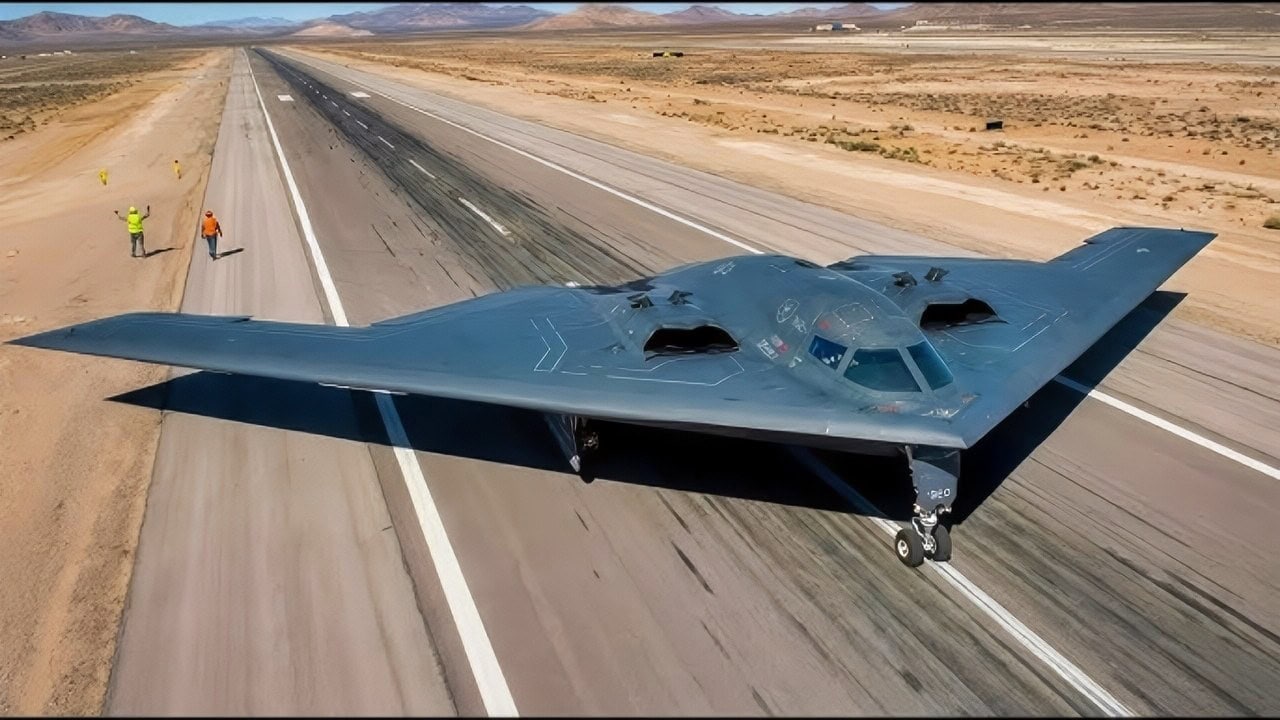
Summary and Key Points: A Hangzhou defense firm, Jingan Technology, says its “Jingqi” AI system intercepted radio signals from four B-2 Spirit bombers — call signs Petro 41 to 44 — and reconstructed their flight path over Iran. It has produced no recordings or transcripts, and the boast echoes an earlier, still-unverified Chinese claim to have tracked the F-35.
China’s Big B-2 Stealth Bomber Claim
The Northrop (which became Northrop Grumman back in 1994) B-2 Spirit—the original “Stealth Bomber”—made its maiden flight on July 17, 1989, and officially entered into operational service on New Year’s Day 1997, making it, relatively speaking, the youngest member of the United States Air Force’s strategic bomber triumvirate. (The B-1B Lancer AKA the “Bone,” celebrates the 40th operational service anniversary this year, whilst the B-52 Stratofortress AKA the “BUFF,” is a septuagenarian, thus earning it the additional unofficial nickname of “Stratosaurus”).
In that time, the B-2 has proven its worth in combat over and over again, from Operation Allied Force (the 1999 Kosovo campaign) to the Global War on Terror (Afghanistan and Iraq alike) to the skies over Iran, both last year’s Operation Midnight Hammer and the current Operation Epic Fury.
So, naturally, America’s adversaries, such as the People’s Republic of China (PRC), are actively seeking to counter the technological advantages conferred by the Spirit. For one thing, the PRC is developing its own stealth bomber, the Xi’an H-20. Meanwhile, China is also attempting to develop technologies to detect the American stealth bomber, and now they’re claiming to have done just that, in those aforementioned skies over Iran, no less.
The Basics
News on this disturbing development (assuming that it’s a legitimate claim and not a mere PRC propaganda ploy) comes to us courtesy of Chris Young of Interesting Engineering (IE) in a March 12, 2026, article titled “Chinese defense firm claims it intercepted radio signals from US B-2 bomber over Iran.”
To wit: “The Chinese private defense firm, Jingan Technology, provides intelligence-gathering services to China’s People’s Liberation Army (PLA). It claims it used AI to detect signals linked to U.S. military activities long before the recent escalation of the conflict in the region…Though the U.S.-Israel military action in Iran began on February 28, Jingan Technology said it used AI to detect early indicators of the conflict before that date. According to Hangzhou-based Jingan Technology, its Jingqi war-monitoring system reconstructed a sequence of signals from the U.S. military, showing it was mobilizing for war…The company claimed it analyzed open-source intelligence on February 6, at the start of U.S.-Iran talks on the Iranian missile program. In doing so, it discovered a steady increase in U.S. military deployments near Iran.“
Deeper Dive
Using a March 11, 2026, report in the South China Morning Post (SCMP) as his primary resource, Mr. Young notes that the Jingqi system integrates satellite imagery, aviation trajectory data, and public military records to interpret reconnaissance flight patterns, transport aircraft routes, and even the types of aircraft stationed at military bases.
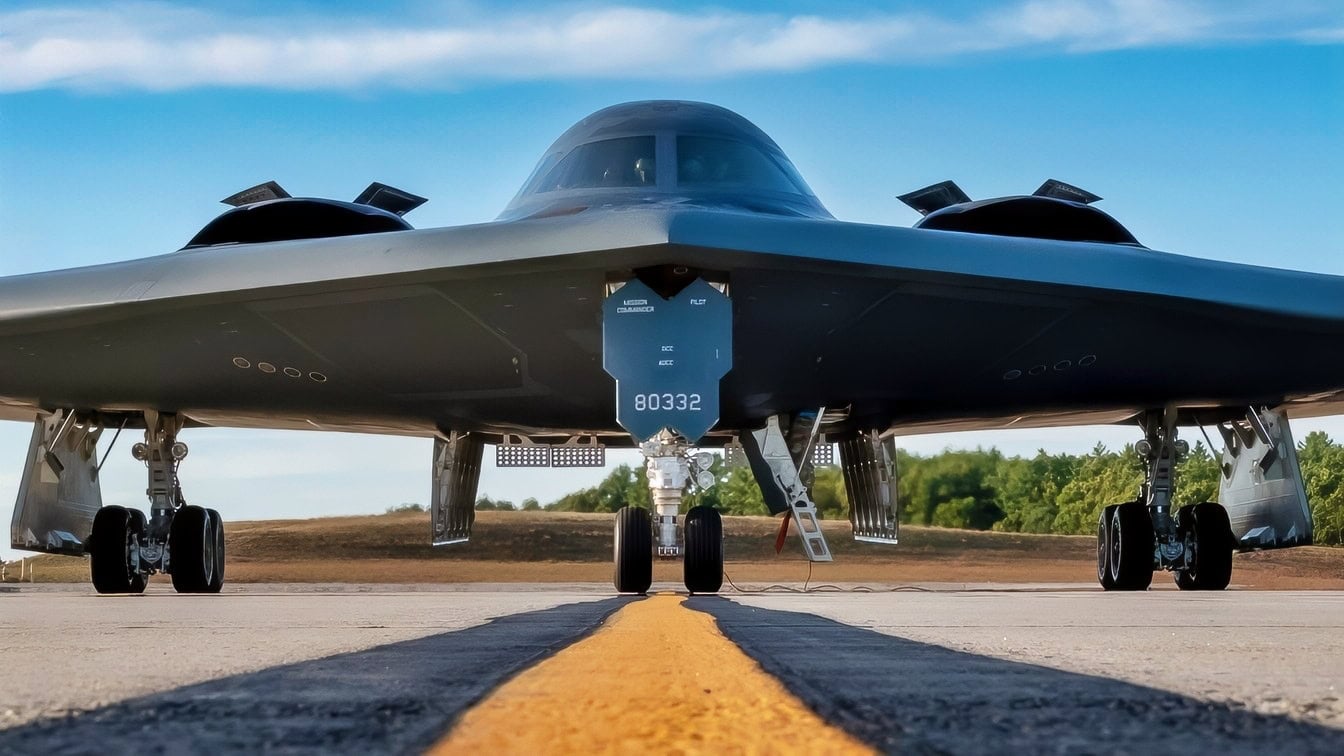
A U.S Air Force B-2 Spirit aircraft is shown on the flight line at Pease Air National Guard Base, New Hampshire, Sept. 20, 2025. The aircraft is the first operated by the 509th Bomb Wing to land at Pease ANGB, formerly Pease Air Force Base, since the 509 BW, formerly 509th Bombardment Wing, was stationed at Pease AFB and the active-duty base closed nearly 35 years ago. The lineage of the 509th BW traces back to the World War II Era when the 509th Composite Group dropped the atomic bombs on Japan. (U.S. Air Force photo by Staff Sgt. Joshua Hastings)
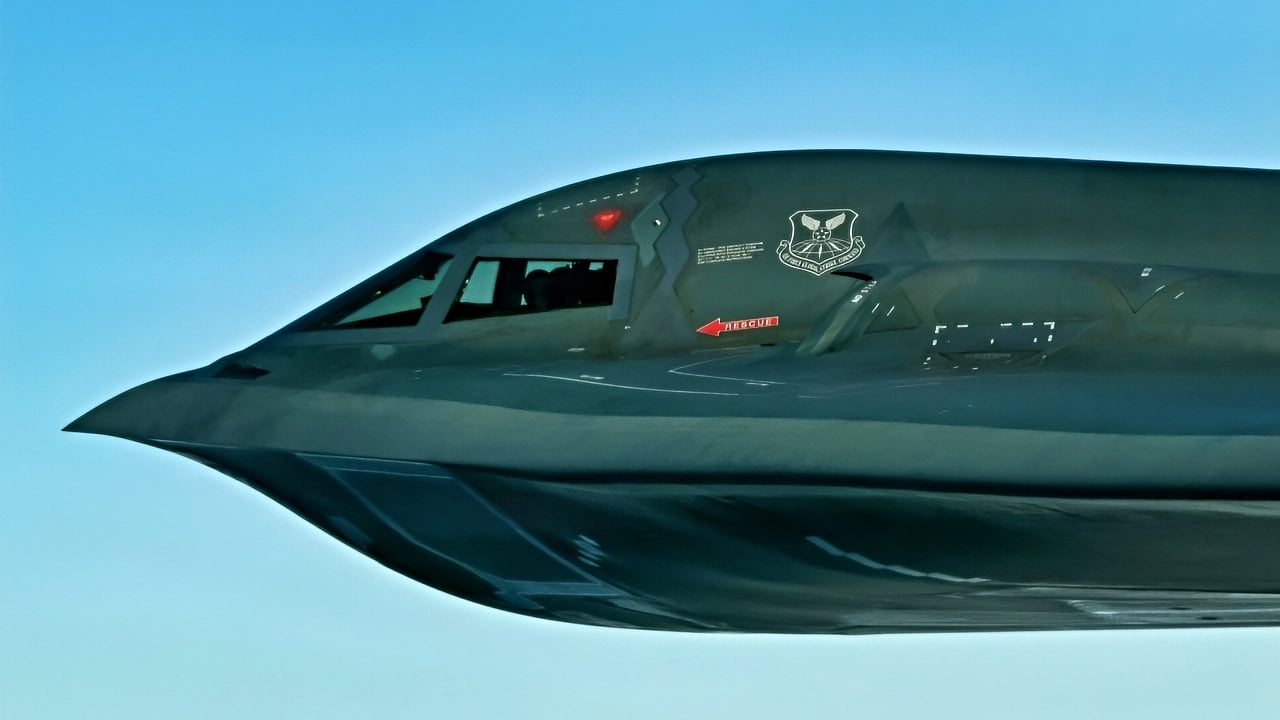
A U.S. Air Force B-2 Spirit conducts an integrated maritime strike training exercise with U.S. Navy F-35C Lightning II and F/A-18E Super Hornets from Carrier Air Wing Eleven (CVW-11) off the coast of California, on Feb. 10-11, 2026. Practicing innovative methods to employ and integrate strategic bombers like the B-2 with Navy carrier strike groups enhances combat capabilities through synchronized, integrated power projection. (U.S. Navy photo by Katie Archibald)
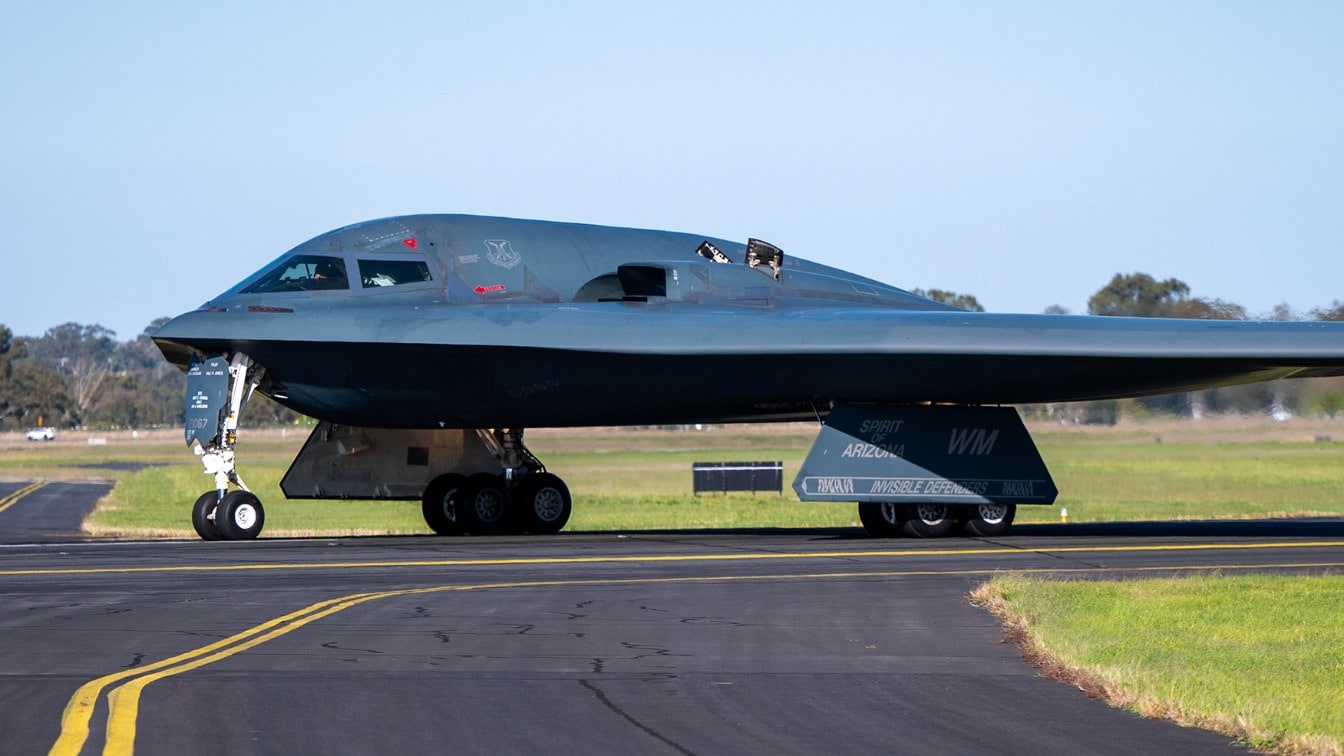
A U.S. Air Force B-2 Spirit stealth bomber arrives after a Bomber Task Force mission at Royal Australian Air Force Base Amberley, Australia, Sept. 5, 2024. U.S. Indo-Pacific Command routinely and visibly demonstrates commitment to its allies and partners through the employment of military forces, demonstrating strategic predictability, while becoming more operationally unpredictable to adversaries. (U.S. Air National Guard photo by Staff Sgt. Whitney Erhart)
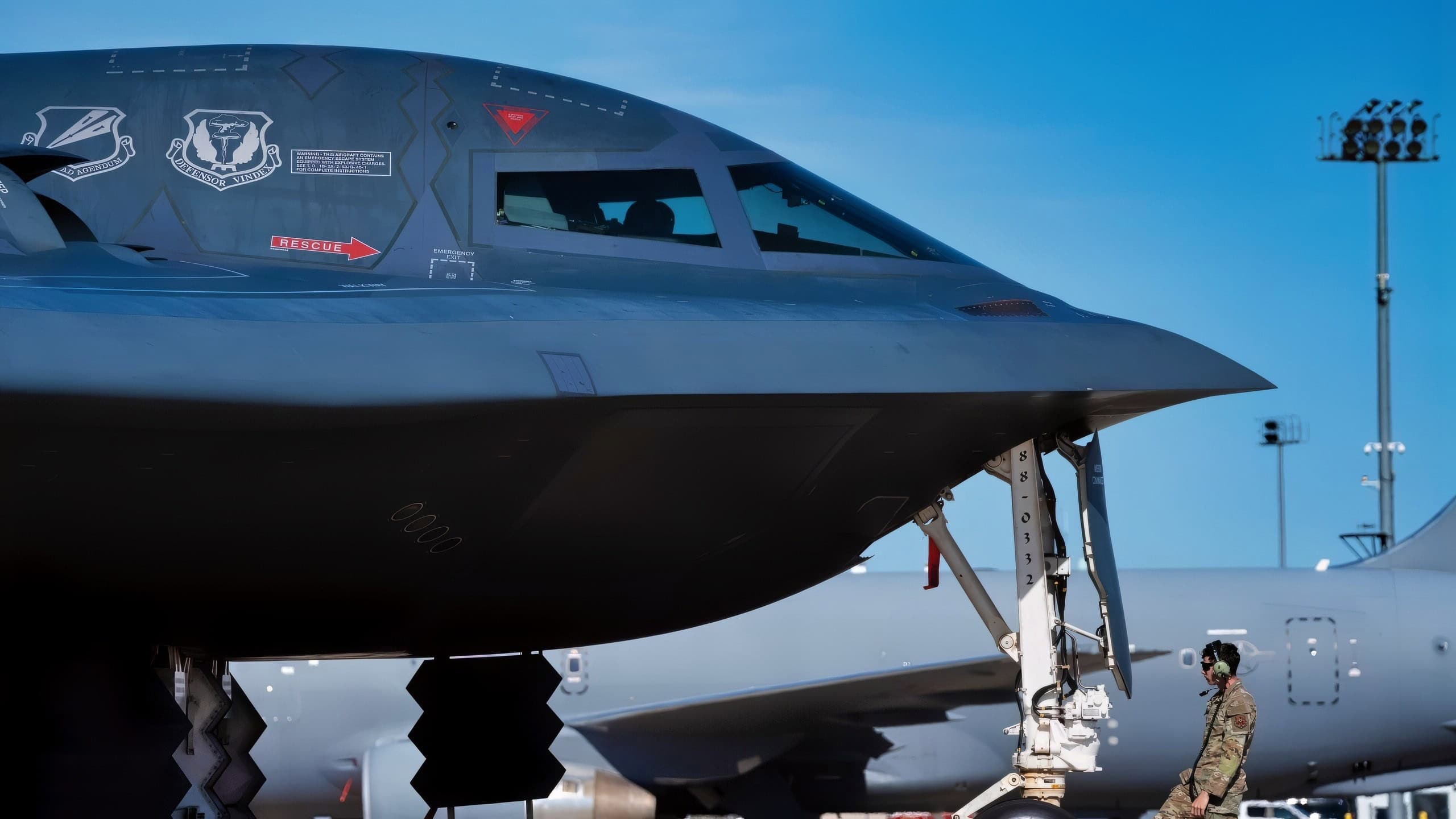
U.S. Air Force Staff Sgt. Hunter Kaloci, 393rd Bomber Generation Squadron crew chief, adjusts a wheel chock in front of a parked B-2 Spirit aircraft at Pease Air National Guard Base, New Hampshire, Sept. 20, 2025. The 393rd BGS provides worldwide combat capability by planning and conducting all aspects of on-aircraft maintenance, launch and recovery of B-2 aircraft in direct support of Joint Chiefs of Staff nuclear and conventional taskings. (U.S. Air Force photo by Staff Sgt. Joshua Hastings)
The specific mission that Jingqi allegedly hacked took place on March 1, 2026, when the United States Air Force deployed four B-2A Spirit stealth bombers—operating under the call signs Petro 41 to Petro 44—in the opening phase of the bombing campaign. The following day, the Jingan mouthpieces shared a social media post stating that Jingqi had picked up radio transmissions from the returning B-2 bombers and reconstructed the Spirits’ flight path using its proprietary technology.
Claim Credibility Questions
Of course, as is true of any claim emanating from a Communist country—even an ostensibly private sector company within that Communist country—these claims must be taken with a grain of salt. For one thing, from reading the article, there’s no indication that the Jingan execs offered any solid proof (no “smoking gun,” if you will) of their supposed achievement, e.g., actual audio recordings or transcriptions from the B-2 drivers’ radio comms.
Then there’s this: “Even before that point, in January, the company’s system had found evidence that the U.S. was amassing its largest military buildup in the Middle East in almost two decades. As the SCMP noted, this deployment even surpassed the one seen during the Iraq war.”
Okay, so how exactly is that Earth-shattering news or some mind-blowing testament to Jingan Technology’s capabilities? The American buildup in the Persian Gulf wasn’t exactly a secret (“hiding in plain sight,” as the saying goes), as it was widely publicized in Western media, including Fox News and other outlets. Instead of being lauded as some major open-source intelligence (OSINT) coup, this one should instead be filed under “Thank You, Captain Obvious!”
What’s more, this isn’t the first time that ChiComs have boasted about stealth-busting detection technologies. Roughly 11 months ago, researchers from the Changchun Institute of Optics, Precision Mechanics, and Physics in China claimed they had developed a system capable of tracking the F-35 Lightning II stealth fighter. Supposedly, this system could pick up the intense heat signature of the F-35’s Pratt & Whitney F135 engine, using high-altitude drones equipped with infrared sensors, backed by China’s BeiDou satellite network (their version of GPS), and thus detect an F-35 from over 1,100 miles away.
Thus far, this claim has not been independently verified. In the meantime, neither that claim nor this latest allegation about B-2 radio comms being compromised passes the proverbial “smell test.” If and when either of those claims is actually proven, I’ll have the rueful humility to admit that I’m wrong…but I’m not holding my breath in the meantime.
About the Author: Christian D. Orr
Christian D. Orr is a Senior Defense Editor. He is a former Air Force Security Forces officer, Federal law enforcement officer, and private military contractor (with assignments worked in Iraq, the United Arab Emirates, Kosovo, Japan, Germany, and the Pentagon). Chris holds a B.A. in International Relations from the University of Southern California (USC) and an M.A. in Intelligence Studies (with a concentration in Terrorism Studies) from American Military University (AMU). He is also the author of the newly published book “Five Decades of a Fabulous Firearm: Celebrating the 50th Anniversary of the Beretta 92 Pistol Series.”