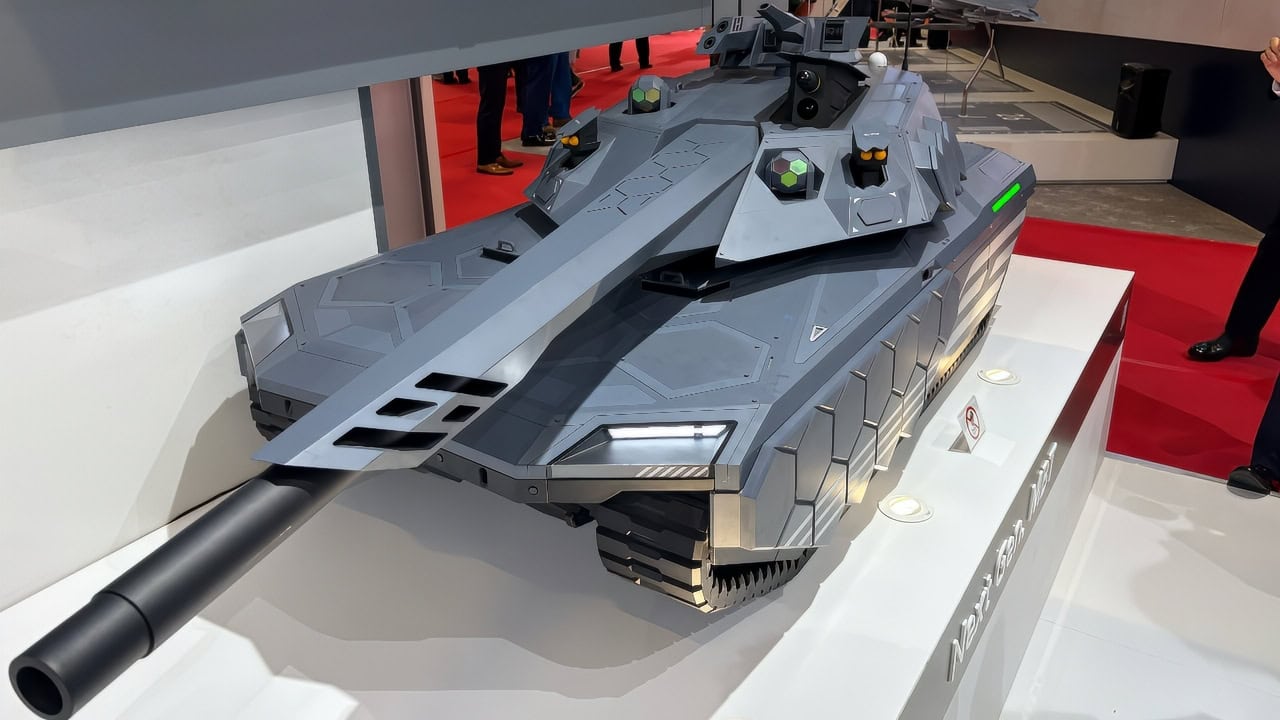
Summary and Key Points: Drawing on his expertise as a Senior National Security Editor and defense consultant, author Brandon J. Weichert examines South Korea’s radical leap in armored warfare: the K3 Next-Generation Main Battle Tank.
-Developed by Hyundai Rotem and the Agency for Defense Development, this fifth-generation MBT abandons traditional diesel-and-steel designs for a hydrogen fuel-cell powertrain and a blended stealth hull reminiscent of the B-21 Raider.
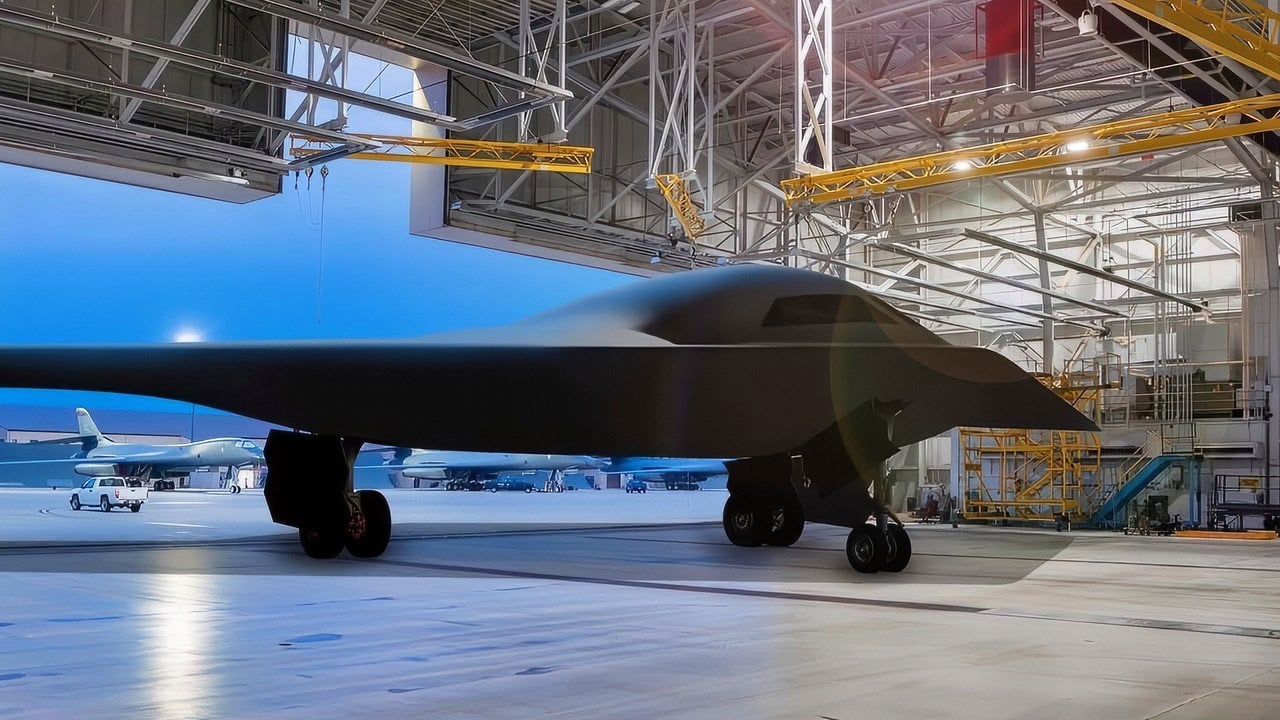
Artist rendering of a B-21 Raider in a hangar at Ellsworth Air Force Base, South Dakota, one of the future bases to host the new airframe. AFCEC is leading a $1 billion construction effort at Ellsworth to deliver sustainable infrastructure to meet warfighter demands for bomber airpower. (U.S. Air Force graphic)
-Armed with an unmanned turret, a 130mm smoothbore cannon, and AI-assisted targeting, the K3 aims for a 2040 deployment.
-Weichert argues this drone-launching platform exposes the sluggishness of the U.S. defense industrial base, which remains stuck debating incremental Abrams upgrades.
The Hydrogen-Powered K3: Inside South Korea’s 5th-Generation Stealth Tank
For decades, the United States and its allies assumed that the main battle tank (MBT) had reached something close to its final form. The Abrams, Leopard-2, Challenger, and Leclerc defined armored warfare for a generation. Incremental upgrades followed, but the basic formula remained the same: diesel engines, heavy steel composite armor, large crews, and brute-force firepower defined these systems.
South Korea is betting that this formula is obsolete.
The Republic of Korea’s defense industry is developing the K3 Next-Generation Main Battle Tank, a radically new design that combines hydrogen propulsion, stealth shaping, artificial intelligence, and unmanned systems into what may be the first true fifth-generation tank. If the K3 enters service as planned around 2040, it could redefine armored warfare just as stealth aircraft redefined modern air combat.
A Tank That Looks More Like a Stealth Bomber
One of the first things observers notice about the K3 is its appearance. Unlike traditional tanks with sharp angles and exposed turret structures, the K3 uses a smooth, blended hull-and-turret design reminiscent of the United States Air Force’s B-21 Raider long-range stealth bomber.
This is not merely cosmetic.
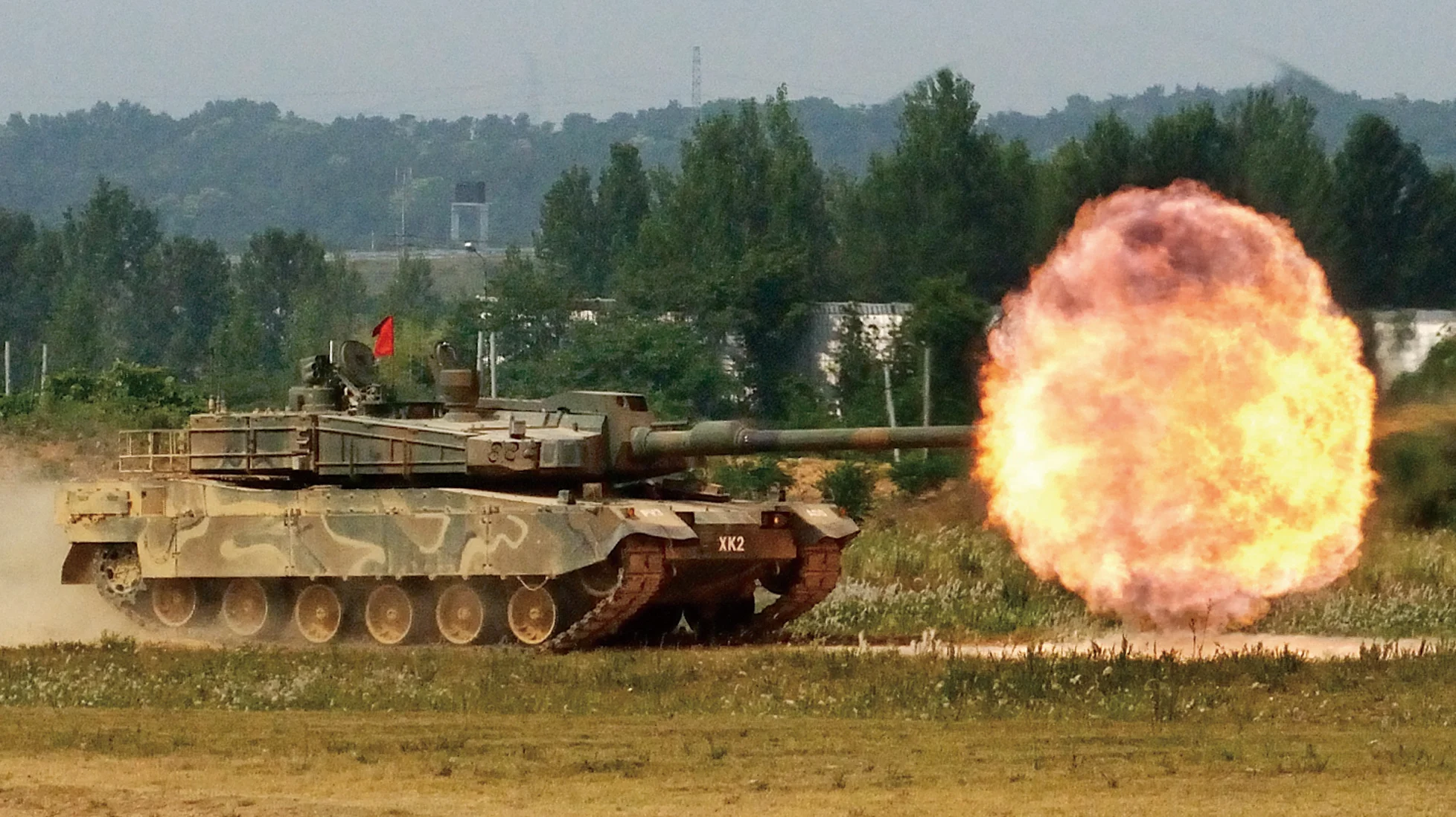
K2 Black Panther, the most expensive tank on Earth.
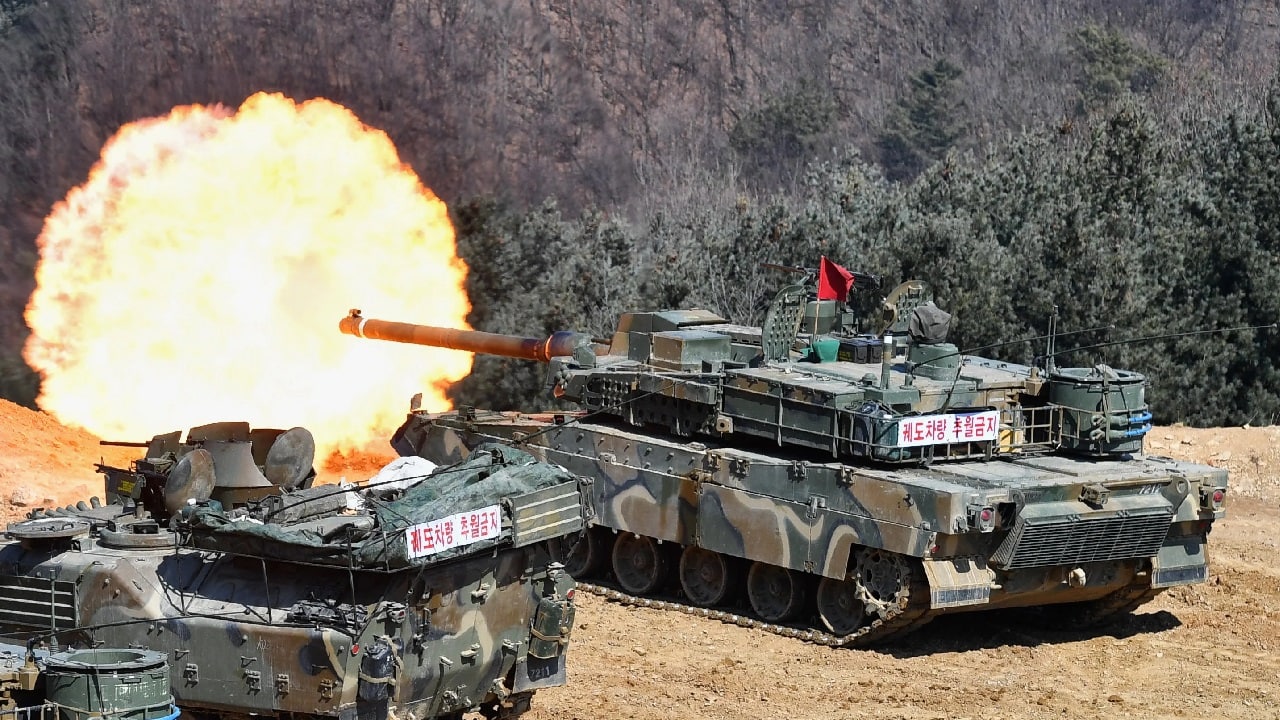
K2 Black Panther. Image Credit: Creative Commons.
The shaping, along with radar-absorbent materials and thermal management systems, is intended to reduce the tank’s radar, infrared, and acoustic signatures—an increasingly critical capability on a battlefield saturated with drones and sensors.
Modern tanks no longer need to worry only about rival tanks on the battlefield.
Satellites, loitering munitions, anti-tank missiles, and swarms of unmanned aerial vehicles (UAVs) all define the threats that tanks today must survive. South Korean engineers have assessed that a quieter, cooler-running vehicle will be harder for enemy anti-tank units to detect.
Hydrogen Power: The Quiet Revolution
The K3’s most radical feature is its propulsion system.
Rather than relying on diesel engines, the K3 MBT is designed to use a hydrogen fuel-cell hybrid powertrain, eventually transitioning to full hydrogen propulsion once the technology matures.
Early variants will likely combine diesel and hydrogen systems, but the long-term goal is a fully electric drive powered by fuel cells.
The approach in question offers several important advantages, including lower heat signatures, reduced engine noise, improved fuel efficiency, and greater electrical power for sensors and weapons. In the age of infrared targeting and persistent drone surveillance, a quieter tank equals a more survivable—and dominant—tank.
Hydrogen propulsion will provide the electrical capacity needed for future systems, such as directed-energy weapons (DEWs), advanced sensors, and autonomous operation.
Projected K3 Tank Specs
While the K3 remains under development, publicly released data gives a sense of its intended capabilities. It is built by Hyundai Rotem and South Korea’s Agency for Defense Development.
The K3 is designed to carry a crew of three (a driver, commander, and gunner). It has an unmanned turret with an autoloader.
There is a 130mm smoothbore cannon as the tank’s main gun, too. A secondary 30mm remote weapon station is also available.
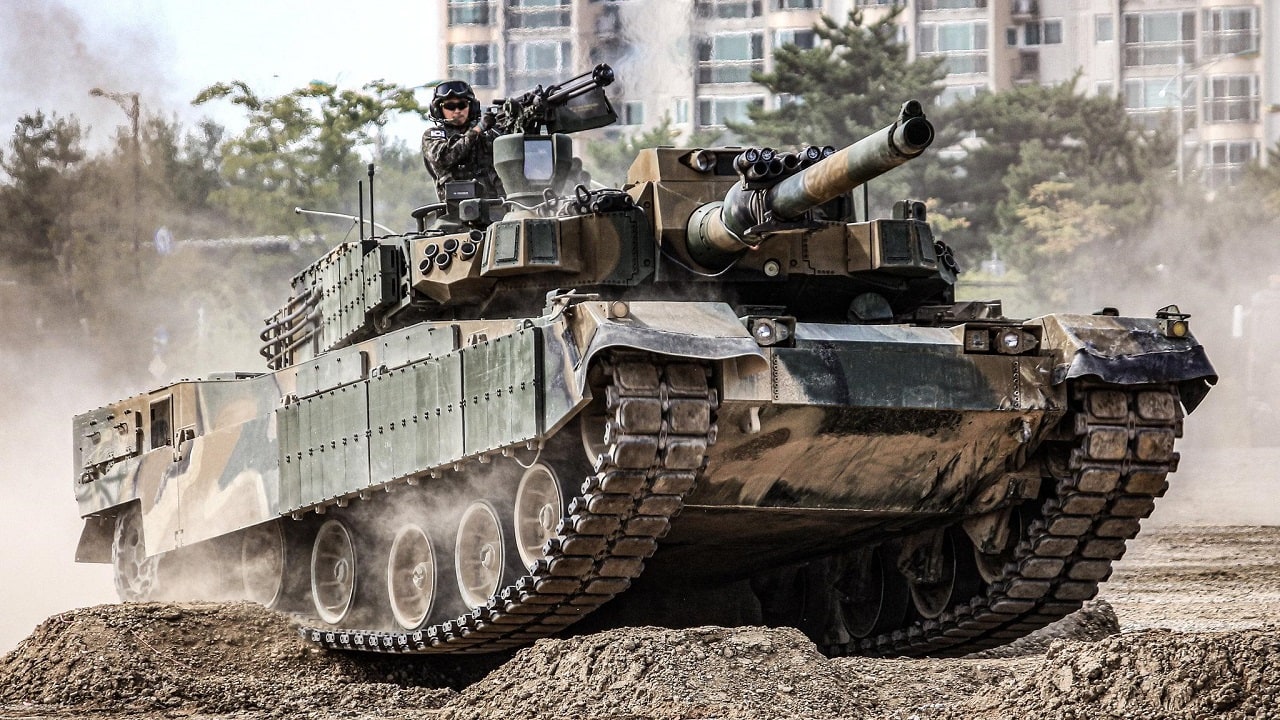
K2 Black Panther. Image Credit: Creative Commons.
Additionally, the K3 is designed to carry anti-tank guided missiles (ATGMs), loitering munitions, and will have UAV launch capabilities.
As noted above, the powerplant for the K3 is a dynamic hybrid diesel-electric engine with a hydrogen fuel cell. Additionally, Hyundai fantasizes about achieving full hydrogen power by around 2040.
The hull has an armored capsule to protect troops. Beyond that, the K3 has modular composite armor, APS, IR countermeasures, and drone jammers.
In terms of fire control, there is AI-assisted targeting and long-range engagement up to 5 miles (give or take).
All these features paint the K3 MBT less as a conventional tank and more as a mobile, armored, mobile combat system.
Why South Korea is Moving Faster Than the West
South Korea’s rapid innovation in armored vehicles should surprise no one. Unlike the United States, which must maintain a global force structure, South Korea faces a single, existential threat from North Korea. That really forces Seoul to focus relentlessly on survivability, mobility, and technological age.
Besides, South Korea has already demonstrated the approach with the K2 Black Panther, one of the most advanced tanks in the world, and is now pushing even further with the K3.
Meanwhile, the US is still debating incremental upgrades to the Abrams while experimenting with hybrid propulsion concepts that remain years away from deployment.
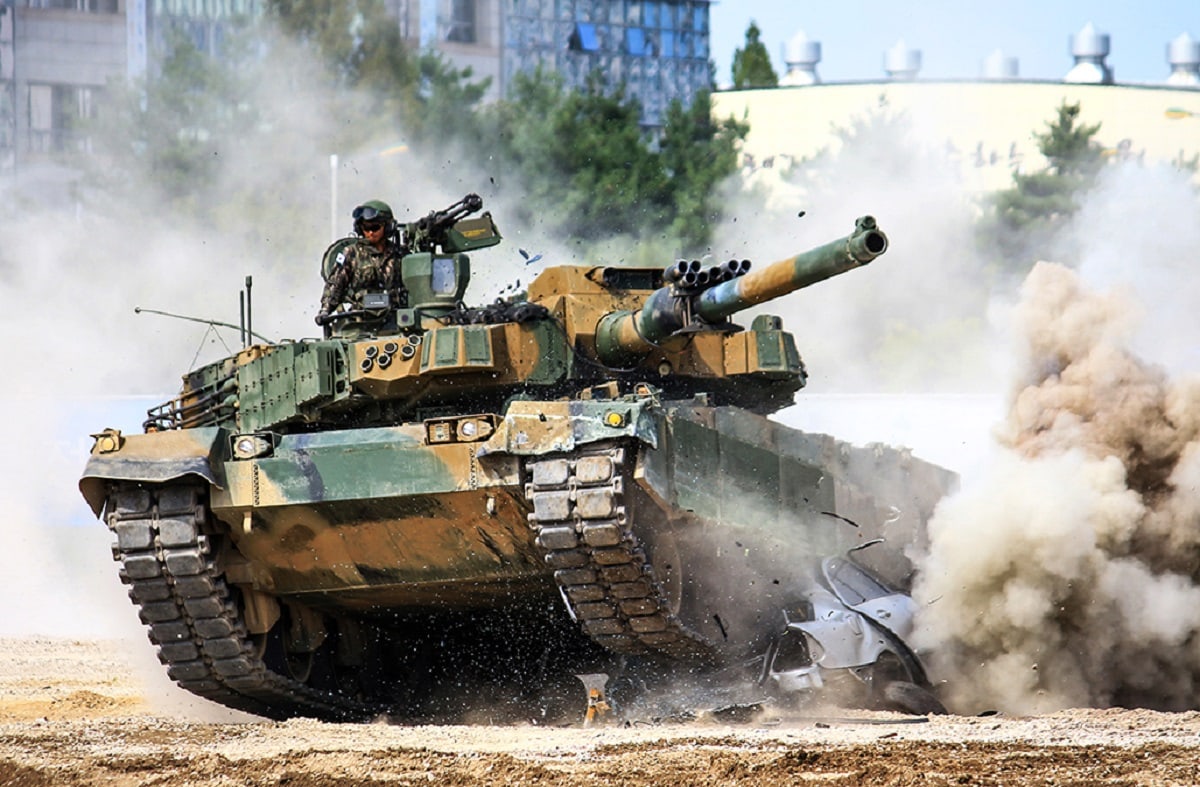
K2 Black Panther. Image: Creative Commons.
The Real Lesson for the United States
The K3 program highlights a defense industry in the United States that is completely broken. Programs in the US defense department drag on for decades, costs spiral, and by the time a new system arrives, the battlefield has already changed.
South Korea, by contrast, is designing a tank for the world of 2040—not 1991.
The world will be defined by persistent surveillance, drone swarms, precision strikes, electronic warfare, energy-intensive weapons, and networked combat.
A hydrogen-powered stealth tank may sound futuristic.
But the real question is whether the United States can afford to build something like it.
About the Author: Brandon J. Weichert
Brandon J. Weichert is the Senior National Security Editor at 19FortyFive.com. Recently, Weichert became the editor of the “NatSec Guy” section at Emerald.TV. He was previously the senior national security editor at The National Interest. Weichert is the host of The National Security Hour on iHeartRadio, where he discusses national security policy every Wednesday at 8pm Eastern. He hosts a companion show on Rumble entitled “National Security Talk.” Weichert consults regularly with various government institutions and private organizations on geopolitical issues. His writings have appeared in numerous publications, among them Popular Mechanics, National Review, MSN, and The American Spectator. And his books include Winning Space: How America Remains a Superpower, Biohacked: China’s Race to Control Life, and The Shadow War: Iran’s Quest for Supremacy. Weichert’s newest book, A Disaster of Our Own Making: How the West Lost Ukraine, is available for purchase wherever books are sold. He can be followed via Twitter/X @WeTheBrandon.