
Britain Wanted an Aircraft Carrier Out of Ice in World War II. It Almost Worked.
Dear readers, please don’t let that title fool you. This is neither a science fiction story nor a Cold War-era action thriller.
Nope, the notion of an aircraft carrier made of ice predated the Space Age. It was hatched during World War II, and was given the catchy name of Operation Habbakuk. The craziest part was that it almost actually worked!
What’s In a Name?
Persons of Judeo-Christian faith and ancient history buffs alike will associate the Habbakuk moniker with the Old Testament Book of Habakkuk, which is the eighth book of the so-called Twelve Minor Prophets of the Hebrew Bible, most likely written during the reign of Jehoiakim as king of Judah (609–598 BC).
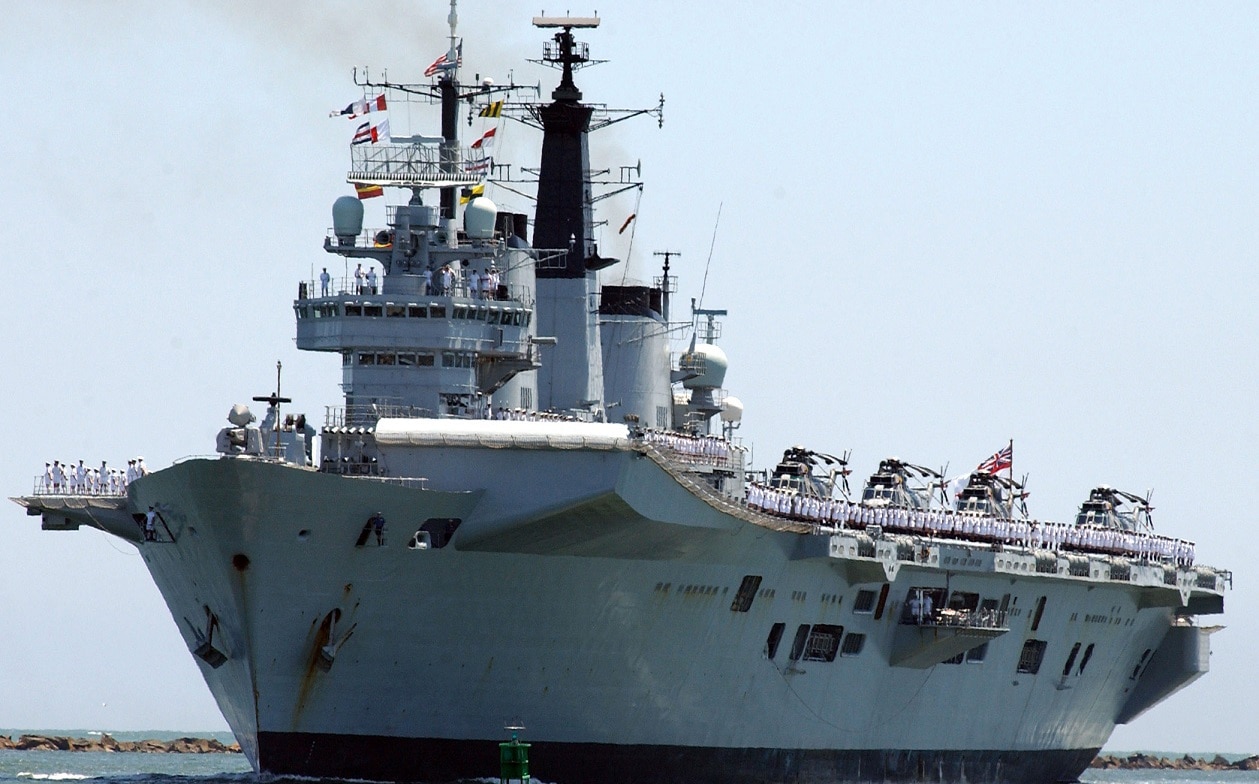
Naval Station Mayport, Jacksonville, Fla. (May 20, 2004) – Her Majesty’s Ship HMS Invincible (R05) arrives in Jacksonville, Fla., for a five-day port visit before continuing on to Norfolk, Va., and New York city. Invincible, is the sixth ship of the Royal Navy to bear the name and the first of the Invincible Class of Anti-Submarine Warfare Carriers. U.S. Navy photo by Photographer’s Mate 2nd Class Charles E. Hill (RELEASED)
Project Habbakuk: Where It Began
Ancient Israel was a decidedly non-Arctic region, so one has to wonder how the Old Testament prophet’s name became the name for such a quirky project as a giant ice cube aircraft carrier.
Stephen D. Lutz of Warfare History Network shed some light on that nomenclature in a September 2011 article:
“A quirky Englishman came up with a plan for a 2.2 million ton aircraft carrier. Her weight would have been overwhelmingly of manmade ice called pykrete. Geoffrey Pyke named his fantasy Project Habakkuk, a biblical reference to its ambitious goal: … ‘be utterly amazed, for I am going to do something in your days that you would not believe, even if you were told’ (Habakkuk 1:5, NIV). … This quirky Englishman, perhaps best described as a cross between Albert Einstein and Howard Hughes, offered Winston Churchill his solution to stemming Nazi U-boat successes across the North Atlantic in late 1942.”
Yes, you read that correctly: 2.2 million tons.
To put that in perspective, the British and American flattops of World War II typically had a displacement between 20,000 and 30,000 tons.
For further perspective, the world’s largest aircraft carrier, and the largest warship ever constructed— the supercarrier USS Gerald R. Ford (CVN-78)—displaces a measly 100,000 tons.
Promise and Premise of Pykrete
The premise of Pyke’s proposal was a gargantuan carrier that would be virtually unsinkable, and thus would be an ideal floating fortress for guarding mid-Atlantic shipping routes.
As for the chief ingredient of pykrete, Neil Taylor of the Alberta Aviation Museum describes it as “a mix of 15 per cent wood pulp and 85 per cent water, that was stronger than concrete, resistant to thawing and largely immune to heavy blows (as might be inflicted by a torpedo).
Yet amazingly, it could be easily molded into different forms and shaped by saw or wood plane.”
Pyke floated the idea to Lord Louis Mountbatten, Chief of Combined Operations. Lord Mountbatten was a champion of unorthodox thinking, so instead of dismissing the proposal as totally crazy, he actually passed it up the chain of command … all the way up to Prime Minister Winston Churchill himself.
Indeed, Mountbatten went so far as to demonstrate pykrete’s unique characteristics and potential by floating a block of the material in the Prime Minister’s bathtub. Churchill was sufficiently impressed by the audacity of the plan that he called for construction of a pykrete aircraft carrier 2,000 feet long and 300 feet wide, with a draft of 150 feet, and capable of carrying 200 fighter planes and 100 twin-engine bombers.
“O Canada…”
Neither the U.S. Navy brass nor the British Admiralty shared Mountbatten’s and Churchill’s enthusiasm for the project. So instead, the Canadian government was approached to determine both the feasibility and cost of a “bergship.”
The project was assigned to Dr. C. J. Mackenzie of the National Research Council.
He was initially skeptical, regarding it as “another of those mad wild schemes” from the crazy Brits, but nonetheless kept a sufficiently open mind and proceeded with the research, enlisting assistance from Western educational institutions, including the University of Alberta.
Dr. Mackenzie conducted his ice testing at Lake Louise (part of Banff National Park), but, given the secretive nature of the project, quickly decided that a less visible locale was needed. Accordingly, he chose Patricia Lake, because it was already closed to the public for ski paratrooper training.
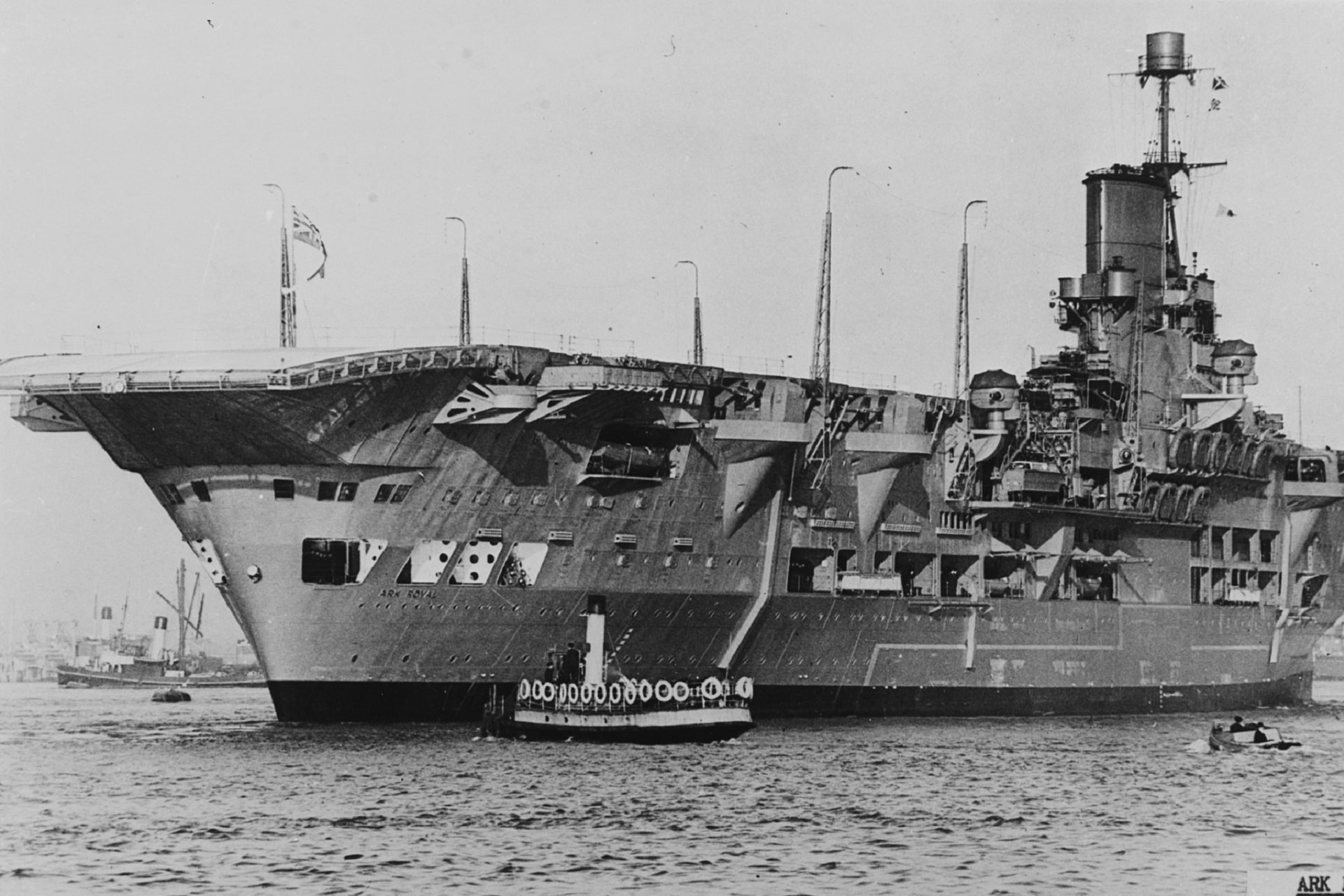
Ark Royal’s flight deck overhung the stern. Her unusual height above the waterline is visible in comparison with the tugboat.
It also was close to rail facilities, and laborers were readily available from a nearby camp for conscientious objectors.
From there, work on the ice test model began in mid-February 1943, when a patch of the frozen lake was cleared of snow, and wooden framing and flooring was erected. The first layer of ice was laid on the flooring the following month, and by that summer, a scale model measuring 60 feet long and 30 feet wide, weighing 1000 tons, and kept frozen by air circulation from a 1-horsepower motor was completed.
In order to provide for a convenient cover story, the entire test model was covered by a roof giving the test site the appearance of a boat house.
At first, it looked like the project might succeed, as the test model did float.
So, What Went Wrong?
Well, several things.
For one thing, there was the proposed coolant system—a brine coolant circulated through ducts in the pykrete hull. It was so complex that it would require piping throughout the icy structure, doubling or tripling construction costs.
In addition, a whopping 300,000 tons of wood pulp would be required to produce the necessary quantities of pykrete, inflicting severe strain on the pulp and paper sector.
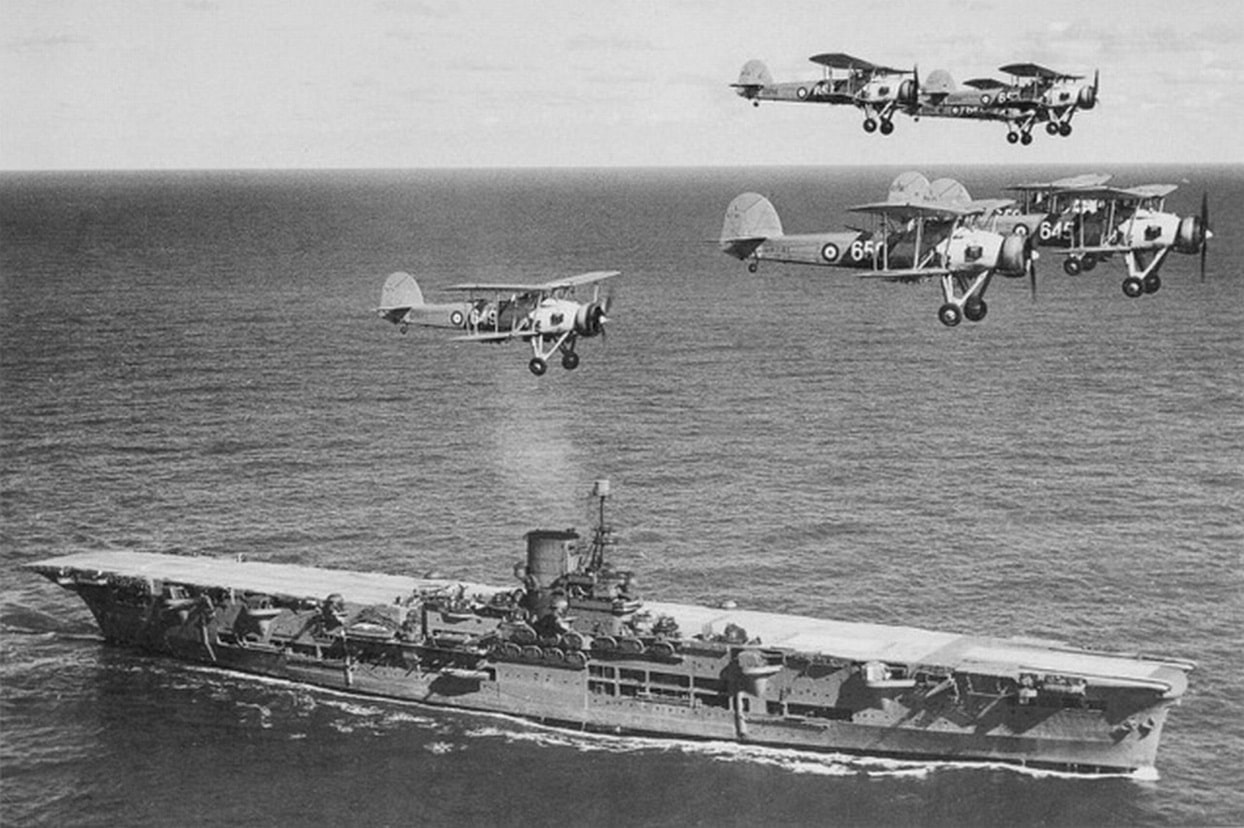
Photo # NH 85716 – British aircraft carrier Ark Royal with a flight of “Swordfish” overhead, circa 1939. Courtesy of Donald M. McPherson, 1977.
Moreover, the march of time and technology rendered the project moot: the introduction of longer range patrol aircraft (such as the Short Sunderland) with improved radar detection capabilities had eliminated the “Atlantic gap” and reduced the number of merchant shipping losses. By mid-May 1943, the Kriegsmarine’s Unterseerboote were ordered to leave the mid-North Atlantic, thus signifying Nazi Germany’s defeat in the Battle of the Atlantic.
Thus it came to pass that this plan came to a halt in June 1943. There were some lingering signs flagging support for the project at the August 1943 Quebec Conference involving Churchill, FDR, and then-Canadian Prime Minister William Lyon Mackenzie King, but that was the proverbial dead duck bounce, and by October 1943 that duck was indeed essentially dead.
The test model on Patricia Lake had been abandoned over the summer, but it lingered another year before it finally melted and inauspiciously sank to the bottom of the lake.
Where Is It Now?
As noted by Mr. Taylor in the concluding paragraph of his writeup, “Today, metal piping and asphalt strewn across the lake bottom are all that remain of the would-be aircraft carrier. Divers can visit the wreckage, and a commemorative plaque along the shoreline of Patricia Lake memorializes one of Canada’s more unusual wartime projects.”
O Canada, o what might have been.
About the Author: Christian D. Orr
Christian D. Orr is a Senior Defense Editor. He is a former Air Force Security Forces officer, Federal law enforcement officer, and private military contractor (with assignments worked in Iraq, the United Arab Emirates, Kosovo, Japan, Germany, and the Pentagon). Chris holds a B.A. in International Relations from the University of Southern California (USC) and an M.A. in Intelligence Studies (with a concentration in Terrorism Studies) from American Military University (AMU). He is also the author of the newly published book “Five Decades of a Fabulous Firearm: Celebrating the 50th Anniversary of the Beretta 92 Pistol Series.”