
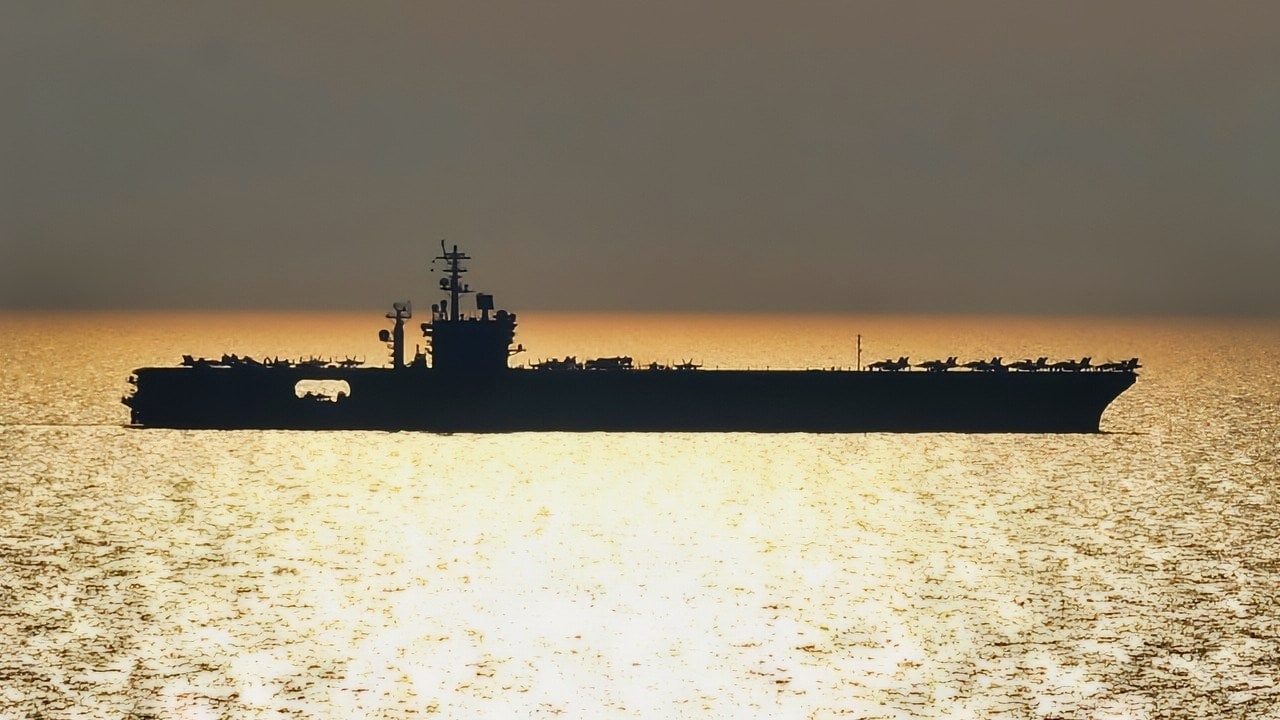
CVA-68: The U.S. Navy’s Bomber Aircraft Carrier That Never Made It Out To Sea
The USS United States (CVA-58) was a proposed aircraft carrier that would have been truly special.
But CVA-58 wasn’t meant to serve as a supercarrier in the way that modern supercarriers, like the Ford or Nimitz, were. Rather, CVA-58 was designed as a “bomber carrier,” a distinct purpose and key distinction from contemporary supercarriers.
So instead of being designed to launch lots of small fighters, CVA-58 would have launched a few very large aircraft, equipped with nuclear bombs.
And, for many reasons as we will see, it didn’t exactly work out.
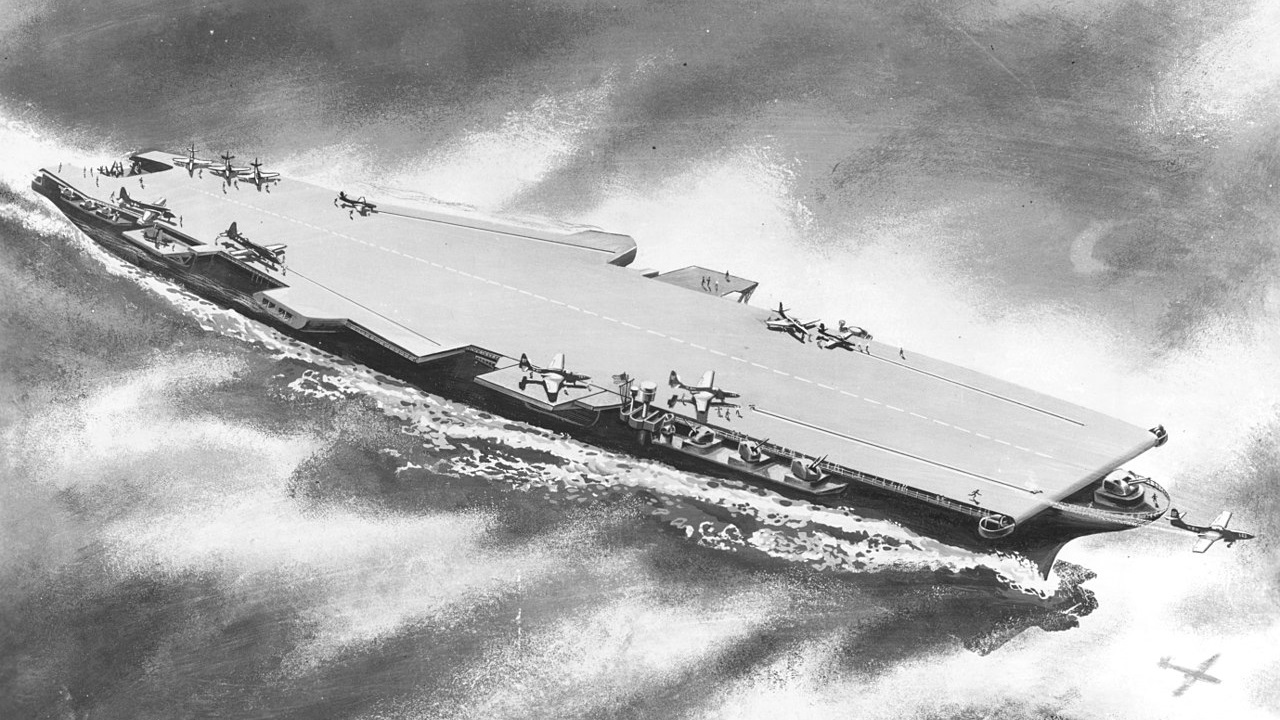
Artist’s conception of the U.S. Navy aircraft carrier USS United States (CVA-58) by Bruno Figallo, October 1948, showing the ship’s approximate planned configuration as of that time. Many details, among them the location of smoke stacks, elevators and the retractable bridge, were then still not finally decided. This carrier was laid down at Newport News, Virginia (USA), on 18 April 1949 and cancelled by the Secretary of Defense a few days later.
Why This Existed
After World War II, the US was grappling with the recent and most consequential weapons development: the nuclear weapon.
While effective strategic tools, early nukes presented operational problems because the bombs were so large (multi-ton), requiring large bombers to deliver.
The Air Force used strategic bombers to deliver nuclear weapons.
But the Navy wanted a sea-based nuclear strike capability. The proposal? A floating nuclear bomber base, the designs for which would become CVA-58.
Different Breed
CVA-58 was distinct from its contemporaries in the 1940s. Whereas normal WWII carriers had fighters, dive bombers, and torpedo planes, generating a high sortie rate, the CVA-58 concept carried huge nuclear bombers, generating a low sortie—but—each sortie offered a strategic-level strike.
The estimated cost of the program was $189 million. In 2026 dollars, this is about $2 billion. CVA-58 would have been one of the largest carriers ever conceived at the time, and the cost reflects that.
Designed around hypothetical bombers fielded in the 1952-1960 timeframe, these aircraft would have weighed up to 100,000 pounds and carried 5-ton nuclear weapons. So, the carrier would have been designed for aircraft that didn’t yet exist, adding an extra wrinkle to the project.
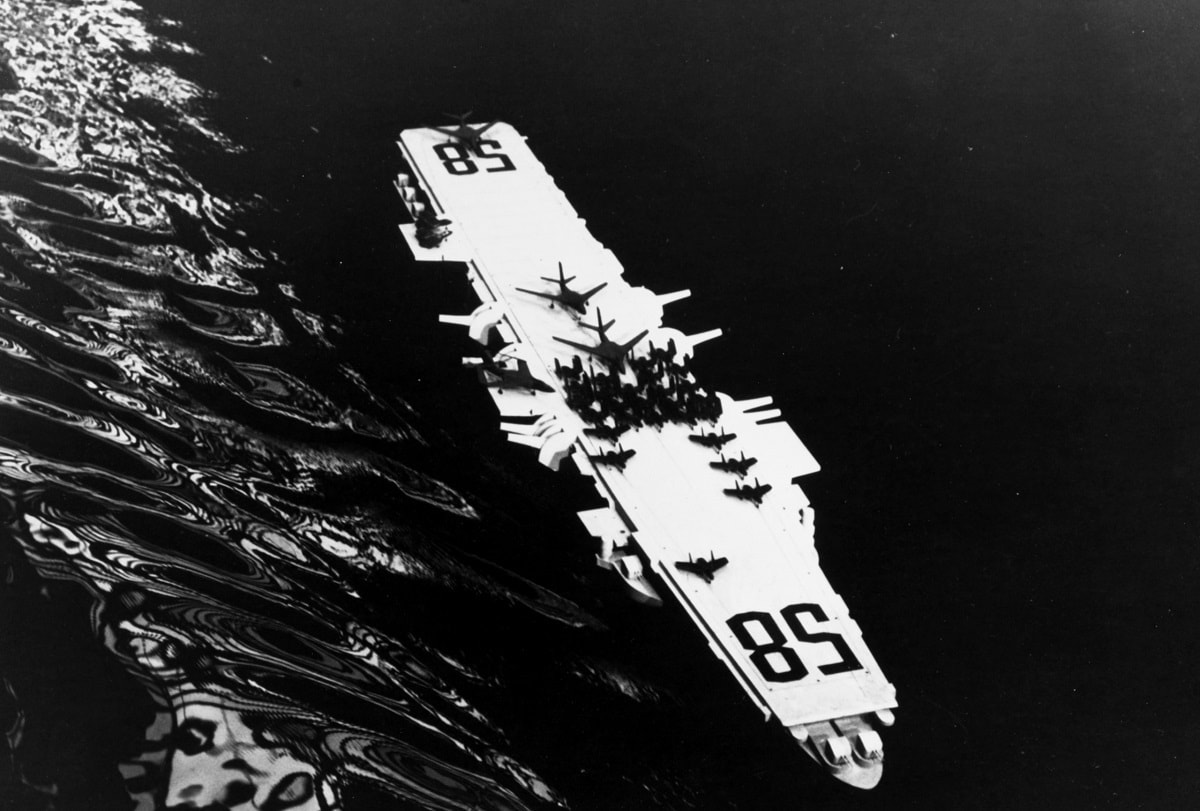
A preliminary design model of the proposed U.S. Navy aircraft carrier USS United States (CVA-58) undergoing seakeeping tests at the David Taylor Model Basin, Carderock, Maryland (USA), circa 1947. This is an early version of the CVA-58 design, without catapult sponsons. Note the folding smokestacks in the down position, as they would have been during flight operations. Aircraft models on the flight deck appear to represent the Vought F7U Cutlass fighter and a notional heavy attack bomber.
Because CVA-58 was geared for bombers, which are too large for rapid cycling, and too few for sustained operations, the sortie rate would have been small. Whereas WWII carriers produced dozens of sorties per hour, CVA-58 would have produced only a handful.
The Design Logic
CVA-58 would have looked quite weird. For starters, the deck was island-less and flat. Why? Heavy bombers would have needed maximum space to accommodate their massive wingspans, so removing the island was necessary. The tradeoff would have been that carrier operations would have been more difficult.
CVA-58 also featured a strengthened flight deck because the aircraft aboard would have been far heavier than those of WWII.
The implication is that the ship would have been top-heavy, likely leading to stability issues, which wouldn’t have been ideal in the open ocean.
Similarly, to accommodate such large bombers, CVA-58 would have featured limited hangar space; the bombers would have spent more time sitting on the deck. Why? Because they were too big to move easily, like fighters, which are small enough to move between the deck and hangar on elevators.
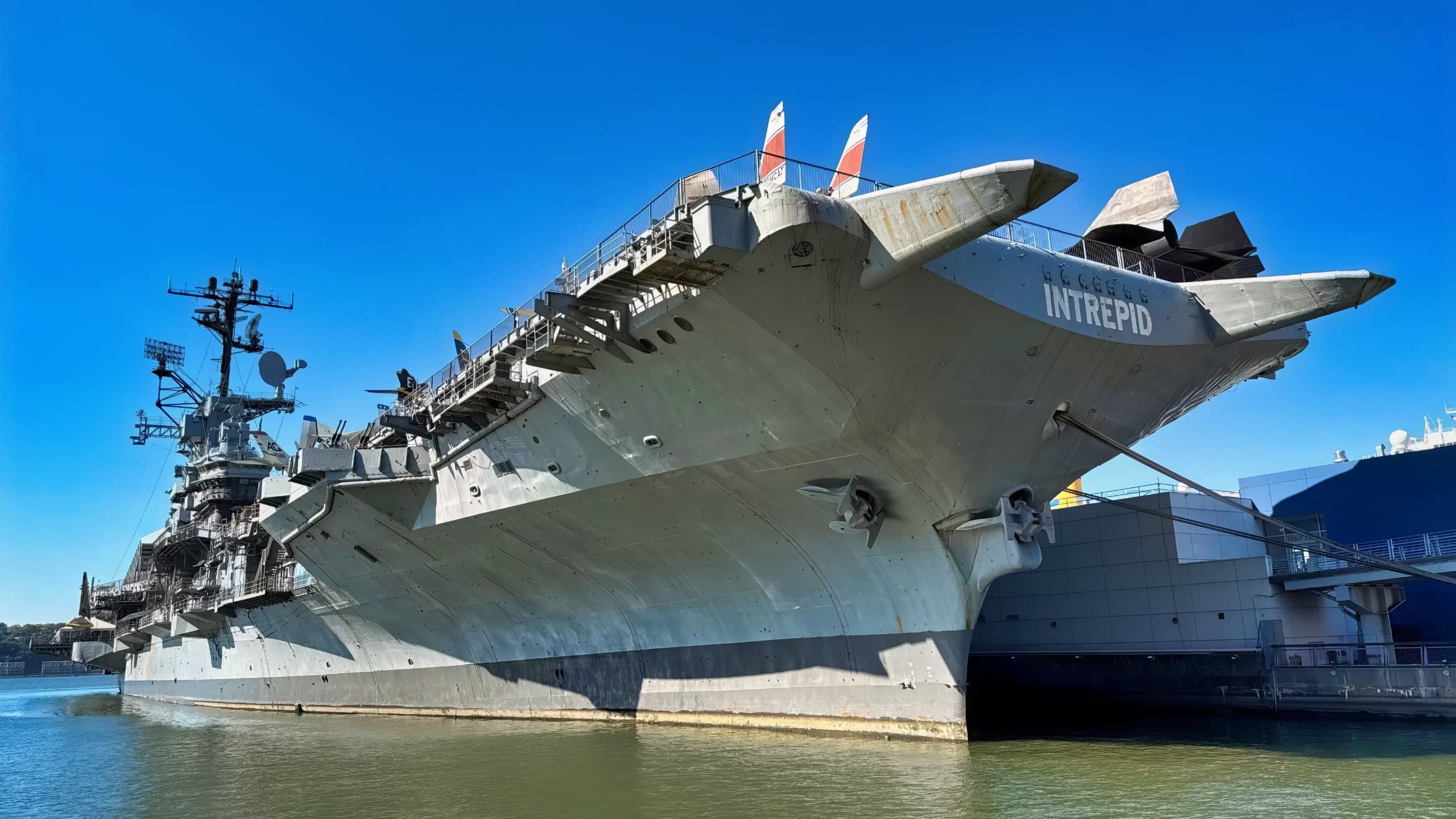
Essex-Class USS Intrepid 19FortyFive.com Photo
CVA-58 would have needed four catapults to launch the extremely heavy bombers. Catapults are complicated machines, so having four aboard would have complicated day-to-day operations and maintenance, etc.
And importantly, CVA-58 would not have been self-sufficient.
It would have required escort carriers, loaded with fighter aircraft, as well as separate radar/command ships, to compensate for the removal of the island.
The Mission Set
CVA-58’s primary mission would have been to deliver nuclear strikes from the sea. Today, submarines fill that role, but in the 1940s, the ability to launch a nuclear warhead from a submarine didn’t exist yet, hence the CVA-58.
Secondarily, CVA-58 would have offered limited air support and sea control. But realistically, CVA-58 would have been first and foremost, and almost exclusively, about delivering nuclear weapons.
CVA-58 would have been, arguably, over-specialized, designed entirely around a nuclear strike mission.
To operate effectively, the CVA-58 would have needed escort carriers and command ships and fighter cover; CVA-58 would have not been able to operate independently.
This inefficiency—a huge platform with a limited sortie generation rate and a massive cost per strike—was a problem. And, of course, the platform’s strategic risk was enormous; if the ship were destroyed, it would have meant the loss of an entire strike capability in one blow. The Air Force, meanwhile, had a distributed bomber fleet that was more flexible and harder to eliminate.
Why It Got Cancelled
CVA-58 was cancelled in 1949. At the time, the US was cutting its military budget.
The Air Force was arguing that they already had long-range bombers (the B-36), which were much cheaper and more efficient than a specialized aircraft carrier; the Air Force argued that the Navy was duplicating the B-36s mission, only in a wasteful, more complicated manner.
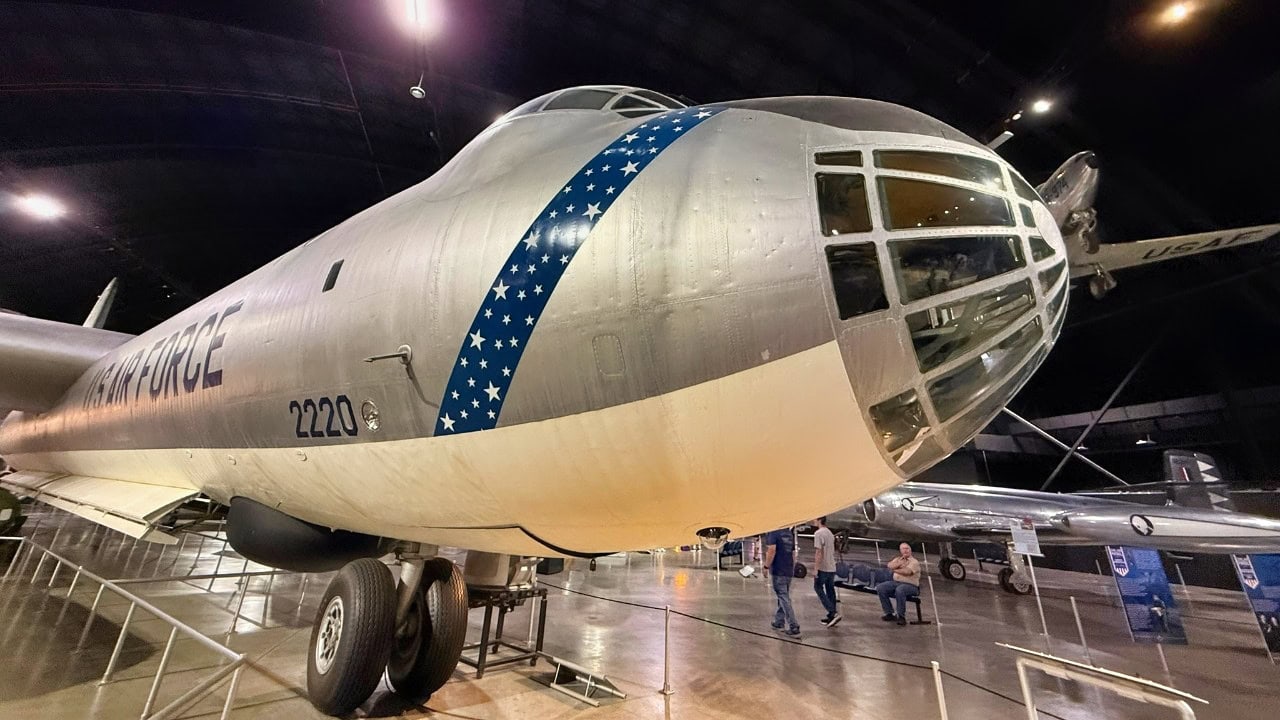
B-36 Bomber 19FortyFive Image.
So, five days after the keel was laid, the program was cancelled.
The Navy did not take the cancellation quietly. Rather, senior Navy leadership publicly rebelled. Military officers publicly criticized civilian leadership. Careers were destroyed. The CNO, Admiral Louis Denfield, was forced out.
That may seem like a drastic response and fallout for a cancelled ship. But the response wasn’t about a ship—it was about which service branch controlled nuclear war.
And CVA-58’s cancellation meant that the Air Force, not the Navy, would control nuclear war, a decision with ramifications that persist today.
Granted, today the Navy has submarine-launched ballistic missiles, representing the sea-based component of the nuclear triad. But the Air Force possesses the other two legs and is generally more closely associated with the execution of the nuclear mission.
But backing up a step—why did the Navy lose? Early nuclear doctrine favored a centralized strategic bombing concept.
In the late 1940s, the Air Force had political momentum and a much simpler concept (land-based bombers). But the Navy was right about something: fixed airbases, from which the Air Force based their strategic bombers, were vulnerable to attack in a way that mobile aircraft carriers were not.
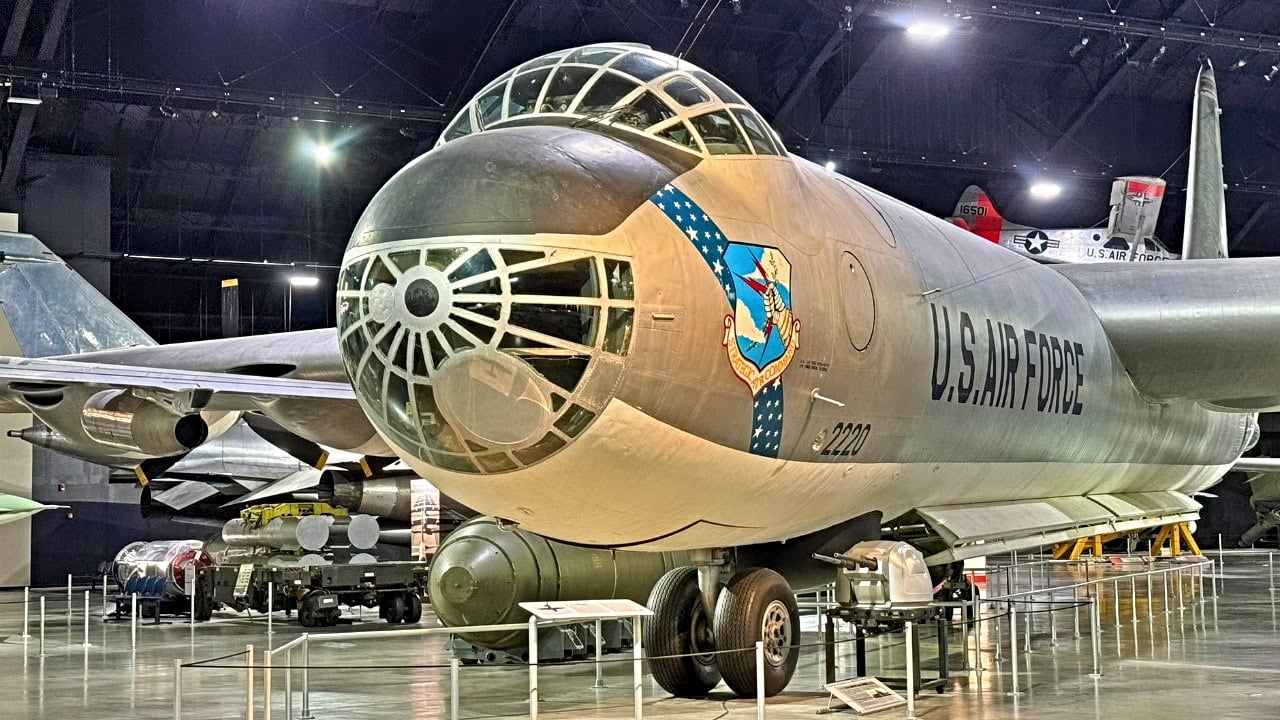
B-36. 19FortyFive.com image.
Evolution of the Idea
But with the 1950s and the outbreak of the Korean War, the need for naval aviation was concretely demonstrated. Within months of CVA-58s cancellation and the resultant fallout, the Navy was validated.
The Pentagon recognized that carriers were essential, and importantly, the Navy figured out how to deploy nuclear weapons from existing carriers, simplifying the process drastically, eliminating the need for the clean-sheet development of a dedicated nuclear-strike-enabling carrier.
The Navy pivoted; instead of a giant bomber carrier, the idea evolved into what would become the modern supercarrier, with flexible air wings featuring a mixture of fighters, strike aircraft, EW, and ISR. The impacts on warfare were long-term.
Carriers became multi-role, not just nuclear delivery devices but full-spectrum power projection tools.
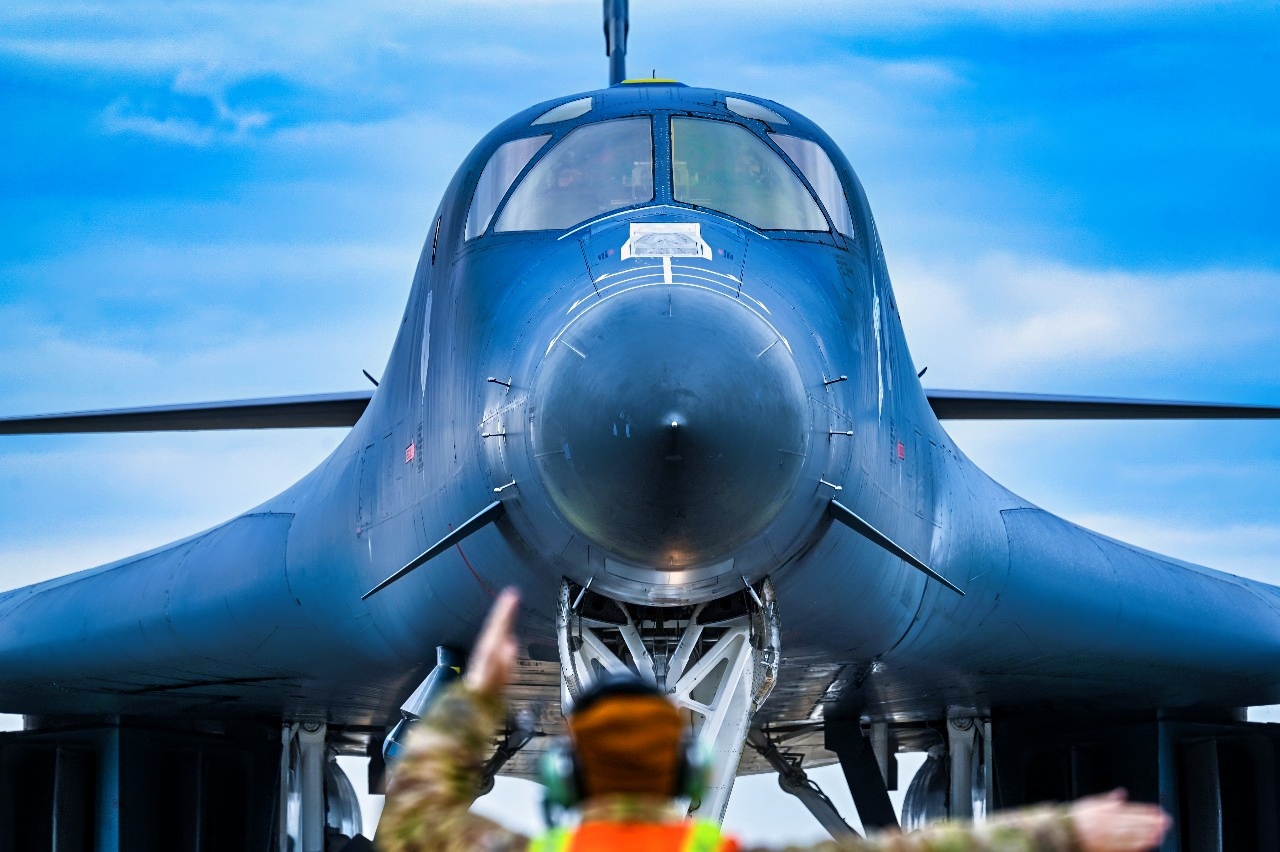
An Airman assigned to the 9th Expeditionary Bomb Squadron marshals a B-1B Lancer, preparing for take off during Bomber Task Force 25-2 at Misawa Air Base, Japan, May 3, 2025. BTF 25-2 is a demonstration of Allied strength, unity, and commitment to global security. By projecting force, reinforcing strong partnerships, and showing our unwavering resolve, it aims to deter aggression and uphold peace and stability in the Indo-Pacific region and beyond. (U.S. Air Force photo by Airman 1st Class Mattison Cole)
The Air Force kept the strategic bombing lane—with the B-52, B-1, and B-2—but a division of labor emerged. The Air Force took over strategic strike; the Navy accepted forward presence and a more tactical strike role.
Today, the central concept of CVA-58 lives on: the Navy can deliver massive firepower worldwide.
But that ability is enhanced by precision-guided weapons, networked targeting, and smaller warheads. So CVA-58 failed as an individual platform, but it arguably succeeded as an idea, albeit a modified idea.
About the Author: Harrison Kass
Harrison Kass is an attorney and journalist covering national security, technology, and politics. Previously, he was a political staffer and candidate, and a US Air Force pilot selectee. He holds a JD from the University of Oregon and a master’s in global journalism and international relations from NYU.