
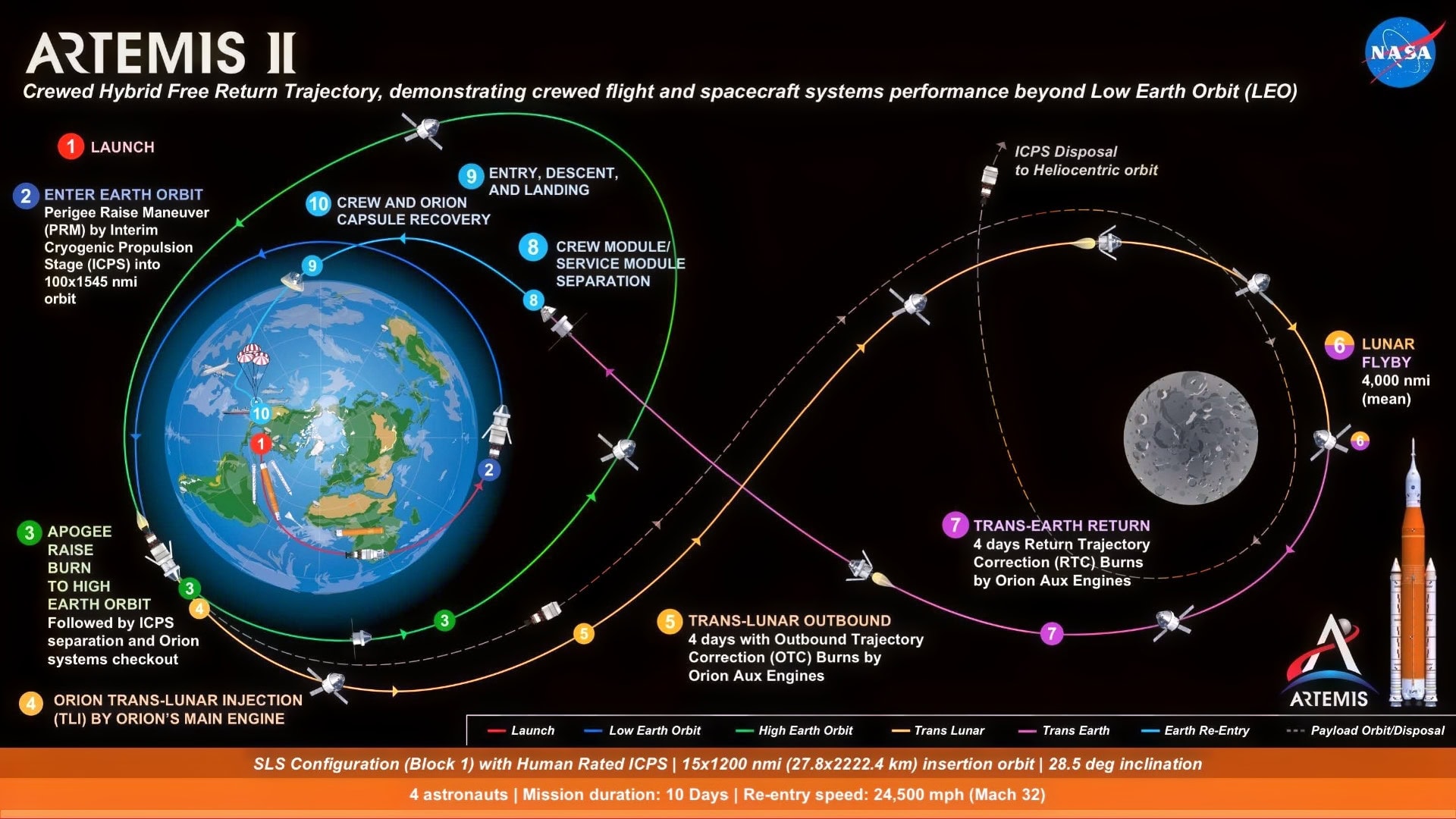
Four astronauts are hours from splashing down after circling the far side of the Moon. There’s a helium leak on board that turned out to be 10 times worse than anyone predicted — and tonight’s 25,000 mph reentry will show if that matters.
The Artemis II mission has gone surprisingly well. Despite some early issues with the toilets on board, the mission has gone off without a hitch prior to the anticipated splashdown on Friday evening in the Pacific Ocean.
The three American and one Canadian astronauts, Reid Wiseman, Victor Glover, Christina Koch, and Jeremy Hansen, are scheduled to land off the coast of San Diego after the mission that took them to the far side of the Moon aboard the Orion spacecraft, named Integrity.
However, another issue will require some redesign work after they return home. Helium is leaking inside the propulsion system, and it’s leaking faster than anyone predicted.
Canceled Manual Flight Testing Due To Helium Leak:
NASA had planned for the astronauts to take manual control of Integrity in a piloting demonstration on Wednesday night.
However, that demonstration was scrubbed due to a “small helium leak.” Jeff Radigan, NASA’s lead flight director for the Artemis II mission, stated that the spacecraft uses helium to force hydrazine fuel and its oxidizer, nitrogen tetroxide, into the spacecraft’s rocket engines.
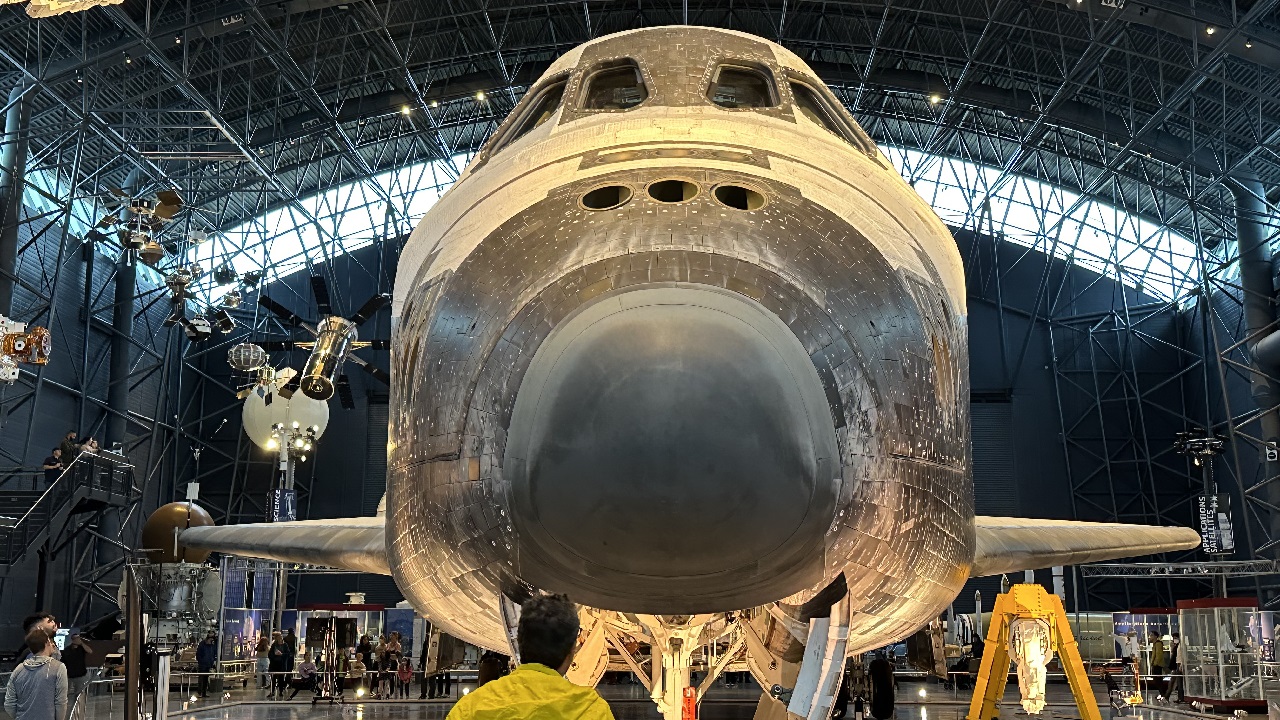
NASA Space Shuttle Discovery. Image Credit: 19FortyFive.com taken on October 1, 2022.
“The leak is not to space. It’s internal to the system across some of our valves, and we really need to characterize that to see what, if any, modifications we might need to make in the future,” Radigan said.
The Helium Leak Poses No Risk To The Astronauts:
NASA officials were quick to point out that the leak, located within the European Service Module’s propulsion system, poses no risk to the crew or the reentry sequence.
NASA associate administrator Amit Kshatriya said that engineers were aware of a low-level helium leak before Orion’s launch. And a similar leak had appeared during the uncrewed Artemis I flight in 2022.
Managers, however, cleared the spacecraft to fly because it followed a “free return trajectory,” was so close to preflight predictions, and would use the Moon’s gravity to slingshot Orion back toward Earth without needing complex orbital maneuvers. Full propulsion capability was never required.
The midcourse burns that have occurred were all low-impulse maneuvers using the service module’s smaller thrusters, which don’t require the helium system to recharge pressure.
However, the in-flight data revealed something engineers hadn’t anticipated. Kshatriya noted that the leak was larger than NASA had anticipated.
“The leak rate we saw in flight is now an order of magnitude higher than what we saw on the ground. It’s still acceptable, but that will lead us to probably an extensive redesign of that valve system,” he said.
Because the Service Module is jettisoned and burns up during re-entry into the atmosphere, NASA engineers worked to troubleshoot the issue in space to characterize the leak before the hardware was lost.
Kshatriya confirmed that the gathered data will likely lead to an extensive valve redesign for the Artemis IV mission, which will require full system pressurization for lunar orbit insertion.
Artemis III Won’t Return To The Moon:
Under a revised plan announced by NASA earlier this year, Artemis III will not travel to the Moon but will instead fly in low Earth orbit.
The Artemis III mission will launch a crew in the Orion spacecraft atop the SLS (Space Launch System) rocket to test rendezvous and docking capabilities between Orion and commercial spacecraft, which are needed to land astronauts on the Moon.
NASA will announce specifics on the Artemis III mission design and crew closer to the planned 2027 launch.
The tests in Earth orbit will pave the way for Artemis IV, NASA’s first attempt to put humans on the lunar surface since 1972.
Kshatriya said Artemis IV is when NASA must have new helium valves ready to go. “I don’t need those valves to hold pressure in the same way for a LEO [low-Earth orbit] orbiting mission, but for a lunar orbit mission, I do,” he said.
Artemis II Timeline For Earth Re-entry:
The spacecraft is slated to enter Earth’s atmosphere at approximately 25,000 mph, initiating a critical sequence in which the heat shield must withstand temperatures approaching those of the Sun’s surface.
“Every system we’ve demonstrated over the past nine days—life support, navigation, propulsion, communications—all of it depends on the final minutes of flight,” said Kshatriya. “The crew has done their part. Now we have to do ours.”

Shuttle Discovery at National Air and Space Museum on October 1, 2022. Image Credit: 19FortyFive.com

NASA’s Space Shuttle Discovery. Image Taken by 19FortyFive.com on October 1, 2022.
Radigan provided a detailed timeline for the spacecraft’s re-entry:
7:33 p.m. ET: The Crew Module and Service Module will separate.
7:53 p.m. ET: Orion enters the communication blackout period as plasma builds around the capsule.
8:03 p.m. ET: Drogue parachutes will deploy.
8:04 p.m. ET: The three main parachutes deploy.
8:07 p.m. ET: Splashdown in the Pacific Ocean off the coast of San Diego.
About the Author: Steve Balestrieri
Steve Balestrieri is a National Security Columnist. He served as a US Army Special Forces NCO and Warrant Officer. In addition to writing on defense, he covers the NFL for PatsFans.com and is a member of the Pro Football Writers of America (PFWA). His work was regularly featured in many military publications.