
As the Iran war grinds on, the administration of US President Donald Trump has cast around for rationales to justify US bombing. The president has bounced among explanations, including regime change, security of US regional allies, denial of an Iranian nuclear weapon, and now, increasingly, the opening of the Strait of Hormuz.
The most defensible has always been that this is a preventive strike on Iran to block its incipient nuclearization. Changing the regime’s politics and returning the Strait of Hormuz to a fully international waterway – without Iran charging tolls – would likely require a ground invasion.
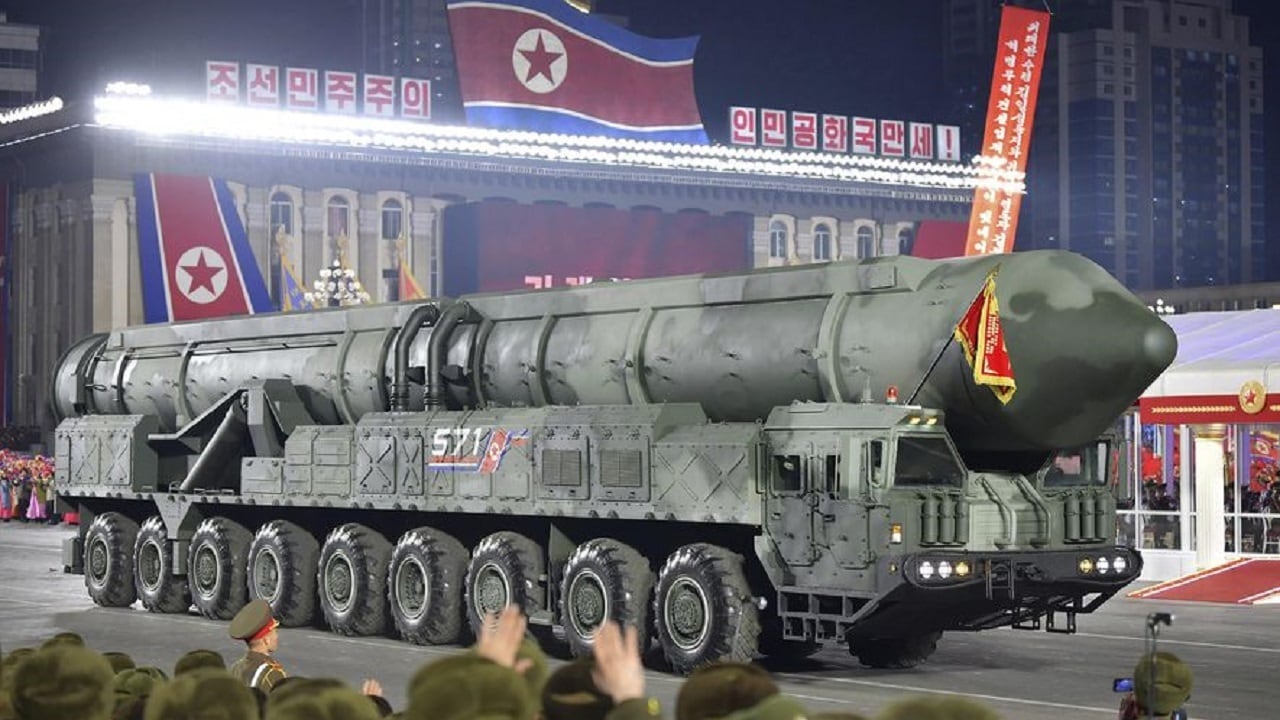
Image Credit: KCNA/North Korean Government.
But preventing Iran from emerging as the North Korea of the Middle East – a rogue state using nuclear weapons as a shield to make trouble – is a robust argument with roots in strategic theory.
But the argument for this position on Iran misses why a preventive strike on North Korea was never conducted.
Launching a preventive war against Iran has long been more feasible than doing so against North Korea, because our local allies in the Middle East supported it, while our local allies in northeast Asia were wary, if not outright opposed.
Preemption vs Preventive War
A preemptive strike or war is one in which one country attacks when it has immediate, highly credible information that another country will attack it shortly. The would-be defender moves first; it pre-empts the imminent attack. War almost always gives the first mover an advantage, especially in the modern era of airpower. The best-known recent pre-emptive attack is Israel’s first move against Egypt in the Six-Day War.
This is widely considered legitimate if the looming attack is real. South Korean defense strategy – the Three Axis System – includes a preemptive airstrike option if North Korea is surveilled fueling its missiles. More controversial – what South Korea has repeatedly blocked – is a preventive strike.
Preventive war strikes an opponent who may eventually become a major threat, but is not an imminent one.
The 2003 Iraq War was arguably preventive. Iraq was not an immediate threat. But the George W. Bush administration argued that it would become one.
Striking a gathering threat like that is controversial. A far-off threat might be remediated by diplomacy or otherwise contained.
A preventive war can easily appear offensive and can provoke the very war it is intended to prevent.
In the North Korean case, South Korea has always been deeply wary that America would launch, over its head, a preventive war against Pyongyang. South Korea has always insisted that its consent is required for such a war, as the costs would fall mostly on Seoul.
An Allied Veto in Northeast Asia; Allied Assent in the Middle East
The US came close to striking North Korea three times in the last four decades – in 1994, 2003, and 2017. 1994 was the most feasible. In 1994, the North was not nuclear, and the US was not distracted by other wars.
In 2003, Bush became tied down in the Middle East, despite putting North Korea on the ‘axis of evil.’ He could not risk a preventive strike on Pyongyang that would spiral into another major war.

North Korea Hwasong-17 ICBM. Image Credit: Creative Commons.
In 2017, Trump entertained a ‘bloody nose’ strike on North Korea, but by then, North Korea had nuclear weapons. So the potential consequences of even a mild US strike could have been disastrous.
But President Clinton could have struck North Korea in 1994. There was some build-up of US forces in the region to do so. North Korea was clearly interested in going for nukes and preventively hitting them before they crossed that line – much as the US is doing now in Iran – was attractive.
The drift toward war, however, was halted when former president Jimmy Carter uninvitedly interjected himself to fly to Pyongyang to negotiate, putting the Clinton team on the spot to back down.
But behind the scenes, the real problem was South Korean reticence. And that is the difference with Iran today, where US allies Israel and the Gulf states support the strikes. More formally put, local US allies who will carry the costs of a preventive war will also have an informal veto over US action.
This will not be admitted publicly, of course. The US will never publicly accept limits on its freedom of action.
But to strike without allied consent would strain the relationship, as the allies would be left with huge, unwanted costs due to brash American action.
Ironically, allied assent in the Gulf today may be a problem for Trump. He clearly wants an exit, while US allies want him to finish the job.
Author: Dr. Robert Kelly, Pusan National University
Dr. Robert E. Kelly is a professor of international relations in the Department of Political Science and Diplomacy at Pusan National University in South Korea. His research interests focus on Security in Northeast Asia, U.S. foreign policy, and international financial institutions. He has written for outlets including Foreign Affairs, the European Journal of International Relations, and the Economist, and he has spoken on television news services such as the BBC and CCTV. His personal website/blog is here; his Twitter page is here.