Summary and Key Points: Dr. Bruce E. Bechtol Jr., a political science professor and proliferation expert, evaluates the strategic partnership between Iran and North Korea.
-Despite reports downplaying the threat, Bechtol analyzes evidence of the transfer of an 80-ton rocket booster—the core of the Hwasong-15 ICBM—from Pyongyang to Tehran.
-This 19FortyFive report highlights how entities like the Korea Mining Development Company likely facilitate the exchange of RD-250 engine technology.
-Bechtol concludes that as Operation Epic Fury targets conventional launchers, the destruction of Iran’s ICBM-capable infrastructure is vital for U.S. national security, given the Hwasong-15’s 8,000-mile range.
The Rogue Alliance: Why North Korea’s Hwasong-15 Technology is the Hidden Heart of Iran’s ICBM Program
Since the war with Iran began last weekend, there has been a great deal of spin by various analysts and pundits in the press about the threat Iran presents to the region and to the United States. Included in this “analysis” have been assessments—largely in the press—declaring Iran does not have an ICBM program that could threaten the United States now, is not even close, and (even more importantly), has the capability to develop such a program in only the most abstract sense.
The most active press service beating this drum over and over again, citing “unnamed Pentagon sources,” is CNN, which has repeatedly stated this is not a real threat. These reports are decidedly untrue.
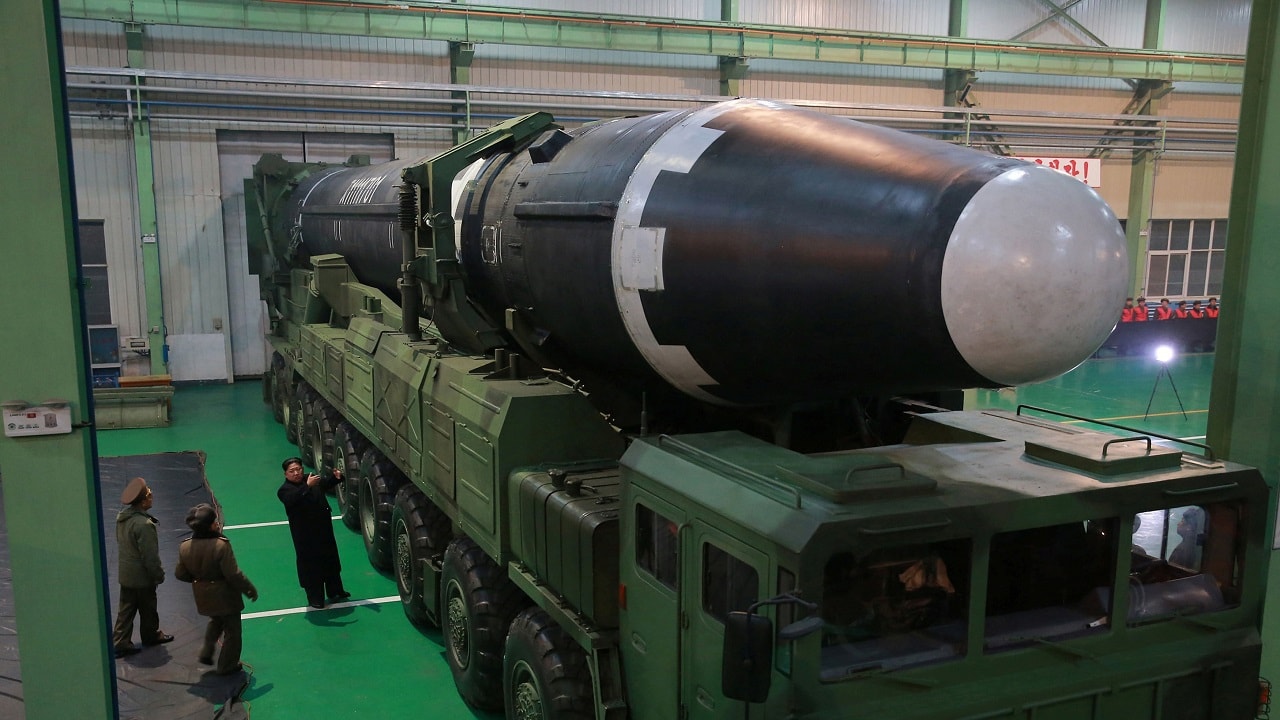
North Korean leader Kim Jong Un near Hwasong ICBM. Image Credit: North Korean State Media.
Further, reports in past years, as this program has been developing, downplay the proliferation and assistance that North Korea has provided to build this program, are not only factually lacking but also dangerous for anyone trying to assess threats from both North Korea and Iran reasonably.
I will address specific evidence—in detail—in this report.
ICBM Program Claims
While pundits in the press can certainly be criticized for not doing in-depth research instead of just relying on “unnamed Pentagon sources,” much of this has been pushed by scholars who have an agenda—that there is not any important proliferation going on between North Korea and Iran (and hasn’t since the 1980s), that the Iranian and North Korean threats are both over-hyped, and that their research needs to support that narrative.
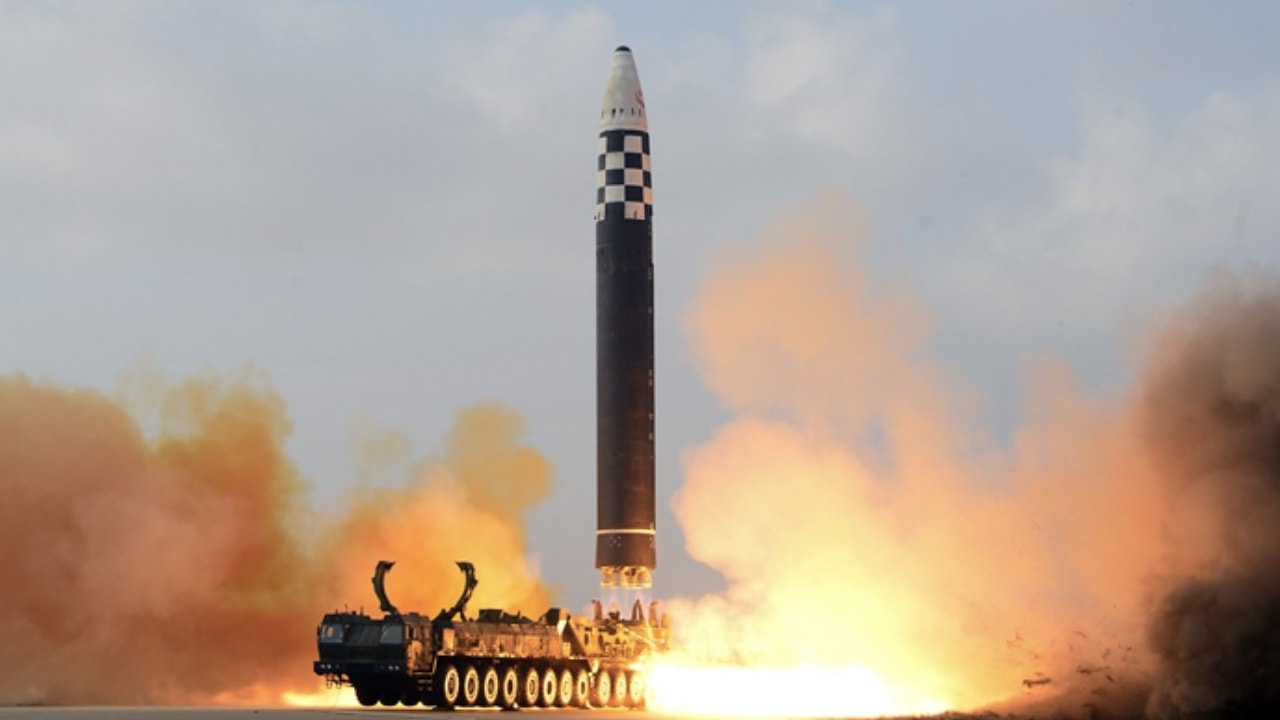
One example of this is a piece written for War on the Rocks by two left-of-center researchers who actually titled the article, “No, Iran Does Not Have an ICBM Program.” In the piece, no doubt widely read, the two analysts claimed that despite both Iran and North Korea being sanctioned by the US Treasury Department in 2016, for Pyongyang’s proliferation of an 80-ton rocket booster (used in a North Korean ICBM known as the Hwasong-15), any reporting that North Korea was working with Iran on an ICBM was “speculative.”
By this time, of course, North Korea had already conducted a successful test launch of its ICBM with the 80-ton rocket booster. The Hwasong-15 has been successfully launched again since then (in 2023) and can target the entire continental United States. Was there any further comment from these scholars? Well, yes.
Hwasong-12. Image Credit: KCNA/North Korean State Media.
In 2021, one of the co-authors of the report described above made a posting on the International Institute for Strategic Studies (IISS) website, again attempting to cast doubt on the viability of North Korea assisting Iran with an 80-ton rocket booster used in the manufacturing of an ICBM (of course, already developed by North Korea). By this time, the UN Panel of Experts had also weighed in on this (as I will address later), and the Treasury Department had again sanctioned both Iran and North Korea for the same proliferation (as I will also highlight later). It should be noted that, as I say in my recent book, “the first stage of the Hwasong-15 appears to be powered by two thrust chambers, much like the original Ukrainian RD-250 engine. This engine delivers 80 tons of thrust at sea level and gives this two-stage ICBM the capability to target all or most of the continental United States (8,000-mile range).”
And what of the evidence regarding both the Hwasong-15 and its proliferation to Iran? I will draw on a large excerpt from my book, Rogue Allies: The Strategic Partnership Between Iran and North Korea (University Press of Kentucky, 2025).
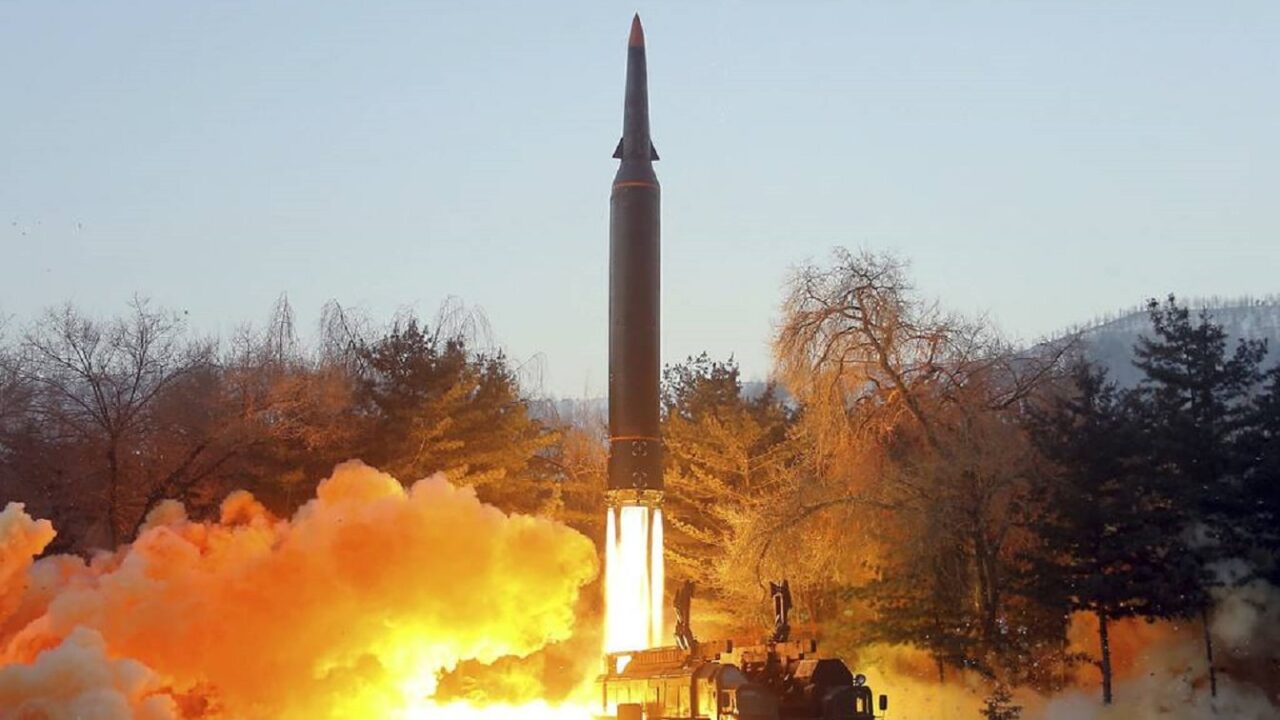
North Korean Missile Launch. Image Credit: Creative Commons.
North Korea began to assist Iran with the development of an 80-ton rocket booster (presumably for an ICBM) as early as 2013. In 2015, further developments were revealed in the press when it was disclosed that several shipments of the aforementioned rocket from North Korea to Iran had occurred even as Joint Comprehensive Plan of Action (JCPOA) talks were ongoing. In 2016, following the conclusion of the JCPOA talks, the U.S. Treasury Department imposed sanctions on Iranian companies and individuals for violations of sanctions imposed on North Korea.
To put a finer point on it, North Korean and Iranian officials had visited both nations. This exchange was conducted to enable Iran to procure an 80-ton rocket booster for a missile that North Korea was developing at the time. The names and companies (including front companies) involved are in the actual Treasury Department document.
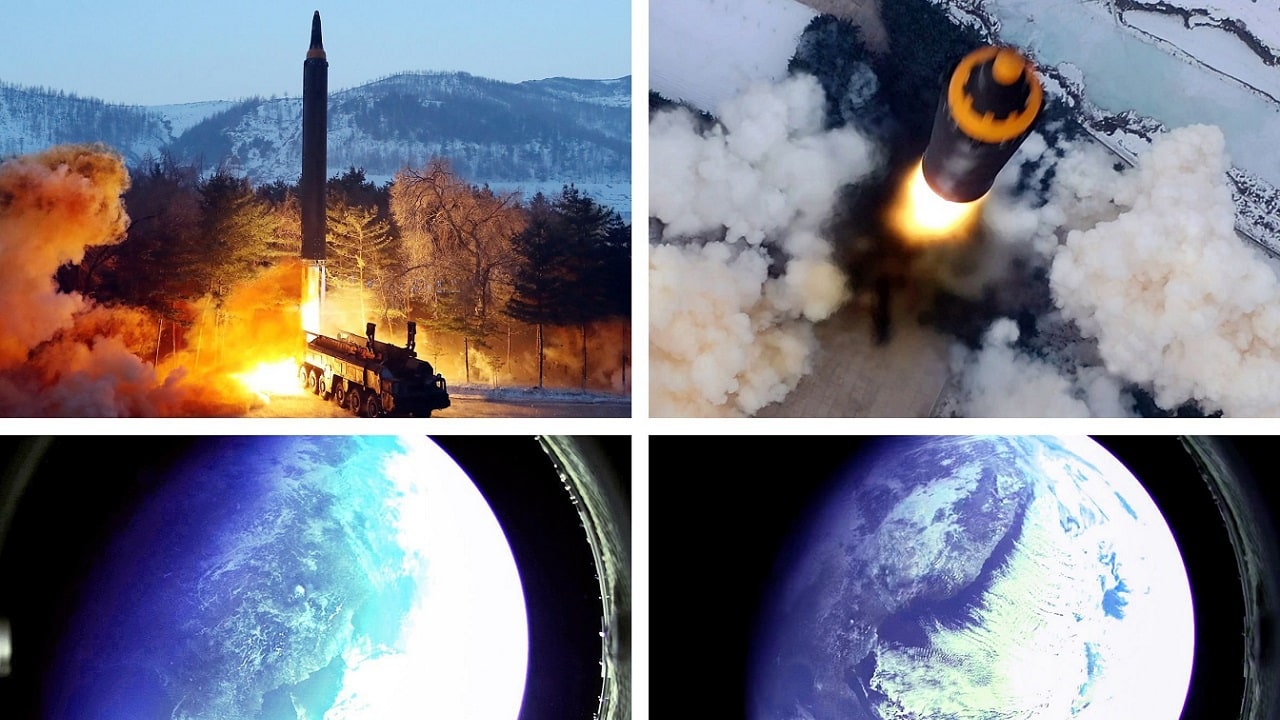
In 2017, North Korea tested what they called the “Hwasong-12.” This missile is an Intermediate-Range Ballistic Missile (IRBM) with a range of forty-five hundred kilometers (or more). It turns out, the Hwasong-12 is powered by a rocket engine reportedly based on an engine procured from the Ukrainians (according to the Ukrainians, illegally, under the table, and unknown to officials, or not at all), known as the RD-250. This engine is rated at 80 tons of thrust at sea level, making it likely the system known (for several years) as the “eighty-ton rocket booster” that North Korea collaborated on and proliferated to Iran. Later in 2017, North Korea tested two ICBMs. The first, the “Hwasong-14,” is assessed to be capable of hitting Anchorage in Alaska, while the second, the “Hwasong-15,” is assessed by many analysts to be capable of hitting the east coast of the United States.
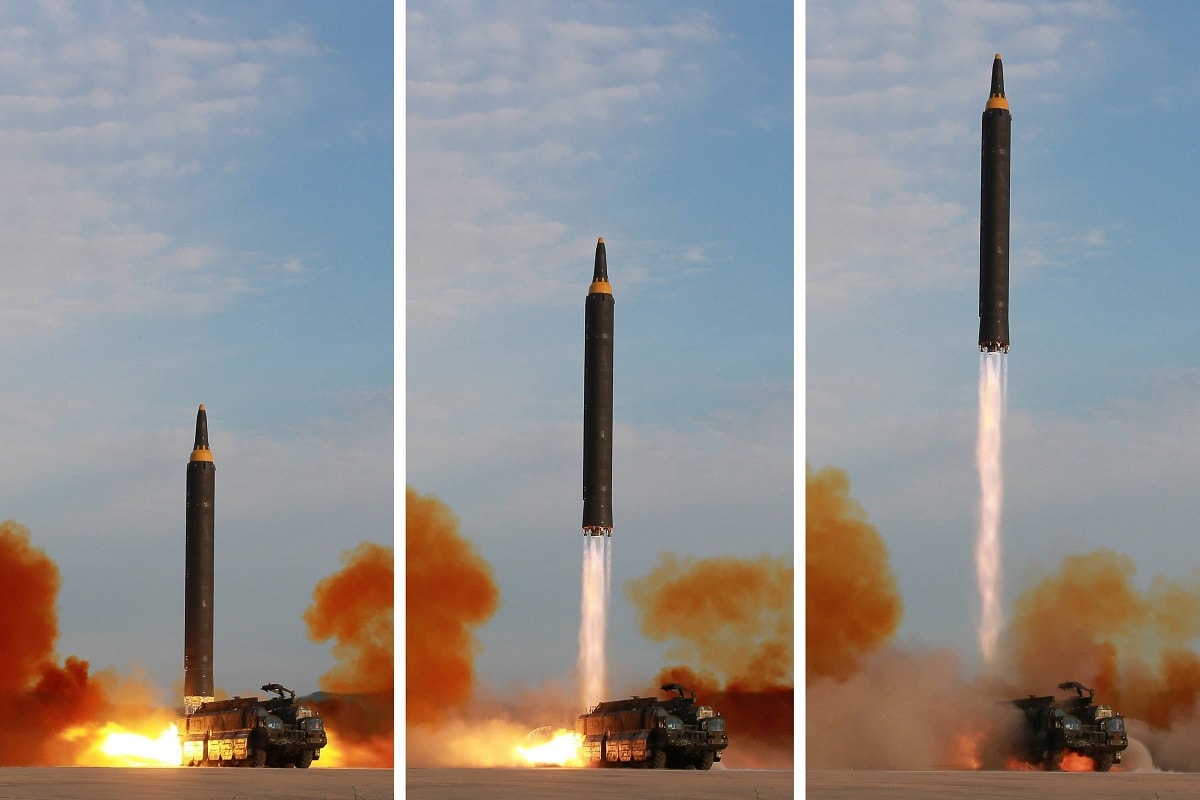
Image: KCNA/North Korean State Media.
The Hwasong-12 is powered by a large single rocket motor, which, though it appears to be based on the RD-250, is not exactly the same, as the RD-250 has two thrusters. The Hwasong-12 appears to be the first stage of the Hwasong-14 two-stage ballistic missile. The Hwasong-15 appears to use a much more powerful engine as its first stage—one that looks very much like the actual RD-250. The first stage of the Hwasong-15 uses what looks like a complete RD-250 rocket motor with two thrusters (instead of the one-thruster unit used by the Hwasong-12/14). This engine has 80 tons of thrust at sea level. This is probably the system with the 80-ton rocket booster that the North Koreans have proliferated to the Iranians and assisted them with its construction.
The North Korea-Iran Missile Connection
What does this mean?
It almost undoubtedly means North Korea collaborated on and then proliferated a system to Iran that was then tested in 2017—first as an IRBM and then (using the rocket from the first test as the first stage of an ICBM) as two separate ICBM systems.
If this is the case—and it most certainly appears that it is—this means that North Korea has proliferated an IRBM (based on the RD-250 engine) to Iran. If they have also proliferated the associated technology from the Hwasong-14/15, they have now given Iran both advanced IRBM and ICBM capabilities. It also means that when it comes to ballistic missile technology, North Korea has now proliferated Scud, No Dong, Musudan, Unha, and Hwasong 12/14/15 technology to Iran—updating Iran’s missile capabilities as they update their own. On September 21, 2020, the US Treasury Department sanctioned several entities and individuals active in Iran’s nuclear and ballistic missile programs. Among them was Seid Mir Ahmad Nooshin, who was “key to negotiations with the North Koreans on long-range missile development projects.”
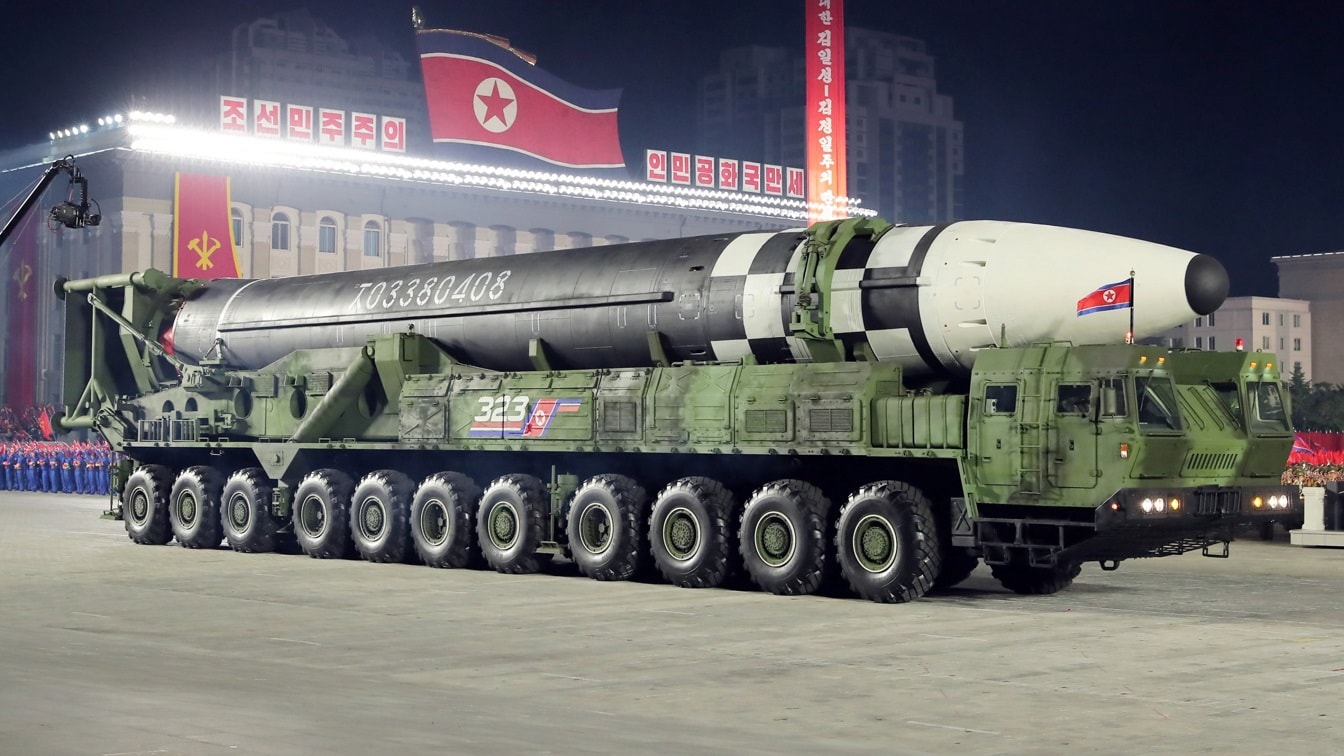
Image of North Korean Road-Mobile ICBM. Image Credit: Creative Commons.
Perhaps related to the aforementioned sanctions by the US Treasury Department, in 2021, it was disclosed that, according to the UN Panel of Experts, North Korea had resumed actual shipping of technology and parts to Iran for long-range missile projects. The 2021 information stated, “Citing information from a member state, the U.N. report noted that the cooperation included ‘the transfer of critical parts,’ with the most recent shipment taking place in 2020.”
It appears that if there was a “lull” in North Korean military cooperation and assistance to Iran, it didn’t last for very long. There are currently representatives of two key North Korean proliferation front companies in Tehran — the Korea Mining Development Company and Green Pine. Both companies are active in not only North Korea’s assistance to Iran’s ICBM development and deployment, but also short and medium-range ballistic missile production, as well as conventional weapons proliferation to Iran and its proxies.
We Should Look at the ICBM Evidence Above All Else
There are those in the United States who are both for and against the current combat operations being prosecuted against Iran. But if one is against these current operations or previously has been against an aggressive foreign policy regarding Iran, that does not excuse downplaying the Iranian threat (or the North Korean proliferation threat). Assessments should be based on evidence, not cherry-picked or adjusted based on politics.
Thus, we must keep in mind the proliferation that North Korea engaged in to give Iran an ICBM. What else do these pundits think the reason was behind Pyongyang’s proliferation? We must also keep in mind that the Hwasong-15 has already been successfully tested (twice) and can range the United States.
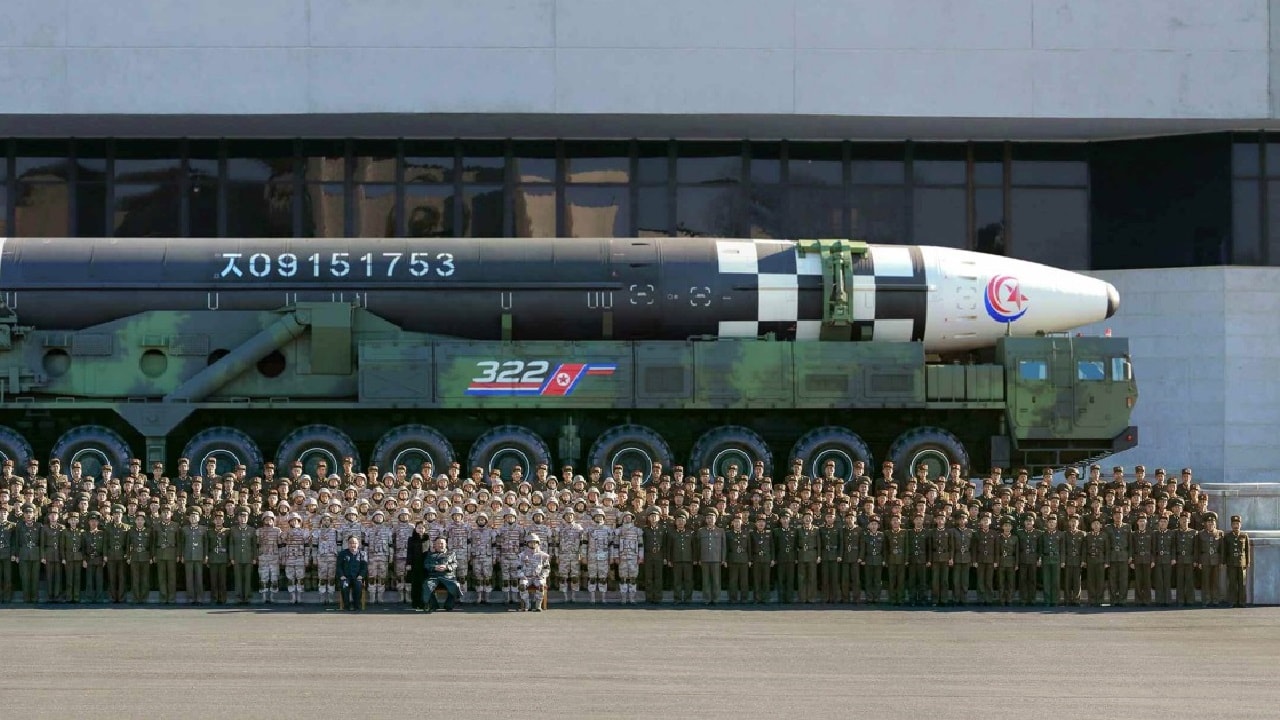
North Korea ICBM. Image Credit: KCNA.
In the coming days and weeks, as Iran’s ballistic missile systems and launchers are destroyed, one hopes its ICBM system (developed or close to it) will also be targeted and destroyed.
Threat equals: Capabilities+Intent. Getting rid of those capabilities will be important for our national security.
About the Author: Dr. Bruce E. Bechtol Jr.
Dr. Bruce E. Bechtol Jr. is a professor of Political Science at Angelo State University. He is also the president of the International Council on Korean Studies and a fellow at the Institute for Korean American Studies. The author of five books dealing with North Korea, his latest work is entitled North Korean Military Proliferation in the Middle East and Africa.