

In a somewhat strange incident, a U.S. Navy sailor was medically evacuated after getting scratched by a monkey while on his way to remove mines in the Strait of Hormuz. The sailor, assigned to the USS Chief (MCM-14), was making a brief stop in Phuket, Thailand, before receiving several scratches from an aggressive monkey. According to the Navy, demining operations were not harmed or delayed by the incident.
“Weird Stuff Happens”
The injured sailor was assigned to the USS Chief, an Avenger-class mine countermeasures ship with a crew of around 84 sailors, which was tasked with a demining operation in the Strait of Hormuz. “The sailor received medical care and was transferred back to Japan for further care,” a spokesperson for the U.S. 7th Fleet told Axios, who first reported the incident. “There were no operational impacts.”

The crew of a U.S. Air Force B-1B Lancer display their mascot from the cockpit window during a presence patrol above the U.S. Central Command’s area of responsibility Oct. 30, 2021. Multiple partner nations’ fighter aircraft accompanied the B-1B Lancer at different points during the flight, which flew over the Gulf of Aden, Bab el-Mandeb Strait, Red Sea, Suez Canal, Arabian Gulf, Strait of Hormuz and the Gulf of Oman before departing the region. (U.S. Air Force photo by Senior Airman Jerreht Harris)
The sailor was transferred back to Sasebo, Japan, which is currently the Chief’s forward base in the Pacific. The Navy did not specify the details of the attack, nor did it provide details about the monkey that initiated it. “Weird stuff happens,” said an unnamed Navy official, “This was definitely an unknown unknown.”
The extent of the sailor’s injuries is also unknown.
Based on reports, the attack was serious but not life-threatening, and the sailor is expected to return to active duty within a couple of weeks at most.
Since the outbreak of the U.S. war with Iran, 64 sailors have been wounded in the line of duty as a direct result of Iranian hostilities.
With this bizarre incident, 65 U.S. Navy personnel have been injured as a direct and indirect result of Iranian operations.

STRAIT OF HORMUZ (Nov. 12, 2021) Guided-missile destroyer USS O’Kane (DDG 77) performs a Strait of Hormuz transit with the amphibious assault ship USS Essex (LHD 2), Nov. 12. Essex and the 11th Marine Expeditionary Unit are deployed to the U.S. 5th Fleet area of operations in support of naval operations to ensure maritime stability and security in the Central Region, connecting the Mediterranean and the Pacific through the western Indian Ocean and three strategic choke points. (U.S. Navy photo by Mass Communication Specialist 1st Class Joe Rolfe)
The Importance of Minesweepers
The Avenger-class minesweeper that the sailor was stationed aboard is one of the few remaining ships in the class that are still remaining.
In the past, the U.S. Navy stationed four Avenger-class boats in Bahrain near the Persian Gulf.
All four of these ships were retired in 2025, with the remaining ships in the class stationed in Japan. Interestingly, the Navy did not forward-deploy any minesweepers to the Middle East at the start of Operation Epic Furry.
The Avenger-class is built specifically to have a lower magnetic and acoustic signature. It uses powerful sonars to detect mines, which are then destroyed by helicopters or other ships.
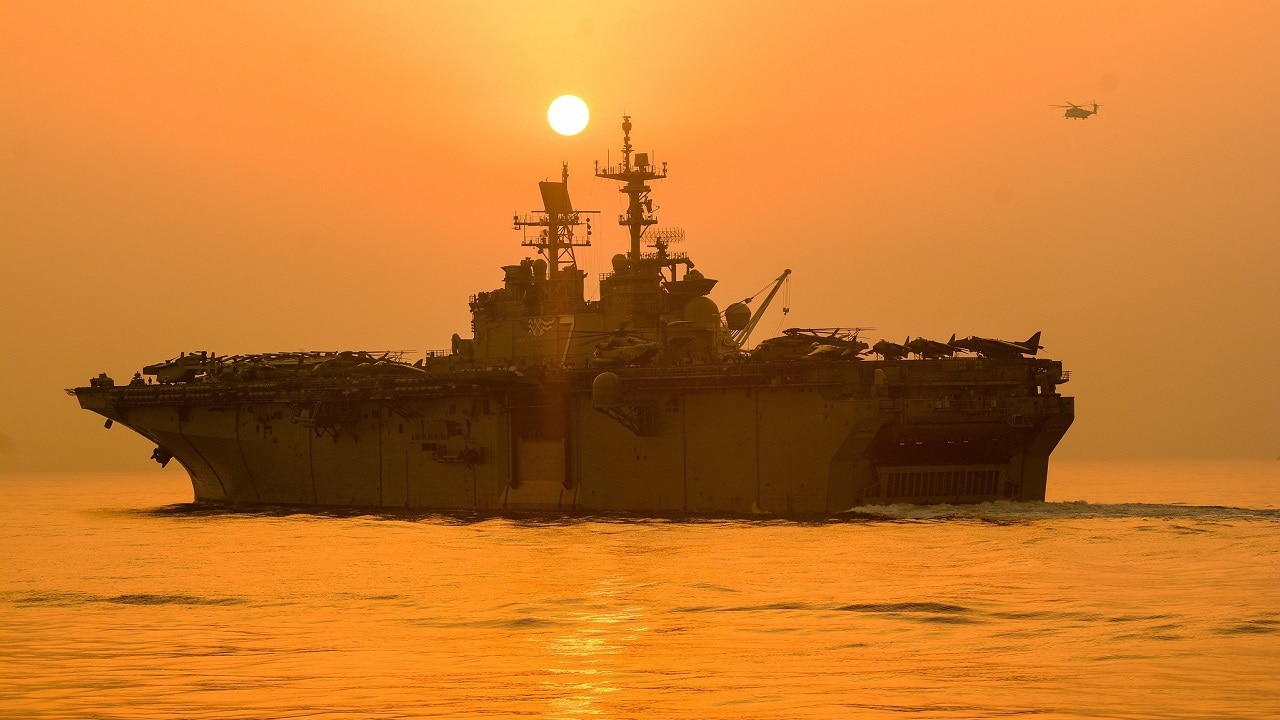
(Aug. 4, 2021) The Wasp-class amphibious assault ship USS Iwo Jima (LHD 7) transits the Strait of Hormuz, Aug. 4, 2021. Iwo Jima is deployed to the U.S. 5th Fleet area of operations to ensure maritime stability and security in the Central Region, connecting the Mediterranean and the Pacific through the western Indian Ocean and three strategic choke points. (U.S. Navy photo by Seaman Logan Kaczmarek)
In the last decade, the U.S. began replacing the Avenger-class with the littoral combat ship (LCS).
The LCS was also designed with a lower magnetic signature and, when combined with the mine countermeasures (MCM) mission package, makes the ship ideal for detecting and neutralizing sea mines. Despite experiencing problems with the LCS program, the Navy currently has no plans to reactivate any of its Avenger-class ships.
The Strait of Hormuz is Still Closed
The incident with the monkey occurred as the U.S. is still trying to reopen the Strait of Hormuz.
Ever since hostilities began in late February, the Iranian Navy has laid hundreds of mines throughout the strait. According to defense officials, demining operations could take up to six months, assuming Iran does not hinder them.
According to President Trump on Tuesday, U.S. minesweepers are currently in the Strait and conducting clearing operations. He also added that U.S. forces have been given the order to shoot any Iranian naval vessels that try to interfere with their operations.
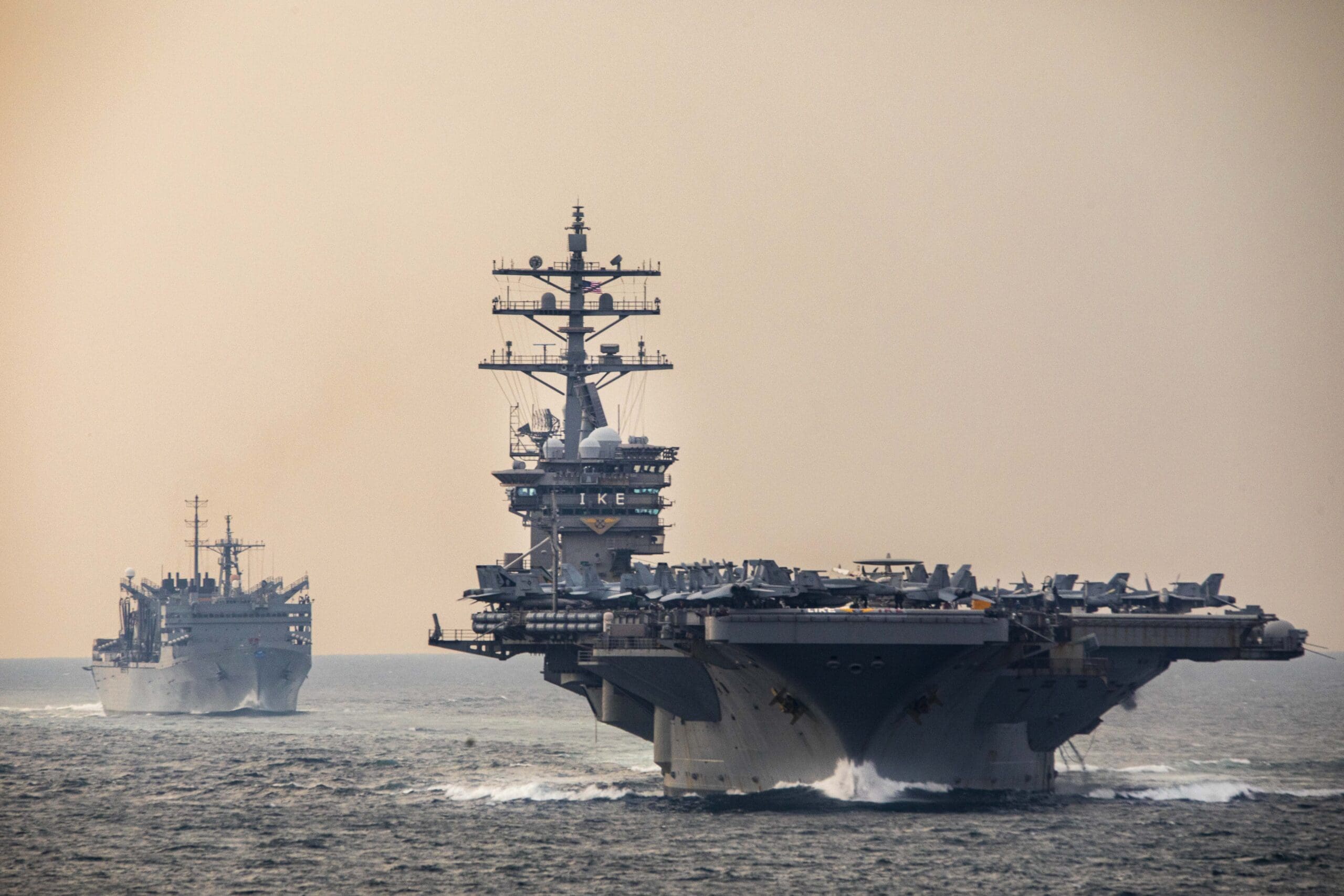
Components of the Dwight D. Eisenhower Strike Group (IKECSG) and the fast combat support ship USNS Supply (T-AOE 6) transit the Strait of Hormuz, Dec 14, 2023. As part of the Dwight D. Eisenhower Carrier Strike Group (IKECSG), the Philippine Sea is deployed to the U.S. 5th Fleet area of operations to help ensure maritime security and stability in the Middle East region. (U.S. Navy photo by Mass Communication Specialist 2nd Class Keith Nowak)
According to the U.S. officials, the ceasefire between the U.S. and Iran has been extended indefinitely until Iran’s leaders submit a “unified proposal” to end the war with Israel and the U.S. Negotiations between the three states appear to have been stalled since neither party appears to be willing to accept the demands of the other, leaving the Strait of Hormuz’s fate up in the air.
Despite American efforts to reopen the Strait, Iran continues to seize commercial tankers that attempt to pass through.
In the last several days, at least two oil tankers have been attacked or seized by the Iranian navy, using small speedboats for their operations. Because of the persistent blockade, oil prices worldwide have risen sharply, with Europe among the most affected.
About the Author: Isaac Seitz
Isaac Seitz, a Defense Columnist, graduated from Patrick Henry College’s Strategic Intelligence and National Security program. He has also studied Russian at Middlebury Language Schools and has worked as an intelligence Analyst in the private sector.