

The first time a machine built by humans landed on another planet, the control room recorded it as just one more dead probe. On December 15, 1970, a one-ton ball of reinforced titanium named Venera 7 settled onto the surface of Venus and became the first spacecraft ever to soft-land on another world and send data back from its surface. The Soviet engineers watching almost missed the moment entirely. The probe’s parachute tore during descent; it slammed into the ground, toppled onto its side, its antenna pointed the wrong way, and the strong signal died at impact. To the men in the control room, it looked like exactly what the dozen Venus probes before it had been: another spacecraft crushed by the planet it was built to survive. Only weeks later, replaying the recorded tapes, did a radio astronomer find a faint whisper of a signal that nobody had known was there. The greatest first in the history of planetary exploration arrived not as a triumphant live broadcast but as a trace pulled out of what had been dismissed as noise.
The Cold War Race To Venus
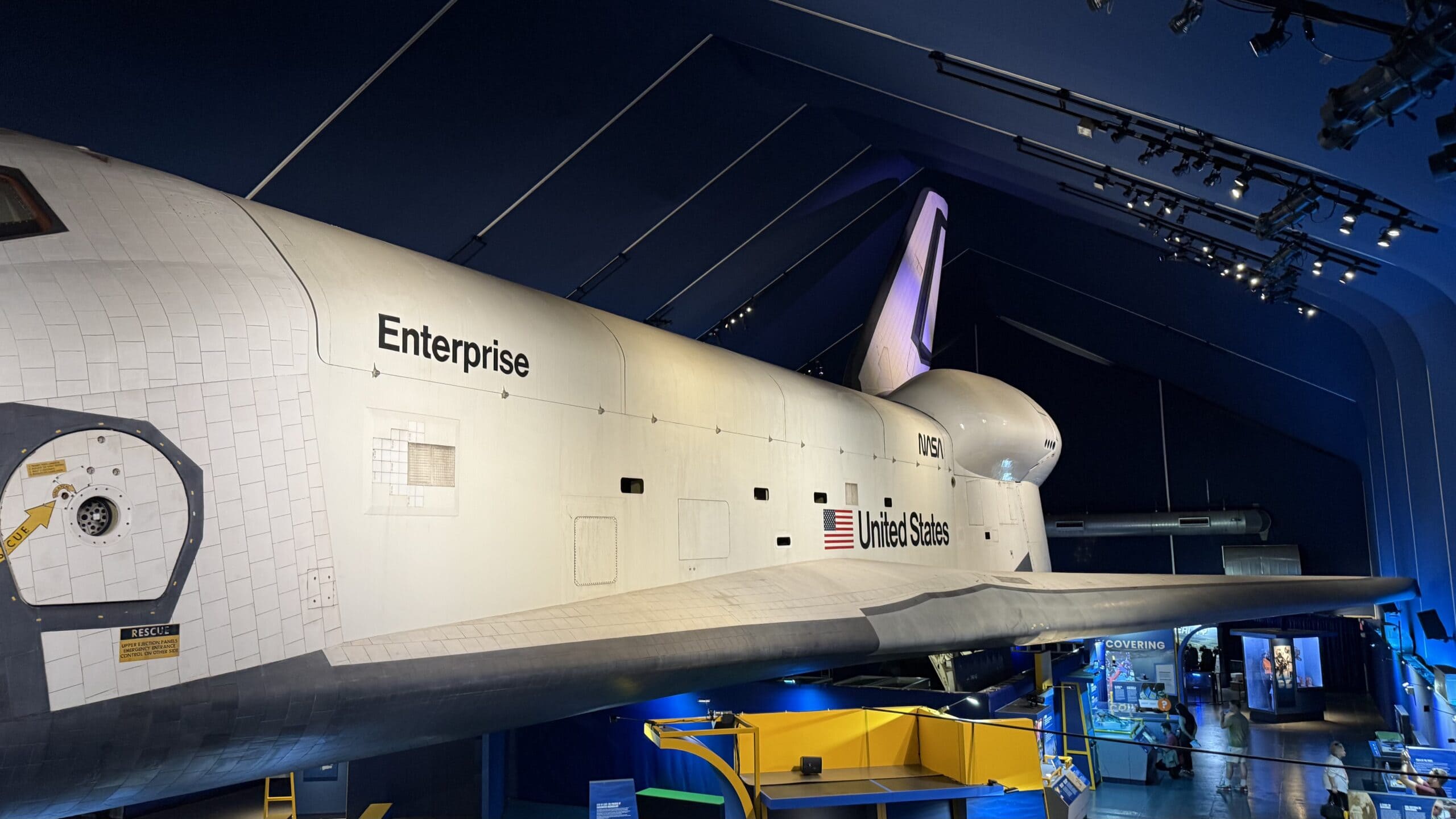
NASA Space Shuttle Onboard USS Intrepid. 19FortyFive.com image. Take back in 2025.
While the United States fixed its attention on the Moon and Mars, the Soviet Union became fixated on Venus, the cloud-shrouded world that early observers called Earth’s twin. Reaching it and surviving its surface, even briefly, was a way to demonstrate that Soviet science could conquer a place no one else could, and the USSR pursued that goal with a persistence that bordered on stubbornness.
The record through the 1960s was mostly a record of failure. Venera 1 and Venera 2 were flyby attempts that both went silent before they could return anything useful, and the probes that followed kept dying in the same place, somewhere above the surface of a planet far crueler than anyone had expected.
The pattern of near misses is what makes Venera 7’s reception understandable. Venera 3 crash-landed on Venus in March 1966, becoming the first human-made object to strike another planet, but its instruments had already failed, and it returned no data. Venera 4 entered the atmosphere in 1967 and returned the first direct readings of another planet’s air, showing it was almost entirely carbon dioxide, before it was crushed.
That mission delivered the discovery that reshaped everything: Venus’s surface pressure was far higher than expected, in the range of 75 to 100 times Earth’s, well beyond what the probe’s hull could withstand. Venera 5 and 6 followed in 1969 as atmospheric probes, lasting 53 and 51 minutes as they descended by parachute before their batteries gave out, still short of the ground.
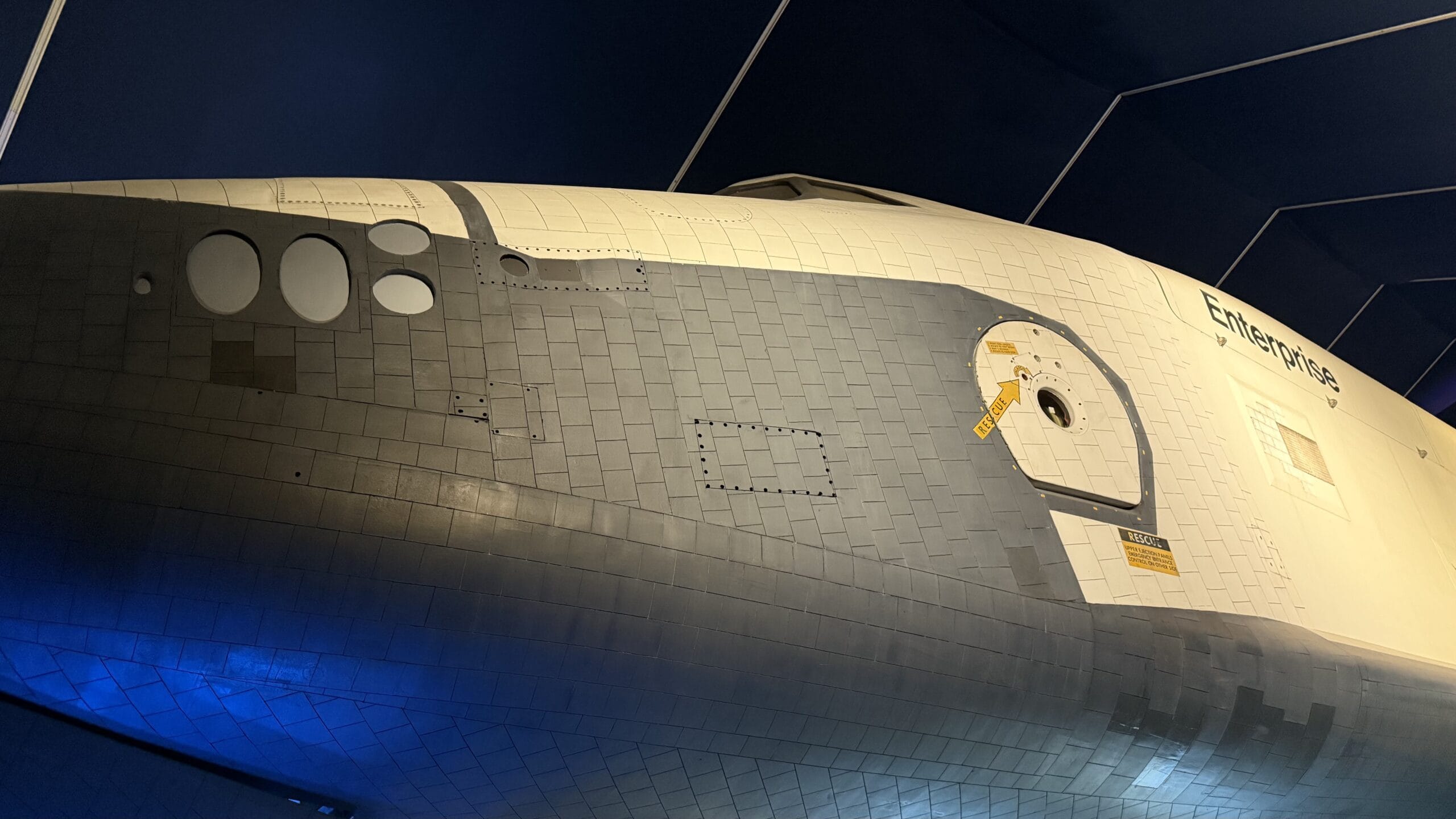
NASA Space Shuttle Onboard USS Intrepid. 19FortyFive.com image. Take back in 2025.
By the time Venera 7 was being built, the Soviets knew Venus was a furnace hot enough to melt lead, under pressure equivalent to the deep ocean, and that everything they had sent so far had died trying to reach the bottom of it.
A Sphere Built To Survive the Worst Conditions
After the program’s chief designer, Sergei Korolev, died in 1966, the Venera work passed to Georgy Babakin’s Lavochkin design bureau, a shop known for meticulous testing and high engineering quality.
Babakin’s team understood that the only way to land on Venus was to overbuild for it, and Venera 7 was overbuilt to an extreme. Its descent capsule was a single seamless titanium sphere weighing roughly 490 kilograms, with no welds or holes to fail under pressure, lined with shock-absorbing material and rated to survive about 180 atmospheres and temperatures well above 500 degrees Celsius, far beyond even the brutal conditions Venus was now known to present. The uncertainty was so great that the engineers simply piled on margin.
That hardening came at a price. The heavier the shell, the less mass remained for science, so Venera 7 carried little more than temperature and pressure sensors. Because replicating Venus on Earth was so difficult, Babakin built a custom high-pressure, high-temperature chamber to test the capsule against the planet’s conditions before launch, working punishing hours and demanding justification for every design choice.
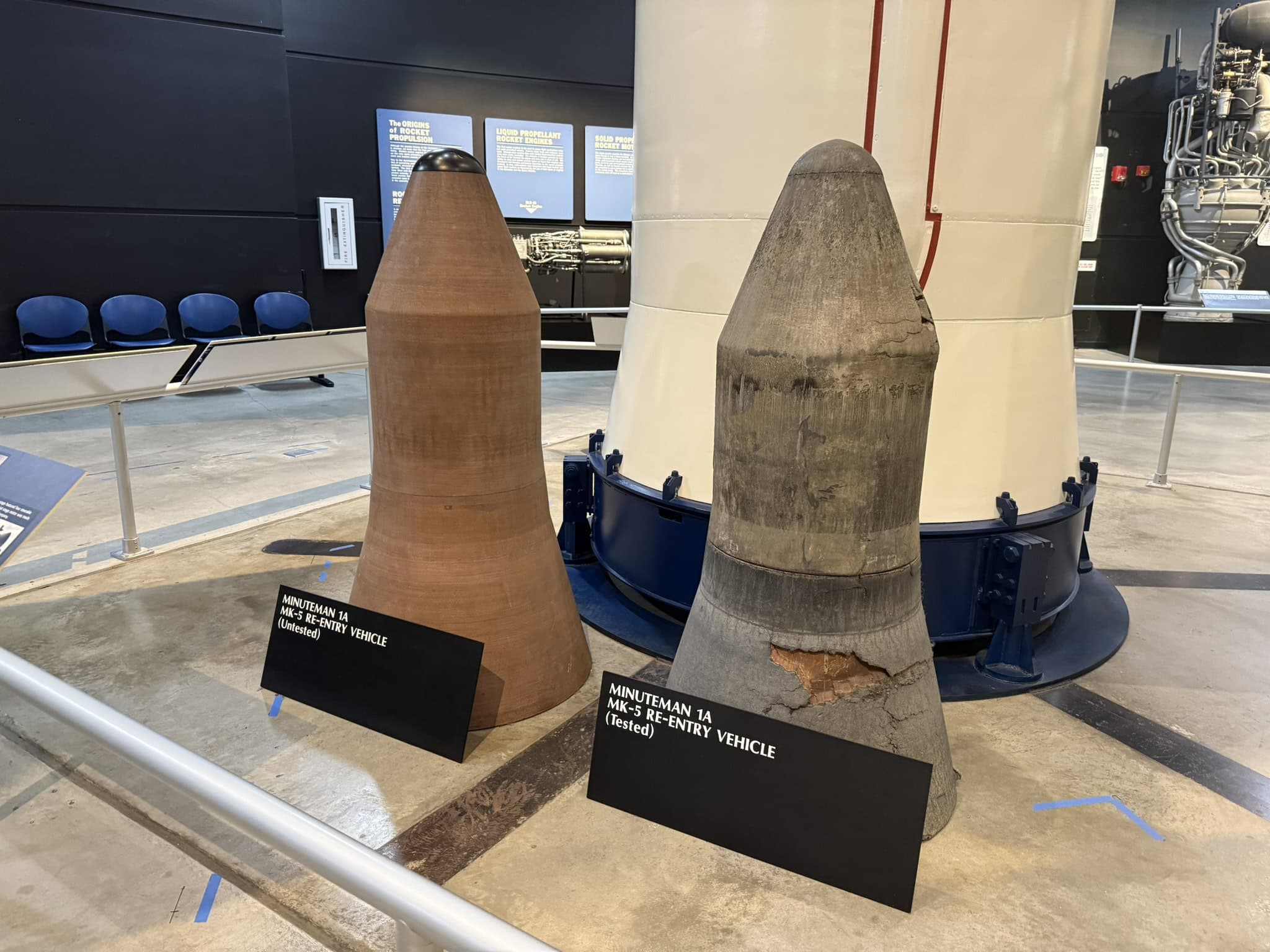
Cold War Rockets and Missiles. Image by Harry J. Kazianis Take at the National Museum of the U.S. Air Force.
The finished probe was a stark object, a heavy white sphere with four red Cyrillic letters painted on its shell.
An engineering model of it, white with “CCCP” emblazoned in red, would later sit in a museum as the artifact of the moment the Soviet Union planted a flag on the worst surface in the solar system.
A Race Against The Heat
Venera 7 launched from Baikonur on August 17, 1970, and reached Venus after a four-month cruise, arriving on December 15. To keep the lander alive as long as possible, the engineers left it attached to its carrier bus during the first stage of entry so the bus could chill it down to about minus 8 degrees Celsius, buying precious thermal margin before the heat closed in. Then came the most counterintuitive choice of the mission.
Rather than slow the descent, the designers used a deliberately small parachute meant to bring the probe down fast, because the longer it lingered in that carbon dioxide furnace, the more likely something critical would cook and fail. Time, not speed, was the enemy.
The plan held until it didn’t. The parachute, made of heat-rated fabric, began to fail partway down and then tore apart, causing Venera 7 to enter a faster-than-intended fall.
The capsule hit the surface at roughly 16.5 meters per second, about 37 miles per hour, highway speed for a machine falling onto another planet. The reinforced sphere did what it was built to do and survived the impact, but it bounced and came to rest on its side, leaving its antenna aimed away from Earth. That single misalignment nearly erased the achievement, because it choked the signal to almost nothing at the exact instant the probe reached the ground.
The Control Room Gives Up
From the perspective of the engineers tracking the descent, the mission ended at touchdown. The strong signal that had carried the descent data cut off when the capsule hit, and the obvious conclusion was the one they had reached six times before.
Venus had won again, and Venera 7 had died on the surface like every probe that came before it, swallowed by the planet it was designed to outlast. The mission went into the books, at least initially, as another costly failure in a program that had produced little but failures.
A Whisper Pulled From The Tapes
The recording equipment back on Earth, however, had never stopped running. A few weeks after the landing, the radio astronomer Oleg Rzhiga went back through the magnetic tapes of the mission and found something buried in them: another 23 minutes of an extremely weak signal, less than one percent of normal strength, faint enough that it had been treated as background noise and ignored.
The probe had not died at impact. It had landed, toppled onto its side so its antenna pointed away from Earth, and kept transmitting for 23 more minutes, the trace too weak for anyone to notice in real time. There was a further indignity in the data: an internal switchboard had failed in the “transmit temperature” position, so for much of that time the one thing Venera 7 could report was the temperature. The first message ever sent from the surface of another planet survived almost by accident, on top of the accident that nearly destroyed it.
What It Found On The Surface
What that faint signal carried was the first direct measurement humanity had ever taken from the surface of another world. Venera 7 reported a surface temperature of 475 degrees Celsius, about 887 degrees Fahrenheit, hotter than molten lead.
The probe’s pressure sensor had failed during the descent, so scientists could not measure the surface pressure directly. Using the temperature reading and atmospheric models, they calculated it at roughly 90 times Earth’s sea-level pressure, the equivalent of being some 900 meters underwater. From the way the capsule had stopped almost instantly on impact, they could even tell it had struck solid ground with little dust. In 23 minutes, a half-ton ball of titanium had confirmed that Venus was not Earth’s gentle twin but one of the most hostile places in the solar system, and it had done so from the surface, a thing no machine had ever managed before.
The Origin Of Everything That Followed
Venera 7’s identical twin from that 1970 launch window, a probe later cataloged as Cosmos 359, never even left Earth orbit after a rocket failure, the same fate the Soviets quietly hid behind the generic “Kosmos” label they used for failed missions. But the probe that made it became the foundation of everything the Venera program did next.
Venera 9 sent back the first images ever taken from the surface of another planet in 1975, and Venera 13 and 14 returned the first color photographs of the Venusian landscape in 1982. The Soviet Union remains the only nation ever to land working spacecraft on Venus and the only one to have photographed its surface, and every one of those later triumphs stood on the 23 minutes that Venera 7 bought.
The probe never did anything gracefully. It rode a torn parachute into a hard landing, fell over, jammed its own instruments, and whispered its findings so quietly that its builders nearly threw the achievement away.
Yet it survived long enough to take humanity’s first reading from the ground of another planet, and it proved that a machine could be built to endure a place that destroys almost everything sent into it.
More than half a century later, the surface of Venus has still been reached by working spacecraft from a single program, and the first of them was a battered titanium sphere that landed on the worst world humans have ever touched and was, for a few weeks, mistaken for a failure.
About the Author: Harry J. Kazianis
Harry J. Kazianis (@Grecianformula) was the former Senior Director of National Security Affairs at the Center for the National Interest (CFTNI), a foreign policy think tank founded by Richard Nixon based in Washington, DC. Harry has over a decade of experience in think tanks and national security publishing. His ideas have been published in the NY Times, The Washington Post, The Wall Street Journal, CNN, and many other outlets worldwide. He has held positions at CSIS, the Heritage Foundation, the University of Nottingham, and several other institutions related to national security research and studies. He is the former Executive Editor of the National Interest and the Diplomat. He holds a Master’s degree focusing on international affairs from Harvard University.

