The sweeping changes to Germany’s defense posture that began under former Chancellor Olaf Scholz and continued under the current Chancellor, Friedrich Merz, have led to an expansive transformation of the German military.
Tanks, artillery, and air defense acquisitions have been some of the main beneficiaries of Germany’s revamped defense posture thanks to Russia’s full-scale invasion of Ukraine in 2022.
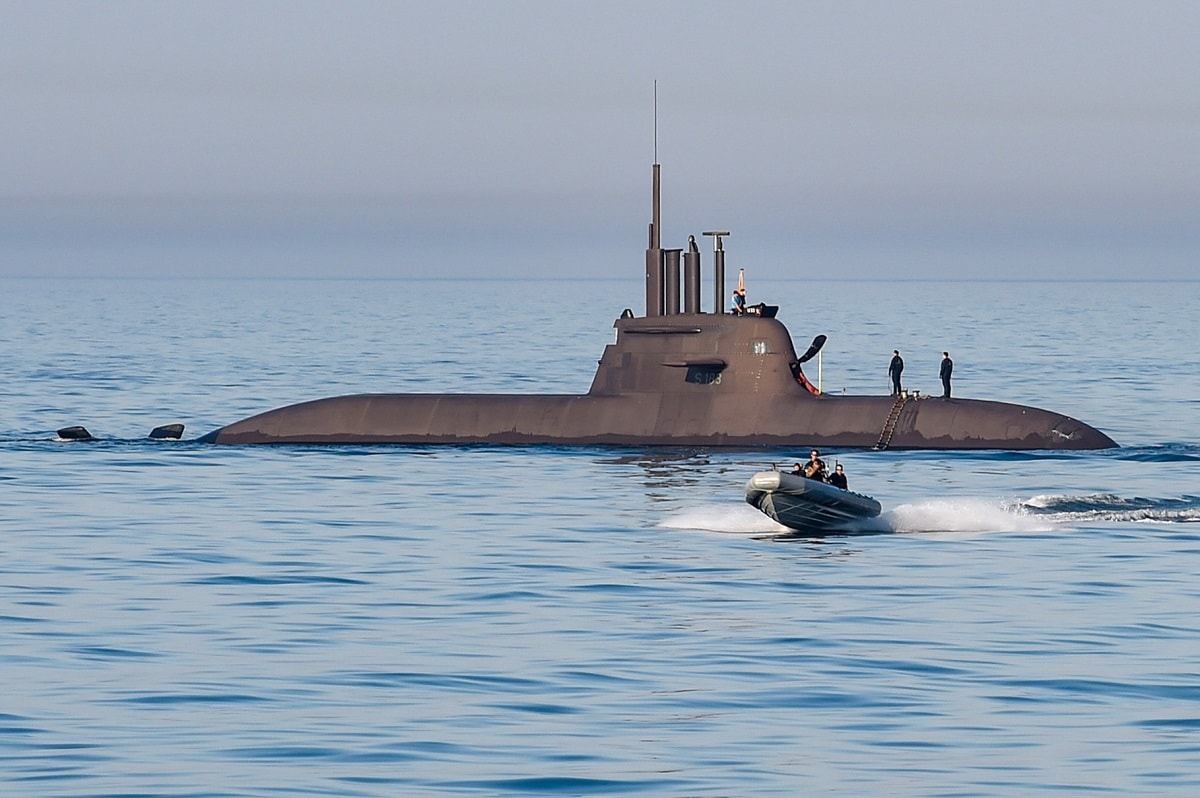
(June 5, 2019) A rigid-hull inflatable boat from the guided-missile destroyer USS Gravely (DDG 107) departs a German U-33 submarine during a passenger transfer exercise. Gravely is underway on a regularly-scheduled deployment as the flagship of Standing NATO Maritime Group 1 to conduct maritime operations and provide a continuous maritime capability for NATO in the northern Atlantic. (U.S. Navy photo by Mass Communication Specialist 2nd Class Mark Andrew Hays/Released)
But the German Navy — the Deutsche Marine — has also benefited from one of the most significant shifts since the end of the Cold War.
Following German reunification, the German Navy operated as an expeditionary force, spending time in the Mediterranean, the Indian Ocean, and off the Horn of Africa.
The pervasive assumption was that large-scale naval conflict around Europe was exceedingly unlikely.
But now the Baltic and North Seas, as well as the North Atlantic, are the primary theaters of the Deutsche Marine, and Germany’s naval planners have refocused on protecting sea lanes, underwater communications infrastructure, tracking Russian submarine patrols, and bolstering NATO’s northern maritime flank.
Visible Changes in Procurement: In the Air
Some of the most immediately obvious shifts have been in procurement and modernization.
Germany is replacing its rapidly aging P-3C Orion fleet with more modern P-8A Poseidon maritime patrol aircraft, in what will be a dramatic expansion to Germany’s anti-submarine warfare and maritime patrol and surveillance capabilities.
In the future, German naval aircraft and ships will be more tightly integrated into NATO’s anti-submarine warfare network.
Russian submarine activity in the North Atlantic has been a growing concern for the NATO alliance.
The Greenland-Iceland-United Kingdom gap, or GIUK Gap, is a key maritime choke point during the Cold War, and its importance continues to this day.
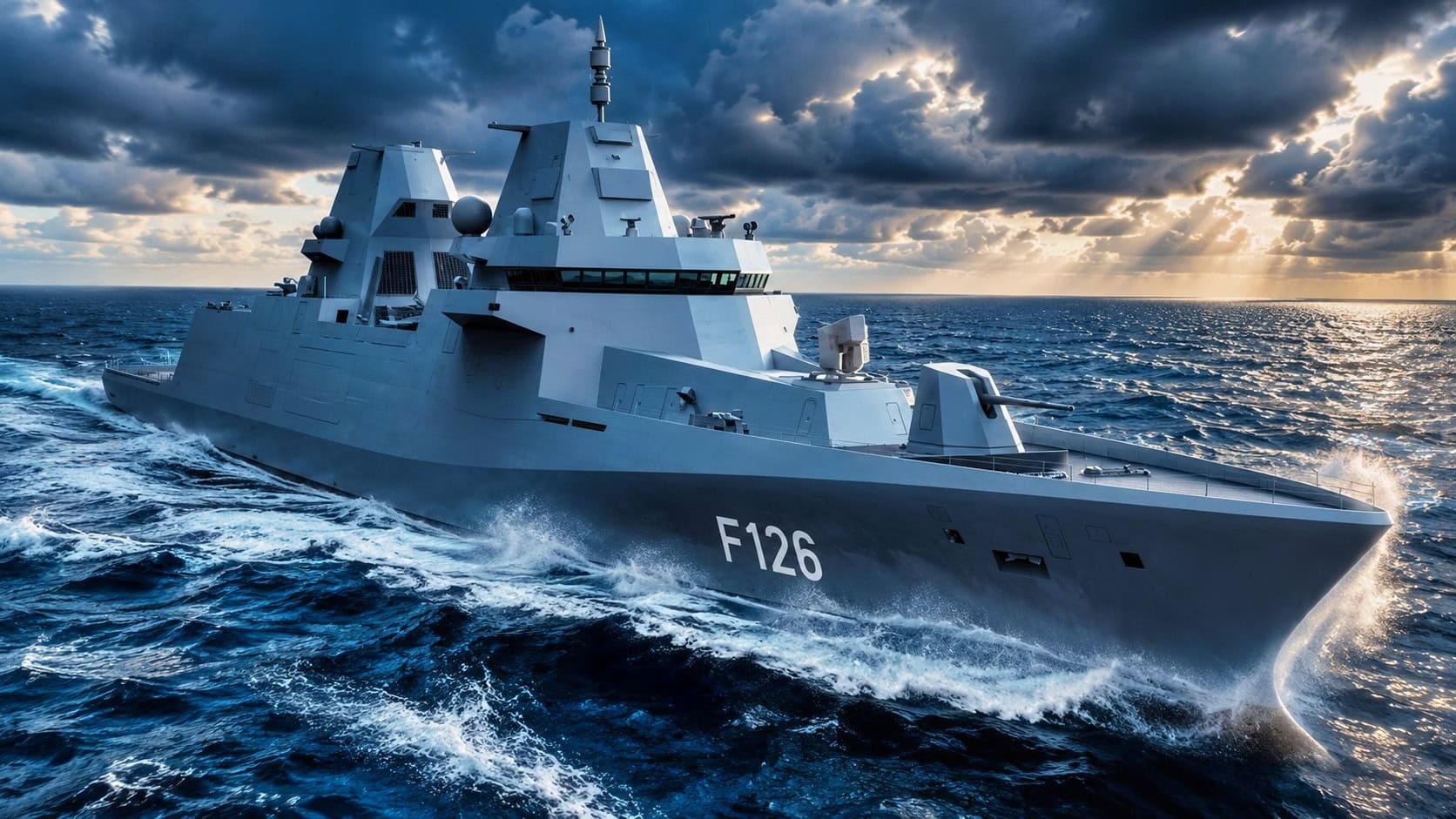
Germany’s Canceled F126 Frigate Program
It is not all smooth sailing within the Deutsche Marine, however.
Earlier this week, the German Ministry of Defense opted to cancel its F126 Frigate program.
That project, under contract with Dutch shipbuilder Damen Schelde Naval Shipbuilding, had been awarded in 2020 and provided about $11.3 billion for six frigates.
Those ships were to perform anti-submarine patrols and would have displaced nearly 11,000 tons.
But Damen notified Berlin that it would not be able to build the frigates on time nor at budget, prompting the cancellation decision.
Instead, the Deutsche Marine will acquire eight MEKO A-200 frigates from ThyssenKrupp Marine Systems.
Though approval has yet to be granted by German lawmakers, the initial tranche of four MEKO ships is slated to cost €6.3 billion, or about $7.15 billion, with the option of four other MEKO ships for €5.3 billion, or about $6 billion, bringing the total for the entire eight-ship buy to €11.6 billion, or about $13.2 billion.
The F127 Program
One frigate program that has not been administratively torpedoed, however, is the Deutsche Marine’s F127 air defense frigate program.
Once in service, the ships will provide long-range air and missile defense, with the potential for umbrella projection from ballistics and missile defense capabilities.
Once in service, the ships may become some of the most important naval assets available to the NATO alliance in northern Europe.
The Deutsche Marine Submarine Force
Germany’s submarine force has also gained importance in recent years.
While Germany already operates some of NATO’s more highly-regarded conventionally-powered submarines, in particular the Type 212A class, the upcoming Type 212CD submarines, developed and procured jointly with the Royal Norwegian Navy, will offer both countries improvements to endurance, a superior sensor suite, better sonar mitigation capabilities, and commonality between the two countries.
Into the Future: Challenges and Problems
While today’s Deutsche Marine enjoys an importance not seen in over a generation, not all problems have evaporated for the force.
Shipbuilding delays, personnel shortages, recruitment challenges, and persistent procurement bottlenecks remain a challenge.
The German Navy is a significantly smaller force today than it was at the height of the Cold War, when the NATO alliance anticipated a thrust into Western Europe by the Warsaw Pact countries.
The aforementioned modernization program will take years to fully realize, leaving perceptible gaps in NATO’s defenses before completion.
But compared to its pre-2022 posture, today’s Deutsche Marine has more funding, shoulders a greater share of responsibility within NATO, has new frigates and modern maritime patrol aircraft on the way, and has a bolstered anti-submarine posture.
Rather than simply investing in new ships and equipment, however, Germany is steadily moving toward becoming one of NATO’s primary maritime powers within northern Europe — and not thanks to an ambitious capital ship building program, but thanks in part to its geography at the nexus of the Baltic and Northern Seas and the North Atlantic.
Like this article? Add Us As a Preferred Source on Google
About the Author: Caleb Larson
Caleb Larson is an American multiformat journalist based in Berlin, Germany. His work covers the intersection of conflict and society, focusing on American foreign policy and European security. He has reported from Germany, Russia, and the United States. Most recently, he covered the war in Ukraine, reporting extensively on the war’s shifting battle lines from Donbas and writing on the war’s civilian and humanitarian toll. Previously, he worked as a Defense Reporter for POLITICO Europe. You can follow his latest work on X.